
Military calisthenics workout are bodyweight exercises used in military physical training to build strength, muscular endurance, and control of movement. Push-ups, squats, lunges, planks, pull-ups, mountain climbers, and burpees are familiar examples.
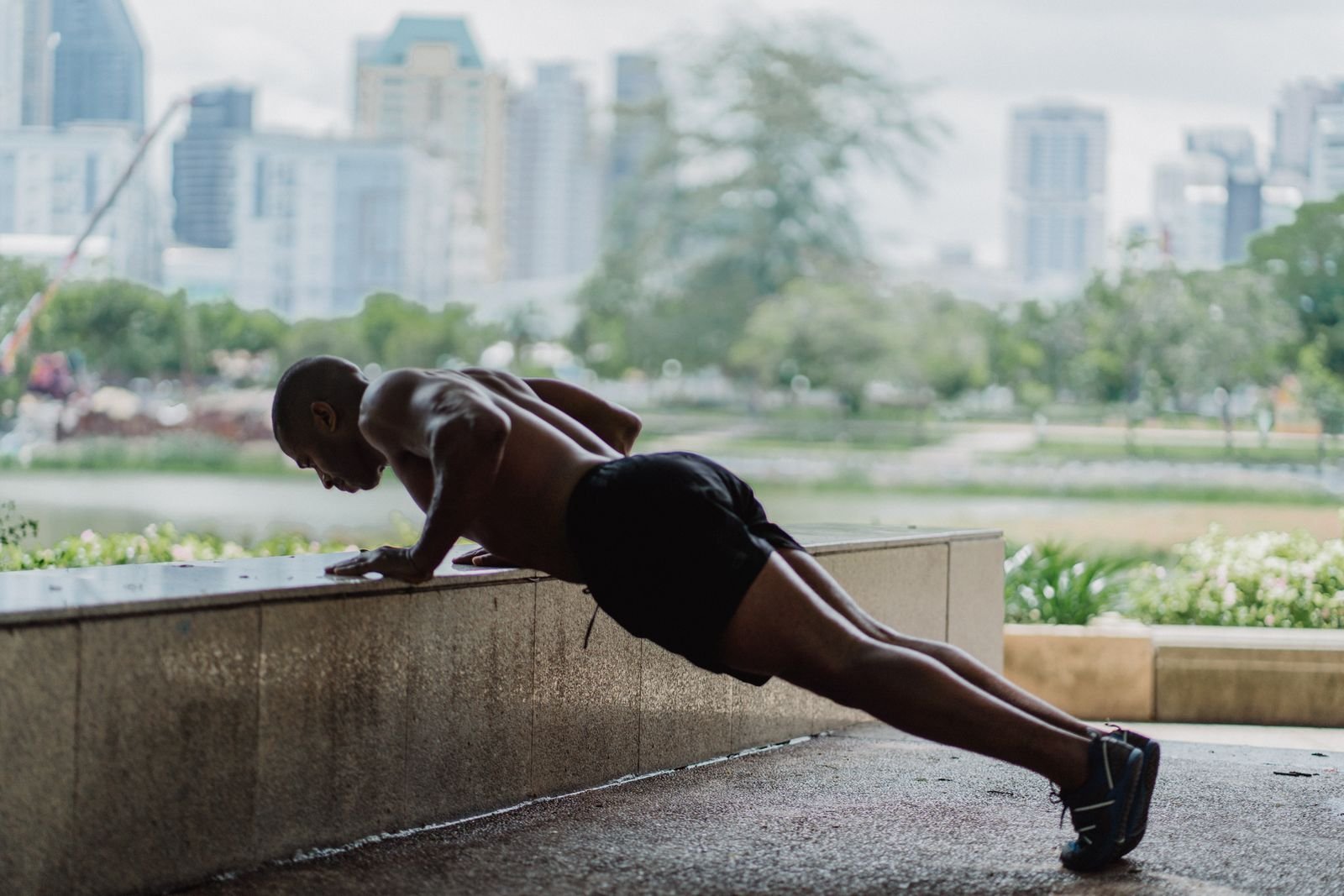
You can adapt these movements to your current fitness level. Start with manageable variations, practice controlled technique, and increase the challenge gradually. Understanding how to scale each exercise makes it easier to build a routine you can repeat consistently.
What Are Military Calisthenics Workout?
Calisthenics use your body weight as resistance. Some movements involve lifting and lowering your body, such as push-ups. Others, such as planks, involve holding a position while your muscles work to keep you steady.
The military connection comes from how these exercises are used in physical preparation. For example, the official MARSOC preparation guide includes push-ups, air squats, lunges, planks, pull-ups, mountain climbers, and burpees among its calisthenics exercises.
There is no single military calisthenics routine used by every service. Exercises may be organized into sets, circuits, or coordinated drills, alongside running, lifting, and other training.
Many calisthenics exercises need only floor space. Pull-ups require a secure bar or suitable assistance equipment, so “minimal equipment” is a more accurate description of the full list below.
What Are the Benefits of Military Calisthenics Workout?
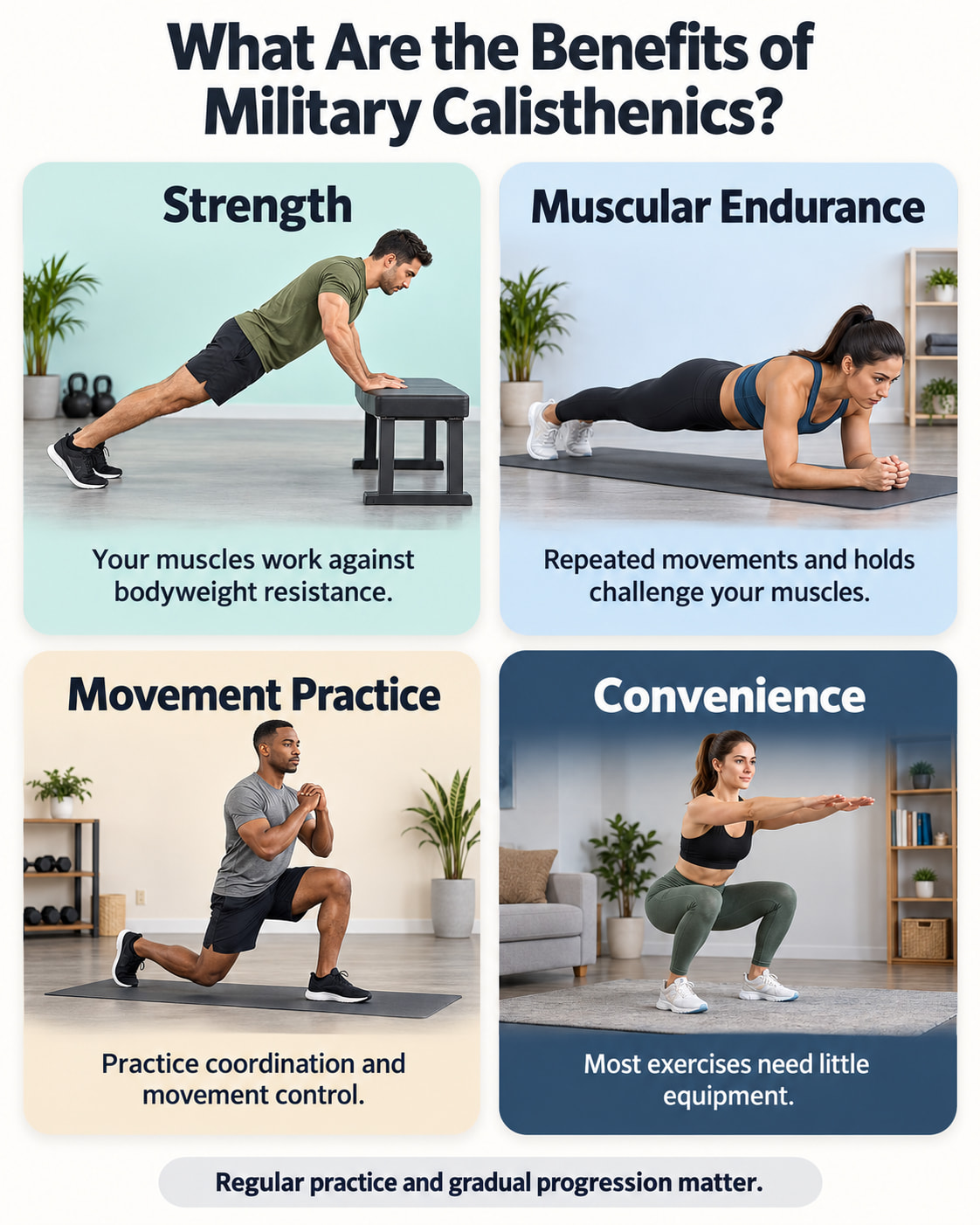
The main benefits come from regularly practicing appropriately challenging exercises:
- Strength: Your muscles work against the resistance created by your body weight.
- Muscular endurance: Repeated movements and holds challenge your ability to sustain muscular effort.
- Movement practice: Squatting, lunging, pushing, and pulling give you opportunities to improve coordination and control.
- Convenience: Most of the exercises can be performed at home or in another small training space.
In its March 2026 update, the American College of Sports Medicine identifies bodyweight exercises and home routines as effective resistance training options. The guidance emphasizes regular participation, individualization, and gradual progression. Training every set to complete muscular failure is not necessary for general fitness results.
Your exercise choices should become more challenging as you improve. Eventually, an easy variation may need more repetitions, an additional set, or a harder version to remain useful.
7 Best Military Calisthenics Exercises to Try
These seven exercises cover pushing, pulling, lower-body movement, core work, and conditioning. The best variation is one you can perform with control at an appropriate level of effort.
1. Push-Ups
Main focus: Chest, shoulders, triceps, and trunk control.
Push-ups combine upper-body pushing with the challenge of keeping your body aligned.
How to do them:
- Place your hands slightly wider than shoulder-width apart.
- Extend your legs and maintain a straight line from your head to your heels.
- Bend your elbows, keeping them angled slightly back, and lower your chest toward the floor.
- Press through your hands to return to the starting position.
Use a range you can control without letting your hips sag or your head reach forward.
Make it easier: Perform wall push-ups or place your hands on a sturdy, immovable elevated surface. A higher surface generally makes the movement easier.
Common mistake: Lifting the chest before the hips. Your trunk and legs should move together.
2. Bodyweight Squats
Main focus: Thighs and glutes.
Bodyweight squats, also called air squats, let you practice lowering and raising your body through your hips and knees.
How to do them:
- Stand with your feet around shoulder-width apart and your toes turned out slightly if comfortable.
- Bend your hips and knees, lowering between your feet.
- Keep your heels and the fronts of your feet grounded.
- Lower as far as you can comfortably control, then stand.
Let your knees follow the direction of your toes. You do not need to force a particular depth.
Make it easier: Squat toward a stable chair placed against a wall. Sit lightly if needed, then stand.
Common mistake: Forcing a deep squat while your heels lift or you lose balance.
3. Reverse Lunges
Main focus: Thighs, glutes, and balance.
Reverse lunges add a backward step and require you to control your weight between your legs.
How to do them:
- Stand with your feet about hip-width apart.
- Step one foot backward, keeping enough space between your feet to balance.
- Bend both knees and lower your body while keeping your front foot flat.
- Press through your front foot to return to standing.
- Repeat on the other side.
Your back knee can move toward the floor without touching it. Keep the movement smooth and use a comfortable range.
Make it easier: Hold a stable support and perform a shallow split squat, keeping your feet in a staggered stance throughout.
Common mistake: Placing your feet on one narrow line, which makes balancing more difficult.
4. Forearm Planks
Main focus: Trunk endurance and body alignment.
A plank challenges you to maintain a steady position while breathing normally.
How to do them:
- Place your forearms on the floor with your elbows under your shoulders.
- Extend your legs and support yourself on your toes.
- Gently tighten your abdomen and glutes.
- Hold your body in a straight line while continuing to breathe.
End the hold when you can no longer maintain your position.
Make it easier: Keep your knees on the floor and maintain alignment from your head through your hips to your knees. You can also shorten the hold.
Common mistake: Holding your breath or letting your lower back sag to keep going longer.
5. Pull-Ups or Assisted Pull-Ups
Main focus: Back, arms, and grip.
Pull-ups add an upper-body pulling movement to a routine that otherwise contains several pushing and hand-supported exercises.
How to do them:
- Use a properly installed, weight-rated bar.
- Take an overhand grip around shoulder-width apart.
- Begin with your arms extended and your shoulders controlled.
- Pull upward until your chin clears the bar without craning your neck.
- Lower smoothly to the starting position.
Keep swinging and kicking out of the movement.
Make it easier: Use an assisted pull-up machine with enough assistance to complete smooth repetitions. Follow the equipment instructions and ask a qualified trainer for setup help if needed.
Common mistake: Choosing too little assistance and turning each repetition into a swing.
If you do not have a secure pulling setup, leave this exercise out until suitable equipment is available. Plan to include pulling work as your routine develops.
6. Mountain Climbers
Main focus: Trunk control and conditioning.
Mountain climbers combine a supported plank position with alternating knee movements.
How to do them:
- Start in a high plank with your hands under your shoulders.
- Bring one knee forward toward your chest.
- Return that foot to the starting position.
- Repeat with the other leg.
Begin slowly. Keep your hips relatively steady and your shoulders supported over your hands.
Make it easier: Place your hands on a sturdy, immovable elevated surface and bring one knee forward at a time.
Common mistake: Moving quickly while bouncing your hips or losing control of your lower back.
7. Burpees
Main focus: Whole-body conditioning and transitions between standing and floor positions.
A full burpee can combine a squat, plank, push-up, and jump. Learn the easier version first if you are new to the movement.
How to do the full version:
- From standing, bend your hips and knees and place your hands on the floor.
- Move your feet backward into a plank.
- Perform a controlled push-up.
- Bring your feet back toward your hands.
- Stand and add a small jump, landing softly.
Use a pace that allows you to maintain control during every transition.
Make it easier: Step backward and forward one foot at a time, omit the push-up, and stand without jumping. This is a modified burpee.
Common mistake: Rushing the floor transition and letting your lower back collapse.
Skip burpees if getting into and out of the floor position is uncomfortable. They are an optional exercise.
A Beginner Military Calisthenics Workout
Build toward two sessions on nonconsecutive days each week, such as Monday and Thursday. Start with less if you have been inactive.
NIH guidance on physical activity recommends gradually increasing strengthening exercise and allowing at least one day of rest before training the same muscle groups again.
The following is a suggested starting session for generally healthy adults. Adjust the amounts to your ability; it is not a military test or an official training protocol.
Warm Up First
Spend about 5–10 minutes walking or marching at an easy pace. Then rehearse a few comfortable squats, wall push-ups, and backward steps.
The goal is to ease into the movements before the more challenging work.
Start With One Round
| Exercise | Suggested starting amount |
|---|---|
| Incline push-ups | 5–8 repetitions |
| Bodyweight squats or chair squats | 8–10 repetitions |
| Assisted pull-ups, if suitable equipment is available | 3–5 repetitions with sufficient assistance |
| Supported reverse lunges or split squats | 4–6 repetitions per side |
| Forearm plank or knee-supported plank | 10–20 seconds |
| Optional finish: slow elevated mountain climbers or modified burpees | 5–8 knee movements per side or 3–5 modified burpees |
Rest around 1–2 minutes between exercises, or longer if you need it to regain comfortable breathing and good technique.
Use fewer repetitions or shorter holds whenever necessary. Finish each set while you could still perform a few more controlled repetitions. For planks, stop before your alignment breaks down.
One pass through the table is one round. Add a second round only when the first feels manageable and you recover well between sessions.
Finish with a few minutes of easy walking to gradually settle your breathing.
How to Progress Your Military Calisthenics Workout
Progress one part of the workout at a time.
- Add repetitions: Move gradually toward the upper end of a comfortable range.
- Add a round: Increase total work while keeping your current exercise variations.
- Choose a harder variation: For example, lower the support used for incline push-ups.
- Reduce assistance: Use slightly less help on an assisted pull-up machine when you can maintain the same control.
For example, if five incline push-ups feel manageable across several sessions, try six at the same height. You can lower the incline later.
Keep a simple record of your variation, repetitions, and how the session felt. This helps you recognize progress without testing your maximum every workout.
Calisthenics can be part of a broader activity plan. CDC recommendations include at least 150 minutes of moderate-intensity aerobic activity per week, or 75 minutes of vigorous activity, plus strengthening all major muscle groups on at least two days. Walking, cycling, or swimming can complement your strength sessions.
Common Mistakes to Avoid
- Copying advanced military workouts immediately: Choose a workload that matches your current ability.
- Making every session a maximum-effort test: Leave room to practice good technique and recover.
- Increasing everything together: Avoid adding rounds, harder variations, and shorter rests in the same session.
- Rushing repetitions: Slow down when speed interferes with alignment or control.
- Ignoring pulling movements: Include suitable pulling work when equipment is available.
- Pushing through joint pain: Stop a movement that causes sharp or worsening pain and reassess the exercise.
When to Get Guidance Before Starting
If you have an injury, persistent joint pain, or a health condition that affects exercise, ask a qualified healthcare professional about suitable modifications.
NIH exercise safety guidance advises people with heart conditions or other chronic diseases to discuss appropriate activities with their doctor. It also recommends medical advice for symptoms such as chest pain or dizziness during activity.
Stop exercising if those symptoms occur. Seek urgent medical care for severe or persistent chest pain.
Frequently Asked Questions
Can Beginners Do Military Calisthenics?
Yes. Start with wall or incline push-ups, chair squats, supported lunges, and short plank holds. Use enough assistance for pulling exercises, and leave demanding movements such as full burpees for later.
How Are Military Calisthenics Different From Regular Calisthenics?
The exercises often overlap. “Military” describes their use in physical preparation, organized drills, or training programs. The underlying movement principles also apply to general fitness.
Can Military Calisthenics Build Muscle?
Bodyweight resistance training can support muscle growth when exercises remain sufficiently challenging. As you improve, you may need harder variations, additional sets, or other forms of resistance to continue progressing.
Should You Do Military Calisthenics Every Day?
You do not need a demanding daily routine to get started. Allow recovery between challenging sessions for the same muscles. Easy walking or other comfortable activity can fit between strength days.
Can You Do Military Calisthenics Without Equipment?
You can perform push-ups, squats, lunges, planks, mountain climbers, and burpees without specialized equipment. Pull-ups require a suitable bar or machine, and some easier variations need a stable support.
Will This Routine Prepare You for a Military Fitness Test?
It can help you practice useful movements, but military assessments have specific events, techniques, and standards. Anyone preparing to join should follow the current guidance for their service and intended role.
Conclusion
Military calisthenics offer practical exercises you can adapt to your ability. Start with controlled repetitions, use easier variations when needed, and build gradually.
Choose a few suitable movements, complete a manageable first session, and record what you did. Repeat consistently before adding more difficulty.
References
- U.S. Marine Corps Forces Special Operations Command: Preparation Guide.
- American College of Sports Medicine: 2026 Resistance Training Guidelines.
- National Institute of Diabetes and Digestive and Kidney Diseases: Health Tips for Adults.
- MedlinePlus: Warming Up and Cooling Down.
- Centers for Disease Control and Prevention: Adult Activity Recommendations.
- National Heart, Lung, and Blood Institute: Physical Activity and Your Heart—Risks.
- American Heart Association: Physical Activity Safety and Warning Signs.