
The military press is a strict overhead pressing exercise that builds shoulder strength, triceps strength, core stability, and upper-body control. It is usually performed standing with a barbell, but beginners can also learn the movement with dumbbells or lighter variations.
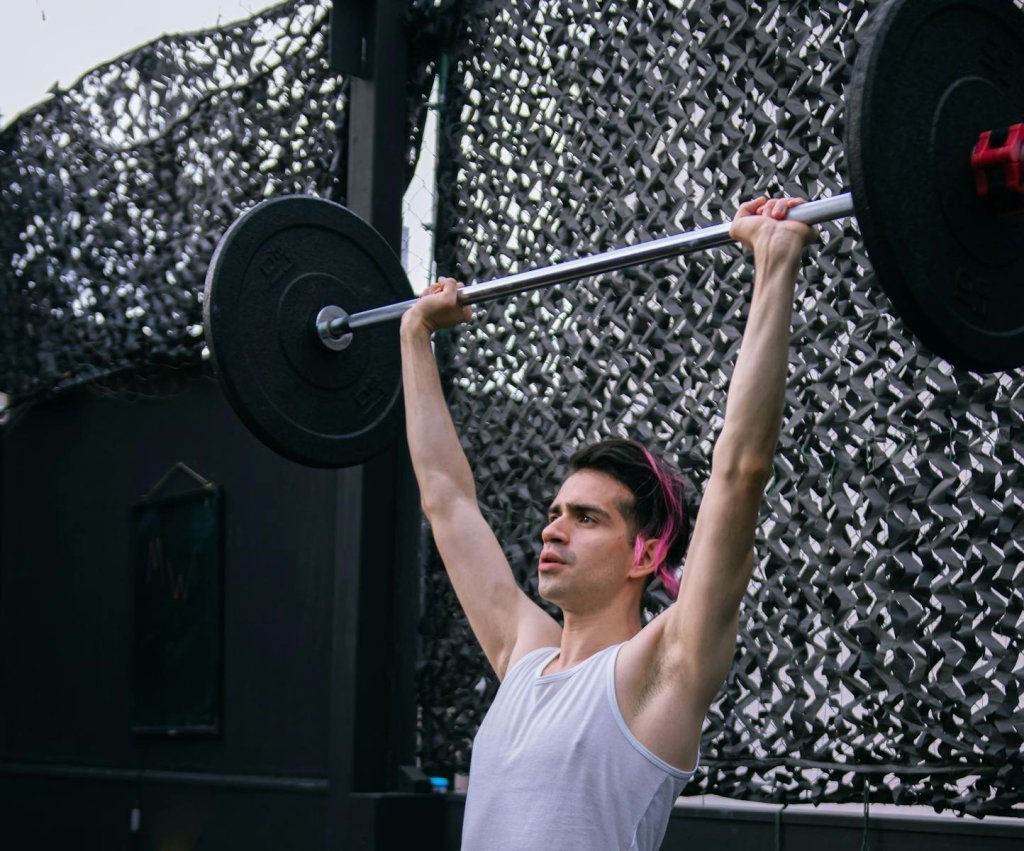
The key is simple: press the weight overhead without using your legs, leaning back, or losing core control. The American Council on Exercise explains that overhead pressing requires a braced torso, controlled movement, and stable positioning through the shoulders and arms.
This guide explains what the military press is, which muscles it works, how to do it with proper form, common mistakes to avoid, and how to fit it safely into your workout routine.
What Is the Military Press?
The military press is a vertical pressing exercise where you press a weight from shoulder level to overhead while keeping your body strict and stable.
In most fitness settings, the term “military press” usually refers to a standing barbell overhead press with a controlled stance, tight core, and no help from the legs.
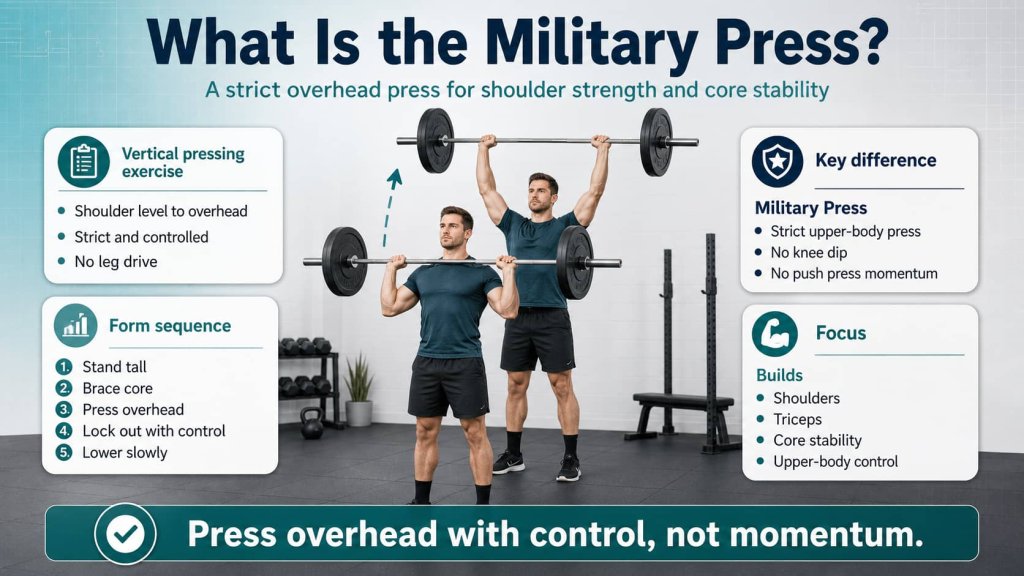
A basic military press looks like this:
- Stand tall with the bar at upper-chest or shoulder height.
- Brace your core.
- Press the bar overhead.
- Lock out with control.
- Lower the bar back to the start position.
Unlike a push press, the military press does not use a knee dip or leg drive. That makes it more focused on strict upper-body strength and trunk stability.
How to Do the Military Press With Proper Form
Start light. The goal is to learn the movement before adding heavy weight.
How to do it:
- Set a barbell in a rack at about upper-chest height.
- Grip the bar slightly wider than shoulder-width.
- Keep your wrists stacked over your elbows as much as possible.
- Step back and stand tall with your feet about hip-width apart.
- Brace your core like you are preparing for a firm punch to the stomach.
- Squeeze your glutes lightly to help control your pelvis.
- Start with the bar near your upper chest or shoulders.
- Press the bar upward in a straight, controlled path.
- Move your head slightly back as the bar passes your face.
- Once the bar clears your head, bring your head back through gently.
- Finish with the bar over your shoulders, hips, and midfoot.
- Lower the bar with control back to the starting position.
Trainer Tip: Think “ribs down, bar up.” If your ribs flare and your lower back arches hard, the weight is probably too heavy or your setup needs work.
Military Press Form Checklist
Use this quick checklist before each set:
- Feet planted and stable
- Glutes lightly squeezed
- Core braced
- Wrists neutral, not bent far backward
- Elbows slightly in front of the bar at the start
- Bar close to the face on the way up
- No knee dip or leg drive
- No excessive low-back arch
- Smooth lowering phase
Mayo Clinic emphasizes using proper strength-training technique, choosing an appropriate load, and stopping an exercise if it causes pain.
Military Press Muscles Worked
The military press mainly trains the shoulders, but it is not just a shoulder exercise. Because the weight moves overhead while you stand upright, several muscles work together to press, stabilize, and control the bar.
Primary muscles worked
The main muscles used in the military press are:
- Anterior deltoids: front of the shoulders
- Lateral deltoids: sides of the shoulders
- Triceps: back of the upper arms
- Upper chest: assists during the pressing path
Secondary muscles worked
These muscles help stabilize the body and support the press:
- Upper traps
- Serratus anterior
- Rotator cuff muscles
- Core muscles
- Glutes
- Upper back stabilizers
A 2022 study available through PubMed Central found that different overhead press variations can shift muscle emphasis, especially between front and behind-the-neck pressing. For most beginners and general fitness readers, the standard front military press is the more practical option to learn first.
Military Press Benefits
The military press is popular because it builds strength you can use both inside and outside the gym. It trains the body to press overhead while keeping the spine, ribs, and shoulders controlled.
Builds shoulder strength
The military press directly challenges the deltoids, especially the front and side shoulder muscles. Over time, this can help improve your ability to press, lift, and control weight overhead.
Strengthens the triceps
Your triceps help straighten the elbows at the top of the press. If your lockout feels weak, the triceps are often one of the muscles that need more strength and control.
Trains core stability
Because the military press is often done standing, your core has to work hard to prevent excessive leaning, rib flare, and low-back arching.
This is one reason the standing military press can feel harder than a seated shoulder press, even when the weight is lighter.
Improves overhead control
The military press teaches you to move weight overhead with control. That can support other exercises such as dumbbell presses, push presses, handstand progressions, and some athletic movements.
Fits well into a balanced strength plan
The CDC recommends adults do muscle-strengthening activities on 2 or more days per week that work all major muscle groups, including the shoulders, arms, chest, back, legs, hips, and abdomen. The military press can be one upper-body pushing exercise inside that larger plan.
Military Press vs Shoulder Press: What Is the Difference?
The terms are often used together, but they are not always exactly the same.
| Exercise | Main difference | Best for |
|---|---|---|
| Military press | Usually strict, standing, and often done with a barbell | Building strict overhead strength |
| Shoulder press | Broader term that can include dumbbells, machines, seated presses, and standing presses | General shoulder training |
| Push press | Uses a small leg drive to help move the weight overhead | Power and heavier overhead loading |
| Seated overhead press | Done seated, often with dumbbells or a machine | More support and less balance demand |
The military press is usually the strictest version. The shoulder press is a larger category.
Common Military Press Mistakes
The military press looks simple, but small form errors can make it feel harder and less comfortable.
| Mistake | Why it matters | Quick fix |
|---|---|---|
| Leaning back too much | Can shift stress to the low back | Brace harder and use less weight |
| Using leg drive | Turns it into a push press | Keep knees locked softly but still |
| Pressing the bar too far forward | Makes the lift harder on shoulders and back | Keep the bar close to your face |
| Flaring the ribs | Reduces core control | Keep ribs stacked over pelvis |
| Bending wrists back | Can irritate wrists and weaken pressing position | Keep knuckles up and wrists stacked |
| Lowering too fast | Reduces control and increases strain | Lower slowly to the start position |
| Going too heavy too soon | Breaks form quickly | Master lighter sets first |
How Many Sets and Reps Should You Do?
Your ideal sets and reps depend on your experience, goal, and recovery.
For beginners, a simple starting point is:
| Goal | Sets | Reps | Load |
|---|---|---|---|
| Learn form | 2–3 | 8–12 | Light |
| Build strength | 3–5 | 3–6 | Moderate to heavy |
| Build muscle | 3–4 | 6–12 | Moderate |
| Improve control | 2–3 | 10–15 | Light to moderate |
Mayo Clinic notes that many people can start strength training with a weight they can lift comfortably for about 12 to 15 repetitions, then gradually increase resistance as they get stronger.
The American College of Sports Medicine released updated resistance-training guidance in 2026, emphasizing progressive resistance training, individual goals, and practical programming rather than one single “perfect” routine.
How Often Should You Do the Military Press?
Most people can train the military press 1–2 times per week, depending on their full workout plan.
A practical weekly setup could look like this:
- Beginner: 1 day per week
- Intermediate: 1–2 days per week
- Advanced: 2 days per week with different intensities
Avoid training heavy overhead presses hard every day. Your shoulders, triceps, upper back, and nervous system need time to recover.
Mayo Clinic recommends resting one full day between training the same muscle group hard.
Best Military Press Variations
Variations help you adjust the exercise to your strength level, equipment, and shoulder comfort. Some versions are better for beginners, while others are better for strength, muscle balance, or power development.
1. Dumbbell Military Press
Why it works:
The dumbbell military press lets each arm move independently, which can help improve shoulder control and reduce side-to-side strength differences. It may also feel more natural than a straight barbell because your hands can move in a slightly more comfortable path.
Muscles worked:
This variation mainly works the deltoids, triceps, upper chest, upper traps, serratus anterior, rotator cuff, and core stabilizers.
How to do it:
- Stand tall with a dumbbell in each hand at shoulder height.
- Keep your feet about hip-width apart.
- Brace your core and keep your ribs stacked over your pelvis.
- Start with your palms facing forward or slightly inward.
- Press both dumbbells overhead until your arms are extended.
- Keep your shoulders controlled and avoid shrugging too hard.
- Lower the dumbbells back to shoulder height with control.
- Repeat for your target reps.
Trainer Tip:
Use a neutral grip if your shoulders feel better that way. Keep the dumbbells slightly in front of your shoulders instead of forcing them directly out to the sides.
2. Seated Dumbbell Shoulder Press
Why it works:
The seated dumbbell shoulder press gives your body more support, which can make it easier to focus on pressing form. Because your back is supported, it may reduce the tendency to lean back or overuse the lower back.
Muscles worked:
This exercise mainly targets the deltoids and triceps, with support from the upper chest, upper traps, serratus anterior, and rotator cuff muscles.
How to do it:
- Sit on a bench with your feet flat on the floor.
- Hold a dumbbell in each hand at shoulder height.
- Keep your chest tall and your back supported.
- Brace your core lightly.
- Press the dumbbells overhead in a controlled path.
- Stop before your shoulders shrug excessively.
- Lower the dumbbells slowly back to shoulder height.
- Repeat with steady control.
Trainer Tip:
Do not turn the seated press into a lower-back arch. Keep your ribs down and avoid pushing your chest forward just to move heavier weight.
3. Landmine Press
Why it works:
The landmine press uses an angled pressing path instead of a straight overhead path. This can make it more comfortable for people who struggle with full overhead mobility while still training the shoulders, triceps, and core.
Muscles worked:
The landmine press works the deltoids, triceps, upper chest, serratus anterior, core, obliques, and upper-back stabilizers.
How to do it:
- Place one end of a barbell into a landmine attachment or secure corner.
- Hold the free end of the barbell at shoulder height with one or both hands.
- Stand tall with your feet stable.
- Brace your core and keep your ribs down.
- Press the bar upward and slightly forward along its natural angled path.
- Keep your shoulder controlled at the top.
- Lower the bar back to shoulder height slowly.
- Repeat, then switch sides if doing the single-arm version.
Trainer Tip:
Think of pressing “up and away,” not straight overhead. This helps you follow the landmine’s natural path and keeps the movement smoother.
4. Single-Arm Dumbbell Press
Why it works:
The single-arm dumbbell press trains one side at a time, which helps expose strength differences between your left and right sides. It also challenges your core because your body has to resist leaning away from the weight.
Muscles worked:
This variation works the deltoids, triceps, upper chest, upper traps, serratus anterior, rotator cuff, obliques, deep core muscles, and glutes.
How to do it:
- Stand tall with one dumbbell at shoulder height.
- Keep your feet about hip-width apart.
- Brace your core and squeeze your glutes lightly.
- Keep your free hand by your side or lightly on your ribs for feedback.
- Press the dumbbell overhead with control.
- Avoid leaning to the opposite side.
- Lower the dumbbell slowly back to shoulder height.
- Complete all reps, then switch arms.
Trainer Tip:
Use a lighter weight than you would for a two-arm press. The goal is not just pressing strength, but also staying tall and stable without side bending.
5. Push Press
Why it works:
The push press uses a small knee dip and leg drive to help move the weight overhead. It is not the same as a strict military press, but it can help more advanced lifters train power and handle heavier loads once their basic overhead pressing form is solid.
Muscles worked:
The push press works the deltoids, triceps, upper chest, upper traps, core, glutes, quadriceps, calves, and upper-back stabilizers.
How to do it:
- Stand with the barbell at upper-chest or shoulder height.
- Keep your feet about hip-width apart.
- Brace your core and keep your torso upright.
- Bend your knees slightly in a short, controlled dip.
- Drive through your legs and press the bar overhead.
- Finish with your arms extended and the bar stacked over your body.
- Lower the bar back to the starting position with control.
- Reset before the next rep.
Trainer Tip:
Do not let the dip become a squat. Keep it short, vertical, and controlled so the power transfers into the press instead of throwing you off balance.
Military Press Alternatives
If the military press does not feel right for your shoulders, wrists, or lower back, you can still train similar muscles with other exercises. The best alternative is the one that lets you press or raise your arms with control and without pain.
1. Machine Shoulder Press
Why it works:
The machine shoulder press gives you a fixed path and more body support. This can make it easier to train the shoulders without worrying as much about balance or bar path.
Muscles worked:
This exercise mainly works the deltoids and triceps, with help from the upper chest and upper traps.
How to do it:
- Sit on the machine with your back against the pad.
- Adjust the seat so the handles start around shoulder height.
- Place your feet flat on the floor.
- Grip the handles and brace your core lightly.
- Press the handles upward until your arms are extended.
- Avoid locking out aggressively.
- Lower the handles slowly back to the start.
- Repeat with control.
Trainer Tip:
Adjust the seat before you start. If the handles are too low or too high, your shoulders may feel uncomfortable before the first rep.
2. Incline Dumbbell Press
Why it works:
The incline dumbbell press is not a pure overhead press, but it trains the upper chest, front shoulders, and triceps with more bench support. It can be a useful alternative if vertical pressing feels uncomfortable.
Muscles worked:
This exercise works the upper chest, anterior deltoids, triceps, serratus anterior, and shoulder stabilizers.
How to do it:
- Set a bench to a low or moderate incline.
- Hold a dumbbell in each hand near your upper chest.
- Keep your feet flat on the floor.
- Brace your core and keep your shoulder blades controlled.
- Press the dumbbells upward over your upper chest.
- Keep your wrists stacked over your elbows.
- Lower the dumbbells slowly.
- Repeat for your target reps.
Trainer Tip:
Use a moderate incline instead of a very steep one if your shoulders feel cranky. A lower incline often feels smoother and easier to control.
3. Pike Push-Up
Why it works:
The pike push-up is a bodyweight alternative that trains a similar overhead pressing pattern. It is useful when you do not have weights, but it can still be challenging because your shoulders must support much of your body weight.
Muscles worked:
The pike push-up works the deltoids, triceps, upper chest, serratus anterior, core, and upper-back stabilizers.
How to do it:
- Start in a push-up position.
- Walk your feet closer to your hands and lift your hips high.
- Keep your arms straight and your head between your upper arms.
- Bend your elbows to lower the top of your head toward the floor.
- Keep your core tight and hips lifted.
- Press through your hands to return to the start.
- Repeat with slow, controlled reps.
Trainer Tip:
Start with a small range of motion. Do not rush deep reps if your shoulders or wrists are not ready.
4. Cable Shoulder Press
Why it works:
The cable shoulder press provides steady tension through the movement. It can also let you adjust the angle and grip more easily than a barbell.
Muscles worked:
This exercise works the deltoids, triceps, upper chest, serratus anterior, rotator cuff, and core stabilizers.
How to do it:
- Set cable handles around lower-chest or shoulder height.
- Stand between the cables or in a staggered stance.
- Hold the handles at shoulder height.
- Brace your core and keep your ribs down.
- Press the handles upward in a smooth path.
- Keep your wrists controlled.
- Lower the handles slowly back to shoulder height.
- Repeat without letting the cables pull you out of position.
Trainer Tip:
Use lighter weight than you expect at first. Cables can feel unstable, so control matters more than load.
5. Lateral Raise
Why it works:
The lateral raise does not replace the full military press, but it is one of the best simple exercises for targeting the side delts. It can help build shoulder shape and balance when used with pressing movements.
Muscles worked:
The lateral raise mainly works the lateral deltoids, with support from the upper traps, supraspinatus, and core stabilizers.
How to do it:
- Stand tall with a dumbbell in each hand at your sides.
- Keep a slight bend in your elbows.
- Brace your core and keep your shoulders relaxed.
- Raise the dumbbells out to the sides until they reach about shoulder height.
- Keep the movement controlled and avoid swinging.
- Lower the dumbbells slowly.
- Repeat for your target reps.
Trainer Tip:
Use light weights. If you have to swing your body or shrug hard, the dumbbells are too heavy.
6. Front Raise
Why it works:
The front raise targets the front delts, which are also active during pressing exercises. It can be useful for shoulder isolation, but it should not replace balanced shoulder training.
Muscles worked:
The front raise mainly works the anterior deltoids, with support from the upper chest, upper traps, serratus anterior, and core.
How to do it:
- Stand tall with a dumbbell in each hand in front of your thighs.
- Brace your core and keep your ribs down.
- Keep a slight bend in your elbows.
- Raise the dumbbells forward to about shoulder height.
- Avoid leaning back to lift the weight.
- Lower the dumbbells slowly.
- Repeat with control.
Trainer Tip:
Go lighter than you think. Front raises are easy to cheat by leaning back, so keep your torso still and let the shoulders do the work.
Who Should Be Careful With the Military Press?
The military press may not be the best starting exercise for everyone.
Be careful or get guidance first if you have:
- Current shoulder pain
- Recent shoulder, neck, back, elbow, or wrist injury
- Limited overhead mobility
- Pain when raising your arms overhead
- A history of shoulder instability
- Trouble controlling low-back arching
- Dizziness or discomfort when lifting overhead
This does not mean you can never overhead press. It may simply mean you need a lighter variation, a shorter range of motion, or help from a qualified coach, physical therapist, or healthcare professional.
Military Press Safety Tips
Use these tips to make the exercise safer and more effective:
- Warm up for 5–10 minutes before lifting.
- Start with an empty bar, light dumbbells, or a lighter variation.
- Keep the bar path close to your body.
- Do not force range of motion if your shoulders feel pinchy.
- Avoid behind-the-neck pressing unless you have the mobility, experience, and coaching to do it well.
- Stop if you feel sharp, sudden, or worsening pain.
- Balance pressing exercises with pulling exercises like rows and pulldowns.
- Increase weight gradually.
Mayo Clinic’s weight-training guidance also recommends moving through a full range of motion when possible, using proper form, and avoiding rushed or uncontrolled reps.
Where the Military Press Fits in a Workout
The military press usually works best near the beginning of an upper-body or full-body workout, after your warm-up.
Upper-body strength example
- Military press
- Pull-up or lat pulldown
- Dumbbell bench press
- Seated row
- Lateral raise
- Triceps pressdown
Full-body beginner example
- Goblet squat
- Military press or dumbbell shoulder press
- Romanian deadlift
- Cable row
- Plank
Shoulder-focused example
- Military press
- Dumbbell lateral raise
- Rear delt fly
- Face pull
- Triceps extension
A balanced workout should include both pushing and pulling. If you only press and never train your upper back, your shoulders may not feel as strong or stable over time.
Military Press Progression Plan for Beginners
Use this simple progression if you are new to the movement.
Week 1–2: Learn the pattern
Use an empty barbell, light dumbbells, or a landmine press.
Do:
- 2–3 sets
- 8–12 reps
- Slow, controlled reps
Focus on posture, bar path, and core bracing.
Week 3–4: Add small load
Add a small amount of weight only if your form stays clean.
Do:
- 3 sets
- 6–10 reps
- 60–90 seconds rest
Stop the set before your form breaks.
Week 5 and beyond: Progress gradually
Choose one progression at a time:
- Add 2.5–5 lb to the bar
- Add 1–2 reps per set
- Add one extra set
- Slow the lowering phase
- Add a pause at shoulder level
Do not increase everything at once. Good pressing strength comes from steady, controlled progress.
FAQs About the Military Press
Is the military press good for shoulders?
Yes, the military press can be good for building shoulder strength when done with proper form, appropriate weight, and good control. It mainly trains the deltoids and triceps while also challenging the core and upper back.
Is military press the same as overhead press?
They are closely related. The military press is usually considered a stricter standing overhead press. The broader term “overhead press” can include standing, seated, barbell, dumbbell, machine, and other variations.
Is military press better standing or seated?
Standing military presses train more total-body stability because your core and glutes help control your posture. Seated presses offer more support and may be easier for beginners to control.
Why does my lower back hurt during military press?
Low-back discomfort often happens when the weight is too heavy, the ribs flare, or the lifter leans back too much. Reduce the load, brace your core, squeeze your glutes lightly, and keep your ribs stacked over your pelvis. Stop if pain is sharp, worsening, or does not go away.
Should the military press touch the chest?
The bar often starts near the upper chest or front shoulders, but your exact range depends on your mobility and comfort. Lower the bar under control without forcing your shoulders into a painful position.
Can beginners do the military press?
Yes, beginners can do the military press, but they should start light. Dumbbells, landmine presses, or seated shoulder presses may be easier starting options before moving to a standing barbell military press.
How much weight should I use for military press?
Use a weight you can lift with clean form for your target reps. For beginners, that may mean an empty barbell or light dumbbells. If you have to lean back, use leg drive, or lose control, the weight is too heavy.
Conclusion
The military press is one of the best classic exercises for building strict overhead strength. It trains your shoulders, triceps, core, and upper-body control in one simple movement.
Start light, brace your core, keep the bar close, and avoid leaning back. Once your technique is consistent, progress slowly with more reps, slightly heavier weight, or controlled variations.
References
- American Council on Exercise: Seated Overhead Press
Useful for overhead press setup, shoulder press form, and safe pressing cues. - American Council on Exercise: Single-Arm Overhead Press
Useful for single-arm military press variations, unilateral training, and core stability. - Mayo Clinic: Weight Training Do’s and Don’ts
Useful for strength-training safety, proper form, breathing, load control, and injury prevention. - Mayo Clinic: Strength Training Guide
Useful for beginner strength training, sets and reps, gradual progression, and recovery. - CDC: Adult Physical Activity Guidelines
Useful for supporting weekly muscle-strengthening recommendations and balanced training. - PubMed Central: Front vs Back and Barbell vs Machine Overhead Press
Useful for explaining how overhead press variations may change muscle activation. - PubMed Central: Stability of Resistance Training Implement Alters EMG Activity During Overhead Press
Useful for discussing overhead press stability demands, equipment differences, and muscle activity. - American College of Sports Medicine: Resistance Training Guidelines Update 2026
Useful for updated resistance-training guidance, progressive overload, and individualized programming.