
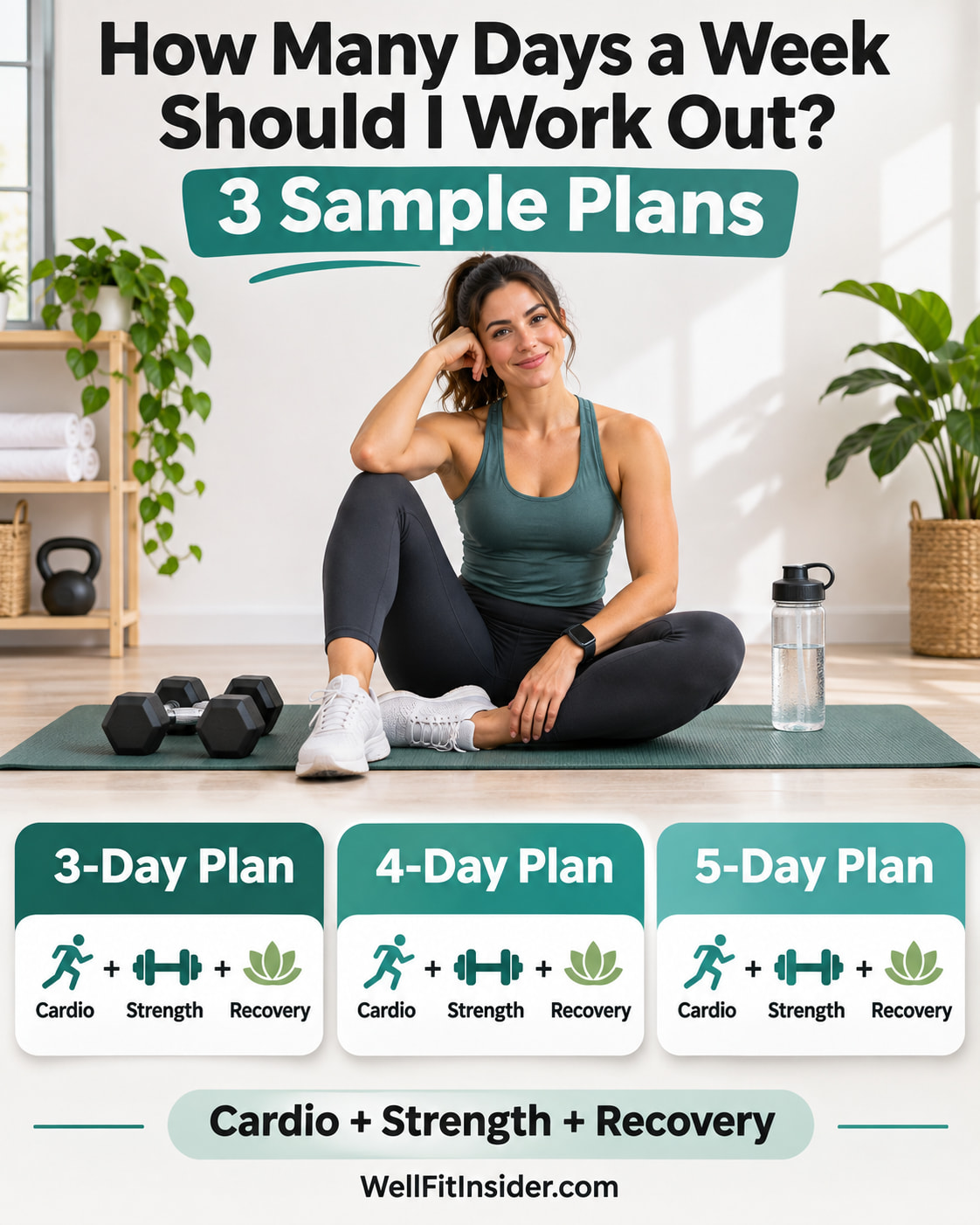
Three to five workout days a week can be a practical schedule for many adults, including at least two days of strength training. Your answer to “how many days a week should I work out?” also depends on your goals, session length, and recovery.
A useful routine includes enough weekly aerobic activity, exercises that strengthen your major muscle groups, and time to recover. The three sample plans below show how to organize those pieces around your available days.
How Many Days a Week Should I Work Out?
There is no single required number of workout days. For general health, start with the weekly activity targets and decide how to distribute them.
The CDC’s adult activity guidelines recommend the following:
| Type of activity | Weekly recommendation |
|---|---|
| Moderate-intensity aerobic activity, such as brisk walking | At least 150 minutes |
| Vigorous-intensity aerobic activity, such as running | At least 75 minutes, as an alternative to moderate activity |
| A combination of moderate and vigorous activity | An equivalent mix of the two |
| Muscle-strengthening activity | At least 2 days, covering all major muscle groups |
You can do cardio and strength training on the same day. For example, three scheduled workout days could include two combined strength-and-cardio days and one cardio-only day.
Five 30-minute cardio sessions are another way to reach 150 minutes. That familiar example does not mean everyone must exercise exactly five days a week. Some activity is also beneficial before you reach the full recommendation.
What Counts as Moderate Cardio?
Moderate activity raises your breathing and heart rate while still allowing you to hold a conversation. Singing would be difficult. During vigorous activity, you generally need to pause for breath after a few words.
Brisk walking, cycling, swimming, or dancing can fit your routine. Choose the intensity according to your fitness rather than assuming one speed works for everyone.
How Many Days a Week Should I Work Out for My Goal?
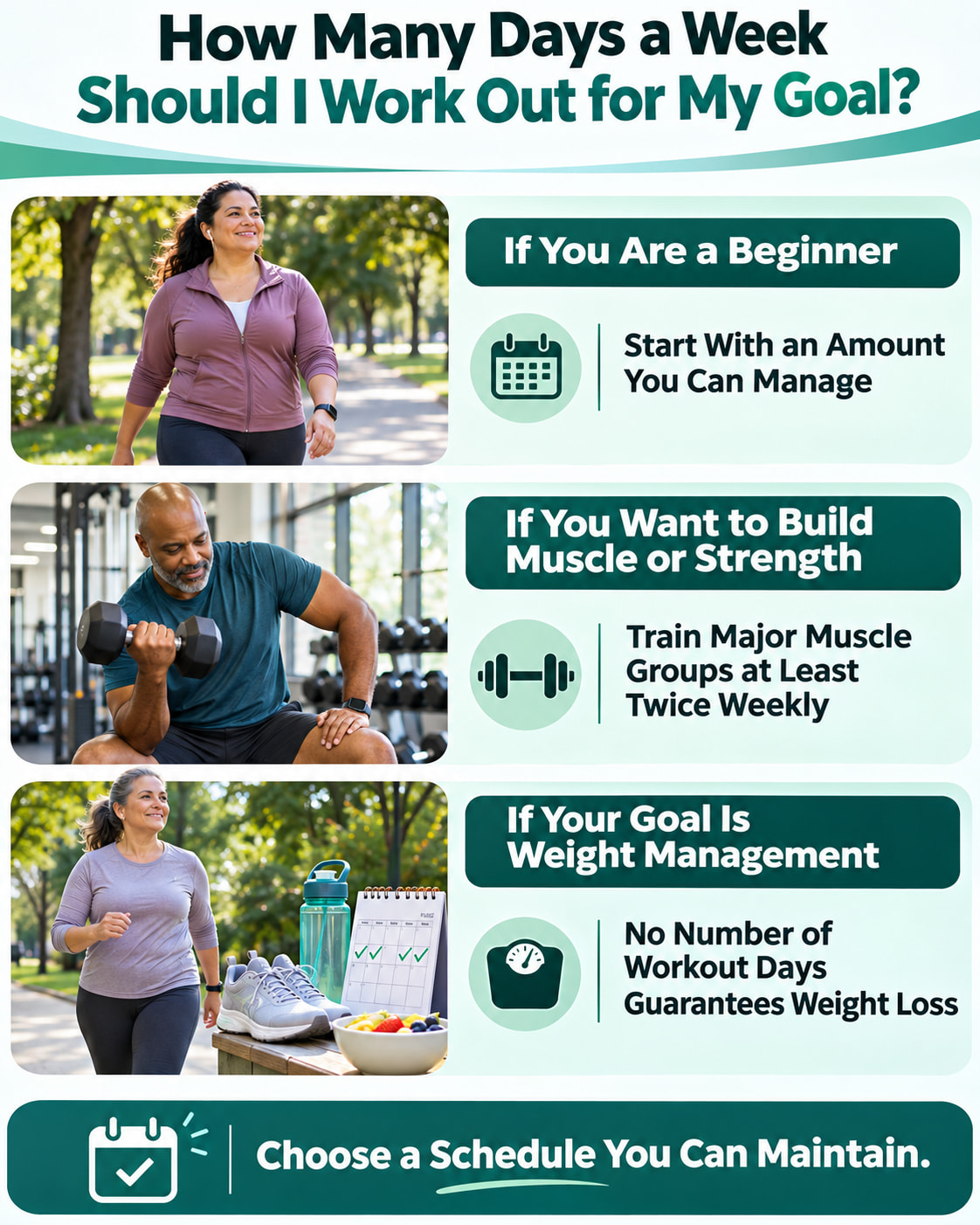
Your goal helps determine what to include in your schedule. It does not automatically determine a fixed number of training days.
If You Are a Beginner
Begin with an amount you can manage and repeat. You can choose a three-day schedule while initially doing shorter sessions than those shown below.
For example, if a 50-minute cardio session feels out of reach, start with a shorter walk and build from there. Establishing regular activity times can make the routine easier to organize.
CDC guidance recommends starting slowly and gradually increasing the duration or challenge of activity. You do not need to reach the full weekly target immediately.
If You Want to Build Muscle or Strength
Include strength training for all major muscle groups at least twice weekly.
The American College of Sports Medicine’s March 2026 guidance emphasizes consistent participation, suitable effort, and a program that fits the individual. Its updated position stand drew on 137 systematic reviews involving more than 30,000 participants.
Two full-body sessions provide a straightforward way to organize that frequency. A third session can give you another opportunity to distribute your weekly training.
More workout days do not automatically produce better results. The amount of training you complete, the challenge of the exercises, and your ability to maintain the routine also matter. Body-weight exercises, resistance bands, machines, and free weights can all be useful options.
If Your Goal Is Weight Management
There is no number of workout days that guarantees weight loss.
According to the CDC’s activity and weight guidance, updated in April 2026, activity needs vary between people. Some people need more activity than the general minimum to support their weight goals.
Choose a schedule you can maintain, include both cardio and strength training, and consider your eating patterns alongside exercise. A five-day routine may suit your calendar, but its results depend on more than attendance.
3 Sample Weekly Workout Plans
These schedules are examples for generally healthy adults who can manage the listed activity. Build toward the totals if you are starting from a lower activity level.
Before choosing a plan, keep these points in mind:
- All listed cardio minutes are moderate intensity.
- Strength-training time is additional to the cardio minutes.
- Each full-body strength session should cover your major muscle groups.
- Combined sessions can happen at different times on the same day.
Shorter aerobic bouts can contribute to your weekly total; there is no requirement that every bout last at least 10 minutes. For example, you could divide 50 minutes into two 25-minute walks.
3-Day Workout Plan
Choose this option if: You have fewer available workout days and can set aside more time on those days.
| Day | Activity |
|---|---|
| Monday | Full-body strength training + 50 minutes of cardio |
| Tuesday | Rest or comfortable everyday movement |
| Wednesday | 50 minutes of cardio |
| Thursday | Rest or comfortable everyday movement |
| Friday | Full-body strength training + 50 minutes of cardio |
| Saturday | Rest or comfortable everyday movement |
| Sunday | Rest or comfortable everyday movement |
Weekly total: 150 minutes of cardio and 2 full-body strength sessions.
This plan concentrates your scheduled activity into three days. Monday and Friday require enough time for both components, so consider separating strength and cardio into different parts of the day.
For example, you could do strength training in the morning and accumulate your walking minutes later.
4-Day Workout Plan
Choose this option if: You prefer to spread your activity across more days while keeping two strength sessions.
| Day | Activity |
|---|---|
| Monday | Full-body strength training + 30 minutes of cardio |
| Tuesday | 45 minutes of cardio |
| Wednesday | Rest or comfortable everyday movement |
| Thursday | Full-body strength training + 30 minutes of cardio |
| Friday | Rest or comfortable everyday movement |
| Saturday | 45 minutes of cardio |
| Sunday | Rest or comfortable everyday movement |
Weekly total: 150 minutes of cardio and 2 full-body strength sessions.
The aerobic minutes add up as 30 + 45 + 30 + 45 = 150.
This arrangement gives you two combined sessions and two days devoted to cardio. You can move the days to fit your calendar while keeping recovery time between full-body strength sessions.
5-Day Workout Plan
Choose this option if: You want a third strength session and can comfortably manage activity on five days.
| Day | Activity |
|---|---|
| Monday | Full-body strength training + 20 minutes of cardio |
| Tuesday | 45 minutes of cardio |
| Wednesday | Full-body strength training + 20 minutes of cardio |
| Thursday | Rest or comfortable everyday movement |
| Friday | Full-body strength training + 20 minutes of cardio |
| Saturday | 45 minutes of cardio |
| Sunday | Rest or comfortable everyday movement |
Weekly total: 150 minutes of cardio and 3 full-body strength sessions.
The aerobic minutes add up as 20 + 45 + 20 + 20 + 45 = 150.
This plan includes more strength training than the other examples. Choose it when the additional session fits your goals, available time, and recovery.
What Should a Full-Body Strength Session Include?
A full-body session should address the legs, hips, back, abdomen, chest, shoulders, and arms. Some exercises work several of these areas together.
You can use body weight, resistance bands, machines, or free weights. Select exercises you can perform with control, and allow enough time to cover the intended muscle groups. If you are unfamiliar with the movements, a qualified trainer can help you learn the technique.
How Much Rest Do You Need Between Workouts?
Recovery should reflect what you trained and how demanding the session was.
Mayo Clinic’s strength-training guidance, updated in June 2026, recommends allowing a full day between strength sessions for the same muscle group. The sample plans follow that approach by placing full-body strength sessions on nonconsecutive days.
A day away from lifting can still include comfortable walking or other manageable movement. The recovery guidance concerns the muscles you trained; it does not require complete inactivity.
Stop an exercise that causes pain. If you have a chronic condition or concerns about exercise safety, discuss suitable activities with a healthcare professional.
How to Choose a Workout Schedule You Can Maintain
Start With Your Available Time
Look at your calendar before choosing a plan. A three-day schedule with longer sessions may suit you better than five separate appointments—or the shorter cardio blocks in the five-day plan may be easier to arrange.
Include the time needed for strength training. A session labeled “strength + 30 minutes of cardio” will take longer than 30 minutes overall.
Choose Activities You Can Repeat
Pick cardio you enjoy and strength exercises that match your equipment and experience.
For example, you might use brisk walking for most cardio sessions and complete strength training at home. Another person may prefer cycling and gym-based strength sessions. Either arrangement can fit the schedules.
Track Minutes and Strength Sessions Separately
A simple weekly record can include:
- Total moderate or vigorous aerobic minutes.
- Days that included strength training.
- Which muscle groups you trained.
- Whether the sessions felt manageable.
This helps you see what your schedule actually contains. Completing several strength sessions does not automatically show that you have accumulated the planned aerobic minutes.
Build Gradually
Start below the sample totals if needed. As the routine becomes manageable, increase the time or challenge gradually.
For example, you might keep the same walking days while extending the walks. You can also keep two strength days before deciding whether an additional session fits.
There is no need to change your frequency, duration, and workout difficulty all at once. CDC guidance supports a gradual approach to increasing activity.
Frequently Asked Questions
Is Working Out Three Days a Week Enough?
It can be. The three-day sample plan includes 150 minutes of moderate cardio and two full-body strength sessions.
Whether three days are enough for a particular performance or muscle-building goal depends on the training you complete during those sessions. Count the actual activity rather than relying only on the number of workout days.
Is It Okay to Work Out Every Day?
Daily movement can fit a healthy routine, but workout intensity and muscle recovery still matter. A comfortable walk is a different demand from a challenging full-body strength session.
If you enjoy being active daily, vary the activities and allow recovery time before training the same muscle groups again.
Does Walking Count as a Workout?
Yes. Brisk walking can count toward your moderate-intensity aerobic minutes.
Use your breathing and the talk test to judge the effort: you should be able to converse, while singing would be difficult. A very easy stroll still adds movement, but it may not reach moderate intensity.
Can I Do Cardio and Strength Training on the Same Day?
Yes. The sample schedules combine them on some days to make the week easier to organize.
You can complete both during one visit or separate them—for example, strength training earlier in the day and a brisk walk later. Choose an arrangement that lets you complete each activity comfortably and with good technique.
Can I Exercise Only on Weekends?
Concentrating activity into fewer days may be an option when your schedule is limited, provided the amount is manageable for you.
An October 2026 systematic review found no clear difference in all-cause mortality between concentrated and more regularly distributed activity patterns in middle-aged and older adults. However, the evidence was rated very low certainty and did not establish equal outcomes or safety.
These findings support flexibility, but they do not prove that every two-day routine produces the same results as a routine spread across the week.
How Long Should Each Workout Last?
There is no single required session length. It depends on your weekly schedule and what the session includes.
In these examples, cardio lasts 20–50 minutes on scheduled days, with strength training taking additional time. You can divide the cardio into smaller blocks. Choose session lengths you can manage and build gradually when necessary.
Choose a Routine You Can Repeat
The best answer to “how many days a week should I work out?” is a schedule that fits your goals, available time, and recovery.
Use the three-, four-, or five-day plan as a starting framework. Put the days on your calendar, choose manageable activities, and begin with an amount you can repeat. Build toward the weekly targets as your routine develops.
This content is for informational purposes only and not medical advice.
References
- Centers for Disease Control and Prevention. Adult Activity Guidelines.
- American College of Sports Medicine. 2026 Resistance Training Guidelines Update.
- Centers for Disease Control and Prevention. Measuring Physical Activity Intensity.
- Office of Disease Prevention and Health Promotion. Key Points About the Physical Activity Guidelines.
- Centers for Disease Control and Prevention. Getting Started With Physical Activity.
- Centers for Disease Control and Prevention. Physical Activity and Weight Management.
- Mayo Clinic. Strength Training Guidance.
- Lu and colleagues. Weekend Warrior and Regularly Active Patterns: Systematic Review. Journal of Science and Medicine in Sport.