
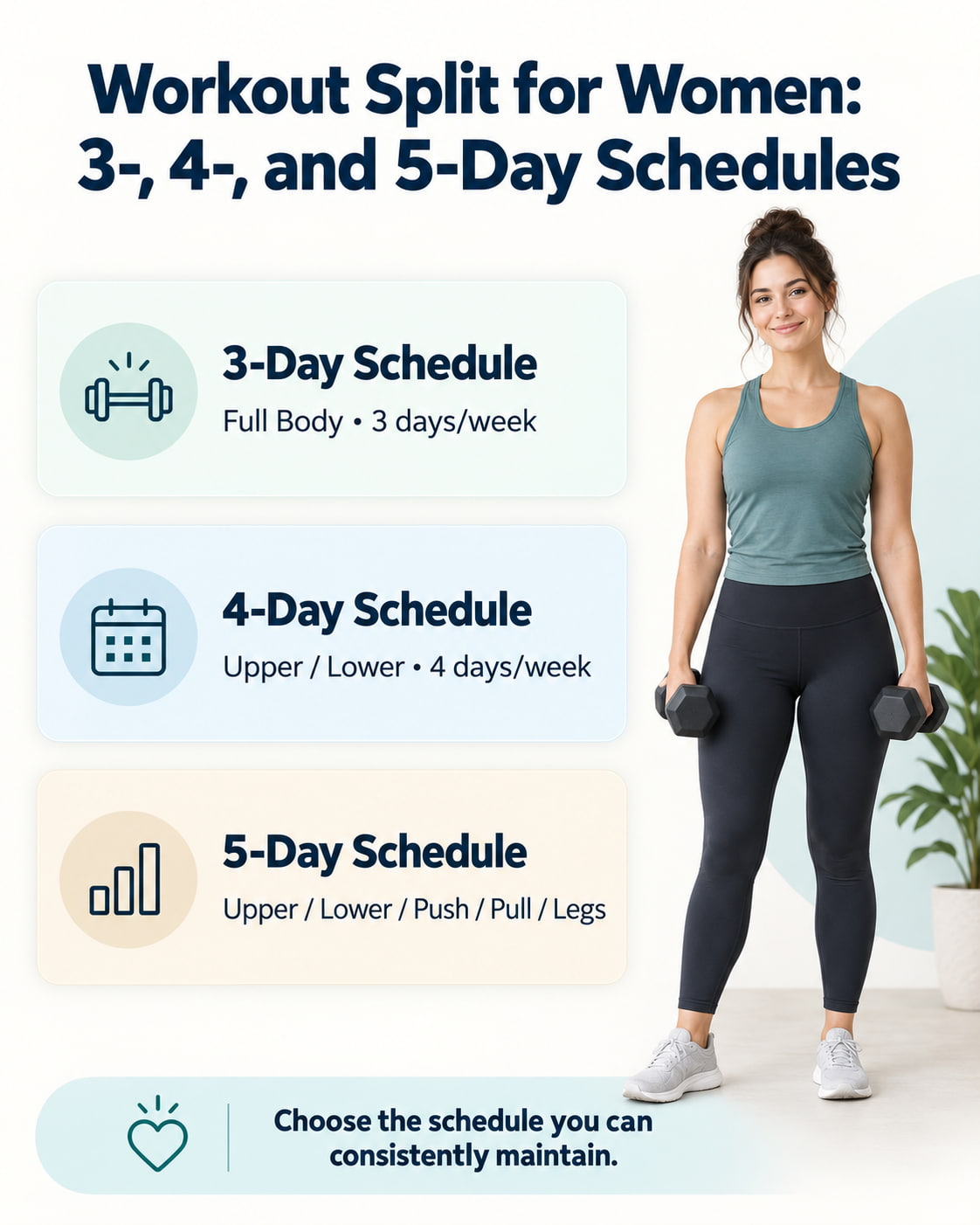
A practical workout split for women can include three full-body days, four upper/lower days, or five upper/lower/push/pull/legs days per week. Choose the schedule that fits your experience, available time, and ability to recover—not simply the one with the most workouts.
A clear schedule makes it easier to know what to train, track your progress, and leave room for recovery. The American College of Sports Medicine’s 2026 resistance-training guidance emphasizes consistency and training all major muscle groups at least twice weekly rather than searching for a complicated “perfect” routine.
Below are three complete lifting schedules, followed by guidance on choosing weights, progressing your workouts, and fitting in cardio.
What Is a Workout Split?
A workout split organizes strength training across different sessions. An upper/lower split separates upper-body and lower-body workouts. A push/pull/legs split groups exercises by movement pattern and body region.
A full-body routine trains upper- and lower-body muscles in the same session. Technically, it is not a body-part split, but it is a useful alternative when planning your training week.
In the five-day schedule below, push and pull refer to upper-body sessions. Push workouts include pressing movements, while pull workouts include rows and pulldowns. Leg training has its own sessions.
How to Choose a Workout Split for Women
Start with the number of lifting days you can realistically maintain.
- Choose three days when you prefer fewer gym visits, are learning the exercises, or need more days free for other activities.
- Choose four days when an upper/lower structure fits your week and you prefer separating leg workouts from upper-body training.
- Choose five days when you already have a consistent lifting habit, enjoy more focused sessions, and can accommodate the additional training and recovery demands.
These are practical scheduling suggestions, not scientifically established rankings. A 2024 systematic review and meta-analysis found no significant differences in strength or muscle growth between split and full-body routines when training volume was matched. The review included 14 studies and 392 participants. More workout days alone did not make one approach superior.
Weekly Schedule Comparison
| Day | 3-Day Schedule | 4-Day Schedule | 5-Day Schedule |
|---|---|---|---|
| Monday | Full Body A | Upper Body A | Upper Body |
| Tuesday | Rest from lifting | Lower Body A | Lower Body |
| Wednesday | Full Body B | Rest from lifting | Rest from lifting |
| Thursday | Rest from lifting | Upper Body B | Push |
| Friday | Full Body C | Lower Body B | Pull |
| Saturday | Rest from lifting | Rest from lifting | Legs |
| Sunday | Rest from lifting | Rest from lifting | Rest from lifting |
“Rest from lifting” does not mean you must avoid movement. These calendars organize strength training only; walking and other aerobic activities can fit around them.
How to Use These Workout Plans
These are sample starting templates for generally healthy adults, not individualized rehabilitation, pregnancy, or postpartum programs. Choose one schedule rather than combining them.
The plans use dumbbells, an exercise bench, a mat, and common gym machines. They are not matched for weekly training volume; the five-day plan includes more total work as written.
Before attempting unfamiliar exercises, ask a qualified fitness professional to demonstrate the setup and technique. The American Heart Association also recommends learning safe lifting techniques before beginning a strength-training program.
Understand the Sets and Repetitions
A prescription of 2 × 8–12 means two working sets of eight to 12 repetitions. Complete one set, rest, and then perform the next.
For exercises marked “per side,” perform the listed repetitions on each side. Working sets do not include lighter warm-up sets.
Complete the exercises in the listed order, finishing each exercise’s sets before moving on. During your first few sessions on the three-day plan, you can begin with one working set per exercise while learning the movements, then gradually build toward the listed amount.
Choose a Manageable Weight
For these plans, aim to finish most working sets with approximately two or three good repetitions still possible. This is called repetitions in reserve. You do not need to reach the point where another repetition becomes impossible on every set.
Use different weights for different exercises. Reduce the weight when you cannot reach the bottom of the repetition range without swinging, rushing, or losing control.
Warm Up and Rest Between Sets
Begin with about five to 10 minutes of easy movement, such as walking or cycling. Then practice the first major exercises with lighter resistance before starting your working sets. The American Heart Association recommends a five- to 10-minute warm-up, while the women’s training trial discussed below also used exercise-specific warm-up sets.
For these sample plans, use approximately:
- Two to three minutes between demanding squats, hinges, presses, rows, and pulldowns.
- One to two minutes between curls, raises, calf exercises, and core sets.
These are starting rest periods, not strict limits. Take longer when needed to perform the next set with control.
3-Day Workout Split for Women
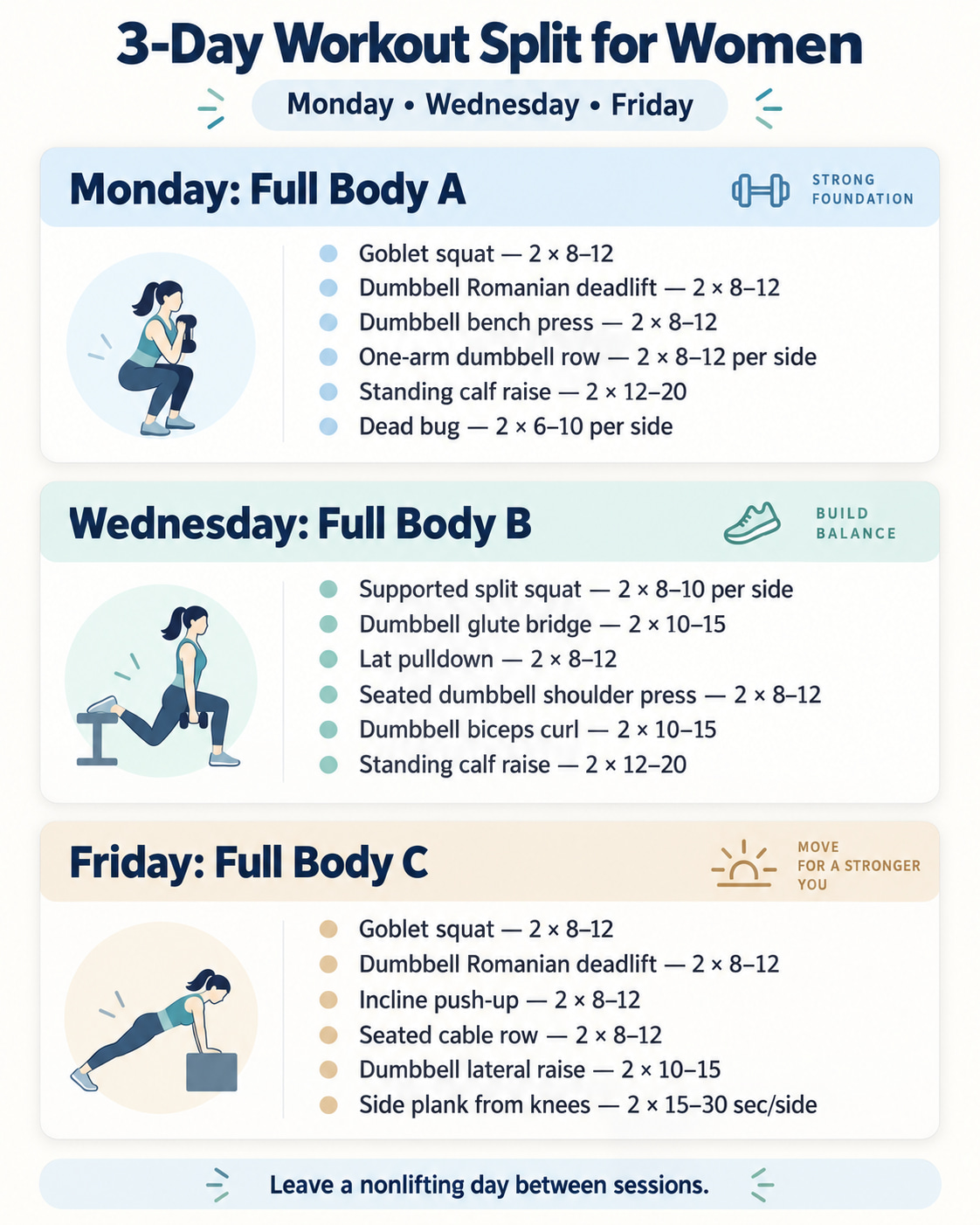
This full-body schedule leaves a nonlifting day between sessions. Each workout combines lower-body exercises with upper-body pushing and pulling.
Use Monday, Wednesday, and Friday, or another arrangement with similar spacing.
Monday: Full Body A
| Exercise | Working Sets × Repetitions |
|---|---|
| Goblet squat | 2 × 8–12 |
| Dumbbell Romanian deadlift | 2 × 8–12 |
| Dumbbell bench press | 2 × 8–12 |
| Bench-supported one-arm dumbbell row | 2 × 8–12 per side |
| Standing calf raise | 2 × 12–20 |
| Dead bug | 2 × 6–10 per side |
For the Romanian deadlift, keep a slight bend in your knees, move your hips backward, and keep the dumbbells close to your legs. Lower only as far as you can while maintaining a controlled trunk position; reaching the floor is not the goal.
Wednesday: Full Body B
| Exercise | Working Sets × Repetitions |
|---|---|
| Supported split squat | 2 × 8–10 per side |
| Dumbbell glute bridge | 2 × 10–15 |
| Lat pulldown | 2 × 8–12 |
| Seated dumbbell shoulder press | 2 × 8–12 |
| Dumbbell biceps curl | 2 × 10–15 |
| Standing calf raise | 2 × 12–20 |
Start the supported split squat without added weight. Use a fixed support for balance and practice a comfortable range before considering additional resistance.
Friday: Full Body C
| Exercise | Working Sets × Repetitions |
|---|---|
| Goblet squat | 2 × 8–12 |
| Dumbbell Romanian deadlift | 2 × 8–12 |
| Incline push-up on a stable exercise bench | 2 × 8–12 |
| Seated cable row | 2 × 8–12 |
| Dumbbell lateral raise | 2 × 10–15 |
| Side plank from knees | 2 × 15–30 seconds per side |
For the side plank, position your supporting elbow beneath your shoulder, keep your knees bent, and lift your hips without rolling forward or backward. Shorten the hold when you cannot maintain the position.
The repeated exercises are intentional. Keep a separate record of the resistance and repetitions used each time so you can compare your sessions.
4-Day Workout Split for Women
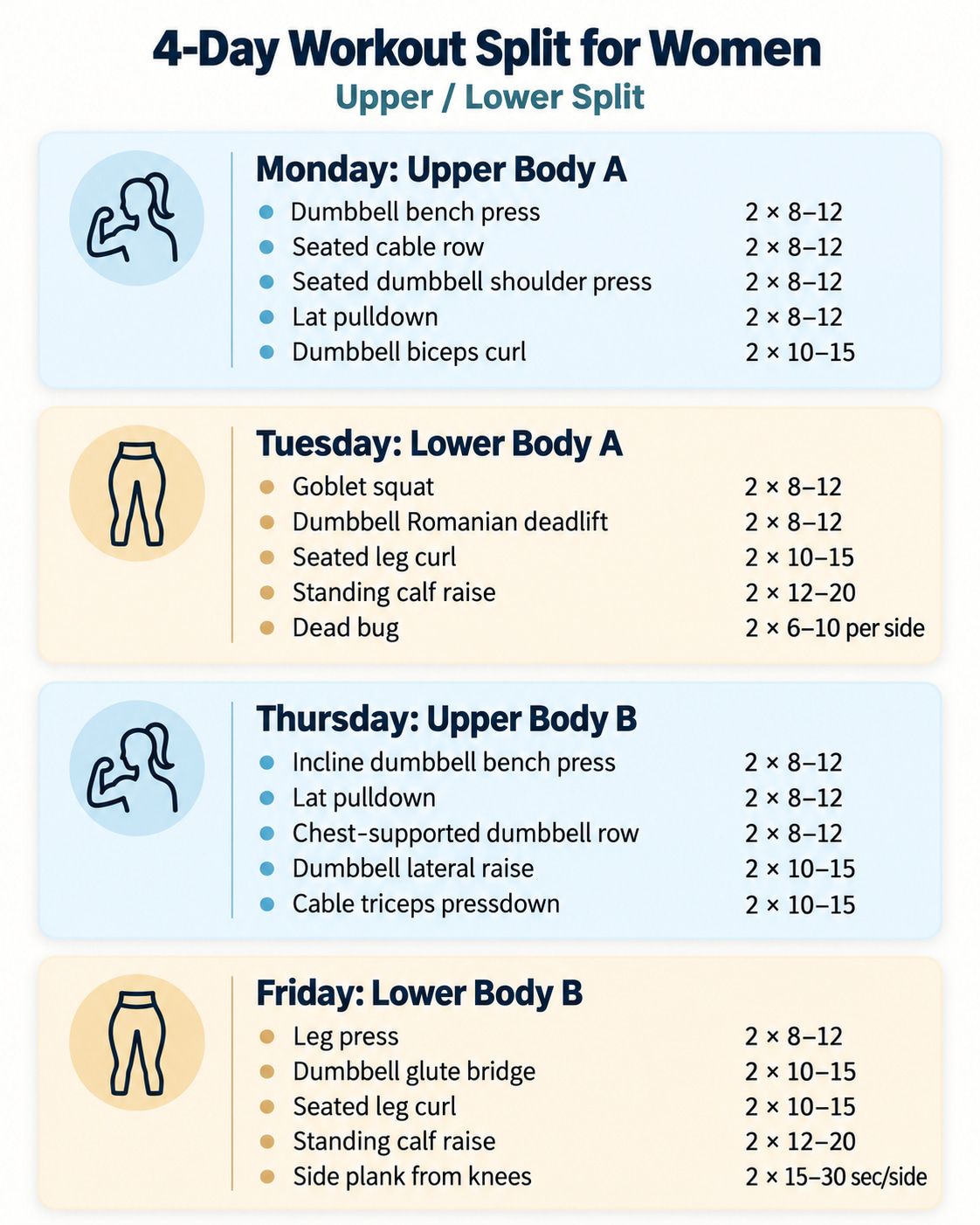
An upper/lower split separates training into two upper-body sessions and two lower-body sessions each week.
A 2022 randomized trial found no significant differences in strength or muscle-mass changes between two weekly full-body sessions and four weekly upper/lower sessions when exercises, weekly sets, and repetitions were matched. The 12-week study randomized 50 young women without regular resistance-training experience. It supports schedule flexibility—not a requirement to train four days.
Monday: Upper Body A
| Exercise | Working Sets × Repetitions |
|---|---|
| Dumbbell bench press | 2 × 8–12 |
| Seated cable row | 2 × 8–12 |
| Seated dumbbell shoulder press | 2 × 8–12 |
| Lat pulldown | 2 × 8–12 |
| Dumbbell biceps curl | 2 × 10–15 |
Tuesday: Lower Body A
| Exercise | Working Sets × Repetitions |
|---|---|
| Goblet squat | 2 × 8–12 |
| Dumbbell Romanian deadlift | 2 × 8–12 |
| Seated leg curl | 2 × 10–15 |
| Standing calf raise | 2 × 12–20 |
| Dead bug | 2 × 6–10 per side |
Thursday: Upper Body B
| Exercise | Working Sets × Repetitions |
|---|---|
| Incline dumbbell bench press | 2 × 8–12 |
| Lat pulldown | 2 × 8–12 |
| Chest-supported dumbbell row | 2 × 8–12 |
| Dumbbell lateral raise | 2 × 10–15 |
| Cable triceps pressdown | 2 × 10–15 |
Friday: Lower Body B
| Exercise | Working Sets × Repetitions |
|---|---|
| Leg press | 2 × 8–12 |
| Dumbbell glute bridge | 2 × 10–15 |
| Seated leg curl | 2 × 10–15 |
| Standing calf raise | 2 × 12–20 |
| Side plank from knees | 2 × 15–30 seconds per side |
Keep Wednesday and the weekend free from scheduled lifting. Avoid filling every open day with another demanding leg or upper-body workout; that would change the workload of this plan.
5-Day Workout Split for Women
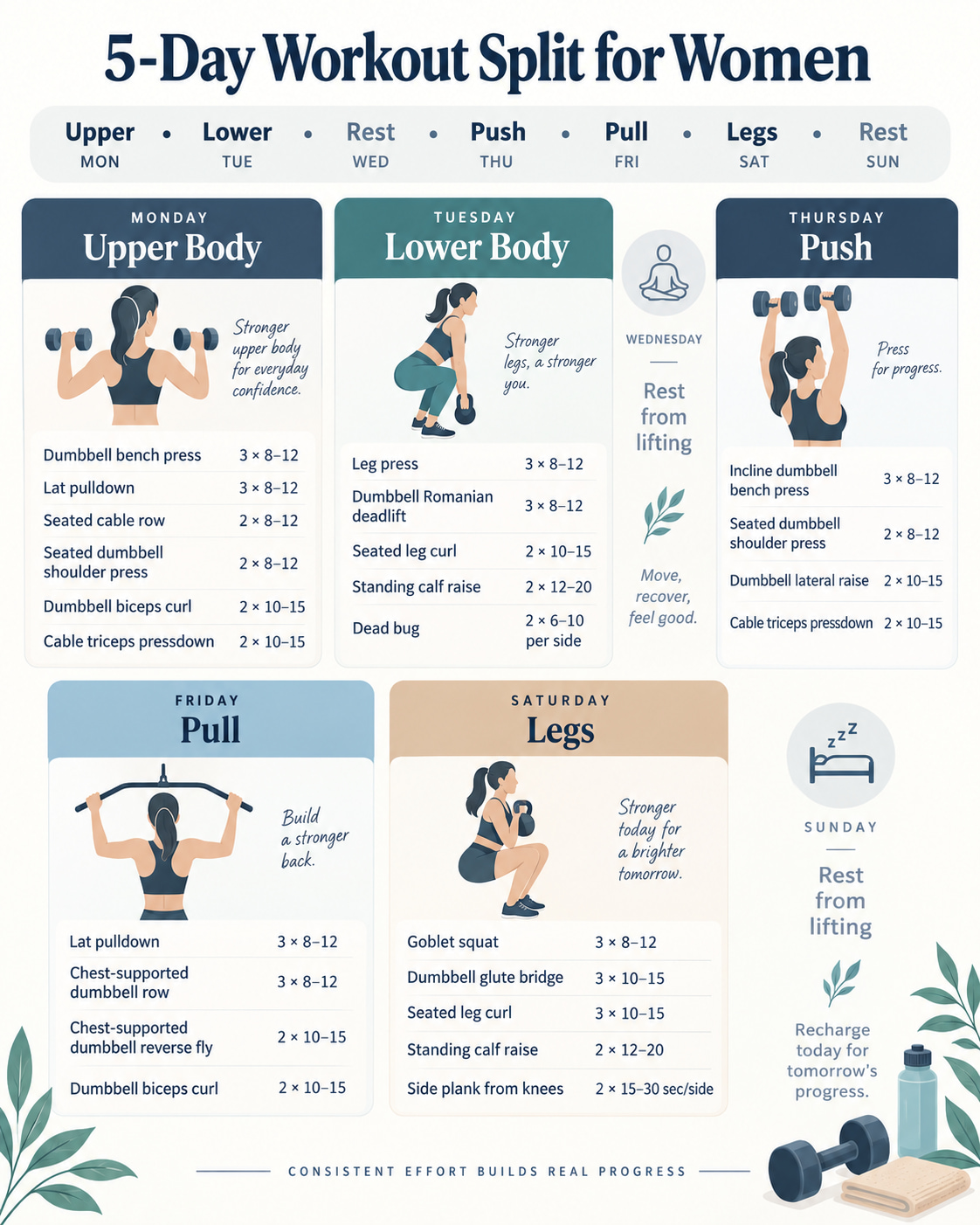
This schedule combines an upper/lower split with separate push, pull, and leg sessions.
Consider it when you are already comfortable with the exercises and can consistently manage five lifting days. It is a separate routine—not the four-day plan with an extra workout added.
Because it includes more working sets, reduce the listed amounts when necessary rather than forcing yourself to complete a workload you cannot recover from.
Monday: Upper Body
| Exercise | Working Sets × Repetitions |
|---|---|
| Dumbbell bench press | 3 × 8–12 |
| Lat pulldown | 3 × 8–12 |
| Seated cable row | 2 × 8–12 |
| Seated dumbbell shoulder press | 2 × 8–12 |
| Dumbbell biceps curl | 2 × 10–15 |
| Cable triceps pressdown | 2 × 10–15 |
Tuesday: Lower Body
| Exercise | Working Sets × Repetitions |
|---|---|
| Leg press | 3 × 8–12 |
| Dumbbell Romanian deadlift | 3 × 8–12 |
| Seated leg curl | 2 × 10–15 |
| Standing calf raise | 2 × 12–20 |
| Dead bug | 2 × 6–10 per side |
Thursday: Push
| Exercise | Working Sets × Repetitions |
|---|---|
| Incline dumbbell bench press | 3 × 8–12 |
| Seated dumbbell shoulder press | 2 × 8–12 |
| Dumbbell lateral raise | 2 × 10–15 |
| Cable triceps pressdown | 2 × 10–15 |
Friday: Pull
| Exercise | Working Sets × Repetitions |
|---|---|
| Lat pulldown | 3 × 8–12 |
| Chest-supported dumbbell row | 3 × 8–12 |
| Chest-supported dumbbell reverse fly | 2 × 10–15 |
| Dumbbell biceps curl | 2 × 10–15 |
Saturday: Legs
| Exercise | Working Sets × Repetitions |
|---|---|
| Goblet squat | 3 × 8–12 |
| Dumbbell glute bridge | 3 × 10–15 |
| Seated leg curl | 3 × 10–15 |
| Standing calf raise | 2 × 12–20 |
| Side plank from knees | 2 × 15–30 seconds per side |
Wednesday and Sunday remain nonlifting days. Keep the Friday workout focused on the listed upper-body exercises rather than adding heavy deadlifts before Saturday’s leg session.
How to Progress Your Workout Split
Progress does not have to mean adding another workout day. Start by tracking the exercises you already perform.
Add Repetitions Before Weight
One simple progression method is:
- Build within the range. Keep the same resistance while gradually adding repetitions.
- Increase the resistance slightly. Do this after reaching the top of the range on every set with controlled technique and the intended effort.
- Return toward the lower end. Build repetitions again with the new resistance.
For example, with 2 × 8–12 dumbbell rows, you might progress from 10 and nine repetitions to 12 and 12. After repeating that performance with good control, try the smallest available weight increase.
This is a practical way to apply progressive training; it is not a requirement to increase weight every week. The ACSM position stand recommends progressive resistance training while allowing the prescription to reflect individual needs.
Add Sets Only When Needed
The 2026 ACSM review found that higher weekly volumes—approximately 10 or more sets per muscle group—could enhance muscle growth. That is not a minimum required for any benefit or a reason for beginners to start with a demanding workload.
These plans start below that amount for some muscle groups. When muscle growth is a priority and the existing workload is manageable, consider adding one set to a relevant exercise rather than increasing every exercise at once.
Adjust When the Workload Stops Fitting
Do not keep adding work when your technique is deteriorating or you repeatedly struggle to complete your usual sessions.
As a practical adjustment, remove a set from selected exercises, reduce the resistance, or return to a schedule with fewer lifting days. Reassess rather than treating the original calendar as a rule you must follow regardless of how you feel.
How to Fit Cardio and Recovery Into Your Schedule
Strength training is one part of an overall activity routine. The CDC’s adult physical activity guidelines recommend at least 150 minutes of moderate-intensity aerobic activity or 75 minutes of vigorous activity weekly, or an equivalent combination, alongside muscle-strengthening activity on at least two days.
For example, five 30-minute brisk walks add up to 150 minutes. You can divide that activity into shorter sessions and build up gradually from your current activity level.
Do not automatically count every minute spent lifting or resting between sets as aerobic activity.
To organize your week, place walks or other manageable cardio sessions after lifting, during separate breaks, or on nonlifting days. Start with amounts that leave you able to complete your planned workouts rather than adding a demanding cardio program all at once.
When to Modify Your Plan or Seek Guidance
Get individualized guidance before using these schedules during pregnancy or postpartum recovery, or when an injury or medical condition affects your ability to exercise. A generic lifting plan may need changes to exercise selection, positions, resistance, and progression.
Stop an exercise that causes sharp or increasing pain. Seek professional assessment when pain keeps returning or limits normal movement. NHS exercise guidance advises stopping if you experience pain or become unwell.
Stop exercising and seek urgent medical help for chest pain, fainting, or severe unexplained shortness of breath. Call emergency services for possible heart-attack symptoms rather than trying to finish the workout.
Frequently Asked Questions
What Is the Best Workout Split for Beginners?
Among these options, start with the three-day full-body plan at a manageable workload. It provides clear practice sessions without requiring frequent gym visits. Two weekly strength sessions can also be a useful starting point; you do not need to jump immediately to three, four, or five days.
Is a 3-Day Workout Split Enough to Build Muscle?
Yes, three weekly sessions can support muscle growth when the training provides sufficient effort, appropriate workload, and progression. A five-day split is not automatically better simply because it includes more gym visits. Comparisons of full-body and split training have found similar results when volume was matched.
Which Workout Split Is Best for Weight Loss?
Choose a schedule you can maintain rather than expecting a particular split to produce weight loss. Weight change depends on overall energy balance and is also influenced by factors such as eating patterns, activity, sleep, medicines, and health conditions. More lifting days do not guarantee greater weight loss.
Can I Follow These Workout Splits at Home?
Yes, but the gym exercises may need substitutions. For example, use dumbbell rows instead of cable rows, goblet squats instead of leg presses, and dumbbell floor presses when a suitable bench is unavailable. Home-based resistance training, including bands and bodyweight exercises, can improve strength and muscle size.
What Should I Do If I Miss a Workout?
Resume the plan without squeezing two complete workouts into one session. You can shift the remaining sessions while preserving recovery time, or continue with the next scheduled workout. When you repeatedly miss the fourth or fifth day, choose a schedule with fewer required sessions.
Should I Change My Workout Split During My Period?
There is no established requirement to change your entire split according to menstrual-cycle phases. A May 2026 study reported only modest phase-related differences in resistance-training performance among 28 trained women, supporting consistent training rather than mandatory phase-based adjustments. The small study does not describe everyone’s experience. Adjust individual sessions for your symptoms instead of following a rigid calendar rule.
Conclusion
Choose your workout split for women around the week you can realistically maintain. Start with manageable resistance, record your repetitions, and progress without sacrificing technique or recovery.
Pick one schedule, put the first week on your calendar, and use your training log—not the number of gym visits—to guide your next step.
References
- Ramos-Campo and colleagues, 2024: Efficacy of Split Versus Full-Body Resistance Training on Strength and Muscle Growth.
- Pedersen and colleagues, 2022: Randomized trial of split-body versus full-body resistance training in women.
- American Heart Association: Strength and resistance training and warm-up guidance.
- National Academy of Sports Medicine: Dumbbell Romanian deadlift technique.
- American Council on Exercise: Modified side plank technique.
- Munteanu and colleagues, 2026: Menstrual-cycle phase, symptoms, and resistance-training performance.
- CDC: Heart-attack warning signs and emergency action.