
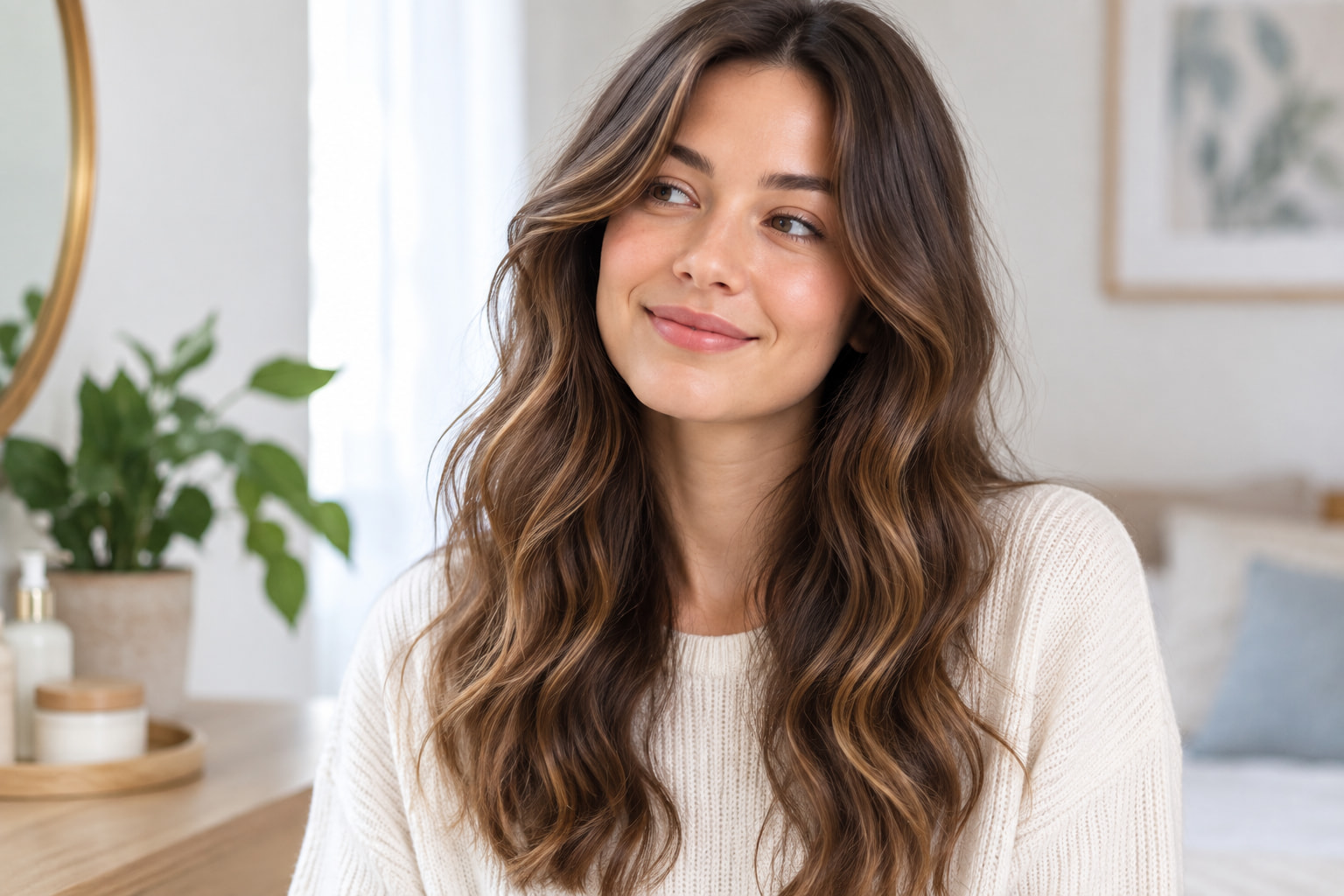
The 2A hair type has loose, gentle waves, often with relatively straight roots and soft bends through the lengths. It is the least-defined pattern in the commonly used type 2, or wavy, hair category.
Recognizing that pattern can help you choose how to style your hair. However, your scalp’s needs and how your strands respond matter more than following a strict “2A routine.”
Start with appropriate cleansing, conditioner, and gentle handling. Add styling products only when they serve a purpose, such as helping your waves hold their shape. You do not need to build a complicated routine before learning what works.
What Is 2A Hair Type?
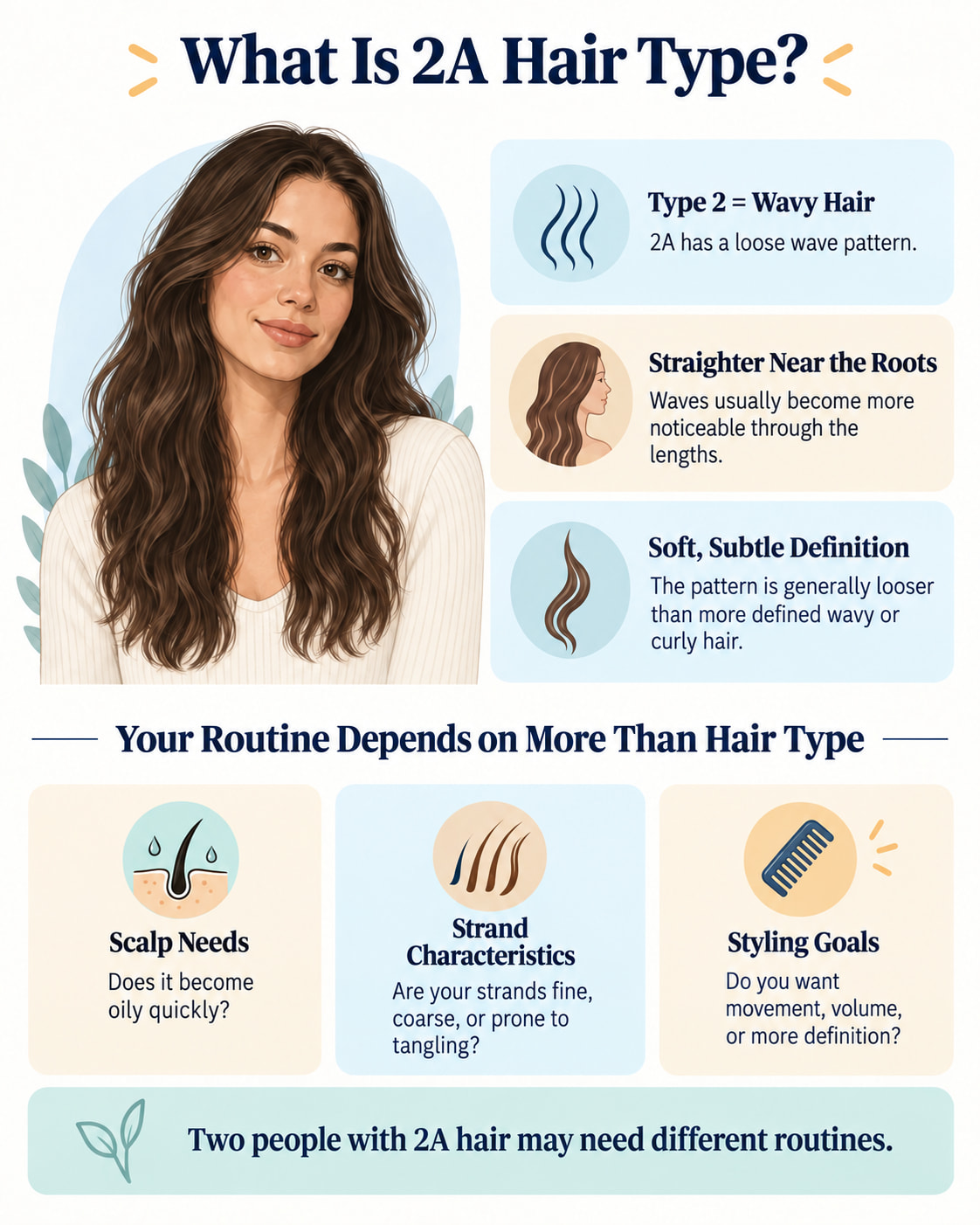
In common hair-typing guides, type 1 is straight, type 2 is wavy, and type 3 forms more distinct curls. Hair-care brand Curlsmith’s type 2 hair guide describes 2A as a loosely waved pattern with a straighter root area. These are styling descriptions, not a medical diagnosis.
Use the label as a starting point, then ask more practical questions:
- Does your scalp become oily quickly, or stay comfortable between washes?
- Are your individual strands fine or coarse, and do they tangle easily?
- Do you prefer soft movement, more volume, or longer-lasting definition?
Two people who describe their hair as 2A may answer those questions differently. There is no reason to give them identical routines.
How to Identify 2A Hair
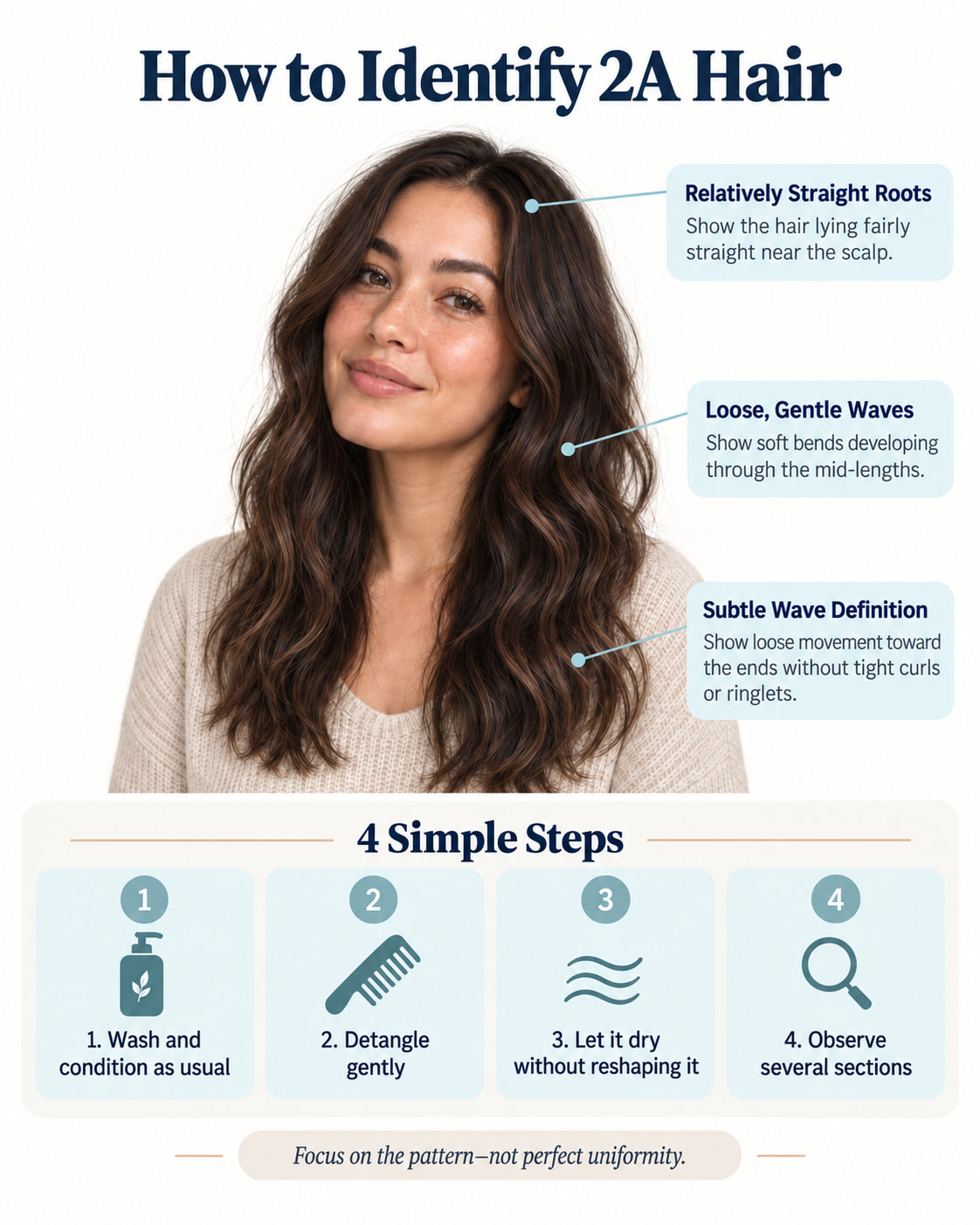
The most useful clue is a recurring loose wave, rather than oiliness, frizz, or how much volume you have. Relatively straight roots followed by gentle bends are consistent with common descriptions of 2A hair.
Observe Your Hair Without Reshaping It
Try this simple observation exercise on a normal wash day:
- Wash and condition as usual. Do not deliberately skip conditioner to make your hair look more textured.
- Detangle gently. Avoid repeatedly pulling your hair straight.
- Let it dry without creating a different pattern. Skip braids, rollers, straightening, and curling for this comparison.
- Look at several sections once dry. Compare the front, sides, and back rather than judging one strand.
This is a practical comparison, not a validated hair-type test. Take a photo and repeat the observation on another wash day before deciding which description is most useful.
Focus on the Pattern, Not a Perfect Photograph
Look for the general shape that returns with minimal styling. Do not make “perfectly smooth,” “completely frizz-free,” or “identical on both sides” part of your personal checklist.
You also do not need to settle a close 2A-versus-2B question before improving your routine. Start with the care needs you can clearly identify.
2A Hair vs. 2B and 2C Hair
The main distinction is how pronounced the wave becomes—not a fixed difference in washing frequency or product needs.
| Hair type | Typical appearance | Most useful distinction |
|---|---|---|
| 2A | Subtle, loose bends with a relatively straight root area | The gentlest wave pattern |
| 2B | More noticeable S-shaped waves through the lengths | Greater wave definition |
| 2C | Stronger, tighter S-shaped waves, often beginning nearer the roots | The most pronounced waves within type 2 |
These descriptions reflect common styling conventions. They are helpful comparisons, not exact boundaries that every section of hair must match.
How to Care for 2A Hair
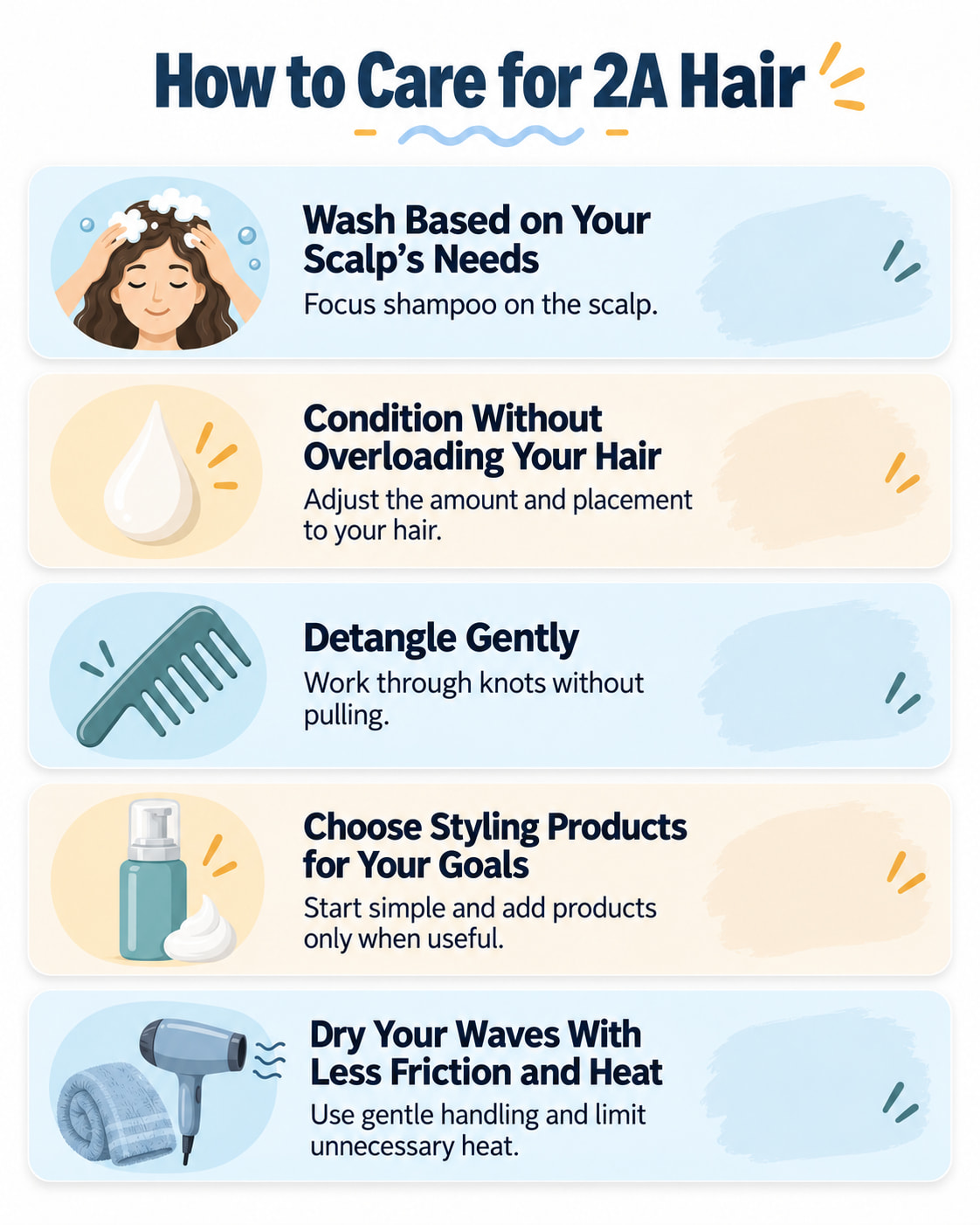
Build your routine around a comfortable scalp, manageable lengths, and the finish you prefer.
Wash Based on Your Scalp’s Needs
The American Academy of Dermatology’s healthy-hair guidance, updated August, 2024, recommends washing according to how quickly hair becomes oily or dirty. It also recommends concentrating shampoo on the scalp.
There is no universal “twice a week” rule for 2A hair. Adjust your interval to cleanliness and comfort instead of trying to reach a particular number of days.
Massage shampoo gently over the scalp and rinse thoroughly. Avoid vigorously rubbing the lengths together.
Condition Without Overloading Your Hair
Conditioner helps with moisture and detangling. The AAD recommends focusing it toward the ends for fine hair, while dry hair may benefit from application through more of the lengths.
For your first routine, try a rinse-out conditioner and assess the result before adding a leave-in, mask, and oil.
Ask whether the conditioner makes detangling easier and whether your hair still feels comfortable once dry. When something is not working, test one adjustment—such as placement or amount—rather than replacing every product at once.
Detangle Gently
Work through smaller sections, beginning near the ends and gradually moving upward. Do not force a comb through resistance.
The AAD’s curly-hair care guidance recommends conditioned detangling with fingers or a suitable comb and working in sections. That approach may be useful when your waves knot easily, but guidance written for tight curls should not become an inflexible rule for loose waves.
Wet hair also needs careful handling. Choose the timing and method that let you remove tangles with the least pulling, rather than assuming more brushing will improve the result.
Choose Styling Products for Your Goals
Styling is optional. Lightweight does not necessarily mean weak hold: a relatively light formula can still help preserve a loose wave. Curlsmith’s type 2 guidance makes this distinction when discussing wave definition.
Consider one mousse, foam, or lightweight gel as a starting experiment. Follow its directions and judge the finished result before adding another layer.
To try scrunching, gather a section of wet or damp hair into your palm and gently lift it toward your head. This is a styling technique for encouraging the existing wave—not a requirement for healthy hair.
Avoid dragging a brush or comb through hair stiffened by strong-hold products. The AAD warns that combing after applying long-lasting hold products can contribute to breakage.
Dry Your Waves With Less Friction and Heat
Gently absorb excess water rather than rubbing your hair vigorously. The AAD’s damage-prevention advice recommends gentle towel handling, air-drying when practical, and lower heat settings when using a dryer.
A 2011 laboratory study of hair drying found more surface damage at higher temperatures. However, it tested hair tresses under controlled conditions—not people following different 2A routines. It does not establish one universally best drying method for loose waves.
Choose air-drying or careful low-heat drying according to your routine. When using heat, follow the tool’s instructions and use a suitable heat-protectant product; excessive heat can damage any hair type.
Refresh Gently Between Washes
For a styling refresh, try lightly dampening flattened sections and gently scrunching. Begin without adding more product, then assess whether a small amount is useful. Water misting and minimal-product refreshing are common wavy-hair styling suggestions.
Treat refreshing as optional. You do not need to restore every bend each morning or keep adding products until your hair matches a particular photograph.
A Simple Wash-Day Routine for 2A Hair
Use this as an adjustable starting point rather than a mandatory formula:
| Stage | What to try |
|---|---|
| Cleanse | Shampoo the scalp and rinse thoroughly. |
| Condition and detangle | Apply conditioner where needed and gently remove knots. |
| Style, optionally | Use one styler according to its directions. |
| Dry | Handle gently and limit unnecessary heat. |
| Assess | Note scalp comfort, ease of detangling, and whether you like the finish. |
The care steps follow dermatology guidance; the optional styling step is a personal preference.
For example, suppose your hair feels manageable after conditioning, but you dislike how it looks after several styling layers. On the next wash day, keep your cleanser and conditioner unchanged and test just one styler.
That comparison gives you more useful information than buying an entirely new routine.
Common 2A Hair Mistakes to Avoid
Changing Everything at Once
When you change shampoo, conditioner, styling technique, and drying method together, it becomes difficult to know which change helped.
Choose one goal first. That might be easier detangling, a lighter finish, or less time spent styling. Keep a brief note after each experiment.
Copying a Routine Designed for Very Different Hair
Advice for thick, tightly curled hair may include richer conditioning and longer washing intervals. The AAD specifically addresses those characteristics in its curly-hair guidance. Do not assume the same schedule suits your loose waves or scalp.
Borrow techniques selectively rather than treating someone else’s routine as a complete prescription.
Using More Force or Heat to Chase Definition
Repeated tugging, excessive brushing, and frequent high-heat styling can damage hair. More manipulation is not automatically better styling.
Make comfort and manageable hair your priorities. A routine that takes considerable effort but leaves your hair difficult to handle deserves simplifying.
Treating Scalp Symptoms as a Styling Problem
Persistent itching, rash, or burning should not be explained away as “just having wavy hair.” Hair-care products can also cause irritation or allergic reactions.
Do not respond to continuing discomfort by repeatedly adding oils, exfoliants, or new styling products without understanding the cause.
When to See a Dermatologist
Seek professional assessment for ongoing scalp itching, burning, rash, or troublesome flaking. Stop using a product that appears to trigger a reaction, and get help when the cause is unclear.
A dermatologist can also assess noticeable thinning, patchy loss, or persistent hair problems that do not improve with gentler care. The AAD advises seeking assessment when routine changes are not helping, especially when hair loss is a concern.
Frequently Asked Questions
Is 2A Hair Straight or Wavy?
It is classified as wavy in common hair-typing guides. The bends may be subtle, especially near relatively straight roots, but 2A describes a loose wave rather than a consistently straight pattern.
How Often Should You Wash 2A Hair?
Wash when your scalp and hair need cleaning. The AAD recommends using oiliness and dirt accumulation—not a hair-type label alone—to guide frequency.
Does 2A Hair Need Leave-In Conditioner?
Do not add one solely because your hair is labeled 2A. First assess your rinse-out conditioner. A leave-in may be worth considering when dryness or difficult detangling remains a concern; additional conditioning is commonly recommended for dry, textured hair.
Is Mousse or Gel Better for 2A Hair?
There is no automatic winner. Both appear in wavy-hair styling guidance. Compare the specific formula, amount, and hold rather than assuming every mousse is light or every gel is heavy.
Should You Brush 2A Hair When It Is Dry?
There is no single rule for every loose-wave routine. Consider whether brushing removes tangles comfortably or requires pulling. Minimize unnecessary brushing, and avoid combing through hair stiffened by hold products.
What Should You Change First When Your Routine Is Not Working?
Start with the problem you can describe most clearly. For an unwanted finish, test product amount or remove one optional layer. For difficult detangling, review conditioning and handling. For persistent scalp symptoms, seek assessment rather than continuing styling experiments.
Conclusion
Caring for the 2A hair type does not require perfect classification or a shelf full of products. Use the label to describe your waves, then make decisions based on your scalp, manageability, and preferred style.
On your next wash day, keep the routine simple and change only one thing you want to improve. Judge success by whether your hair is easier to care for—not whether every wave looks identical.
This content is for informational purposes only and not medical advice.
References
- American Academy of Dermatology. Tips for healthy hair.
- American Academy of Dermatology. 10 hair care habits that can damage your hair.
- American Academy of Dermatology. 6 curly hair care tips from dermatologists.
- American Academy of Dermatology. Hair styling without damage.
- American Academy of Dermatology. 10 reasons your scalp itches and how to get relief.
- Lee Y, et al. Hair Shaft Damage from Heat and Drying Time of Hair Dryer. Annals of Dermatology. 2011;23(4):455–462.
- Curlsmith. Type 2 Hair: How to Identify and Care for Waves. Commercial educational resource used for styling terminology.
- Curlsmith. The Ultimate Guide to Wavy Hair. Commercial educational resource used for optional styling suggestions.