
Ashwagandha tea may help some people feel calmer or sleep a little better, but the best human evidence is for standardized ashwagandha extracts, not brewed tea itself. That distinction matters because tea is not the form used in most clinical trials, and herbal products can vary a lot by ingredient, strength, and safety profile. The most useful way to think about ashwagandha tea is as a lower-certainty herbal option that may support relaxation for some adults, but it is not risk-free and it is not right for everyone. According to the NIH Office of Dietary Supplements fact sheet on ashwagandha, the evidence-backed uses are narrower than many product claims suggest.
What Is Ashwagandha Tea?
Ashwagandha comes from Withania somnifera, an evergreen shrub used for centuries in Ayurvedic medicine. Ashwagandha products are sold in many forms, and herbal medicines in general may be sold as powders, extracts, capsules, dried plants, and teas. In practice, ashwagandha tea is usually a hot-water preparation made from the herb itself or from a tea blend that includes ashwagandha. The key point is that a tea is still an herbal product, not a standardized prescription-style dose.
Ashwagandha Tea Benefits: What the Evidence Really Suggests
Ashwagandha tea may support stress relief, but the research is indirect
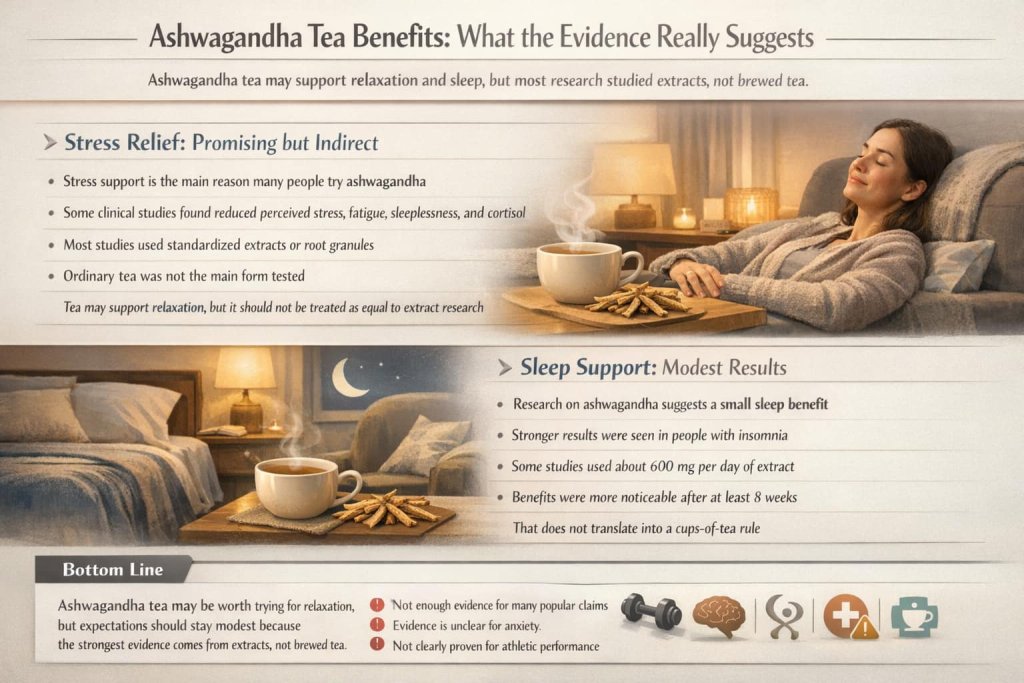
The strongest research-backed reason people try ashwagandha tea is stress support. According to the NIH Office of Dietary Supplements fact sheet, several clinical trials found that some ashwagandha preparations reduced perceived stress, fatigue, sleeplessness, and cortisol compared with placebo.
However, those studies mainly used specific extracts or root granules, not ordinary cups of tea. So it is fair to say that ashwagandha tea may support relaxation, but it is not accurate to claim that one cup of tea gives the same effect shown in extract studies.
Ashwagandha tea may help with sleep, but results are modest
The evidence for sleep is similar. The NIH fact sheet reports that ashwagandha extract had a small but significant effect on sleep in clinical studies, with stronger results in people with insomnia, at doses around 600 mg per day, and when used for at least 8 weeks.
That is useful context for readers, but it should not be turned into a “cups per day” rule for tea because the studies were not designed that way. A realistic takeaway is that ashwagandha tea may be worth trying for evening relaxation, but expectations should stay modest.
What ashwagandha tea is not clearly proven to do
This is where a lot of articles overpromise. The National Center for Complementary and Integrative Health overview of ashwagandha says there is not enough evidence to determine whether ashwagandha is helpful for many other promoted uses, including asthma, athletic performance, cognitive function, diabetes, menopause, and female infertility.
Evidence is also unclear on anxiety specifically, even though stress-related findings are more encouraging. That means a careful article on ashwagandha tea should avoid broad claims about hormone balance, weight loss, brain power, or disease treatment.
Ashwagandha Tea vs. Extracts: Why This Difference Matters
One of the most important things to understand about ashwagandha tea is that the research usually does not test tea. In the stress studies reviewed by NIH, doses ranged from 240 to 1,250 mg per day of extract or 12,000 mg per day of whole-root granules, equal to 6,000 mg of root powder. In several studies, benefits looked stronger around 500 to 600 mg per day of extract. For sleep, the studied range was generally 250 to 600 mg per day of extract.
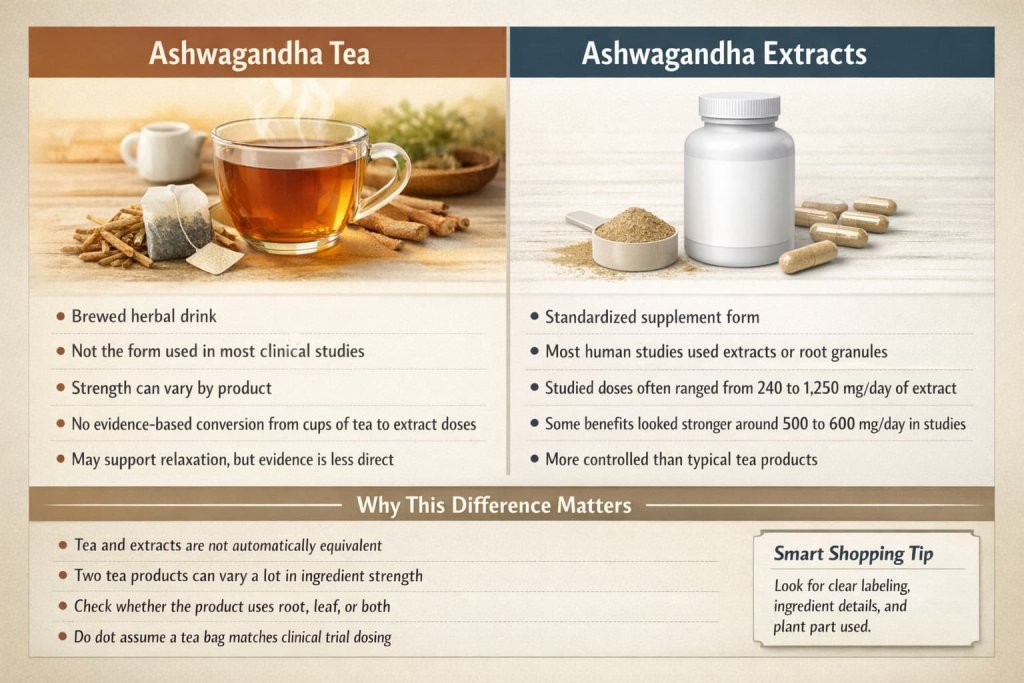
That does not mean tea is useless. It means there is no evidence-based conversion from extract doses to cups of tea. It also means two ashwagandha teas can be very different from each other. The FDA’s questions and answers on dietary supplements explains that dietary supplements are not approved before marketing, and serving sizes are not standardized by law in the way many people assume. Manufacturers are responsible for safety and labeling, but FDA does not pre-approve these products before sale. For readers, the practical bottom line is simple: do not assume a tea bag, powder, or adaptogen blend matches the amounts used in clinical trials.
Another practical detail is the plant part used. The NIH Office of Dietary Supplements notes that the chemical composition of ashwagandha root and leaf differs, and that while most commercial supplements use root extracts, some products use root and leaf together. The NCCIH overview also notes that supplements may contain root, leaf, or root/leaf extracts. That means it is smart to check the label carefully before buying ashwagandha tea or a tea blend. FDA’s Supplement Facts labeling guide says the plant part used in a dietary supplement should be identified in the Supplement Facts panel, which can help you see whether a product is based on root, leaf, or both.
Ashwagandha Tea Side Effects and Safety
For many adults, short-term use appears reasonably well tolerated, but “natural” does not mean harmless. NIH and NCCIH both note that ashwagandha seems to be tolerated in the short term, roughly up to 3 months, while long-term safety is still not well established. Common side effects include drowsiness, stomach upset, diarrhea, vomiting, nausea, and loose stools.
Rare but important: liver injury
A high-quality article on ashwagandha tea should clearly mention the liver warning. The NIH’s LiverTox monograph on ashwagandha states that clinically apparent liver injury has been reported in people taking products labeled as containing ashwagandha. Reported cases have typically appeared within 2 to 12 weeks of starting use, often with jaundice and itching, and most cases have been mild to moderate and self-limited after stopping the product. However, rare cases of fatal liver injury and liver transplantation have also been reported, especially in people with preexisting liver disease or cirrhosis.
Who Should Avoid Ashwagandha Tea?
Ashwagandha tea is not a good fit for everyone. NCCIH says ashwagandha should be avoided during pregnancy and should not be used while breastfeeding. It is also not recommended for people who are about to have surgery or for those with autoimmune disorders or thyroid disorders. The NIH fact sheet also notes concerns about liver effects and mentions that some experts advise against use in men with hormone-sensitive prostate cancer.
Who should be extra careful
You should be especially cautious with ashwagandha tea if you:
- are pregnant or breastfeeding
- have liver disease, cirrhosis, or a history of abnormal liver tests
- have a thyroid condition
- have an autoimmune condition
- are preparing for surgery
- are being treated for hormone-sensitive prostate cancer
That list is more important than most benefits sections because it helps readers decide whether ashwagandha tea is appropriate before they start using it.
Ashwagandha Tea Interactions With Medications
Medication interactions are another reason to be careful. NCCIH says ashwagandha may interact with medicines for diabetes and high blood pressure, immunosuppressants, sedatives, anticonvulsants, and thyroid hormone medications. NCCIH also notes separate preliminary evidence that ashwagandha may increase the effects of some benzodiazepines and other sedatives or anti-anxiety drugs.
This matters for tea as well as capsules. Even if tea may be less concentrated than some extracts, it still contains active plant compounds. If you take prescription medications, the safest move is to check with your clinician or pharmacist before adding ashwagandha tea to your routine.
Can Ashwagandha Tea Affect Thyroid Function?
Possibly, yes. The NIH fact sheet reports that some research suggests ashwagandha might affect thyroid function. In one study, adults taking 500 mg per day of a standardized extract had small increases in T4, and case reports have described thyrotoxicosis that improved after the supplement was stopped. That does not prove that every tea product will have the same effect, but it is a strong enough signal that people with thyroid disease should not treat ashwagandha tea as a casual wellness drink.
How to Use Ashwagandha Tea More Safely
There is no official, evidence-based best dose for ashwagandha tea. That is because the human studies were mostly done with extracts, and FDA does not standardize serving sizes for supplements before they reach the market. A safer approach is to follow the product label, avoid assuming that more is better, and be extra careful with multi-ingredient blends that make aggressive wellness claims.
It also helps to choose products with a clear ingredient list and manufacturer information. FDA advises consumers to read supplement labels carefully and talk with a health care professional before using a dietary supplement. That advice is especially relevant if you are buying ashwagandha tea online, where blends and labeling can vary widely.
It is also wise to be skeptical of products that make disease-style promises. The FDA explains that a product sold as a dietary supplement is not allowed to be marketed as treating, preventing, or curing a specific disease. So if an ashwagandha tea or powder is advertised with drug-like promises, that is a useful warning sign that the marketing may be misleading.
Safety Box
Ashwagandha tea may not be appropriate if you are pregnant, breastfeeding, taking sedatives, using thyroid medication, managing liver disease, or living with an autoimmune condition. Stop using it and get medical advice promptly if you develop symptoms that could suggest liver trouble, such as yellowing of the skin or eyes, dark urine, pale stools, unusual itching, nausea, fatigue, or abdominal pain.
The NIH’s LiverTox monograph notes that most reported cases improve after the product is stopped, and the same product should not be tried again after a suspected liver reaction. General NIH resources on jaundice and liver function tests also list dark urine, pale stools, itching, and jaundice as warning signs of liver problems.
FAQ About Ashwagandha Tea
Is ashwagandha tea good for sleep?
It may help some people unwind, and ashwagandha extracts have shown a small but significant benefit for sleep in clinical research. But the evidence is stronger for standardized extracts than for brewed tea, so results from tea are less certain.
Can you drink ashwagandha tea every day?
Some studies suggest short-term ashwagandha use can be well tolerated for up to about 3 months, but long-term safety is still not clear. Daily use should be approached cautiously, especially if you have any medical condition or take medications.
Who should not drink ashwagandha tea?
People who are pregnant, breastfeeding, about to have surgery, or living with autoimmune or thyroid disorders should avoid it unless a qualified clinician specifically advises otherwise. People with liver disease should be especially cautious because rare liver injury has been reported with ashwagandha products.
Is ashwagandha tea the same as ashwagandha extract?
No. Most research uses standardized extracts or root granules, not ordinary tea. That is why you should not assume a tea bag provides the same strength, dose, or effect seen in clinical trials.
Final Thoughts on Ashwagandha Tea
Ashwagandha tea can be a reasonable option for adults who want a calming herbal drink and who do not have major safety concerns or medication conflicts. But the best way to use it is with realistic expectations: it may help with relaxation or sleep, yet the strongest evidence comes from extracts, not tea. Before making it a daily habit, check the label, review your medications, and be honest about whether it is a smart fit for your health situation. That careful approach is far more useful than chasing exaggerated claims.
This content is for informational purposes only and not medical advice.
References
- National Institutes of Health, Office of Dietary Supplements — Ashwagandha: Health Professional Fact Sheet
- National Center for Complementary and Integrative Health — Ashwagandha
- U.S. Food and Drug Administration — Questions and Answers on Dietary Supplements
- U.S. Food and Drug Administration — Dietary Supplement Labeling Guide: Chapter IV. Nutrition Labeling
- National Library of Medicine, LiverTox — Ashwagandha
- NIH News in Health — Recognizing Jaundice
- MedlinePlus — Liver Function Tests