
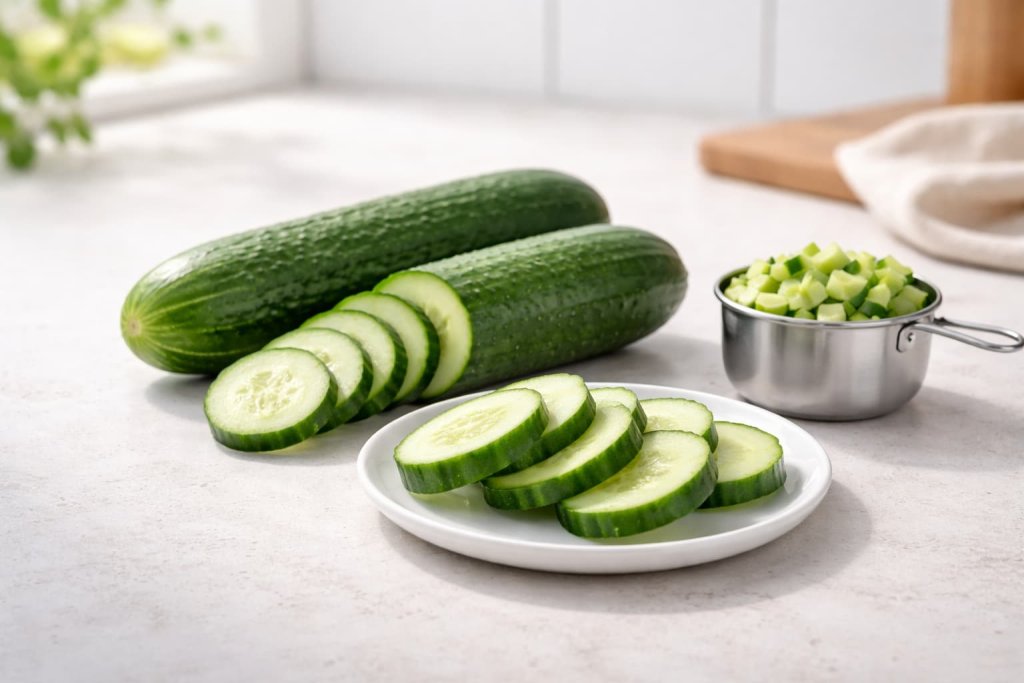
A cucumber is very low in calories. A common official reference point is 10 calories for 1/3 of a medium cucumber, and a whole large cucumber is about 45 calories. That makes cucumbers one of the easiest vegetables to add when you want more volume, crunch, and hydration without adding many calories. According to the FDA, 1/3 of a medium cucumber (99 g) has 10 calories, and the USDA SNAP-Ed listing for 1 whole cucumber (301 g) shows 45 calories.
How Many Calories Are in a Cucumber?
The short answer is that most cucumbers have about 10 to 45 calories, depending on size and how much you eat. A smaller portion stays close to 10 calories, while a full large cucumber is closer to 45 calories. That is why calorie counts can look different across nutrition charts without actually conflicting.
Cucumber calories by serving size
| Serving size | Calories |
|---|---|
| 1/3 medium cucumber (99 g) | 10 |
| 1 whole cucumber, about 8 1/4 inches (301 g) | 45 |
| 1/2 of that whole cucumber | about 22 to 23 |
The first two numbers come from the FDA and USDA SNAP-Ed. The half-cucumber estimate is a simple calculation based on the USDA whole-cucumber serving.
Nutrition Profile of a Cucumber
A cucumber is very low in calories and mostly water. According to the FDA, 1/3 of a medium cucumber (99 g) provides 10 calories, 2 g of carbohydrates, 1 g of fiber, 1 g of sugar, 1 g of protein, 0 g of fat, 0 mg of sodium, 140 mg of potassium, and 4% of the daily value for vitamin C. That makes cucumber a light, hydrating food that adds crunch and volume without adding many calories.
Nutrition Profile table
| Nutrient | 1/3 medium cucumber (99 g) |
|---|---|
| Calories | 10 |
| Carbohydrates | 2 g |
| Fiber | 1 g |
| Total sugars | 1 g |
| Protein | 1 g |
| Total fat | 0 g |
| Sodium | 0 mg |
| Potassium | 140 mg |
| Vitamin C | 4% DV |
These values come from the FDA raw vegetable chart and the USDA SNAP-Ed cucumber nutrition page.
Why Cucumber Calories Can Vary
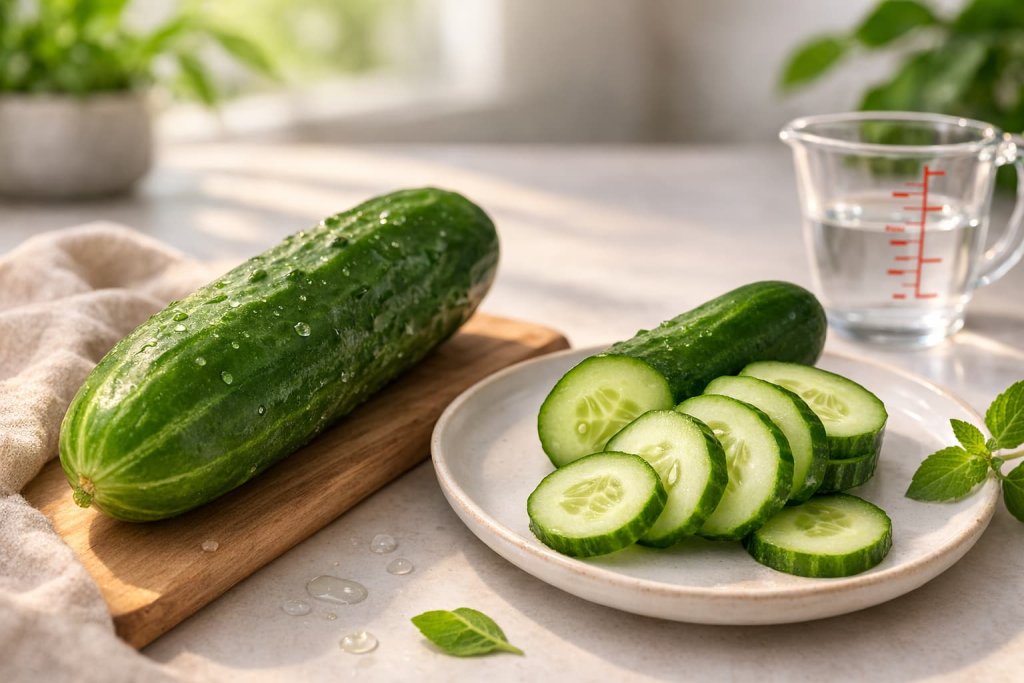
The calorie count changes mostly because cucumbers vary a lot in size. A few slices in a salad may add only a handful of calories, while a full large cucumber naturally contains more because you are eating more total weight. That is why one source may show 10 calories and another may show 45 calories, and both can still be correct.
Another reason for variation is preparation. Plain raw cucumber stays very low in calories, but calories rise when you add dressings, dips, oils, or creamy salad ingredients. The cucumber itself usually is not the part driving the calorie total.
Is Cucumber Good for Weight Loss?
Yes, cucumber can fit very well into a weight-loss eating pattern because it gives you a lot of food volume for very few calories. A whole cucumber at about 45 calories is still a light snack or side, which makes it useful for salads, snack plates, and sandwiches.
That does not mean cucumbers alone cause weight loss. What they can do is help you build lower-calorie meals that still feel fresh and filling. For example, replacing part of a higher-calorie side dish with sliced cucumber can cut calories while adding crunch.
Best Ways to Eat Cucumber Without Adding Many Calories
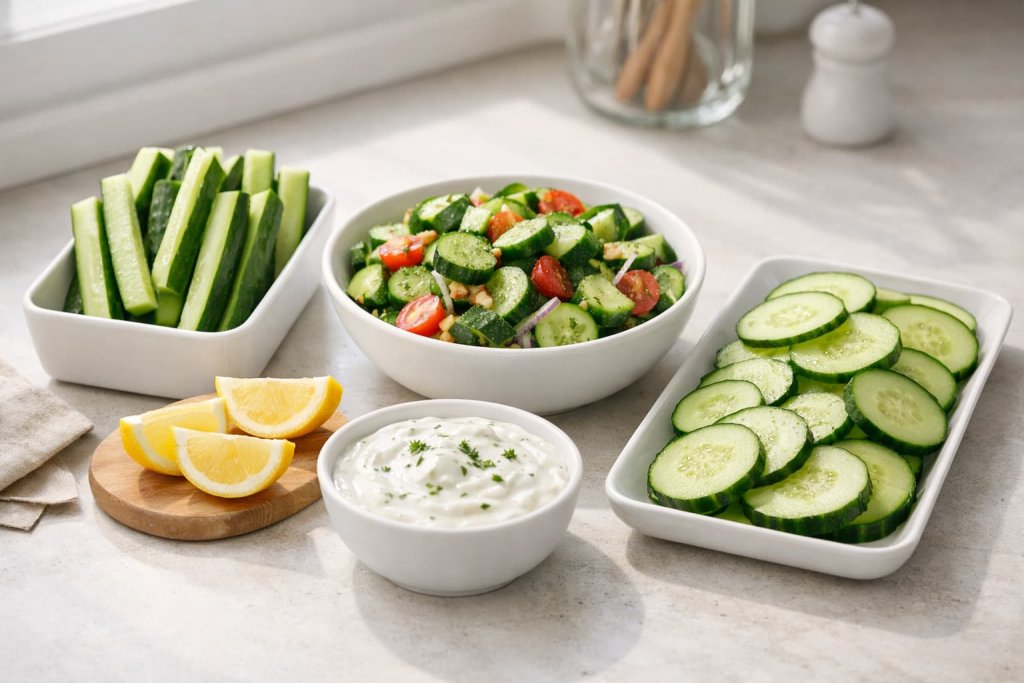
If your goal is to keep cucumber calories low, the simplest options are the best:
- sliced cucumber with lemon juice
- cucumber in a salad with light dressing
- cucumber sticks with a measured portion of dip
- cucumber added to sandwiches or wraps
- cucumber with yogurt-based sauces instead of heavy creamy dressings
The key point is that raw cucumber starts very low in calories, so the extras matter more than the vegetable itself.
Cucumber Calories Compared With Common Portions
A few cucumber slices on a sandwich usually contribute very little. A medium side serving of cucumber in a salad is still likely to stay low in calories, and even eating a full large cucumber only brings you to around 45 calories based on the USDA serving. That is why cucumbers are often used in lighter meals and snack ideas.
FAQs
1. How many calories in a cucumber with peel?
Standard raw cucumber nutrition references commonly count cucumber in its usual edible raw form, and the official values above show it is still very low in calories at about 10 calories for 99 g and 45 calories for a whole 301 g cucumber.
2. Is cucumber low carb?
Yes. A 99 g serving has 2 g of carbs according to the FDA, so cucumber is generally considered a low-carb vegetable.
3. Is cucumber keto-friendly?
For many people, cucumber can fit into a keto-style meal plan because its carbohydrate content is low relative to many other foods. Portion size still matters, especially if you are tracking carbs closely.
4. Does cucumber have protein?
Yes, but only a small amount. The FDA lists 1 g of protein in a 99 g serving, and USDA SNAP-Ed lists 2 g in a whole large cucumber.
5. Is cucumber a good snack?
Yes. Raw cucumber works well as a snack because it is crisp, refreshing, and very low in calories. A whole large cucumber is only about 45 calories before dips or dressings are added.
6. Why do different websites list different cucumber calories?
Most differences come from different serving sizes and cucumber sizes. One source may show a partial cucumber serving, while another shows a full large cucumber.
7. How many calories are in one whole cucumber?
A whole cucumber that is about 8 1/4 inches long and weighs 301 g has 45 calories, according to USDA SNAP-Ed.
8. How many calories are in half a cucumber?
If you use the USDA whole-cucumber value of 45 calories, half a cucumber is about 22 to 23 calories. That is an estimate based on half the listed serving.
9. How many carbs are in a cucumber?
According to the FDA, 1/3 of a medium cucumber has 2 g of carbohydrates. USDA SNAP-Ed lists 11 g of carbohydrates for one whole 301 g cucumber.
10. Does cucumber have fiber?
Yes. The FDA lists 1 g of fiber in 1/3 of a medium cucumber, and USDA SNAP-Ed lists 2 g of fiber in one whole cucumber.
Final Takeaway
If you are wondering how many calories in a cucumber, the practical answer is simple: not many. A 99 g portion has about 10 calories, and a whole large cucumber has about 45 calories. That makes cucumbers an easy choice for salads, snacks, and lighter meals when you want to eat more volume without adding many calories. For the most accurate estimate, match the calorie count to the portion size you are actually eating.