
Krill oil vs fish oil comes down to dose, evidence, safety, and value: fish oil is usually the more practical choice for getting more EPA and DHA, while krill oil may be useful for people who prefer a smaller-dose phospholipid omega-3 supplement. Both provide the long-chain omega-3 fats EPA and DHA, but they are not equal in research depth, capsule strength, cost, allergy concerns, or label clarity.
If you rarely eat fatty fish, either supplement may help you fill an omega-3 gap. But neither one should be treated as a cure-all for heart health, inflammation, cholesterol, joint pain, or brain function. The best choice depends on how much EPA and DHA you actually get, how well you tolerate it, and whether your healthcare provider recommends it for your situation.
Krill Oil vs Fish Oil: Quick Comparison
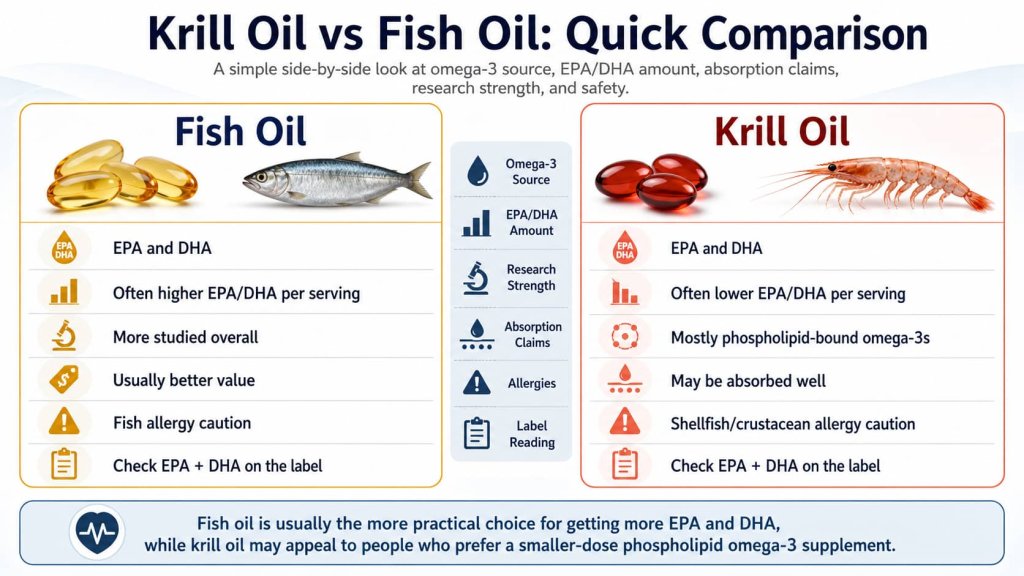
| Feature | Fish Oil | Krill Oil |
|---|---|---|
| Main omega-3s | EPA and DHA | EPA and DHA |
| Source | Fatty fish such as anchovy, sardine, mackerel, salmon, or tuna | Tiny crustaceans called krill |
| Omega-3 form | Often triglyceride, ethyl ester, or re-esterified triglyceride | Mostly phospholipid-bound omega-3s |
| Research strength | More studied overall | Less studied than fish oil |
| EPA/DHA per capsule | Often higher, but varies widely | Often lower, but varies widely |
| Absorption | Effective, but depends on form and product | May be absorbed well, but not clearly superior in outcomes |
| Best for | Higher EPA/DHA intake, value, and broader research support | Smaller-dose option, phospholipid form, people who tolerate it well |
| Allergy caution | Fish allergy caution | Shellfish/crustacean allergy caution |
| Main buying tip | Check EPA + DHA, not just “fish oil” milligrams | Check EPA + DHA, not just “krill oil” milligrams |
What Is Fish Oil?
Fish oil is oil extracted from fatty fish. It contains the omega-3 fatty acids EPA and DHA, which are important for cell membranes, heart health, brain function, and normal inflammatory processes.
The NIH Office of Dietary Supplements explains that many fish oil supplements contain EPA and DHA, but the exact amount varies widely. A common label may say “1,000 mg fish oil,” but that does not mean you are getting 1,000 mg of EPA and DHA.
That distinction matters. For omega-3 benefits, the key number is usually the combined EPA + DHA amount.
What Is Krill Oil?
Krill oil comes from krill, tiny shrimp-like crustaceans that live in the ocean. Like fish oil, krill oil provides EPA and DHA. The main difference is that much of krill oil’s omega-3 content is bound to phospholipids.
Krill oil also naturally contains astaxanthin, a reddish antioxidant compound. That sounds impressive, but it does not automatically make krill oil better than fish oil. The strongest practical question is still: How much EPA and DHA does the product provide per serving?
The Main Difference Between Krill Oil and Fish Oil
The biggest difference is the form and amount of omega-3s.
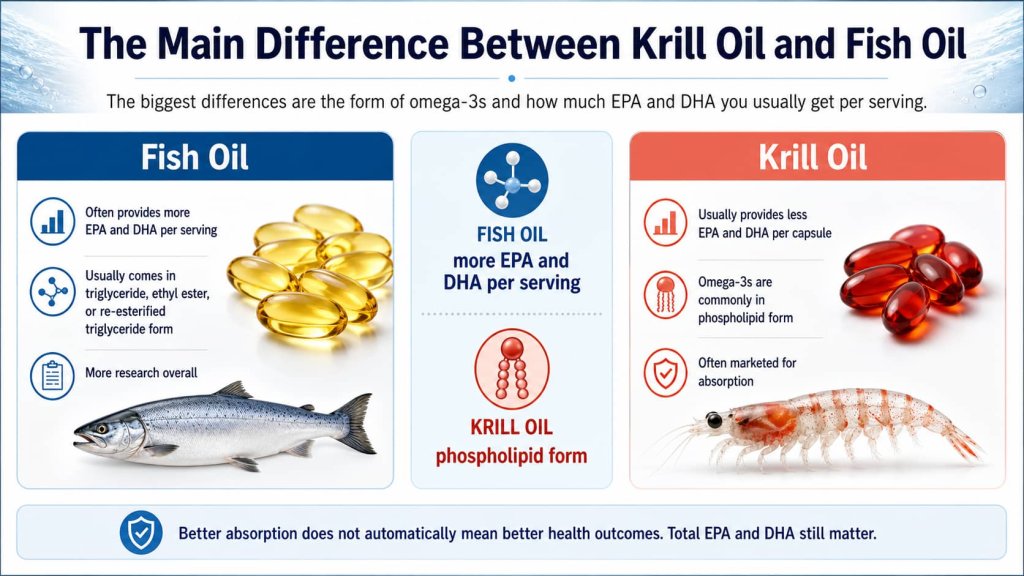
Fish oil often provides more EPA and DHA per serving. Krill oil usually provides less EPA and DHA per capsule, but its omega-3s are commonly in phospholipid form.
Some research suggests phospholipid-bound omega-3s may be absorbed efficiently. However, absorption is not the same as better health outcomes. A supplement can absorb well and still not prove superior for triglycerides, cholesterol, heart events, or long-term health.
Is Krill Oil Better Absorbed Than Fish Oil?
Krill oil may be absorbed well, but the “better absorption” claim needs context.
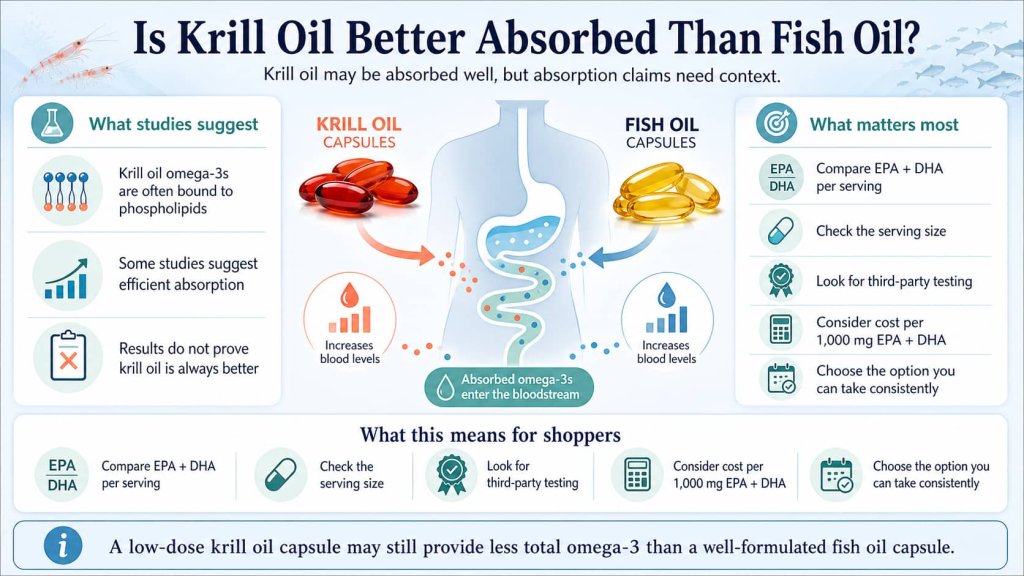
Some studies suggest krill oil can raise omega-3 levels efficiently because its EPA and DHA are often bound to phospholipids. A human bioavailability study published in Lipids in Health and Disease compared krill oil, krill meal, and fish oil and found differences in how fatty acids appeared in blood fractions after intake, but results did not prove krill oil is always better for every person or product.
A later review comparing omega-3 forms found that bioavailability can vary by supplement type, dose, and formulation. In real life, the total EPA and DHA dose still matters a lot.
What this means for shoppers
Do not choose krill oil only because the front label says “better absorption.” A krill oil capsule with a low EPA/DHA amount may still provide less total omega-3 than a well-formulated fish oil capsule.
The smarter approach is:
- Compare EPA + DHA per serving
- Check the serving size
- Look for third-party testing
- Consider cost per 1,000 mg EPA + DHA
- Choose the option you can take consistently
Which Has More EPA and DHA?
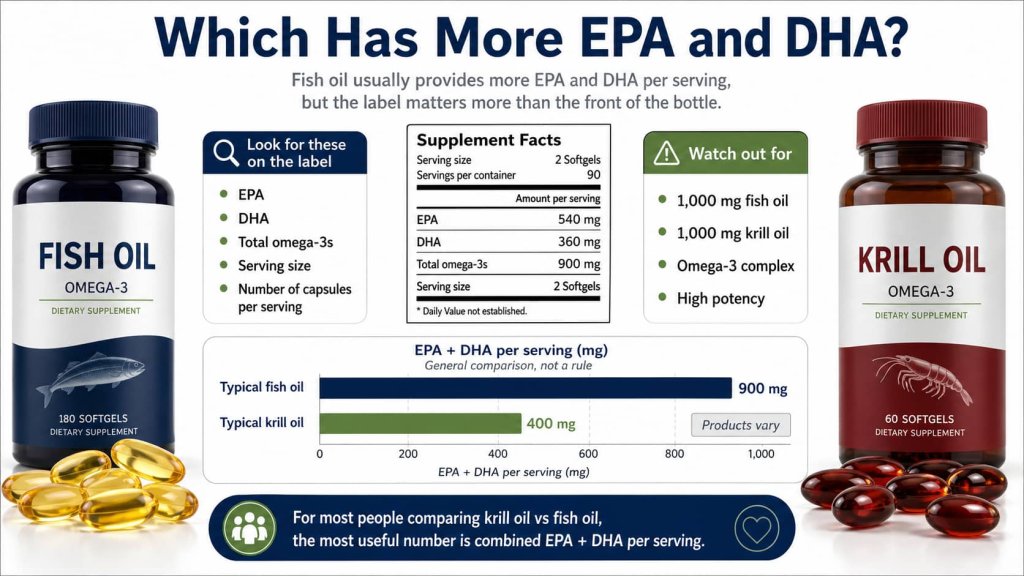
Fish oil usually has more EPA and DHA per capsule than krill oil, although product labels vary.
For example, one fish oil supplement may provide 600–1,000 mg combined EPA and DHA per serving, while a krill oil product may provide much less. But there is no universal rule because supplement formulas differ.
Does the Form of Fish Oil Matter?
Fish oil supplements may come in different forms, including triglyceride, ethyl ester, or re-esterified triglyceride forms. These forms can affect how the supplement is absorbed and tolerated, but the label is not always easy for shoppers to interpret.
For most readers, the practical buying rule is simple: choose a reputable, third-party tested product that clearly lists EPA and DHA. A well-made fish oil with a meaningful EPA/DHA dose is usually more useful than a product that only uses impressive-sounding claims on the front label.
How to read the label
Look past the big front-label number.
A bottle may say:
- “1,000 mg fish oil”
- “1,000 mg krill oil”
- “Omega-3 complex”
- “High potency”
Those numbers may refer to total oil, not EPA and DHA. Turn the bottle around and find:
- EPA
- DHA
- Total omega-3s
- Serving size
- Number of capsules per serving
For most people comparing krill oil vs fish oil, the most useful number is combined EPA + DHA per serving.
How Much EPA and DHA Do You Need?
There is no single omega-3 supplement dose that is right for everyone. For general nutrition, the best starting point is still food. The Dietary Guidelines for Americans recommend eating about 8 ounces of seafood per week for adults, which provides an average of about 250 mg per day of EPA and DHA.
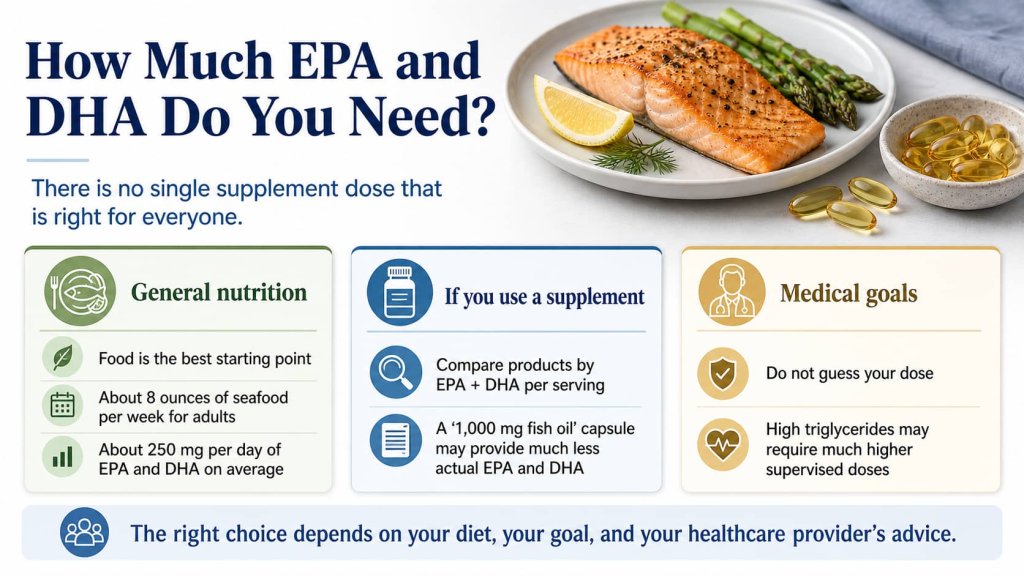
If you use a supplement because you rarely eat fatty fish, compare products based on the EPA + DHA amount per serving. Many people assume a “1,000 mg fish oil” capsule means 1,000 mg of omega-3s, but the actual EPA and DHA amount may be much lower.
For medical goals, such as high triglycerides, do not guess your dose. Therapeutic omega-3 doses are much higher and should be supervised by a healthcare professional.
Krill Oil vs Fish Oil for Heart Health
Fish oil has more research behind it than krill oil, especially for triglycerides and cardiovascular outcomes. But the overall supplement story is more nuanced than many labels suggest.
The National Center for Complementary and Integrative Health notes that omega-3 supplements have been studied for heart disease and triglycerides, but results vary depending on the population, dose, product type, and outcome being measured.
For general heart health, eating fish is still a stronger recommendation than relying on supplements. The American Heart Association recommends eating two servings of fish per week, especially fatty fish. A serving is about 3 ounces cooked.
Does either supplement prevent heart disease?
Do not assume krill oil or fish oil will prevent heart disease on its own. The FDA allows qualified health claims for EPA and DHA, but the FDA’s qualified health claim language also says evidence for some heart-related claims is inconsistent and inconclusive.
That is why omega-3 supplements should be viewed as one possible nutrition tool, not a replacement for:
- A heart-healthy eating pattern
- Regular physical activity
- Not smoking
- Blood pressure management
- Cholesterol management
- Diabetes care when needed
- Prescription medication when medically indicated
Krill Oil vs Fish Oil for Triglycerides
For triglycerides, the most important factor is the amount of omega-3 fatty acids, not whether they come from krill oil or fish oil.
A Nutrition Reviews network meta-analysis on lipid effects found that krill oil and fish oil did not significantly differ in their effects on triglycerides, LDL cholesterol, HDL cholesterol, or total cholesterol. The authors concluded that triglyceride lowering depends mainly on the dose of omega-3 fatty acids consumed.
This is one of the most important points in the krill oil vs fish oil debate. If your goal is triglyceride support, a low-dose krill oil capsule is not automatically better than a higher-dose fish oil capsule.
Prescription omega-3 is different from regular supplements
This is especially important if you have high triglycerides.
The American Heart Association states that prescription omega-3 medications at 4 grams per day can lower triglycerides by about 20% to 30% in most people who need triglyceride treatment. But that refers to prescription omega-3 medication, not ordinary over-the-counter fish oil or krill oil supplements.
If your triglycerides are high, ask your healthcare provider what dose and product type are appropriate. Do not try to self-treat high triglycerides with random supplement doses.
Krill Oil vs Fish Oil for Cholesterol
Neither krill oil nor fish oil should be treated as a cholesterol-lowering supplement.
Omega-3 supplements may lower triglycerides at higher doses, but they do not work like statins and are not a reliable way to lower LDL cholesterol. In some cases, certain omega-3 products may raise LDL cholesterol, especially when used in higher therapeutic doses.
If your main goal is lowering LDL cholesterol, focus on medical guidance, dietary fiber, saturated fat reduction, weight management if needed, and prescribed medication when appropriate.
Krill Oil vs Fish Oil for Inflammation and Joint Health
EPA and DHA are involved in normal inflammatory pathways, so both fish oil and krill oil are often marketed for inflammation and joint comfort. However, the evidence does not support exaggerated claims.
It is reasonable to say omega-3s support normal inflammatory balance. It is not appropriate to claim that krill oil or fish oil cures arthritis, heals joints, or replaces medical care.
For joint pain, stiffness, swelling, or arthritis symptoms, talk with a healthcare professional. Supplements may be one part of a broader plan, but they should not delay diagnosis or treatment.
Krill Oil vs Fish Oil for Brain Health
DHA is an important structural fat in the brain and retina. That is one reason omega-3 intake matters across the lifespan.
However, taking a supplement does not guarantee better memory, focus, mood, or brain performance. Benefits depend on baseline diet, health status, dose, age, and the specific outcome being studied.
For most healthy adults, the safest article takeaway is this: omega-3s are important nutrients, but supplements are not a guaranteed brain booster.
Which Is Better for Pregnancy?
Pregnancy and breastfeeding require careful wording.
Omega-3s, especially DHA, are important during pregnancy, but supplement choices should be discussed with a healthcare professional. Eating lower-mercury fish is also strongly supported.
The FDA advice about eating fish recommends that people who are pregnant or breastfeeding eat 8 to 12 ounces per week of a variety of lower-mercury seafood.
If you are pregnant, trying to become pregnant, or breastfeeding, do not choose krill oil or fish oil based only on marketing claims. Ask your clinician whether you need a DHA supplement and which type is safest for you.
Safety: Who Should Be Careful With Krill Oil or Fish Oil?
Most people tolerate omega-3 supplements well when used as directed, but they are not risk-free.
Be careful or ask a healthcare professional first if you:
- Take blood thinners or antiplatelet medication
- Have a bleeding disorder
- Are preparing for surgery
- Have a history of atrial fibrillation
- Have heart disease or high cardiovascular risk
- Have high triglycerides and are considering high doses
- Are pregnant or breastfeeding
- Have fish allergy
- Have shellfish or crustacean allergy
- Take multiple supplements that may affect bleeding risk
- Have liver disease or complex medical conditions
The FDA dietary supplement guidance explains that dietary supplements are not approved for safety and effectiveness before they are marketed. That is why quality, dose, and medical context matter.
The NIH notes that the FDA has considered omega-3 supplements providing no more than 5 grams per day of EPA and DHA to be safe when used as recommended. That does not mean everyone should take that much. Higher doses are more likely to cause side effects, interact with medications, or require medical supervision.
For everyday supplement use, more is not automatically better.
Allergy warning
Fish oil may be a concern for people with fish allergy. The American College of Allergy, Asthma & Immunology advises people with fish allergy to consult an allergist before taking fish oil supplements.
Krill oil comes from crustaceans, so people with shellfish or crustacean allergy should be especially cautious and should not assume krill oil is safe.
Common Side Effects
Krill oil and fish oil can cause mild side effects, especially at higher doses.
Common side effects may include:
- Fishy aftertaste
- Bad breath
- Burping
- Heartburn
- Nausea
- Loose stools or diarrhea
- Stomach discomfort
- Headache
- Rash in sensitive people
Taking omega-3 supplements with meals may reduce some digestive side effects. Enteric-coated capsules may help some people, but they are not necessary for everyone.
Can Fish Oil or Krill Oil Increase Bleeding Risk?
Omega-3s can have mild antiplatelet effects, especially at higher doses. For most healthy adults using typical supplement doses, this is usually not a major issue. But it matters more for people taking blood thinners, people with bleeding disorders, or people preparing for surgery.
Do not combine high-dose omega-3 supplements with anticoagulant or antiplatelet medication unless your healthcare provider approves it.
Are Krill Oil and Fish Oil Safe From Mercury?
Purified fish oil supplements generally contain very little or no mercury because mercury tends to bind to fish protein rather than purified oil, and processing can remove contaminants. Still, supplement quality varies.
A good product should ideally be tested for:
- Mercury
- PCBs
- Dioxins
- Oxidation/rancidity
- EPA and DHA accuracy
- Heavy metals
- Microbial contaminants
Look for reputable third-party testing from organizations such as USP, NSF, IFOS, or ConsumerLab when available.
Freshness Matters: How to Avoid Rancid Omega-3 Supplements
Omega-3 oils are delicate and can oxidize over time, especially when exposed to heat, light, or air. A rancid supplement may smell strongly fishy, taste unpleasant, or cause more burping and stomach upset.
To reduce freshness problems:
- Choose products with a clear expiration date
- Buy from brands that provide third-party testing
- Store capsules according to the label
- Keep the bottle tightly closed
- Avoid bottles that smell unusually strong or sour
- Do not use capsules that are leaking, sticky, or discolored
A mild ocean-like smell can happen with some products, but a strong rancid odor is a warning sign.
Is Krill Oil More Sustainable Than Fish Oil?
Not automatically.
Krill are a key part of the Antarctic food web. Whales, penguins, seals, squid, and fish depend on krill. Krill oil companies often promote sustainability, but shoppers should still look for transparent sourcing and credible certification.
The NOAA Antarctic Marine Living Resource Program regulates imports, exports, and harvests of Antarctic marine living resources, including krill, under U.S. obligations related to Antarctic marine conservation.
For fish oil, sustainability depends on the fish species, harvest location, and manufacturing practices. Small oily fish such as anchovies and sardines are commonly used, but sourcing still matters.
What to look for
Choose products that clearly state:
- Source species
- Country or region of harvest
- Sustainability certification
- Third-party testing
- Batch testing or certificate of analysis
- EPA and DHA amount per serving
Which Is Better: Krill Oil or Fish Oil?
For most people, fish oil is the better value and more evidence-backed option if the goal is getting a meaningful amount of EPA and DHA.
Krill oil may be a reasonable choice if:
- You tolerate it better
- You prefer a smaller capsule
- You want phospholipid-form omega-3s
- You are not allergic to shellfish or crustaceans
- The product provides a useful EPA/DHA amount
- The cost makes sense for the actual dose
Fish oil may be a better choice if:
- You want more EPA and DHA per serving
- You want a more studied supplement type
- You are comparing cost per gram of EPA/DHA
- You need a higher omega-3 dose under medical guidance
- You do not have fish allergy
How to Choose a Good Omega-3 Supplement
1. Check EPA + DHA
Do not rely on “total fish oil” or “total krill oil.” Look for the actual EPA and DHA amounts.
2. Compare cost per dose
A cheaper bottle is not always cheaper if it provides very little EPA and DHA.
3. Choose third-party tested products
Testing helps confirm purity, potency, and freshness.
4. Avoid exaggerated claims
Be cautious with claims like:
- “Cures inflammation”
- “Melts fat”
- “Prevents heart attacks”
- “Reverses arthritis”
- “Better than medication”
- “Guaranteed brain boost”
These claims are not appropriate for a dietary supplement.
5. Consider your diet first
If you already eat fatty fish twice per week, you may not need a supplement unless your healthcare provider recommends one.
6. Talk to a clinician for medical goals
If you have high triglycerides, heart disease, pregnancy needs, bleeding risk, or allergies, supplement choice should be personalized.
Best Food Sources of Omega-3s
Before choosing krill oil or fish oil, consider omega-3-rich foods.
Good sources include:
- Salmon
- Sardines
- Anchovies
- Trout
- Herring
- Mackerel
- Tuna, depending on mercury category
- Oysters
- Mussels
- Fortified foods
Plant foods such as chia seeds, flaxseeds, walnuts, and canola oil provide ALA, another omega-3 fat. Your body can convert some ALA to EPA and DHA, but the conversion is limited. That is why fatty fish or EPA/DHA supplements are often discussed separately.
What About Algal Oil?
Algal oil is a plant-based omega-3 supplement made from marine algae. It usually provides DHA and sometimes EPA, depending on the product. This can make it a useful option for vegans, vegetarians, people who avoid seafood, or people who cannot take fish oil or krill oil because of allergy concerns.
Like fish oil and krill oil, algal oil products vary in EPA and DHA content. Check the supplement facts label and choose a tested product with clearly listed omega-3 amounts.
Krill Oil vs Fish Oil: Best Choice by Goal
| Goal | Better choice |
|---|---|
| Highest EPA/DHA per dollar | Usually fish oil |
| Smaller capsule preference | Often krill oil |
| Strongest research base | Fish oil |
| Triglyceride support | Dose matters most; ask a clinician |
| Shellfish allergy | Avoid krill oil unless cleared by a clinician |
| Fish allergy | Ask an allergist before fish oil |
| Pregnancy DHA support | Ask a clinician; lower-mercury fish intake is recommended |
| Sustainability priority | Check sourcing and certification for either one |
| Avoiding fishy burps | Krill oil may work for some, but product quality matters |
FAQs About Krill Oil vs Fish Oil
Is krill oil better than fish oil?
Krill oil is not clearly better than fish oil overall. It may have an absorption advantage in some contexts, but fish oil usually provides more EPA and DHA per serving and has more research behind it.
Does krill oil have more omega-3 than fish oil?
Usually no. Fish oil often provides more EPA and DHA per serving, but labels vary. Always compare the EPA + DHA amount, not the total oil amount.
Is krill oil safer than fish oil?
Not necessarily. Both can cause side effects and both require caution for people taking blood thinners or preparing for surgery. Krill oil also carries a shellfish/crustacean allergy concern.
Can I take krill oil and fish oil together?
It is usually unnecessary to take both. Combining them can increase your total EPA/DHA dose and may increase side effects or bleeding concerns at higher intakes. Ask your healthcare provider before combining omega-3 supplements.
Which is better for high triglycerides?
Neither over-the-counter krill oil nor regular fish oil should replace medical treatment. Prescription omega-3 medication may be used for high triglycerides under medical supervision. The dose of EPA/DHA matters more than whether the source is krill or fish.
Should I take omega-3 supplements if I eat fish?
Maybe not. If you eat fatty fish about twice per week, you may already get enough EPA and DHA for general nutrition. Supplements may still be recommended in specific cases, but that should be individualized.
Does fish oil contain mercury?
Purified fish oil supplements generally contain very little or no mercury, but quality varies. Choose third-party tested products.
Is vegan omega-3 better than krill oil or fish oil?
Algal oil can provide DHA and sometimes EPA without fish or krill. It may be a good option for vegans, vegetarians, or people avoiding seafood-based supplements.
Final Verdict
Fish oil is usually the better first choice for most people because it tends to provide more EPA and DHA per serving, costs less per effective dose, and has more research behind it. Krill oil can still be a reasonable option if you tolerate it well, prefer smaller capsules, and choose a product with a clearly labeled EPA/DHA amount.
The smartest move is not choosing the trendiest bottle. It is choosing a safe, tested supplement that gives you a meaningful EPA and DHA dose—or getting omega-3s from fatty fish if that fits your diet.
If you have high triglycerides, heart disease, pregnancy needs, allergies, bleeding risk, or take blood-thinning medication, talk with a healthcare professional before using krill oil or fish oil.
This content is for informational purposes only and not medical advice.
References
- American Heart Association — Fish and Omega-3 Fatty Acids
- American Heart Association — Prescription Omega-3 Medications Work for High Triglycerides
- FDA — Information for Consumers on Using Dietary Supplements
- FDA — Qualified Health Claims for EPA and DHA Omega-3 Consumption
- FDA — Advice About Eating Fish
- Nutrition Reviews — Lipid-Modifying Effects of Krill Oil vs Fish Oil
- Lipids in Health and Disease — Bioavailability of Fatty Acids From Krill Oil, Krill Meal and Fish Oil
- American College of Allergy, Asthma & Immunology — Fish Allergy
- NOAA Fisheries — Antarctic Marine Living Resource Program