
The straight arm pulldown is a cable or band exercise that mainly trains the lats by pulling the arms down from an overhead position while keeping the elbows mostly straight. It is useful because it helps you feel your back working without turning the movement into a biceps-heavy pulldown.

This exercise is often used as a back-day warm-up, lat isolation move, or finishing exercise. When done correctly, it can help build better lat control, improve pulling mechanics, and add focused volume to your upper-back training.
What Is the Straight Arm Pulldown?
The straight arm pulldown is a back exercise performed with a high cable pulley, resistance band, or cable machine attachment. You start with your arms in front of you and slightly overhead, then pull the handle down toward your thighs while keeping your elbows straight or softly bent.
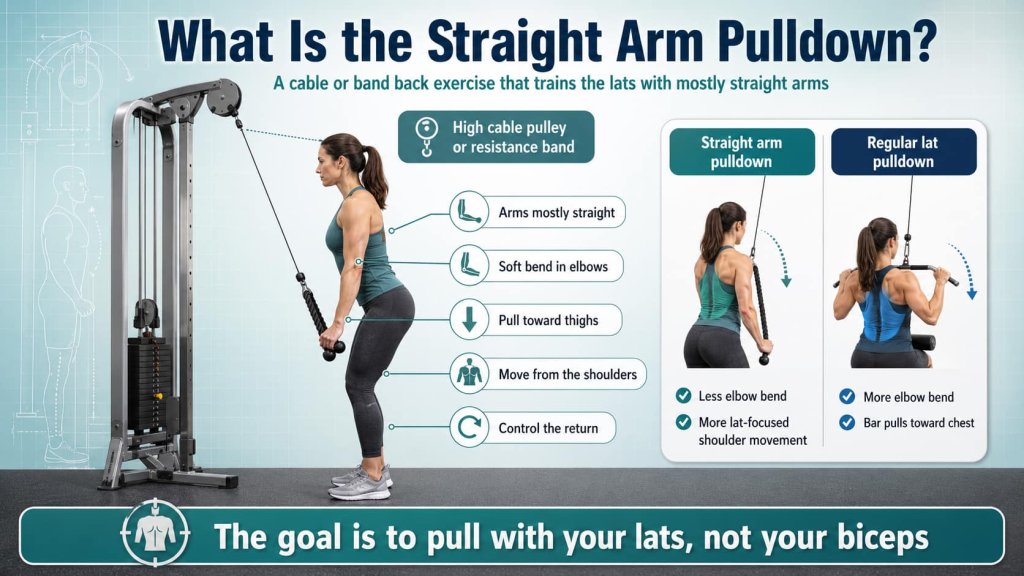
The movement is different from a regular lat pulldown because your elbows do not bend much. Instead of pulling the bar toward your chest with your arms, you move mainly through the shoulder joint.
The American Council on Exercise describes a similar straight-arm cable movement using a high pulley, tall posture, slightly bent knees, and controlled arm movement down toward the front of the waist.
How to Do the Straight Arm Pulldown With Proper Form
Start light. This exercise works best when you can control the cable and feel your lats working through the full range of motion.
How to do it:
- Set a cable pulley to the highest position.
- Attach a straight bar, rope, or EZ-bar handle.
- Stand facing the machine and hold the attachment with both hands.
- Step back until your arms are extended in front of you and slightly overhead.
- Keep your feet about hip-width apart.
- Soften your knees and hinge slightly at the hips.
- Brace your core and keep your ribs down.
- Keep your elbows straight or slightly bent.
- Pull the handle down toward your thighs.
- Pause briefly when your hands reach your thighs.
- Slowly return the handle upward with control.
- Stop before your shoulders shrug or your lower back arches.
Trainer Tip: Think “pull your upper arms toward your pockets.” This cue usually works better than thinking “pull the bar down,” because it shifts attention away from the hands and toward the lats.
Key Form Tips for Better Lat Activation
Small form changes can make a big difference with this exercise.
Use these cues:
- Keep your chest tall without over-arching your lower back.
- Keep your elbows fixed instead of bending and straightening them.
- Pull the attachment toward your thighs, not your stomach.
- Keep your shoulders down away from your ears.
- Control the stretch at the top.
- Use a weight you can move smoothly.
- Pause at the bottom to feel the lats contract.
If you only feel your triceps, shoulders, or lower back, the weight may be too heavy or your range of motion may be too aggressive.
Straight Arm Pulldown Muscles Worked
The straight arm pulldown mainly works the latissimus dorsi, the large back muscle that helps create the “wide back” look.
According to NCBI Bookshelf, the latissimus dorsi helps extend, adduct, and internally rotate the upper arm at the shoulder. That is why the straight arm pulldown matches the lat’s natural function so well.
Primary muscles worked:
- Latissimus dorsi
- Teres major
- Posterior deltoids
- Triceps, mainly to keep the elbows extended
- Core muscles for trunk stability
- Lower traps and scapular stabilizers, depending on your control
The key point is simple: your lats should be the main driver, not your arms, lower back, or momentum.
Common Straight Arm Pulldown Mistakes
| Mistake | Why it matters | Quick fix |
|---|---|---|
| Bending the elbows too much | Turns the exercise into more of a pulldown or pressdown | Keep a soft bend and lock that elbow angle in place |
| Going too heavy | Encourages swinging and lower-back arching | Reduce the weight and slow the tempo |
| Shrugging the shoulders | Shifts tension away from the lats | Keep shoulders down and neck relaxed |
| Pulling too low with poor posture | Can make the lower back take over | Stop around thigh level and keep ribs stacked |
| Rushing the return | Reduces control and lat tension | Take 2–3 seconds on the way up |
| Standing too close to the cable | Limits the stretch and range | Step back until your arms can reach slightly overhead |
Straight Arm Pulldown Variations
You can change the attachment or equipment to make the exercise feel more comfortable.
1. Rope Straight Arm Pulldown
The rope version allows your hands to move naturally as you pull down. Many people like it because it gives a slightly longer range of motion at the bottom.
How to do it:
- Attach a rope to the high cable pulley.
- Hold one end of the rope in each hand.
- Step back and set your arms slightly overhead.
- Keep your elbows softly bent.
- Pull the rope down toward your thighs.
- Let your hands separate slightly at the bottom.
- Return slowly with control.
2. Straight Bar Straight Arm Pulldown
The straight bar version is simple and stable. It is a good starting point for beginners because both hands move together.
How to do it:
- Attach a straight bar to the high pulley.
- Hold the bar with an overhand grip.
- Step back and brace your core.
- Pull the bar down toward your thighs.
- Pause briefly at the bottom.
- Return slowly without shrugging.
3. Band Straight Arm Pulldown
This is a good home workout option if you do not have a cable machine.
How to do it:
- Anchor a resistance band above head height.
- Hold the band with both hands.
- Step back until there is light tension.
- Keep your elbows mostly straight.
- Pull your hands down toward your thighs.
- Control the band as it returns upward.
4. Single Arm Straight Arm Pulldown
The single-arm version can help you focus on one lat at a time and notice side-to-side differences.
How to do it:
- Attach a single handle to the high pulley.
- Hold the handle with one hand.
- Step back and square your hips.
- Pull your arm down toward the same-side thigh.
- Pause and squeeze the lat.
- Return slowly before switching sides.
Straight Arm Pulldown Benefits
The straight arm pulldown is popular because it gives you a focused way to train your lats without needing heavy loads.
Helps isolate the lats
Because the elbows stay mostly straight, the biceps are less involved than they are in regular pulldowns or rows. This can make it easier to focus on the lats.
A 2022 study in Applied Sciences compared the straight arm pulldown with the barbell pullover and found higher latissimus dorsi and triceps brachii activity in the straight arm pulldown variations tested. That supports using it as a lat-focused accessory exercise, especially when your goal is better back activation.
Builds better back awareness
Many beginners struggle to “feel” their lats during rows and pulldowns. The straight arm pulldown can help because the movement is simpler and more controlled.
Instead of thinking about pulling with your hands, think about driving your upper arms down and back.
Adds back volume without heavy spinal loading
The straight arm pulldown does not require a barbell on your back or heavy hip hinging. That makes it a useful option when you want more lat work without adding much fatigue to your lower body or lower back.
Works well before or after bigger back exercises
You can use it before pull-ups, pulldowns, or rows to wake up your lats. You can also use it near the end of a workout as a controlled finisher.
Easy to adjust for different fitness levels
You can do the straight arm pulldown with:
- A straight bar
- Rope attachment
- EZ-bar attachment
- Single handles
- Resistance band
This makes it simple to adjust based on comfort, equipment, and training goal.
Straight Arm Pulldown vs Lat Pulldown
Both exercises train the back, but they are not the same.
| Exercise | Main difference | Best use |
|---|---|---|
| Straight arm pulldown | Elbows stay mostly straight | Lat isolation and mind-muscle connection |
| Lat pulldown | Elbows bend as you pull the bar down | Heavier back training and vertical pulling strength |
| Pull-up | Body moves toward the bar | Full-body pulling strength |
| Pullover | Usually done with a dumbbell, cable, or machine | Lat and shoulder-extension training |
The National Academy of Sports Medicine explains that pulldown grip and technique can change muscle involvement, which is why exercise selection and setup matter for back training.
A smart back workout can include both a lat pulldown and a straight arm pulldown. Use the lat pulldown as a heavier main movement and the straight arm pulldown as a focused accessory.
How Many Sets and Reps Should You Do?
For most people, the straight arm pulldown works best with moderate to higher reps.
Good starting point:
- Beginner: 2 sets of 12–15 reps
- Intermediate: 3 sets of 10–15 reps
- Advanced: 3–4 sets of 12–20 reps
Use a controlled tempo. A good rhythm is:
- 1 second to pull down
- 1 second pause at the bottom
- 2–3 seconds to return
The Mayo Clinic recommends starting strength training with a weight you can lift comfortably for 12 to 15 repetitions, while keeping technique correct.
Where to Put Straight Arm Pulldowns in a Workout
The straight arm pulldown can fit into your workout in three main ways.
As a warm-up
Use 1–2 light sets before rows, pull-ups, or lat pulldowns. This can help you connect with your lats before heavier pulling work.
As an accessory exercise
Use it after your main back movement. For example:
- Lat pulldown
- Seated cable row
- Straight arm pulldown
- Rear delt fly
As a finisher
Use higher reps near the end of your workout. Keep the movement strict and controlled instead of chasing heavy weight.
Sample Back Workout With Straight Arm Pulldown
Here is a simple back workout structure:
| Exercise | Sets | Reps |
|---|---|---|
| Lat pulldown | 3 | 8–12 |
| Seated cable row | 3 | 10–12 |
| Straight arm pulldown | 2–3 | 12–15 |
| Face pull | 2–3 | 12–20 |
This setup trains vertical pulling, rowing, lat isolation, and rear-shoulder control.
For general health, the CDC says adults need at least 2 days of muscle-strengthening activity each week, along with regular aerobic activity.
Who Should Be Careful With the Straight Arm Pulldown?
The straight arm pulldown is usually beginner-friendly, but it may not be right for everyone.
Be careful or ask a qualified professional for guidance if you have:
- Current shoulder pain
- Recent shoulder, elbow, neck, or back injury
- Pain when reaching overhead
- Numbness, tingling, or radiating symptoms
- Trouble controlling your ribs or lower back during the movement
Stop the exercise if you feel sharp pain, pinching, or symptoms that worsen as you continue. Choose a shorter range of motion, lighter resistance, or a different back exercise if needed.
Straight Arm Pulldown Form Checklist
Use this quick checklist before every set:
- Cable starts high
- Arms stay mostly straight
- Knees slightly bent
- Core braced
- Ribs down
- Shoulders away from ears
- Hands pull toward thighs
- Return is slow and controlled
- No swinging
- Lats feel like the main muscle working
FAQs About the Straight Arm Pulldown
Is the straight arm pulldown good for lats?
Yes. The straight arm pulldown is one of the best cable exercises for focusing on the lats because it trains shoulder extension while keeping elbow movement limited.
Is the straight arm pulldown better than the lat pulldown?
Not exactly. The lat pulldown is usually better for heavier vertical pulling strength, while the straight arm pulldown is better for lat isolation and control. Both can fit in the same back program.
Should my arms be completely straight?
Your arms should be mostly straight, but your elbows can stay slightly bent. The important part is keeping the elbow angle fixed during the rep.
Why do I feel straight arm pulldowns in my triceps?
The triceps help keep your elbows extended, so some triceps work is normal. If your triceps dominate the movement, reduce the weight and focus on pulling your upper arms down with your lats.
Can beginners do straight arm pulldowns?
Yes. Beginners can do straight arm pulldowns with a light cable or resistance band. Start with slow reps and focus on control before adding weight.
Are straight arm pulldowns good for a wider back?
They may help build the lats, which can contribute to a wider-looking back when combined with progressive strength training, enough protein, and consistent workouts.
How often should I do straight arm pulldowns?
Most people can do them 1–3 times per week as part of a back or upper-body workout. Avoid doing too much volume if your shoulders or elbows feel irritated.
Conclusion
The straight arm pulldown is a simple but highly useful back exercise for building lat awareness, improving pulling mechanics, and adding focused back volume. Keep the weight controlled, maintain a fixed elbow angle, and pull from your lats instead of swinging with your body.
Add it after your main back exercise or use it as a warm-up before heavier pulldowns and rows.
References
- American Council on Exercise — Straight Arm Pressdown
- NCBI Bookshelf — Anatomy, Back, Latissimus Dorsi
- Applied Sciences — Muscle Activation Comparison Between Barbell Pullover and Straight Arm Pulldown
- National Academy of Sports Medicine — Biomechanics of the Lat Pulldown
- Mayo Clinic — Weight Training: Do’s and Don’ts of Proper Technique
- CDC — Physical Activity Guidelines for Adults
- PubMed Central — Muscle Excitation During Lat Pulldown Variations