
NAD supplements such as NR and NMN can raise blood NAD levels, but improvements in energy, memory, physical performance, and healthy aging are not consistently demonstrated. Understanding NAD supplement benefits starts with separating this biological effect from outcomes you can feel or measure in daily life.
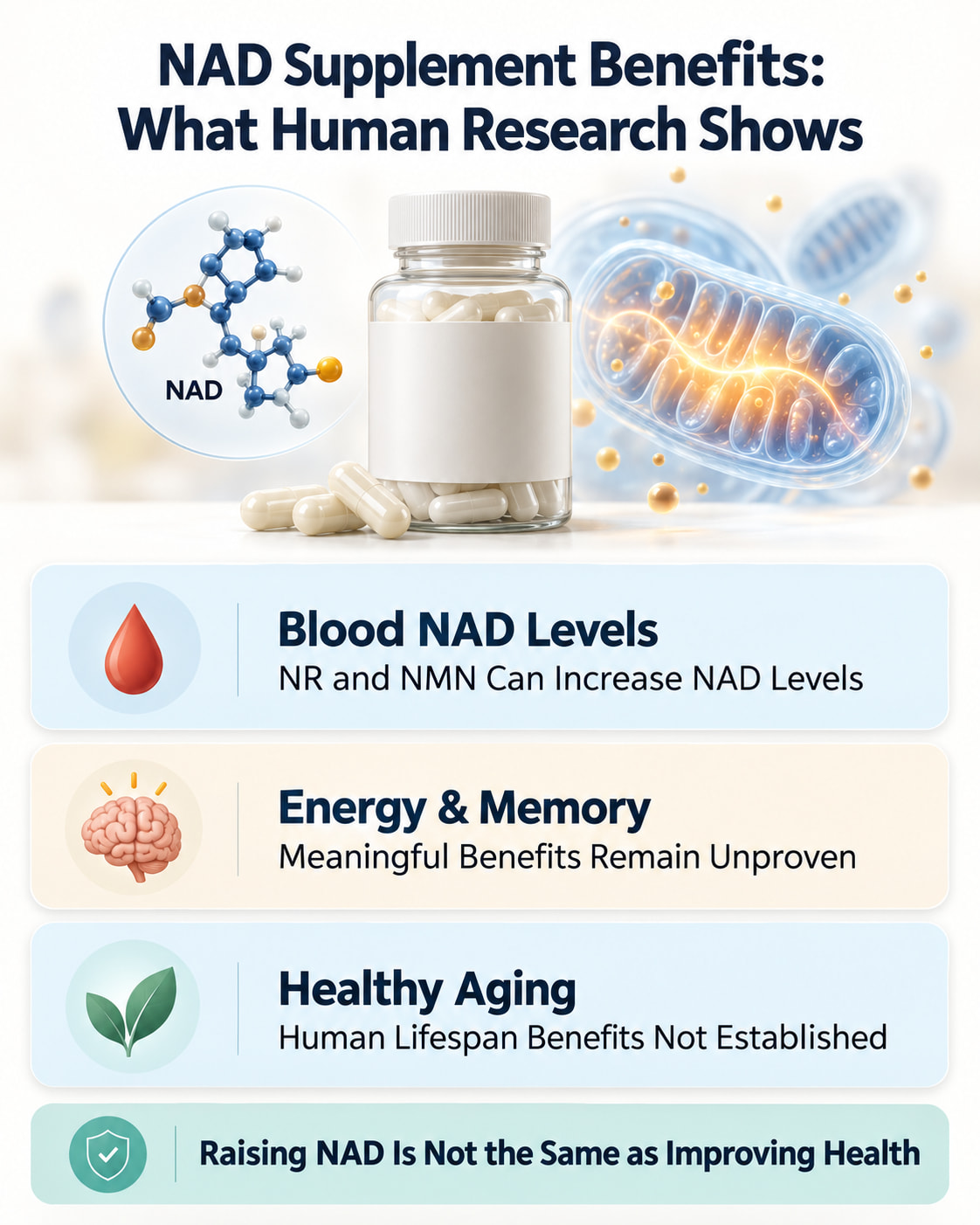
Some studies report promising results in specific groups. Others find that NAD levels increase without meaningful improvements in health. Before buying a product, it helps to know which ingredient researchers tested, what actually improved, and how closely the study participants resemble you.
What Are NAD Supplements?
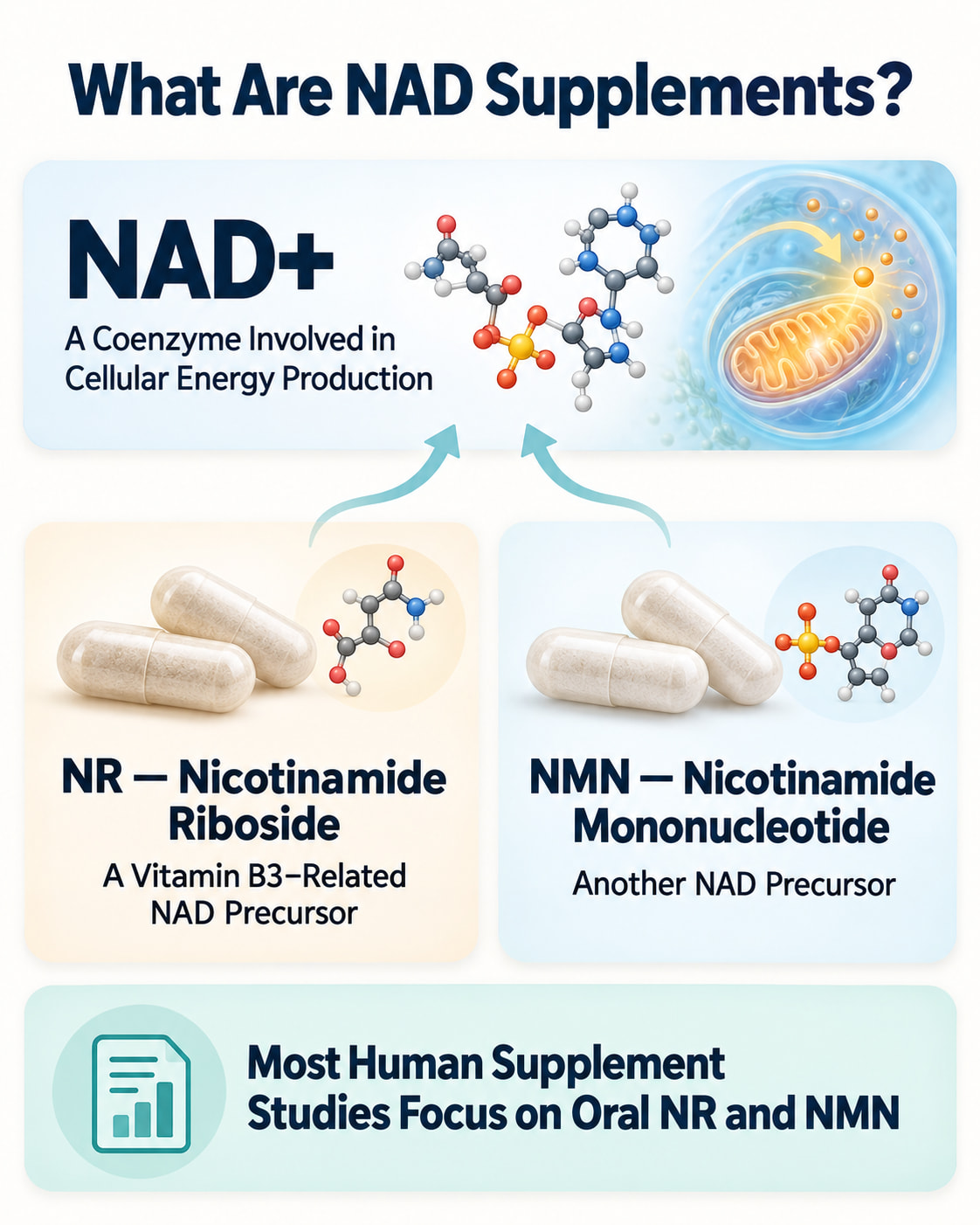
NAD stands for nicotinamide adenine dinucleotide. It is a coenzyme involved in cellular energy production and other essential processes, including maintaining genetic material and supporting communication within cells. Your body makes NAD using nutrients such as vitamin B3 and the amino acid tryptophan.
Products sold as “NAD supplements” can contain different ingredients:
| Ingredient | What it is | What to know |
|---|---|---|
| NAD+ | A form of the coenzyme itself | Research on NR or NMN should not automatically be applied to a product containing NAD+ directly. |
| NR | Nicotinamide riboside, a vitamin B3–related compound | A precursor the body can use to make NAD. |
| NMN | Nicotinamide mononucleotide | Another precursor involved in NAD production. |
Much of the human supplementation research concerns oral NR and NMN. Different ingredients, combination formulas, and delivery methods need their own evidence. A study of an NR capsule does not establish the same effects for an NAD+ injection or a proprietary “NAD booster” blend.
NAD Supplement Benefits: What Human Studies Show
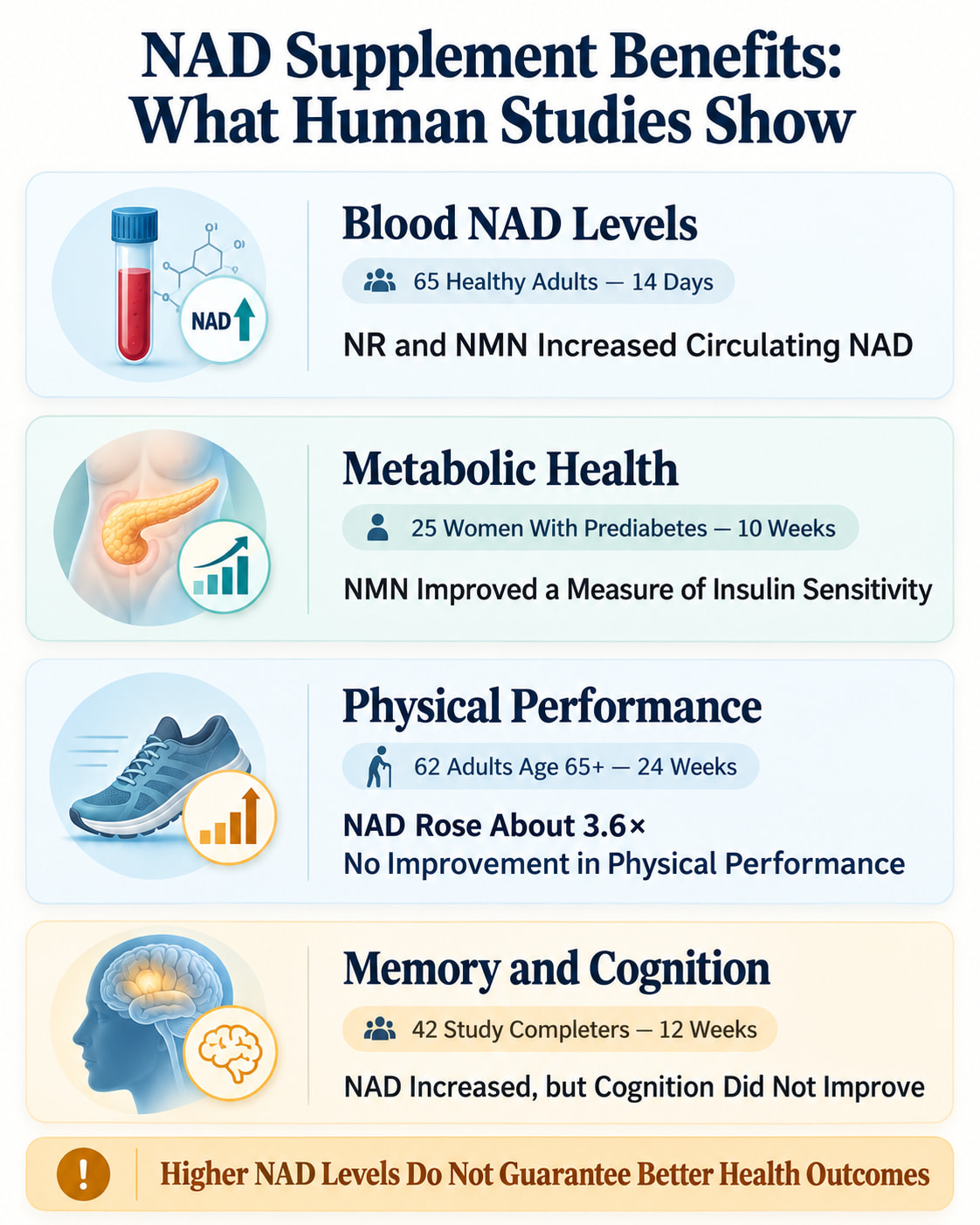
The research supports some claims more strongly than others. The doses mentioned below describe what researchers tested; they are not recommendations for personal use.
Increasing Blood NAD Levels
Increasing circulating NAD is the most consistent finding in human trials.
A January 2026 study in Nature Metabolism compared NAD precursors and placebo in 65 healthy adults over 14 days. Both NR and NMN increased circulating NAD levels. The study showed that these compounds can influence NAD metabolism, but it did not establish long-term health benefits.
A higher blood measurement alone cannot tell you whether you will feel more energetic, remember things better, or remain healthier as you age. Those outcomes require separate testing.
NAD Supplement Benefits for Metabolic Health
One of the more encouraging findings comes from a small randomized NMN trial published in Science in 2021.
The study involved 25 postmenopausal women with prediabetes and overweight or obesity. Participants received NMN at 250 mg daily for 10 weeks or placebo. Insulin-stimulated glucose disposal increased by approximately 25% from baseline in the NMN group, without a corresponding placebo improvement. This measured how effectively the body handled glucose under controlled testing conditions.
That finding does not mean blood sugar fell by 25%, and it does not establish that NMN prevents diabetes or produces weight loss.
Other results have been less encouraging. A trial in 40 men with obesity and insulin resistance found that NR at 2,000 mg daily for 12 weeks did not improve insulin sensitivity, resting energy expenditure, fat metabolism, or body composition.
Any metabolic benefit may depend on the compound, the outcome measured, and the population studied.
Exercise Capacity and Physical Function
Some research suggests a possible benefit for people with particular physical limitations.
The 2024 NICE trial studied 90 people with peripheral artery disease, a condition that can limit walking. Over six months, NR produced a 17.6-meter advantage over placebo in the change in six-minute walking distance. The trial used a less stringent, one-sided statistical threshold, and the authors called for a larger study to confirm the result. It should be viewed as preliminary evidence in that patient group.
More recent findings show that increasing NAD does not necessarily improve physical function. A 24-week NMN trial, published as an accepted paper in September 2026, randomized 62 adults age 65 or older to 1,250 mg daily or placebo.
Blood NAD increased approximately 3.6-fold, but hearing—the primary outcome—and physical performance did not improve. Other apparent physiological changes did not remain significant after researchers adjusted for testing multiple outcomes.
These findings do not support promising better endurance or strength to everyone who takes an NAD supplement.
Memory and Brain Health
Human evidence does not currently establish a reliable memory benefit.
A July 2026 study in Alzheimer’s & Dementia examined NR in people with amnestic mild cognitive impairment. Among 42 participants who completed the 12-week study, blood NAD approximately doubled, but cognitive function did not improve. Total cerebral blood flow and blood pressure also did not improve.
A larger, newer study adds an important caution. The NOPARK randomized clinical trial, published in JAMA in October 2026, randomized 410 people with early Parkinson disease to NR 500 mg twice daily or placebo for 52 weeks.
NR did not improve clinical outcomes. The primary disease-rating score favored placebo by an adjusted 2.72 points. Although statistically significant, this difference was smaller than the paper’s cited threshold for clinically important worsening. The findings apply specifically to early Parkinson disease and do not support using NR to slow its progression.
Changes in blood markers or exploratory brain scans should therefore not be presented as proof of better memory or protection against neurological disease.
Energy, Fatigue, and Sleep
NAD’s role in cellular energy production does not establish that taking a supplement will make you feel more energetic.
A November 2025 trial in eClinicalMedicine studied 58 people with long COVID, using NR at 2,000 mg daily. NAD levels increased, but the main comparisons found no significant improvements over placebo in cognition, fatigue, sleep, anxiety, or depression.
Some exploratory analyses showed improvements from participants’ own starting scores. However, those findings were less conclusive than the placebo comparisons, and substantial dropout limited interpretation.
The study does not establish NR as an effective answer to everyday tiredness, poor sleep, or brain fog.
Can NAD Supplements Slow Aging?
Human lifespan extension from NR or NMN supplementation has not been demonstrated. Higher NAD levels, changes in laboratory markers, and findings from animal experiments do not establish that a supplement reverses aging in people.
The human trials discussed above measured particular outcomes over limited periods. Even the September 2026 NMN study, which substantially increased circulating NAD over 24 weeks, did not demonstrate improved physical performance.
Claims about “cellular rejuvenation” or “biological age reversal” should be evaluated by asking what researchers actually measured. A laboratory change and a longer, healthier life are different outcomes.
NR vs. NMN: Is One Better?
Current human evidence does not establish a clear winner for general health.
The 2026 comparison in healthy adults found that both NR and NMN increased circulating NAD. It did not show that one delivered superior benefits for memory, physical function, or longevity.
When comparing products, consider whether the evidence matches the:
- Ingredient: NR, NMN, or another compound.
- Formulation: A single ingredient or a combination.
- Health goal: A blood-marker change, physical function, or another outcome.
- Population: Healthy adults or people with a specific condition.
Choosing a product because it promises the largest NAD increase leaves the more important question unanswered: what benefit should you realistically expect?
How Much NAD Supplement Should You Take?
There is no established universal dose for improving energy, memory, or healthy aging.
Human trials have used different amounts for different purposes:
| Example from research | Daily amount studied | Study duration |
|---|---|---|
| NMN in women with prediabetes | 250 mg | 10 weeks |
| NR in an early Parkinson disease trial | 1,000 mg | 52 weeks |
| NMN in older adults | 1,250 mg | 24 weeks |
| NR in men with obesity and insulin resistance | 2,000 mg | 12 weeks |
These are research exposures, not recommended intake levels. Several of these doses did not improve the outcomes being studied. A larger amount should not be assumed to produce a larger health benefit.
If you are considering a supplement, review the exact product and your reason for taking it with a healthcare professional.
NAD Supplement Side Effects and Safety
What Human Studies Tell Us
NR and NMN have generally been tolerated in the populations and conditions studied, but that does not establish safety for everyone or for indefinite use.
For example, an eight-week randomized trial in 140 otherwise healthy adults with overweight tested NR at 100, 300, or 1,000 mg daily. Researchers found no significant differences in adverse events between the treatment and placebo groups. The limited duration could not rule out uncommon effects or establish the safety of years of use.
Safety information also needs to match the ingredient. The side effects associated with high-dose nicotinic acid, another vitamin B3 compound, should not automatically be assigned to NR or NMN.
A Recent NMN Safety Assessment
In May 2026, with an amendment in July, the European Food Safety Authority assessed a specific highly purified β-NMN ingredient proposed for use at up to 300 mg daily.
EFSA concluded that this ingredient was safe under the proposed conditions for adults, excluding pregnant and breastfeeding women. This was an ingredient-specific safety assessment, not evidence of anti-aging benefits or a universal dosing recommendation.
Who Should Get Medical Advice First?
Talk with a clinician or pharmacist before starting a supplement if you take prescription medicines, have an ongoing health condition, or are pregnant or breastfeeding. Many supplements have not been adequately tested during pregnancy or breastfeeding. Supplements should also not replace prescribed care.
If your main reason for considering NAD is persistent unexplained fatigue or concerning memory changes, seek an assessment. MedlinePlus recommends medical evaluation when fatigue does not improve despite adequate rest and nutrition. The National Institute on Aging advises discussing persistent or concerning memory problems with a doctor.
These symptoms do not, by themselves, show that you need an NAD supplement.
What to Check Before Buying a NAD Supplement
Use the product label and the underlying research to answer a few practical questions:
- What is the actual ingredient? “NAD support” on the front label does not identify what is inside.
- How much is in a full serving? Check both the amount per capsule and the number of capsules per serving.
- Does the cited study match the product? Evidence about a different ingredient or combination may not apply.
- What outcome was demonstrated? Look for meaningful health results, not just a larger laboratory number.
- Has the product undergone independent quality testing? Testing can help verify ingredients and contamination standards, although it does not guarantee effectiveness or complete safety.
Claims of guaranteed age reversal, major weight loss, or protection from serious disease should prompt closer scrutiny of the supporting evidence.
Frequently Asked Questions
How Long Does It Take for NAD Supplements to Work?
Some NR studies have detected increases in blood NAD within approximately two weeks. That does not establish a timeline for feeling more energetic or thinking more clearly. Changes in a blood marker can occur without noticeable health improvements.
Can NAD Supplements Help With Weight Loss?
Reliable weight-loss benefits have not been established. In a 12-week trial involving men with obesity and insulin resistance, NR did not improve body composition or resting energy expenditure. Claims that these products meaningfully increase calorie burning go beyond that evidence.
Is It Safe to Take NAD Supplements Every Day?
Many studies use daily supplementation, but tolerance during a trial does not establish safety for years of use. The ingredient, dose, health conditions, and other medicines matter. A daily schedule alone does not make a supplement necessary or appropriate.
Can You Support NAD Production Through Food?
Your body uses vitamin B3 and tryptophan to make NAD. Foods such as poultry, fish, peanuts, and fortified cereals contribute vitamin B3, while protein-containing foods supply tryptophan. These nutrients support normal NAD production; food intake is different from taking concentrated NR or NMN supplements.
Are NAD Injections Better Than Pills?
Research on oral NR and NMN does not establish that NAD+ injections are better. Injectable products also have separate safety concerns.
A January 2026 FDA warning letter documented reactions in three patients after administration of a compounded NAD+ product. An unopened vial from the same lot contained excessive bacterial endotoxins. This illustrates a preparation-quality risk distinct from the findings of oral supplement trials.
Are NAD Supplements FDA-Approved?
No. FDA does not approve dietary supplements for safety and effectiveness before sale. Supplement companies are responsible for meeting applicable safety and labeling requirements.
FDA reconsidered its earlier exclusion of NMN in 2025, as documented in EFSA’s 2026 assessment. Eligibility to be considered a dietary supplement is different from approval of a product’s claimed health benefits.
Conclusion
NAD supplement benefits are clearest when discussing increased blood NAD levels. Evidence for improvements in everyday health remains limited, inconsistent, or specific to particular patient groups.
Before buying a product, identify the exact ingredient, check whether its research matches your goal, and discuss relevant health concerns with a clinician. If fatigue or memory changes are driving your interest, understanding their cause is a more useful starting point than assuming you need to raise NAD.
This content is for informational purposes only and not medical advice.
References
- NIH Office of Dietary Supplements: Niacin
- Nature Metabolism: Comparison of three NAD precursors in humans
- Science: NMN and muscle insulin sensitivity in women with prediabetes
- American Journal of Clinical Nutrition: NR and metabolic outcomes in men with obesity
- Nature Communications: The NICE peripheral artery disease trial
- npj Aging: High-dose NMN supplementation over 24 weeks
- Alzheimer’s & Dementia: NR in adults with mild cognitive impairment
- Scientific Repots: NR safety and metabolism trial