
A marathon pace chart shows the pace you need to run per mile or per kilometer to reach a specific marathon finish time. A marathon is officially 26 miles and 385 yards, or 42.195 kilometers, according to World Athletics.
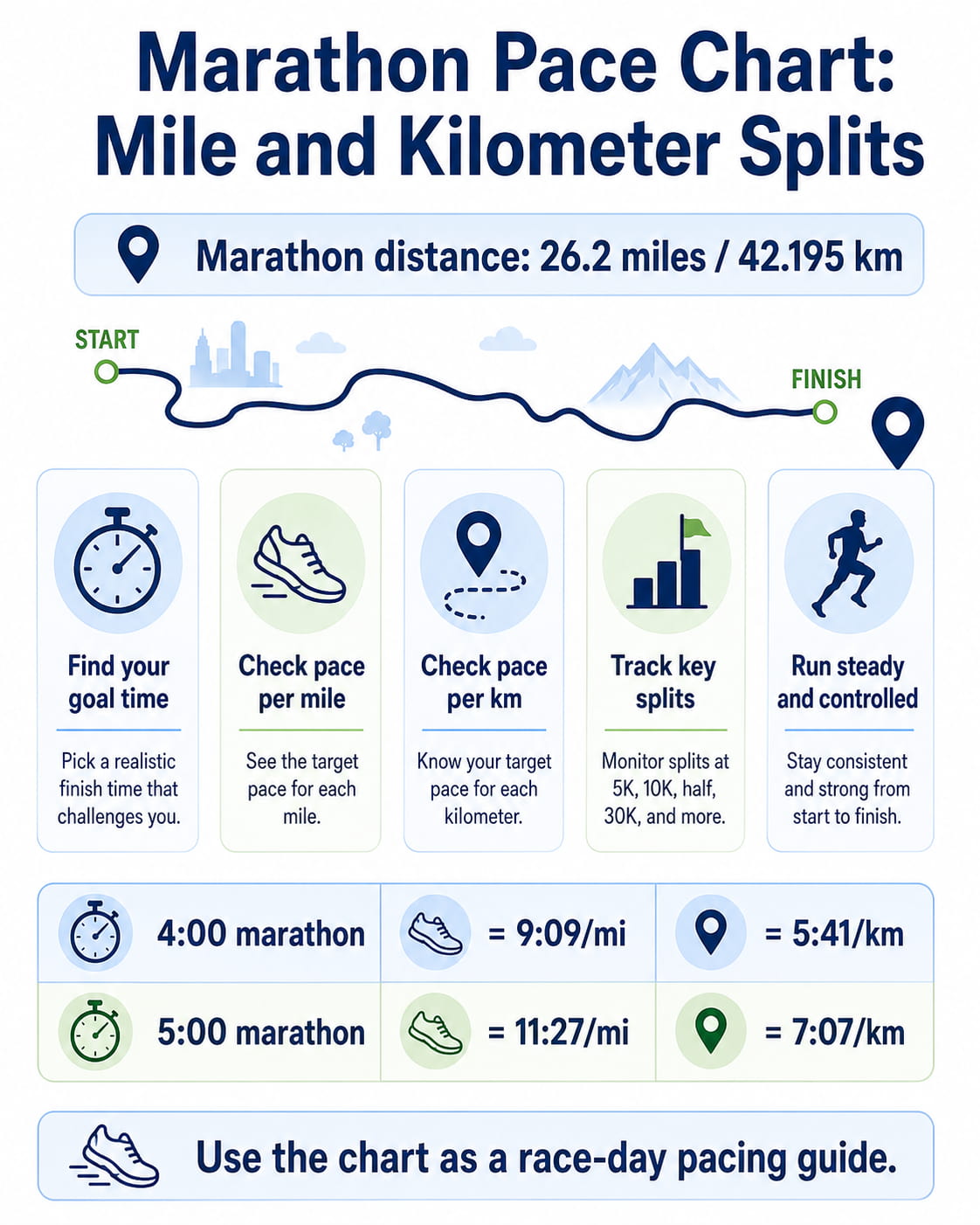
Use this marathon pace chart to find your goal pace, check key split times, and stay on track during training or race day. The chart below includes common marathon finish goals from 2:30 to 6:00, with mile pace, kilometer pace, and major checkpoints.
Marathon Pace Chart for Mile and Kilometer Splits
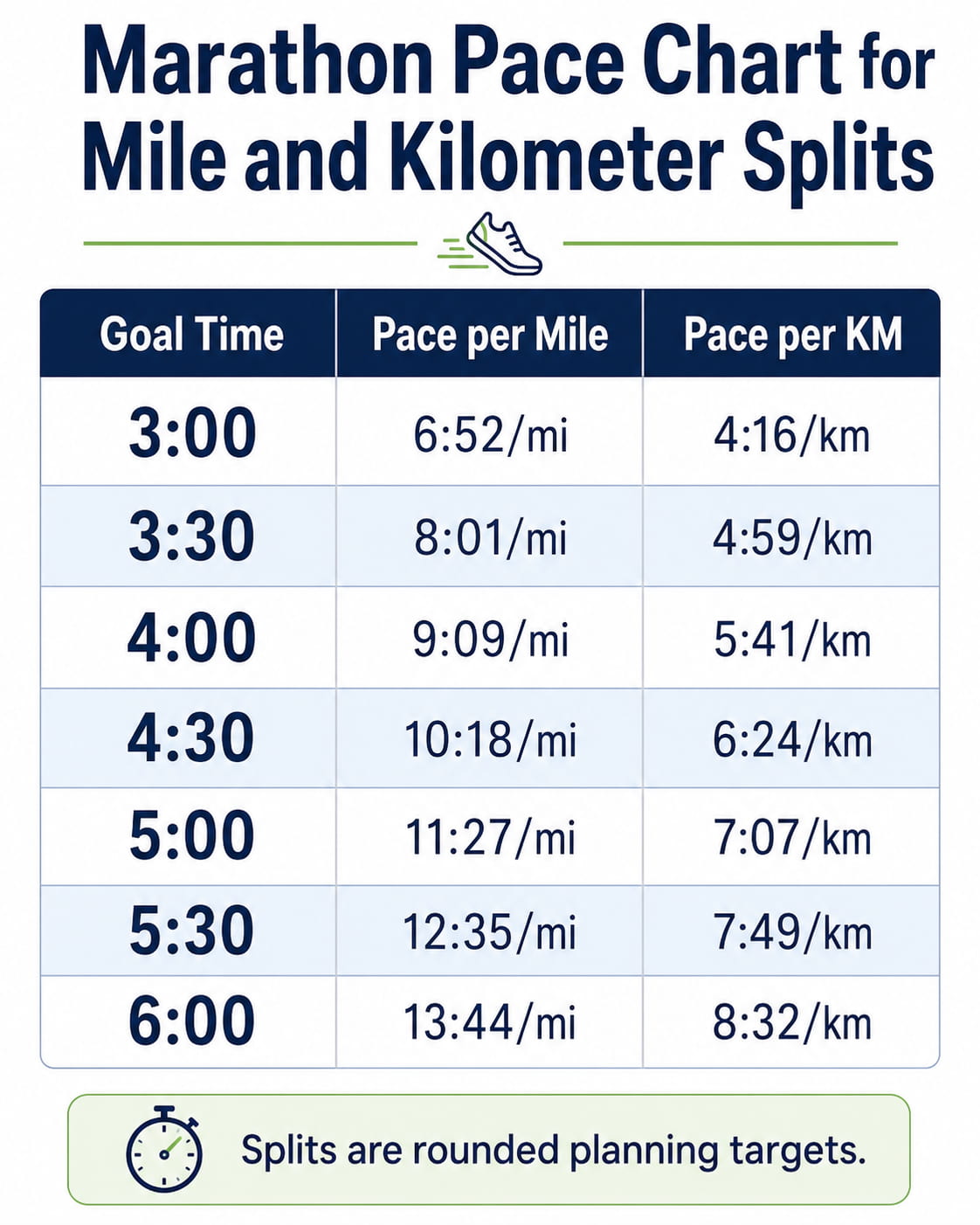
The chart below is based on the official marathon distance of 42.195 km. Split times are rounded to the nearest second, so your watch or race timing mat may show a small difference.
| Goal Time | Pace per Mile | Pace per KM | 5K Split | 10K Split | Half Split | 30K Split | 20-Mile Split | 40K Split | Finish |
|---|---|---|---|---|---|---|---|---|---|
| 2:30:00 | 5:43/mi | 3:33/km | 0:17:46 | 0:35:33 | 1:15:00 | 1:46:39 | 1:54:25 | 2:22:12 | 2:30:00 |
| 2:45:00 | 6:18/mi | 3:55/km | 0:19:33 | 0:39:06 | 1:22:30 | 1:57:19 | 2:05:52 | 2:36:25 | 2:45:00 |
| 3:00:00 | 6:52/mi | 4:16/km | 0:21:20 | 0:42:40 | 1:30:00 | 2:07:59 | 2:17:18 | 2:50:38 | 3:00:00 |
| 3:15:00 | 7:26/mi | 4:37/km | 0:23:06 | 0:46:13 | 1:37:30 | 2:18:39 | 2:28:45 | 3:04:51 | 3:15:00 |
| 3:30:00 | 8:01/mi | 4:59/km | 0:24:53 | 0:49:46 | 1:45:00 | 2:29:18 | 2:40:11 | 3:19:05 | 3:30:00 |
| 3:45:00 | 8:35/mi | 5:20/km | 0:26:40 | 0:53:19 | 1:52:30 | 2:39:58 | 2:51:38 | 3:33:18 | 3:45:00 |
| 4:00:00 | 9:09/mi | 5:41/km | 0:28:26 | 0:56:53 | 2:00:00 | 2:50:38 | 3:03:05 | 3:47:31 | 4:00:00 |
| 4:15:00 | 9:44/mi | 6:03/km | 0:30:13 | 1:00:26 | 2:07:30 | 3:01:18 | 3:14:31 | 4:01:44 | 4:15:00 |
| 4:30:00 | 10:18/mi | 6:24/km | 0:32:00 | 1:03:59 | 2:15:00 | 3:11:58 | 3:25:58 | 4:15:57 | 4:30:00 |
| 4:45:00 | 10:52/mi | 6:45/km | 0:33:46 | 1:07:33 | 2:22:30 | 3:22:38 | 3:37:24 | 4:30:10 | 4:45:00 |
| 5:00:00 | 11:27/mi | 7:07/km | 0:35:33 | 1:11:06 | 2:30:00 | 3:33:18 | 3:48:51 | 4:44:24 | 5:00:00 |
| 5:15:00 | 12:01/mi | 7:28/km | 0:37:20 | 1:14:39 | 2:37:30 | 3:43:58 | 4:00:17 | 4:58:37 | 5:15:00 |
| 5:30:00 | 12:35/mi | 7:49/km | 0:39:06 | 1:18:12 | 2:45:00 | 3:54:37 | 4:11:44 | 5:12:50 | 5:30:00 |
| 5:45:00 | 13:10/mi | 8:11/km | 0:40:53 | 1:21:46 | 2:52:30 | 4:05:17 | 4:23:10 | 5:27:03 | 5:45:00 |
| 6:00:00 | 13:44/mi | 8:32/km | 0:42:40 | 1:25:19 | 3:00:00 | 4:15:57 | 4:34:37 | 5:41:16 | 6:00:00 |
How to Use a Marathon Pace Chart
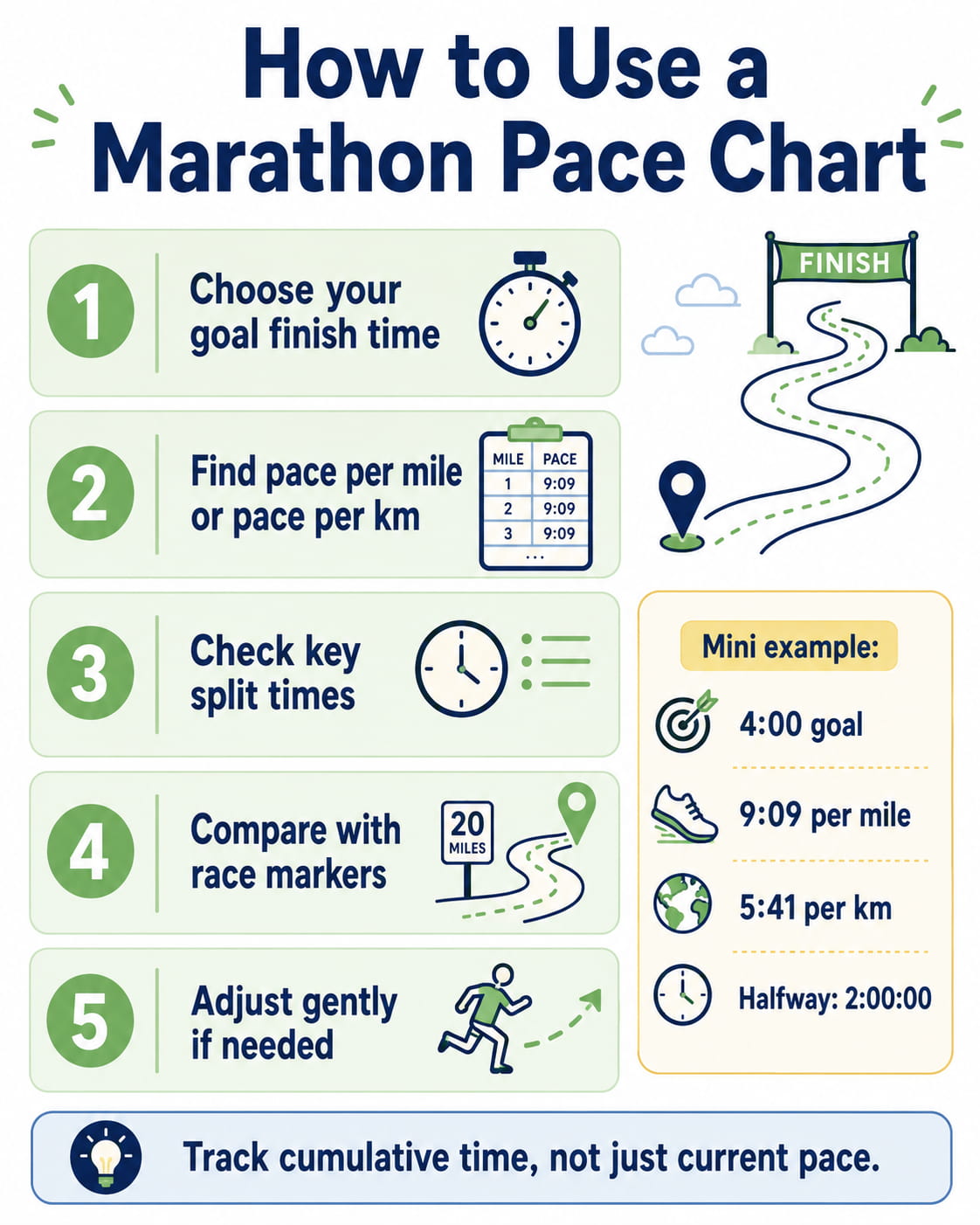
A marathon pace chart helps you turn a finish goal into a simple race-day plan.
Here is the easiest way to use it:
- Choose your goal finish time.
- Find the pace per mile or pace per kilometer.
- Check the major split times.
- Compare your actual race splits to the chart.
- Adjust gently if you are too fast or too slow.
For example, if your goal is a 4-hour marathon, your target pace is about 9:09 per mile or 5:41 per kilometer. Your halfway split should be close to 2:00:00, and your 20-mile split should be close to 3:03:05.
A pace chart is most useful when you check cumulative time, not just current pace. Current pace can jump around on GPS watches, especially near tall buildings, trees, tunnels, crowded starts, and sharp turns.
How to Calculate Marathon Pace
You can calculate marathon pace with a simple formula.
Pace per mile
Goal finish time ÷ 26.21875 miles = pace per mile
Example for a 4-hour marathon:
- 240 minutes ÷ 26.21875 = 9.15 minutes per mile
- That converts to about 9:09 per mile.
Pace per kilometer
Goal finish time ÷ 42.195 kilometers = pace per kilometer
Example for a 4-hour marathon:
- 240 minutes ÷ 42.195 = 5.69 minutes per kilometer
- That converts to about 5:41 per kilometer.
Split time
To calculate any split:
Goal finish time × split distance ÷ marathon distance = target split
For a 4-hour marathon at 10K:
- 240 minutes × 10 ÷ 42.195 = 56.9 minutes
- That equals about 56:53 at 10K.
Common Marathon Goal Times and Paces
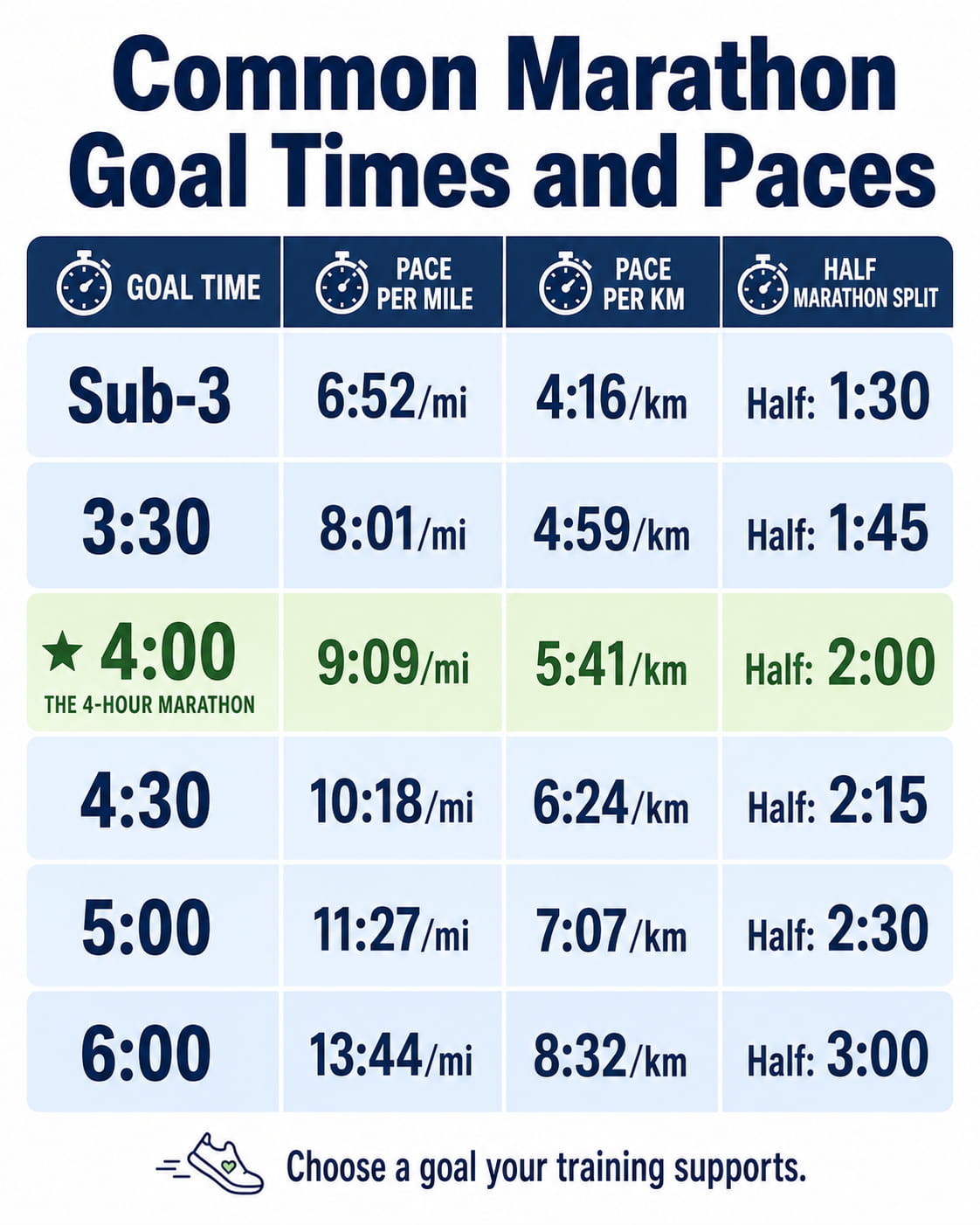
Some marathon goals are searched often because they are common race benchmarks. Use these quick numbers if you want a fast answer.
| Marathon Goal | Pace per Mile | Pace per KM | Halfway Split |
|---|---|---|---|
| Sub-3 marathon | 6:52/mi | 4:16/km | 1:30:00 |
| 3:30 marathon | 8:01/mi | 4:59/km | 1:45:00 |
| 4-hour marathon | 9:09/mi | 5:41/km | 2:00:00 |
| 4:30 marathon | 10:18/mi | 6:24/km | 2:15:00 |
| 5-hour marathon | 11:27/mi | 7:07/km | 2:30:00 |
| 6-hour marathon | 13:44/mi | 8:32/km | 3:00:00 |
What Pace Do You Need for a 4-Hour Marathon?
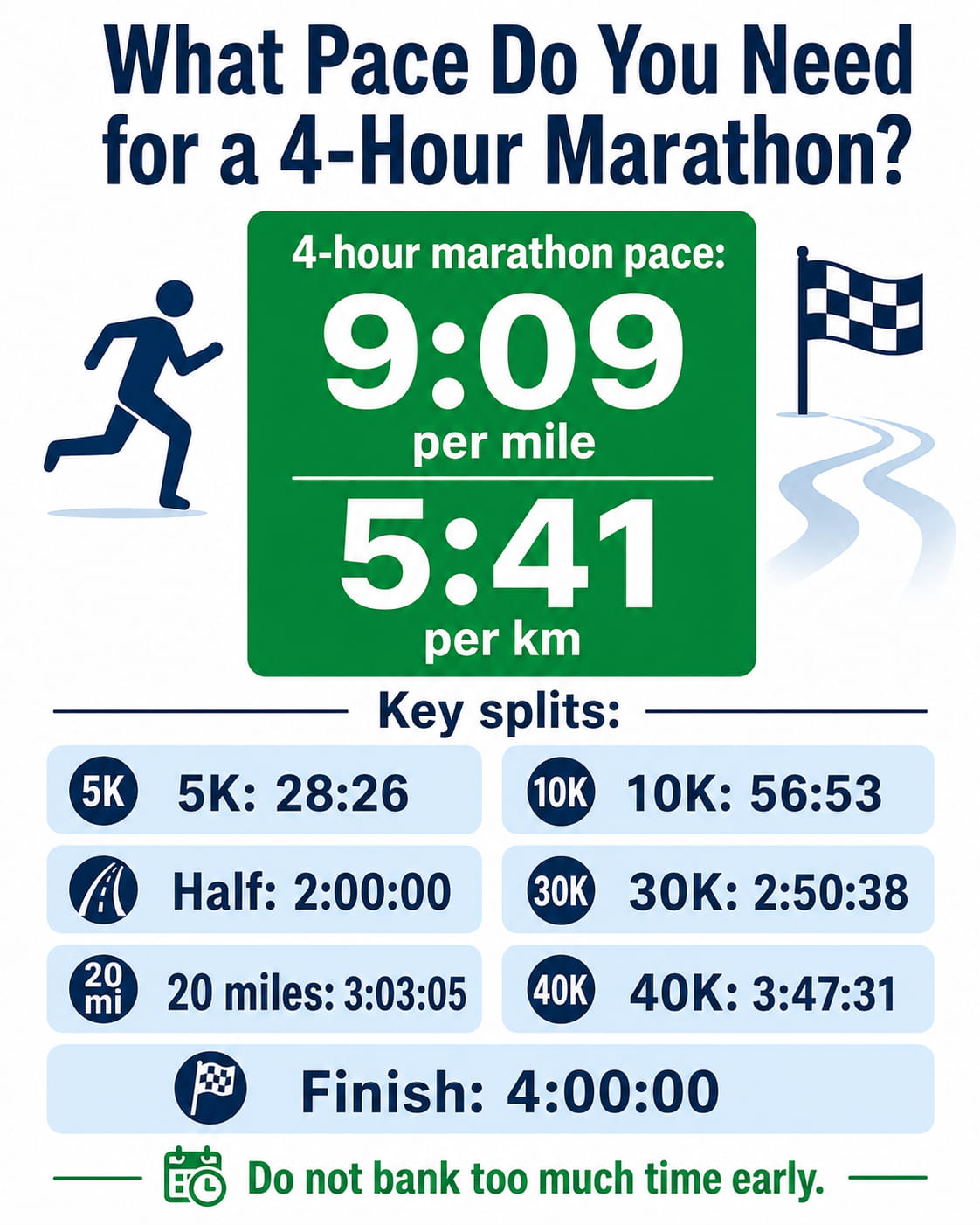
To run a 4-hour marathon, you need to average about 9:09 per mile or 5:41 per kilometer.
A simple 4-hour marathon split plan looks like this:
| Distance | Target Split |
|---|---|
| 5K | 28:26 |
| 10K | 56:53 |
| Half Marathon | 2:00:00 |
| 30K | 2:50:38 |
| 20 Miles | 3:03:05 |
| 40K | 3:47:31 |
| Finish | 4:00:00 |
The key is not to “bank time” too early. Running the first 5K too fast may feel easy, but it can make the final 10K much harder.
Even Splits vs. Negative Splits for Marathon Racing
For most runners, even pacing is the safest and simplest strategy. That means you try to run close to the same pace from start to finish.
The Bank of America Chicago Marathon Pace Team says its pacers run even splits throughout the race and recommends choosing a pace that reflects your training and ability. It also advises runners who are between two pace groups to start with the slower group because they can pick it up later.
A negative split means running the second half faster than the first half. This can work well for trained runners who start controlled and still feel strong after mile 20.
A good race-day approach is:
- Run the first 2–3 miles slightly controlled.
- Settle into goal pace after the crowd clears.
- Avoid chasing every second early.
- Recheck your effort at 10K, halfway, and 20 miles.
- Pick it up late only if you feel strong.
Why Your GPS Pace May Not Match Official Marathon Splits
Your GPS watch may show more than 26.2 miles by the finish. That does not always mean the course is long.
Official road races are measured using specific certification standards. USATF explains that course certification is designed to produce accurately measured road race distances, and certified courses are important for records, rankings, and comparing performances.
Your watch may read long because you may:
- Run wide around turns.
- Weave through crowds.
- Move sideways for aid stations.
- Miss the shortest legal race line.
- Lose GPS accuracy near buildings, trees, or tunnels.
For race pacing, use your watch as a guide, but trust the official mile markers, kilometer markers, and timing mats when available.
How to Choose the Right Marathon Goal Pace
The best marathon pace is not just the pace you want. It is the pace your training supports.
Before choosing a goal time, look at:
- Your recent half marathon or long-run performance.
- Your weekly mileage and consistency.
- How you feel at goal marathon pace during workouts.
- The race course elevation.
- Weather, heat, humidity, and wind.
- Your fueling and hydration practice.
- Your injury history and recovery.
If two goals seem realistic, start with the slightly slower one. A controlled first half gives you more options late in the race.
Boston Qualifying Pace Benchmarks
Many runners use Boston Marathon qualifying standards as long-term marathon goals. For the 2027 Boston Marathon, the Boston Athletic Association lists a standard of 2:55:00 for men ages 18–34 and 3:25:00 for women and non-binary athletes ages 18–34. The B.A.A. also notes that meeting the qualifying standard does not always guarantee entry if applications exceed the field size.
Here are two common Boston-related pace examples:
| Goal | Finish Time | Pace per Mile | Pace per KM |
|---|---|---|---|
| Men 18–34 standard | 2:55:00 | 6:40/mi | 4:09/km |
| Women/non-binary 18–34 standard | 3:25:00 | 7:49/mi | 4:52/km |
Always check the current B.A.A. rules before using a race as a qualifier. The B.A.A. has also announced net-downhill course adjustments for 2027 qualifying results, including time adjustments for some courses with large net downhill drops.
Marathon Pace Chart Tips for Race Day
A pace chart is only helpful if you use it calmly. Marathon pacing is about patience.
Start slower than you feel you can
The first miles often feel easier because of adrenaline, fresh legs, and crowd energy. Stay close to goal pace instead of sprinting ahead.
Use checkpoints, not panic
Being 10–20 seconds off at one checkpoint is not a crisis. Look for trends. If you are consistently too fast, relax. If you are slightly behind, adjust gradually.
Practice goal pace before race day
Do not let race day be the first time you try your target pace. Include controlled marathon-pace segments in training if your plan allows it.
Adjust for heat
Hot weather can make goal pace harder. The CDC advises athletes exercising in hot weather to limit activity during the hottest part of the day, start slowly, drink more water than usual, and stop activity if they feel faint or weak.
Fuel before you fade
A pace chart tells you how fast to run, but your fueling plan helps you keep running that pace. Practice race-day fueling during long runs so your stomach and timing are familiar.
Marathon Pace Mistakes to Avoid
Starting too fast
This is the most common marathon pacing mistake. A pace that feels easy at mile 3 can feel very different at mile 22.
Chasing your watch every few seconds
GPS pace can be noisy. Check lap pace or average pace instead of constantly reacting to instant pace.
Ignoring the course
A hilly course may require effort-based pacing. You may run slower uphill and slightly faster downhill while keeping your effort steady.
Setting a goal from hope, not training
A good marathon goal should match your current fitness, not just your dream finish time.
Forgetting aid-station time
Water stops, bathroom breaks, and crowded sections can add time. Build a small buffer into your plan, but do not sprint early to create it.
Marathon Pace Chart FAQs
What pace is a 3-hour marathon?
A 3-hour marathon requires about 6:52 per mile or 4:16 per kilometer. Your halfway split should be close to 1:30:00.
What pace is a 4-hour marathon?
A 4-hour marathon requires about 9:09 per mile or 5:41 per kilometer. Your 10K split should be about 56:53, and your halfway split should be 2:00:00.
What pace is a 5-hour marathon?
A 5-hour marathon requires about 11:27 per mile or 7:07 per kilometer. Your halfway split should be about 2:30:00.
Is it better to pace by miles or kilometers?
Use the system your race course marks most clearly. If the race has mile markers, use mile pace. If the race has kilometer markers, use kilometer pace. Many international marathons use kilometer markers, while many U.S. races use mile markers.
Should I run even splits or a negative split?
Even splits are simpler for most marathoners. A negative split can work if you start controlled, train for late-race strength, and still feel good after halfway.
Why does my watch show more than 26.2 miles?
Your watch may show extra distance because you did not run the shortest possible line, GPS accuracy varied, or you moved wide around turns and aid stations. Use official course markers to check your true race progress.
How accurate is a marathon pace chart?
A marathon pace chart is accurate as a planning tool when it uses the official 42.195 km distance. Small differences can happen because of rounding, GPS readings, course conditions, and where timing mats are placed.
Conclusion
A marathon pace chart gives you a clear target before race day and a simple way to stay calm during the race. Choose a realistic goal, practice that pace in training, and use mile or kilometer splits to check your progress.
For most runners, the best marathon strategy is steady, controlled, and patient. Start smart, fuel well, respect the conditions, and let the pace chart guide you toward the finish.
This content is for informational purposes only and not medical advice.