
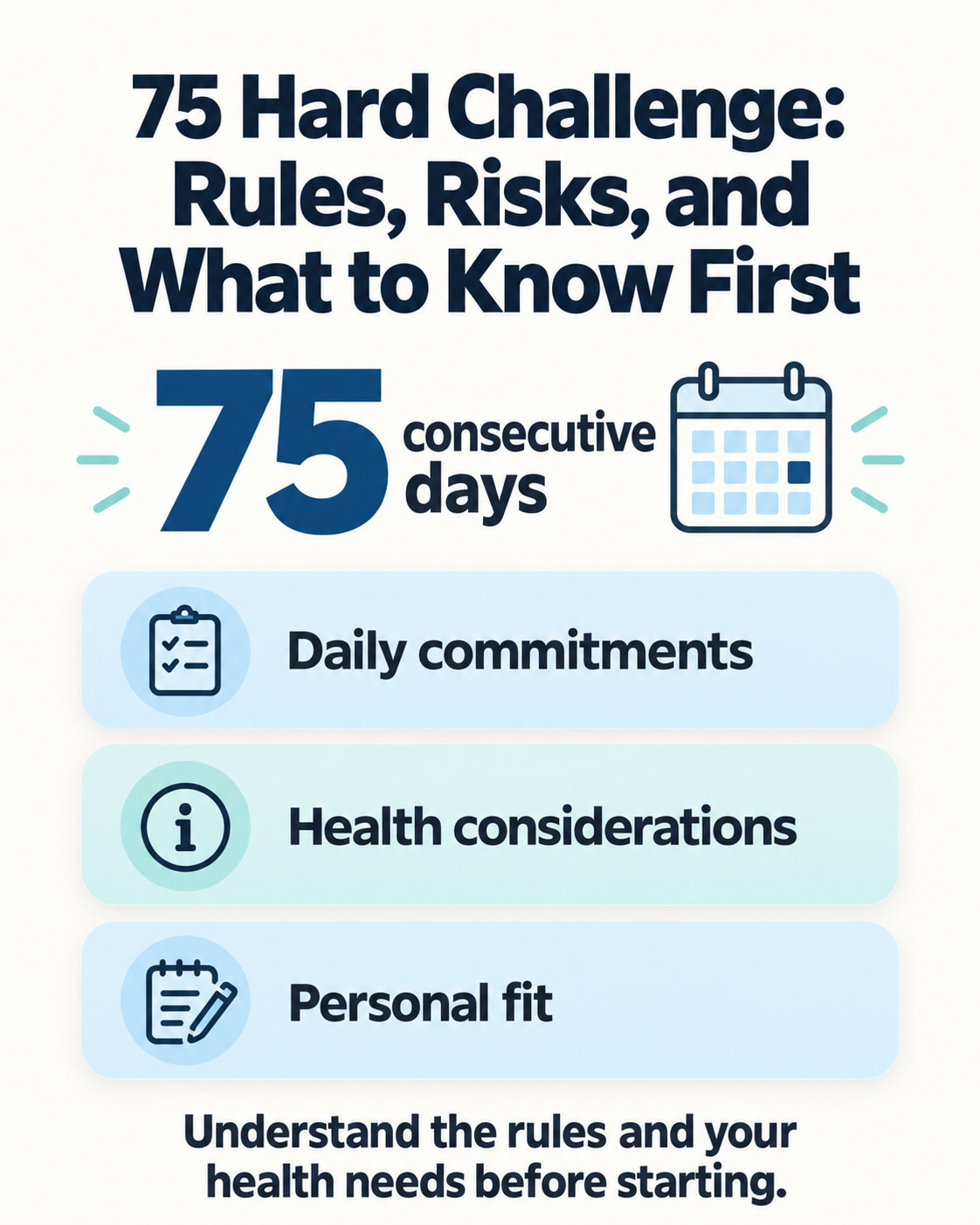
The 75 Hard Challenge is a 75-day program requiring a structured diet, two daily workouts, a gallon of water, 10 pages of reading, and a progress photo each day. Missing any task means restarting from Day 1 under its rules.
Created by entrepreneur Andy Frisella, the program is marketed as a way to build mental toughness. However, its physical demands and strict requirements deserve careful consideration. Before starting, understand the rules, assess your current fitness and health, and consider whether the routine fits your life.
What Are the 75 Hard Challenge Rules?
The basic program is free to follow. You choose your diet and workouts, but the daily requirements stay fixed.
| Daily task | What you must do |
|---|---|
| Follow a structured diet | Choose an eating plan aligned with your goals. Avoid alcohol and what the program calls “cheat meals.” |
| Complete two workouts | Exercise for at least 45 minutes per session, at least three hours apart. At least one session must be outdoors. |
| Drink one gallon of water | Consume 128 US fluid ounces, approximately 3.8 liters, of plain water. |
| Read 10 pages | Read at least 10 pages of educational nonfiction focused on personal development. Audiobooks do not count. |
| Take a progress photo | Take one photograph of yourself every day. |
The official 75 Hard FAQ clarifies that workouts cannot be combined into one session or divided into shorter blocks. Both sessions may be outdoors. Water containing flavorings, carbonation, or additives does not count toward the gallon.
Walking can qualify as a workout when done intentionally for exercise. The program does not require two intense workouts every day.
There are no scheduled days off from the tasks. However, a completion rule does not determine whether continuing is medically appropriate.
Potential Benefits of the 75 Hard Challenge
A daily checklist may appeal to people who like clear expectations. Planning exercise, paying attention to meals, and setting aside time to read can provide structure. Completing achievable commitments may also feel rewarding.
Regular physical activity supports health. However, benefits associated with exercise do not establish that every part of 75 Hard is necessary or suitable.
In its September 2025 assessment, Cleveland Clinic describes limited scientific evidence for the complete program. Participant testimonials cannot establish typical results or show whether improvements last.
The creator’s July 2026 article about the program’s science also discusses proposed mechanisms rather than presenting a clinical trial of 75 Hard.
There is no established guarantee of weight loss, lasting mental toughness, or better results than a more flexible routine. A daily photograph cannot measure cardiovascular fitness, nutritional adequacy, or mental well-being.
75 Hard Challenge Risks to Consider
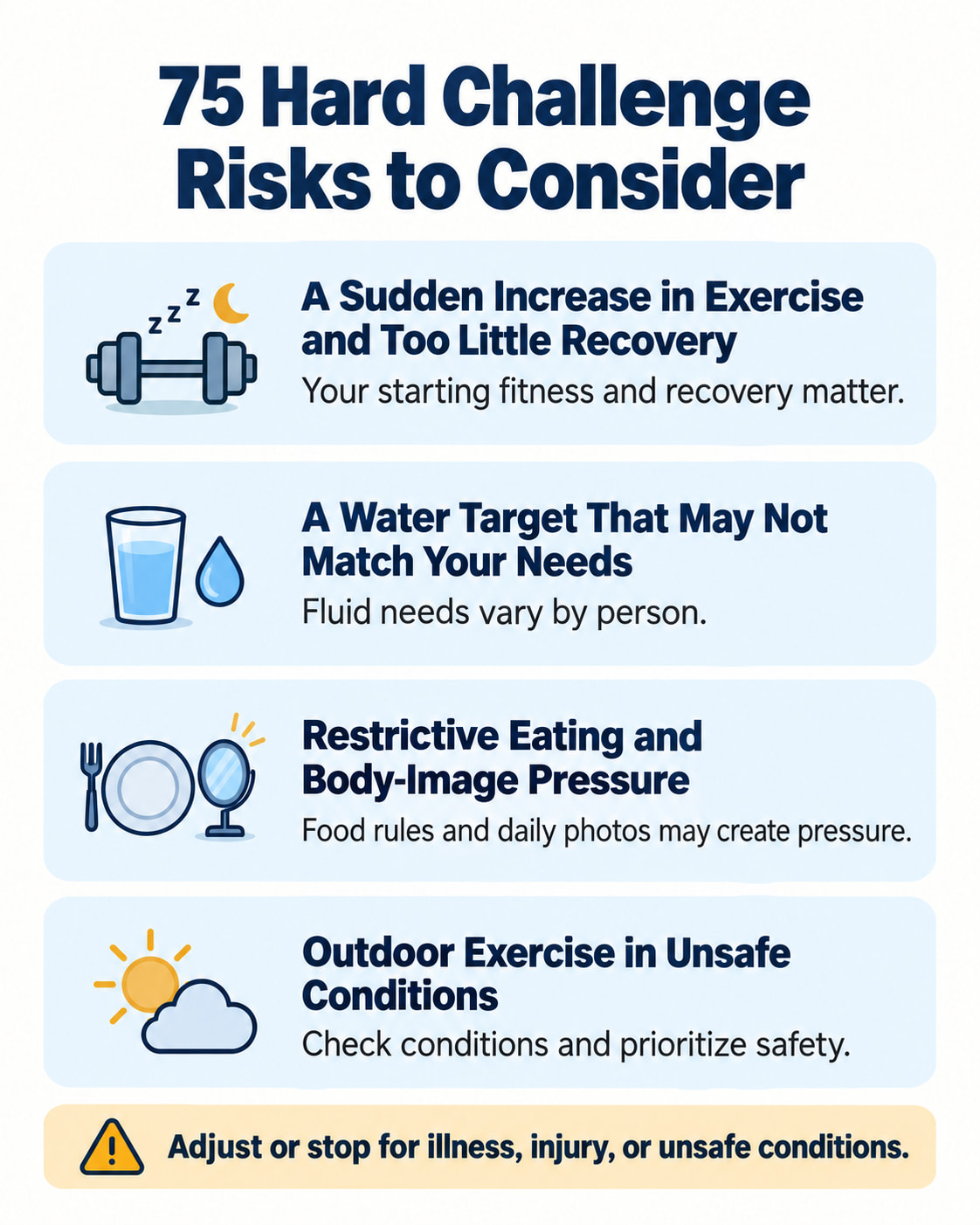
A Sudden Increase in Exercise and Too Little Recovery
Two 45-minute sessions add up to at least 90 minutes daily and 630 minutes weekly. Across 75 days, that is 112.5 hours of exercise, excluding preparation and travel.
For context, the Physical Activity Guidelines for Americans recommend 150–300 minutes of moderate aerobic activity weekly, or 75–150 minutes of vigorous activity, plus muscle strengthening on at least two days.
Those amounts are not upper safety limits. Also, walking, yoga, lifting weights, and running place different demands on your body.
The practical concern is how far the challenge takes you beyond your usual activity. Someone already exercising regularly has a different starting point from someone returning after months of inactivity.
MedlinePlus identifies persistent fatigue, declining performance, sleep problems, and overuse injuries as possible signs of excessive exercise. Easier sessions can reduce training stress, but they do not guarantee sufficient recovery.
A Water Target That May Not Match Your Needs
The gallon requirement is a challenge rule, not an individualized hydration recommendation.
The National Academies’ water-intake reference values are approximately 3.7 liters daily for adult men and 2.7 liters for adult women. These figures include water from food and all beverages, not just plain drinking water.
They are adequate-intake reference values, not maximum safe amounts. Your needs vary with activity, climate, health, and other circumstances.
Drinking excessive amounts, especially rapidly, can contribute to hyponatremia, or dangerously low blood sodium. The CDC’s 2026 Yellow Book chapter on heat and cold illness identifies overdrinking as a major contributor to exercise-associated hyponatremia. It also explains that sports drinks do not reliably prevent this problem when fluid intake is excessive.
Avoid forcing large amounts late in the day to finish a checklist. If you have a prescribed fluid restriction, kidney disease, heart failure, or take medicines affecting fluid balance, ask your clinician about the water requirement before attempting it.
Restrictive Eating and Body-Image Pressure
75 Hard does not require a particular diet or a calorie deficit. However, combining a restrictive eating plan with substantially more exercise can leave you eating too little for your activity.
A useful eating plan needs to account for energy, nutrients, preferences, and medical needs. Sticking to a rule does not automatically make a diet nutritionally adequate.
Daily photographs and the restart requirement may also create pressure for some people. Cleveland Clinic highlights potential body-image and self-esteem concerns.
These concerns deserve particular attention if you have a history of disordered eating or compulsive exercise. Feeling guilty about resting or continuing despite injury is a reason to reassess the approach.
Outdoor Exercise in Unsafe Conditions
An outdoor requirement can become a problem during extreme heat, severe cold, thunderstorms, or poor air quality.
The program’s own FAQ advises staying inside when outdoor exercise poses a serious health or safety threat. It still applies the restart rule if a task is missed.
Your safety takes priority. Check local conditions, adjust plans when necessary, and stop if you feel unwell. Completing an outdoor session is never worth ignoring a weather warning.
What to Know Before Starting 75 Hard
The official program advises checking with a healthcare professional before beginning and avoiding it if they advise against participation. This is especially relevant if you have an injury, a chronic condition, a fluid restriction, or concerns about eating or exercise behaviors.
Use these questions to assess the commitment:
- What is my current activity level? Build a manageable exercise routine before considering a large jump in duration or frequency.
- Can I protect recovery? Include sleep, adequate food, and recovery needs in your planning.
- Does my eating plan support my activity? Avoid choosing restrictions simply because they make the challenge harder.
- Is the water requirement appropriate for me? Consider your health and any professional guidance about fluids.
- Can the schedule fit without displacing essentials? Allow time for meals, work, family responsibilities, and sleep.
- What will I continue afterward? Identify habits you can reasonably maintain beyond Day 75.
You can decide that the complete challenge does not fit your needs while still pursuing meaningful goals.
When to Stop and Seek Help
Stop exercising and seek medical advice for persistent or worsening pain, unusual fatigue, or a sustained decline in performance. Also seek support if eating or exercise feels out of your control.
Headache, nausea, vomiting, or weakness after unusually high water intake warrants prompt medical assessment. These symptoms can overlap with heat illness; do not assume that drinking more will solve them.
New confusion, seizures, or loss of consciousness require emergency medical care. The CDC’s guidance on heat illness and exercise-associated hyponatremia explains why these symptoms need urgent attention.
A More Flexible Alternative to 75 Hard
You can borrow useful ideas from the challenge and set targets that match your circumstances.
| Area | A flexible approach |
|---|---|
| Movement | Start at your current capacity and gradually build toward appropriate activity goals. |
| Recovery | Adjust activity for fatigue, illness, injury, and training demands. |
| Eating | Follow a balanced pattern that provides enough food for your needs. |
| Hydration | Match fluid intake to your circumstances and any clinician guidance. |
| Reading | Choose a realistic reading goal and a format you can access. |
| Progress | Track consistency, energy, strength, or other meaningful measures. |
This would be your own routine rather than an official completion of 75 Hard. That distinction does not diminish the value of sustainable habits.
Frequently Asked Questions
Does Walking Count for the 75 Hard Challenge?
Yes. Intentional walking can qualify. Each workout still needs to meet the duration and separation requirements, with at least one outdoors. A walking session should match your ability and current health.
Can You Take Rest Days During 75 Hard?
The official rules require both workouts every day. Choosing an easier activity changes the workload but does not create a full rest day. If you need rest because of illness, injury, or fatigue, prioritize that need.
What Happens if You Miss One Task?
Under the program’s rules, you restart from Day 1, even if the missed task is a photograph or reading. Restarting the challenge’s count does not mean your earlier effort had no value.
Is a Gallon of Water Safe for Everyone?
No single amount fits everyone. A gallon may suit some circumstances and be excessive or insufficient in others. Total intake, drinking speed, sweat losses, medical conditions, and medications all matter.
Will the 75 Hard Challenge Help Me Lose Weight?
Weight loss is possible but not guaranteed. Results depend on your eating pattern, activity, starting point, and other factors. The program has no established average weight-loss result that can reliably predict your outcome.
Do You Need a Gym Membership or Special Equipment?
No. Walking and suitable bodyweight exercises can meet the activity component without a gym. Choose activities and surroundings that are appropriate for your ability, and allow enough time for each separate session.
Conclusion
The 75 Hard Challenge offers clear structure, but its fixed demands require careful consideration. Understanding the rules is only one part of deciding whether to participate.
Before committing, review your activity level, recovery, eating pattern, and fluid needs. Choose a routine you can follow safely and continue beyond a finish date.
This content is for informational purposes only and not medical advice.
References
- Cleveland Clinic. 75 Hard Challenge Rules and Healthy Alternatives.
- Andy Frisella. 75 Hard program overview and health disclaimer.
- Andy Frisella. 75 Hard rules.
- Andy Frisella. Official 75 Hard frequently asked questions.
- Andy Frisella. The Science of 75 Hard.
- U.S. Department of Health and Human Services. Physical Activity Guidelines for Americans: Executive Summary. Second edition, 2018.
- National Academies. Dietary intake reference values for water.
- MedlinePlus. Are You Getting Too Much Exercise?
- MedlinePlus. Low Blood Sodium.
- Centers for Disease Control and Prevention. Heat and Cold Illness in Travelers.