
There is no single official ideal weight chart for women by age. The most accurate approach depends on life stage: girls and teens are assessed with growth charts and BMI-for-age percentiles, adult women are usually assessed by height and BMI, and older women often need a more individualized view that looks beyond the scale. Understanding which chart applies to your age helps you avoid misleading numbers and use the right standard from the start.
Which Weight Chart Should Women Use at Each Age?
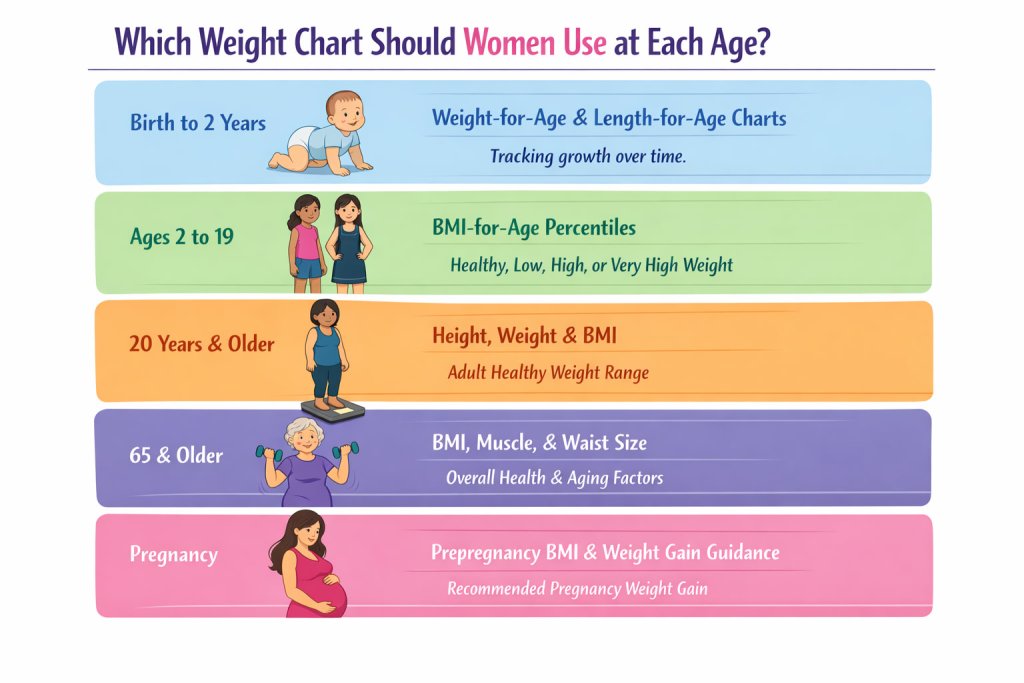
The term “ideal weight chart for women by age” sounds simple, but official guidance does not use one age-only chart for every woman. A more accurate way to think about it is healthy weight by life stage. For infants and young girls, clinicians use growth charts. For girls and teens, they use BMI-for-age percentiles. For adult women age 20 and older, the standard categories are based on BMI. For older women, the National Institute on Aging explains that healthy weight in later life is more individualized and should not be judged by a single number alone.
| Age group | Best chart or method | What it shows |
|---|---|---|
| Birth to 2 years | Weight-for-age and length-for-age growth charts | Whether growth is tracking normally over time |
| 2 to 19 years | BMI-for-age percentiles | Whether weight is low, healthy, high, or very high for age and sex |
| 20 years and older | Height, weight, and BMI | Adult healthy-weight screening range |
| 65 and older | BMI plus muscle, waist size, and overall health | A fuller picture of healthy aging |
| Pregnancy | Prepregnancy BMI plus pregnancy weight-gain guidance | Recommended weight gain during pregnancy |
Is There an Official Ideal Weight Chart for Adult Women by Age?
For adult women age 20 and older, the Centers for Disease Control and Prevention uses the same BMI categories it uses for adult men. Those categories are not adjusted by age. The standard ranges are underweight below 18.5, healthy weight 18.5 to less than 25, overweight 25 to less than 30, and obesity 30 or greater. That means an adult woman usually does not need a separate “by age” weight chart once she is past the teen years.
What does change with age is the context around the number. A woman in her 20s, 40s, or 70s can all have the same BMI, but their muscle mass, fat distribution, health conditions, and nutrition needs may be very different. That is why BMI is a screening tool, not a full diagnosis.
Ideal Weight Chart for Adult Women by Height
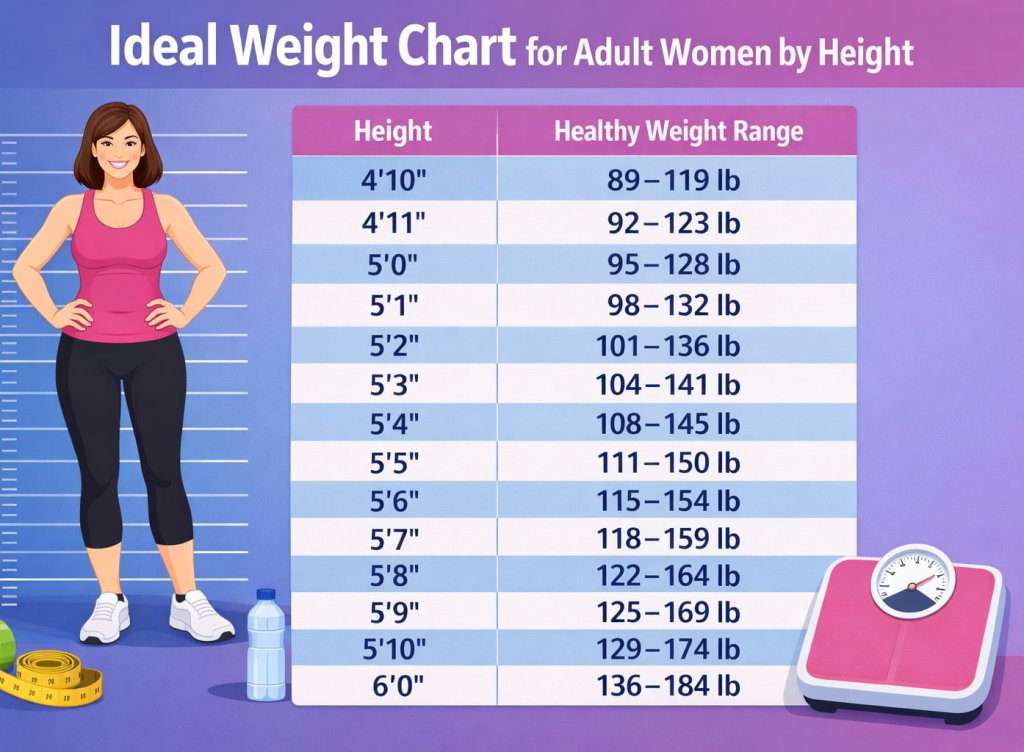
The chart below shows approximate healthy adult weight ranges for women based on the BMI range of 18.5 to 24.9 used by the CDC and reflected in the National Heart, Lung, and Blood Institute BMI table. This is a practical reference chart for adult women, but it is still only a starting point.
| Height | Approximate healthy weight range |
|---|---|
| 4’10” | 89 to 119 lb |
| 4’11” | 92 to 123 lb |
| 5’0” | 95 to 128 lb |
| 5’1” | 98 to 132 lb |
| 5’2” | 101 to 136 lb |
| 5’3” | 104 to 141 lb |
| 5’4” | 108 to 145 lb |
| 5’5” | 111 to 150 lb |
| 5’6” | 115 to 154 lb |
| 5’7” | 118 to 159 lb |
| 5’8” | 122 to 164 lb |
| 5’9” | 125 to 169 lb |
| 5’10” | 129 to 174 lb |
| 5’11” | 133 to 179 lb |
| 6’0” | 136 to 184 lb |
A few quick examples make this easier to use. If you are 5’4”, the healthy-weight screening range is about 108 to 145 pounds. If you are 5’6”, it is about 115 to 154 pounds. If you are 5’8”, it is about 122 to 164 pounds. These are helpful reference numbers, but they do not tell you how much of your weight is muscle, where you carry fat, or whether a recent weight change is intentional or concerning.
How to Measure Correctly Before Using the Chart
Before comparing your weight to the chart, make sure your height and weight are measured as accurately as possible. Weigh yourself without shoes and in light clothing, ideally under similar conditions each time. Measure height without shoes while standing straight against a wall. Even a small height error can shift your BMI range and make the chart look more or less favorable than it really is. This matters even more for older women, since small changes in height over time can affect the healthy-weight range shown on a chart.
Ideal Weight Chart for Girls and Teens
For girls and teens, weight should not be judged by an adult BMI chart. The CDC child and teen BMI guidance uses BMI-for-age percentiles for ages 2 through 19 because children and adolescents are still growing. The categories are underweight below the 5th percentile, healthy weight from the 5th percentile to below the 85th percentile, overweight from the 85th percentile to below the 95th percentile, and obesity at the 95th percentile or above.
This is why there is no reliable “one normal weight” for a 10-year-old girl or a 15-year-old girl based on age alone. Height, age, and sex all matter together. A taller teen and a shorter teen of the same age can both be growing normally at very different weights. In real life, that means parents should use official growth charts or a pediatrician’s interpretation instead of comparing a child’s weight to a simple age list found online.
Weight Charts for Baby Girls and Young Children
For babies and very young girls, the right tool is a growth chart, not an ideal-weight chart. The World Health Organization provides girls’ weight-for-age standards from birth through age 5, and the CDC also provides infant and child growth charts used in clinical care. These charts help track whether a child is following her own growth pattern over time, which is more useful than focusing on one target weight.
Why Age Still Matters for Women After 20
Even though the adult BMI categories stay the same, age still matters in several important ways. As women get older, body composition often changes. MedlinePlus notes that body fat tends to increase with age and fat may collect more around the center of the body. At the same time, changes in muscles, bones, and joints can also affect height and body shape. That means the same body weight can mean something different at 25 than it does at 70.
Midlife Changes Can Affect Weight Without Changing the Chart
Many women notice weight and waist-size changes during midlife. Hormonal changes, lower muscle mass, lower activity, and normal aging can make fat collect more around the abdomen even if body weight does not rise dramatically. This does not create a separate official BMI chart for women in their 40s or 50s, but it does make waist size, strength, and overall health more important when deciding whether a weight is truly healthy.
For older women, the National Institute on Aging says healthy weight ranges can be different than for other age groups, and that a doctor can help decide what a healthy weight means for you. The institute also warns that sudden, unintended weight loss can be a sign of a serious medical problem and should not be ignored.
Why BMI Is Helpful but Not Complete
BMI is useful because it is quick, standardized, and widely used in medical screening. But it has limits. The CDC BMI FAQ says BMI is not a direct measure of body fat, cannot distinguish fat from lean body mass such as muscle and bone, and cannot show where fat is stored in the body.
That matters for women who are very muscular, have low muscle mass, are naturally small-framed or large-framed, or are experiencing age-related body-composition changes. A woman can have a BMI in the healthy range and still carry too much abdominal fat. Another woman can have a BMI slightly above the healthy range and still be metabolically healthy, depending on the rest of her health picture. BMI is best used as one screening tool, not the final word.
Waist Size Matters Too
Body weight alone does not show where fat is stored. The National Heart, Lung, and Blood Institute notes that for women, a waist circumference greater than 35 inches is considered unhealthy and may signal higher risk, even if BMI is not in the obesity range. This is one reason many clinicians look at both BMI and waist size when assessing weight-related risk.
Pregnancy Needs a Different Weight Chart
Pregnancy is a separate case. Standard adult weight charts are not the right way to judge healthy pregnancy weight gain. The CDC pregnancy weight guidance bases pregnancy weight-gain recommendations on prepregnancy BMI. For a singleton pregnancy, the recommended total gain is 28 to 40 pounds if prepregnancy BMI was under 18.5, 25 to 35 pounds if BMI was 18.5 to 24.9, 15 to 25 pounds if BMI was 25.0 to 29.9, and 11 to 20 pounds if BMI was 30.0 to 39.9.
So if you are pregnant, the most accurate “ideal weight” question is not “What should I weigh for my age?” but “What was my BMI before pregnancy, and what weight-gain range fits that starting point?”
How to Use an Ideal Weight Chart for Women the Right Way
A healthy weight chart is most useful when you treat it as a screening guide, not a verdict.
Use it the right way:
- Use growth charts for babies, girls, and teens.
- Use height plus BMI for adult women.
- Use BMI, waist size, muscle, and overall health together for older women.
- Use pregnancy-specific guidance if you are pregnant.
- Pay attention to unexpected weight loss or gain, not just your current number.
A woman may want extra guidance if she is an athlete, has swelling or fluid retention, has recently lost height, is pregnant, or has a condition that affects appetite, mobility, hormones, or body composition. In those situations, a clinician can usually give a more accurate target than a chart alone.
When a Weight Chart Is Not Enough
A weight chart is a useful starting point, but it should not replace medical advice when something feels off. It is a good idea to talk with a clinician if you have rapid unexplained weight loss or gain, swelling, missed periods, trouble eating, ongoing fatigue, loss of strength, or a major weight change during pregnancy. Older women should also get checked if they are losing weight without trying, since unintended weight loss can sometimes point to nutrition, medication, thyroid, digestive, or other health problems.
FAQ
Is there a true ideal weight chart for women by age?
Not one official chart for every age. Babies and young girls are assessed with growth charts, girls and teens with BMI-for-age percentiles, and adult women with BMI and height-based screening ranges. Older women often need a more personalized assessment.
What is a healthy weight for a 5’4” woman?
Using the standard adult healthy BMI range of 18.5 to 24.9, a 5’4” adult woman falls at about 108 to 145 pounds. This is a useful screening range, not a diagnosis.
Does age change a woman’s healthy weight after 60?
The adult BMI categories themselves do not change, but healthy weight in older age can be more individualized. Changes in muscle, body fat, height, and medical conditions can make BMI less complete on its own.
Is BMI enough by itself?
No. BMI is useful for screening, but it does not directly measure body fat and does not show fat distribution. Waist size and overall health still matter.
The Bottom Line
The best “ideal weight chart for women by age” is really the right chart for the right life stage. Adult women usually need a height-and-BMI chart. Girls and teens need BMI-for-age percentiles. Older women often need a more personalized view, and pregnancy needs its own weight-gain guidance. Use charts as a helpful starting point, but let your overall health, body composition, and medical context guide the final answer.
Sources and References
- Centers for Disease Control and Prevention — Adult BMI Categories
- Centers for Disease Control and Prevention — Child and Teen BMI Categories
- Centers for Disease Control and Prevention — Weight Gain During Pregnancy
- Centers for Disease Control and Prevention — BMI Frequently Asked Questions
- Centers for Disease Control and Prevention — Clinical Growth Charts
- National Heart, Lung, and Blood Institute — BMI Table
- National Heart, Lung, and Blood Institute — Overweight and Obesity: Symptoms and Diagnosis
- National Institute on Aging — Maintaining a Healthy Weight
- MedlinePlus — Aging Changes in Body Shape
- World Health Organization — Weight-for-Age
This content is for informational purposes only and not medical advice.