
For most adults, a safe exercise heart rate target is about 50% to 85% of your estimated maximum heart rate, and your estimated maximum is usually 220 minus your age. That is why an exercise heart rate chart by age can help you choose a workout intensity that is challenging but still sensible. According to the American Heart Association, the chart is meant to be a general guide, not a personalized medical prescription.

Understanding your target zone matters because it helps you avoid two common problems: exercising too lightly to build fitness, or pushing too hard too soon. It also gives you a simple way to match your workout to your age, fitness level, medications, and health status. If you take heart-rate-lowering medicine or have a heart condition, the usual chart may not fit you exactly.
Exercise Heart Rate Chart by Age
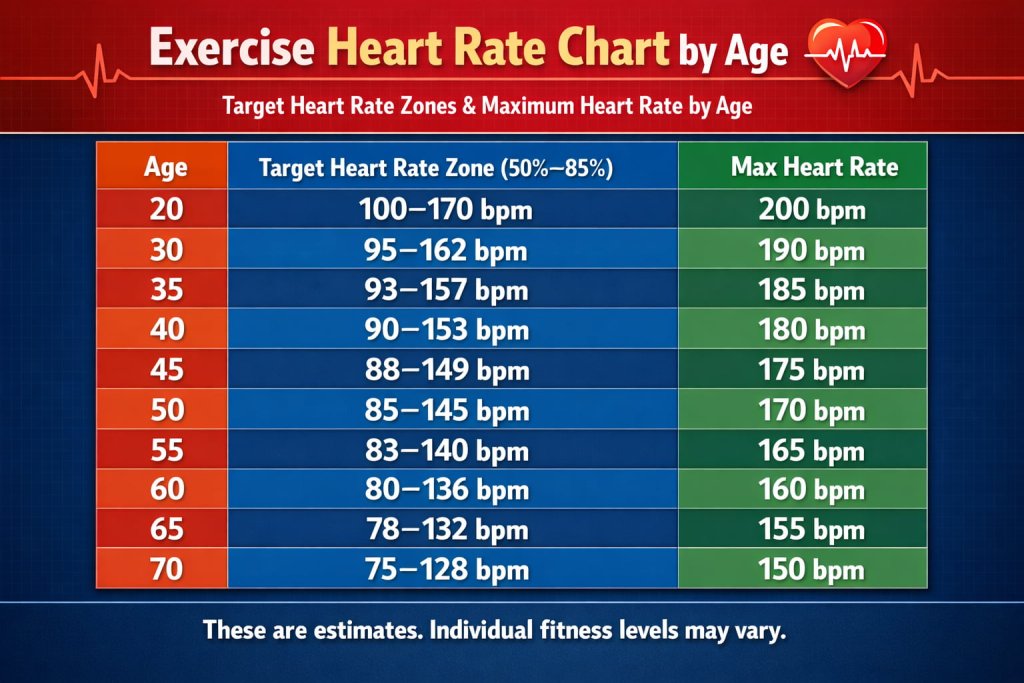
The table below uses the target heart rate chart from the American Heart Association. It shows the full target range of about 50% to 85% of your age-predicted maximum heart rate.
| Age | Target heart rate zone (50%–85%) | Estimated maximum heart rate |
|---|---|---|
| 20 | 100–170 bpm | 200 bpm |
| 30 | 95–162 bpm | 190 bpm |
| 35 | 93–157 bpm | 185 bpm |
| 40 | 90–153 bpm | 180 bpm |
| 45 | 88–149 bpm | 175 bpm |
| 50 | 85–145 bpm | 170 bpm |
| 55 | 83–140 bpm | 165 bpm |
| 60 | 80–136 bpm | 160 bpm |
| 65 | 78–132 bpm | 155 bpm |
| 70 | 75–128 bpm | 150 bpm |
These numbers are useful for quick planning, but they are still estimates. The American Heart Association says the figures are averages, so use them as a general guide rather than an exact personal limit.
What about children and teens?
This chart is mainly an adult quick-reference chart and starts at age 20. For children and teens, official guidance focuses more on getting enough daily activity than on following an adult-style target heart rate chart. Children and adolescents ages 6 to 17 should get 60 minutes or more of moderate-to-vigorous physical activity each day, with activities that are age-appropriate and enjoyable. That makes this adult chart less useful as a primary guide for younger age groups.
What the target heart rate zones mean
Your age chart becomes more useful when you split it into intensity zones. The American Heart Association says moderate-intensity exercise is about 50% to 70% of maximum heart rate, while vigorous exercise is about 70% to 85% of maximum heart rate. MedlinePlus uses the same ranges.
The CDC adds an easy real-world check. During moderate activity, you should usually be able to talk but not sing. During vigorous activity, you can usually say only a few words before pausing for breath. The CDC also says moderate effort often feels like a 5 or 6 out of 10, while vigorous effort starts around 7 or 8 out of 10.
Moderate and vigorous target heart rate zones by age
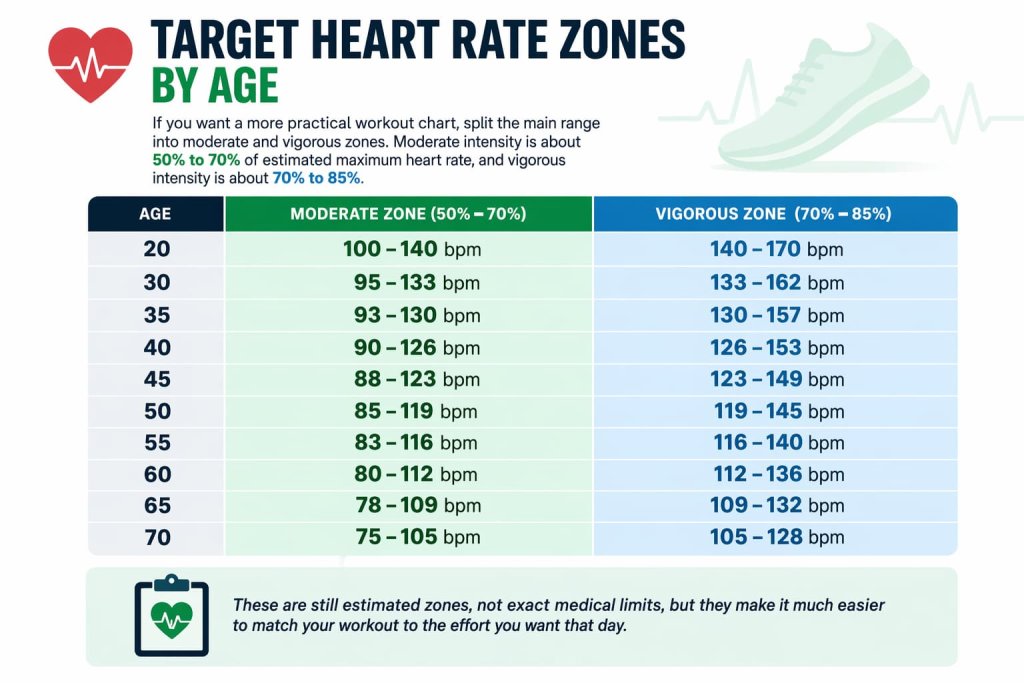
If you want a more practical workout chart, split the main range into moderate and vigorous zones. Moderate intensity is about 50% to 70% of estimated maximum heart rate, and vigorous intensity is about 70% to 85%.
| Age | Moderate zone (50%–70%) | Vigorous zone (70%–85%) |
|---|---|---|
| 20 | 100–140 bpm | 140–170 bpm |
| 30 | 95–133 bpm | 133–162 bpm |
| 35 | 93–130 bpm | 130–157 bpm |
| 40 | 90–126 bpm | 126–153 bpm |
| 45 | 88–123 bpm | 123–149 bpm |
| 50 | 85–119 bpm | 119–145 bpm |
| 55 | 83–116 bpm | 116–140 bpm |
| 60 | 80–112 bpm | 112–136 bpm |
| 65 | 78–109 bpm | 109–132 bpm |
| 70 | 75–105 bpm | 105–128 bpm |
These are still estimated zones, not exact medical limits, but they make it much easier to match your workout to the effort you want that day.
Here is a quick example:
- A 40-year-old has an estimated maximum heart rate of 180 bpm
- Moderate zone: about 90 to 126 bpm
- Vigorous zone: about 126 to 153 bpm
That example comes directly from the American Heart Association formula of 220 minus age, along with its percentage-based target zones.
Resting heart rate is not the same as target exercise heart rate
Many readers mix up resting heart rate and workout heart rate, but they are not the same number. Resting heart rate is how fast your heart beats when you are calm and not exercising. For most adults, the American Heart Association says a resting heart rate of about 60 to 100 bpm is normal. Your target exercise heart rate is higher because it is meant for physical activity, so do not compare your workout zone to your resting pulse. People who are more physically active may also have lower resting heart rates.
How to use an exercise heart rate chart by age during a workout
1. Find your age row
Start with the age closest to yours. If you are between chart ages, use the nearest one as a practical guide.
2. Start near the low end if you are new to exercise
MedlinePlus advises beginners to aim for the lower number in their target range first, then slowly work toward the higher end as fitness improves. This is one of the safest ways to build consistency without overdoing it.
3. Check your pulse during exercise
The American Heart Association says you can check your pulse on the inside of your wrist, use your first two fingers, count for 30 seconds, and multiply by 2. MedlinePlus also describes counting for 10 seconds and multiplying by 6. A wearable can help, but manual checks are still a useful backup.
4. Match the number to the type of workout
Use the lower half of your range for easier steady sessions and the higher part for harder training. If you are doing a brisk walk, easy cycling, or a light cardio session, moderate intensity is often enough. Harder intervals or faster running will usually push you closer to vigorous intensity. The CDC notes that both moderate and vigorous activity count toward weekly aerobic goals.
5. Use the chart with weekly exercise goals, not by itself
A good workout plan is more than one heart rate reading. The CDC says adults need 150 minutes of moderate-intensity aerobic activity a week, or 75 minutes of vigorous activity, or an equivalent mix, plus 2 days of muscle-strengthening activity.
When the heart rate chart may be less accurate
An exercise heart rate chart by age works best as a starting point. It becomes less reliable when something changes how your heart responds to effort.
The biggest example is medication. The American Heart Association says beta blockers slow the heartbeat, and MedlinePlus notes that some blood pressure medicines can lower your target heart rate. If that applies to you, your workout may feel hard even when your pulse looks lower than expected.
You should also get personalized advice before relying on the chart if you have high blood pressure, diabetes, a heart condition, or another ongoing health problem, especially if you have not exercised regularly for a while. MedlinePlus specifically recommends checking with a provider before starting a new routine in those situations.
In those cases, effort-based tools such as the CDC talk test can be more useful than chasing a number on a screen. If you can talk but not sing, you are usually in a moderate zone. If you can only get out a few words at a time, you are likely working vigorously.
Safe workout tips for heart rate training
A heart rate chart helps, but safe training habits matter just as much.
Warm up and cool down
The National Institute on Aging recommends warming up before exercise and cooling down after. A warm-up lets heart rate and breathing increase gradually. A cool-down helps them come down gradually at the end.
Build gradually
The CDC says some physical activity is better than none, and both the CDC and the National Institute on Aging recommend progressing at a safe, steady pace. That is especially important if you are older, out of shape, or returning after a long break.
Older adults need more than cardio alone
For adults 65 and older, the CDC recommends weekly aerobic activity, muscle-strengthening work, and balance activities. A heart rate chart is helpful for the aerobic part, but it does not replace strength and balance training.
Use heart rate with how you feel
If your heart rate looks “fine” but you feel awful, slow down. If your heart rate seems lower than expected but the effort feels hard, medication or fitness level may be affecting the number. Heart rate should support your judgment, not replace it. This is why the CDC’s effort scale and talk test are so useful.
When to stop exercising
MedlinePlus says to stop exercising and rest if activity causes:
- dizziness or lightheadedness
- chest pain
- irregular heartbeat or pulse
- shortness of breath
- nausea
The MedlinePlus guidance also says to contact a provider if you feel pain, pressure, tightness, or heaviness in the chest, arm, neck, or jaw, or if symptoms are severe, do not go away, or you cannot exercise as much as usual. Those warning signs matter more than any target-zone number.
Frequently asked questions
What is a good exercise heart rate by age?
A good exercise heart rate by age is usually the 50% to 85% target range based on your estimated maximum heart rate. The American Heart Association chart is the standard quick-reference guide for this.
What is the best target zone for beginners?
For most beginners, the safest place to start is the lower end of the target range, usually in the moderate-intensity zone of about 50% to 70% of maximum heart rate. MedlinePlus specifically advises starting with the lower number for your age range and building gradually.
Is a higher heart rate always better for fitness?
No. A higher heart rate is not automatically better. The right zone depends on your goal, your fitness level, your age, and your medical situation. Moderate activity still counts and is enough to meet official exercise recommendations when you do enough of it across the week.
Can you use a target heart rate chart if you take beta blockers?
You can use it only with caution. The American Heart Association says beta blockers slow the heartbeat, and MedlinePlus notes that some blood pressure medicines can lower target heart rate. In that situation, ask your health care professional what range is appropriate for you.
Bottom line
An exercise heart rate chart by age is one of the simplest tools for safer workouts. It helps you estimate your maximum heart rate, choose a sensible target zone, and match your effort to your age. For most people, the sweet spot is moderate to vigorous exercise done consistently over the week, with a gradual warm-up, a cool-down, and enough attention to symptoms and medications. The best next step is simple: use the chart as your guide, start where you are, and build from there.
This content is for informational purposes only and not medical advice.
Sources/References
- American Heart Association — Target Heart Rates Chart
- American Heart Association — All About Heart Rate (Pulse)
- American Heart Association — How Do Beta Blocker Drugs Affect Exercise?
- CDC — How to Measure Physical Activity Intensity
- CDC — Physical Activity Basics for Adults
- CDC — Older Adult Activity: An Overview
- National Institute on Aging — Tips for Getting and Staying Active as You Age
- MedlinePlus — Give Your Heart a Workout
- MedlinePlus — Being Active When You Have Heart Disease