
Arm exercises for beginners can absolutely help you build strength and improve muscle tone when you use simple movements, light-to-moderate resistance, and consistent practice. Learning the right beginner exercises matters because it helps you train safely, improve daily function, and build confidence without jumping into advanced workouts too soon.
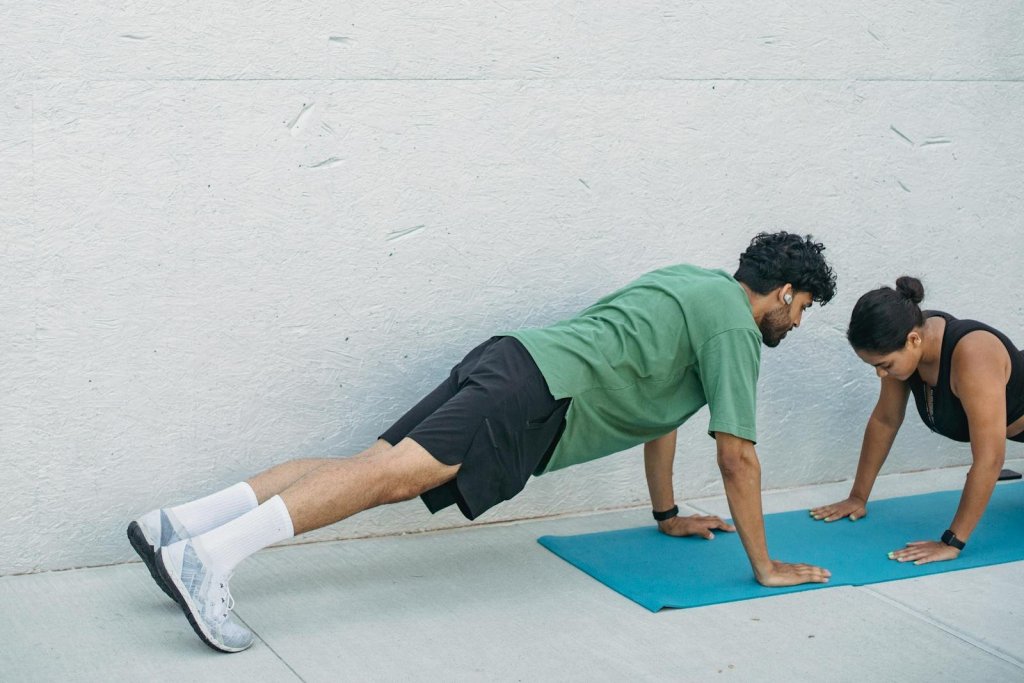
Current guidance from the CDC, Mayo Clinic, and NIA supports doing muscle-strengthening work at least 2 days per week and starting with controlled form before adding more load.
Why arm exercises for beginners are worth doing
Beginner arm training is not just about appearance. Stronger arms can make everyday tasks easier, including carrying groceries, lifting bags, pushing open doors, and supporting better upper-body control during other exercises. The CDC recommends muscle-strengthening activity at least 2 days per week, while Mayo Clinic notes that strength training can help build muscle, improve muscle tone, and support overall health.
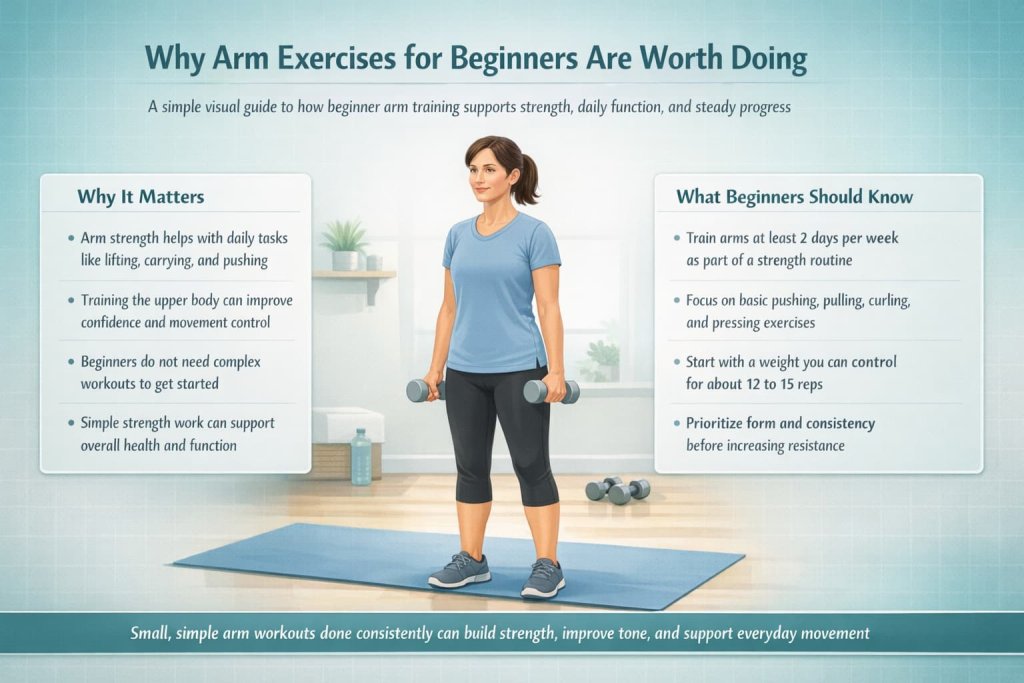
For beginners, the biggest win is usually consistency. You do not need complicated workouts. A small group of basic pushing, pulling, curling, and pressing exercises can train the biceps, triceps, shoulders, chest, and upper back in a balanced way. Mayo Clinic advises starting with a weight you can lift comfortably for about 12 to 15 repetitions and focusing on correct technique first.
Before you start arm exercises for beginners
Start with a resistance level you can control. That might mean bodyweight only, a light resistance band, or small dumbbells. Mayo Clinic advises using a weight you can lift comfortably 12 to 15 times and keeping your movements smooth rather than jerky.
Use these quick beginner rules before each session:
- Warm up for 5 to 10 minutes with easy movement
- Start with 1 set of 12 to 15 reps for each exercise
- Keep your breathing steady
- Stop if you feel sharp or worsening pain
- Rest at least a day before training the same muscle group hard again
Mayo Clinic and the NIA both support beginner-friendly strength training with regular recovery.
10 best arm exercises for beginners
These 10 best arm exercises for beginners are simple, effective moves that help build strength, improve muscle tone, and boost confidence with upper-body training. Start with light resistance, focus on good form, and practice consistently to make beginner arm workouts safe and effective.
1. Wall Push-Up
How to do it
- Stand facing a wall at arm’s length.
- Place your hands on the wall around chest height.
- Keep your body straight from head to heels.
- Bend your elbows and bring your chest toward the wall.
- Press back to the starting position.
- Repeat slowly and with control.
Why it works: Wall push-ups are one of the best starting points for beginners because they build pushing strength without putting full bodyweight on the arms and shoulders. The NHS specifically includes wall press-ups as a beginner strength exercise.
Muscles worked: Triceps, shoulders, chest, and core.
Trainer Tip: Keep your body in one straight line and do not let your lower back sag.
2. Incline Push-Up
How to do it
- Place your hands on a bench, sturdy table, or countertop.
- Walk your feet back so your body forms a straight line.
- Bend your elbows and lower your chest toward the surface.
- Press through your hands to return to the start.
- Keep your neck neutral throughout.
- Use a higher surface if you need an easier version.
Why it works: Incline push-ups are a smart next step after wall push-ups. They increase the challenge while still being easier than floor push-ups, making them ideal for gradual beginner progress. This fits with the general Mayo Clinic advice to build strength with correct form before making exercises harder.
Muscles worked: Triceps, chest, shoulders, and core.
Trainer Tip: Keep your elbows at a comfortable angle instead of flaring them straight out.
3. Biceps Curl
How to do it
- Stand tall with a dumbbell in each hand.
- Let your arms hang by your sides with palms facing forward.
- Curl the weights toward your shoulders.
- Keep your elbows close to your body.
- Lower the weights slowly.
- Repeat without swinging.
Why it works: The biceps curl is one of the simplest beginner arm exercises because it teaches elbow control and directly strengthens the front of the upper arm. Mayo Clinic shows the basic dumbbell curl setup, and ACE also lists curls as a standard arm-strengthening movement.
Muscles worked: Biceps, forearms.
Trainer Tip: Move the weight slowly and do not lean back to help the rep.
4. Hammer Curl
How to do it
- Hold a dumbbell in each hand with palms facing each other.
- Stand tall with your shoulders relaxed.
- Curl the weights upward while keeping your elbows near your sides.
- Pause briefly near the top.
- Lower the weights slowly.
- Repeat with steady form.
Why it works: Hammer curls train the arms from a slightly different angle than standard curls and can feel more comfortable on the wrists for some beginners. ACE includes hammer curls in its exercise library as an arm-strengthening option.
Muscles worked: Biceps, brachialis, forearms.
Trainer Tip: Keep your wrists straight and avoid twisting the dumbbells during the rep.
5. Overhead Triceps Extension
How to do it
- Hold one dumbbell with both hands or one dumbbell in each hand.
- Raise the weight overhead.
- Keep your upper arms mostly still.
- Bend your elbows to lower the weight behind your head.
- Straighten your elbows to return to the start.
- Move slowly and stay in control.
Why it works: This exercise directly trains the triceps, which are important for pushing strength and make up a large portion of the upper arm. Mayo Clinic demonstrates smooth, controlled triceps extensions and emphasizes avoiding jerky movement.
Muscles worked: Triceps, shoulders for support.
Trainer Tip: Keep your ribcage down and avoid arching your lower back as the weight goes overhead.
6. Triceps Kickback
How to do it
- Hold a dumbbell in one hand.
- Hinge forward slightly with your back flat.
- Bring your elbow up close to your side.
- Straighten your arm behind you.
- Pause briefly at the end of the movement.
- Return slowly and repeat before switching sides.
Why it works: Triceps kickbacks help beginners isolate the back of the upper arm with light weight and controlled movement. ACE describes the setup with a braced torso and stable body position.
Muscles worked: Triceps, rear shoulder support.
Trainer Tip: Do not swing the weight. Keep the upper arm steady and let the elbow do the work.
7. Dumbbell Shoulder Press
How to do it
- Sit or stand with a dumbbell in each hand at shoulder height.
- Brace your core.
- Press the weights overhead until your arms are nearly straight.
- Lower them back to shoulder level.
- Keep the movement smooth.
- Repeat with control.
Why it works: The shoulder press builds overhead strength and helps beginners train the shoulders and triceps together. ACE provides setup guidance for seated overhead pressing with a braced torso and stable body position.
Muscles worked: Shoulders, triceps, upper chest.
Trainer Tip: Start seated if standing feels too unstable or if you tend to arch your back.
8. Front Raise
How to do it
- Hold a dumbbell in each hand in front of your thighs.
- Stand tall with a soft bend in your elbows.
- Raise the weights forward to about shoulder height.
- Pause briefly.
- Lower slowly to the start.
- Repeat without using momentum.
Why it works: Front raises are simple for beginners and help build control in the front of the shoulders, which are involved in many pushing movements. This type of light, controlled strengthening fits the broader Mayo Clinic guidance on mastering technique before increasing resistance.
Muscles worked: Front deltoids, upper chest, triceps support.
Trainer Tip: Use lighter weights than you think you need. Front raises get difficult quickly when form is strict.
9. Lateral Raise
How to do it
- Stand with a dumbbell in each hand by your sides.
- Keep a slight bend in your elbows.
- Lift your arms out to the sides until about shoulder height.
- Pause briefly at the top.
- Lower slowly.
- Repeat with light weight and good control.
Why it works: Lateral raises help beginners strengthen the side of the shoulders, which can improve shoulder stability and upper-body balance. ACE describes the standard starting position with dumbbells at the thighs and a controlled lifting motion.
Muscles worked: Lateral deltoids, upper traps support.
Trainer Tip: Lift with control and stop around shoulder height instead of going too high.
10. Bent-Over Row
How to do it
- Hold a dumbbell in each hand.
- Hinge at the hips with your back flat.
- Let your arms hang below your shoulders.
- Pull the weights toward your lower ribs.
- Squeeze your shoulder blades gently.
- Lower the weights slowly and repeat.
Why it works: Rows are important in a beginner arm routine because they train the upper back and biceps together, creating more balanced upper-body strength. Mayo Clinic notes that the movement should stay smooth and controlled, with a neutral spine and stable shoulder position.
Muscles worked: Biceps, upper back, rear shoulders, forearms.
Trainer Tip: Do not round your back. Think chest open, core braced, and pull with your elbows.
A simple beginner arm workout plan
You do not need to do all 10 exercises in one workout. A practical beginner session can use 5 to 6 movements.
Try this example routine 2 to 3 times per week:
Beginner Arm Workout A
- Wall push-up: 1 to 2 sets of 10 to 15 reps
- Biceps curl: 1 to 2 sets of 12 to 15 reps
- Overhead triceps extension: 1 to 2 sets of 12 to 15 reps
- Lateral raise: 1 to 2 sets of 10 to 12 reps
- Bent-over row: 1 to 2 sets of 12 to 15 reps
Beginner Arm Workout B
- Incline push-up: 1 to 2 sets of 8 to 12 reps
- Hammer curl: 1 to 2 sets of 12 to 15 reps
- Triceps kickback: 1 to 2 sets of 12 to 15 reps
- Dumbbell shoulder press: 1 to 2 sets of 10 to 12 reps
- Front raise: 1 set of 10 to 12 reps
This approach lines up well with Mayo Clinic, which says one set can be effective for many people when the resistance is appropriate, and with the CDC, which recommends regular muscle-strengthening work each week.
How often should beginners train arms?
Most beginners do well with arm training 2 to 3 times per week, especially when the workouts are part of a broader full-body routine. The CDC recommends muscle-strengthening activity at least 2 days each week, and Mayo Clinic recommends training all major muscle groups at least twice weekly.
A good starting target is:
- 1 to 2 sets per exercise
- 8 to 15 reps per set
- 30 to 60 seconds of rest between lighter sets
- At least 1 recovery day before repeating hard arm work
Common beginner mistakes to avoid
Using too much weight too soon
Beginners often progress faster when they master the movement first. Mayo Clinic specifically advises starting with a weight you can lift comfortably 12 to 15 times.
Swinging the weights
Momentum can make an exercise feel easier, but it also shifts tension away from the target muscles. Smooth, controlled reps are the better long-term habit. Mayo Clinic notes the importance of moving smoothly and slowly during triceps work.
Training only curls
Many beginners focus only on biceps curls, but that can leave out the triceps, shoulders, chest, and upper back. A better routine includes pushing and pulling movements for more balanced strength.
Ignoring posture
Even simple arm exercises need good body position. Keep your ribcage stacked, shoulders relaxed, and neck neutral.
Are arm exercises for beginners enough to tone the arms?
Yes, beginner arm exercises can support more toned-looking arms over time by helping you build muscle and improve strength. But “tone” usually comes from a mix of muscle development, overall activity, and body composition, not from one move alone. That is why a balanced routine with regular strength training and weekly physical activity tends to work better than chasing one magic exercise. CDC guidance supports combining muscle-strengthening work with regular aerobic activity for overall health.
Who should be careful before starting?
Most healthy adults can begin with gentle arm training. Still, extra caution makes sense if you have:
- Recent shoulder, elbow, wrist, or neck injury
- Recent surgery
- Sharp pain during pushing, pulling, or overhead movement
- Major balance issues that affect standing exercises
If that applies to you, start with easier variations and consider getting guidance from a qualified health professional or exercise professional before progressing. Mayo Clinic notes that people with certain health concerns should check with a healthcare professional before starting new exercise work.
FAQs about arm exercises for beginners
What are the best arm exercises for beginners at home?
Some of the best at-home options are wall push-ups, incline push-ups, biceps curls, hammer curls, triceps kickbacks, and shoulder raises. These are simple, scalable, and do not require much equipment.
How many arm exercises should a beginner do in one workout?
Most beginners do well with about 4 to 6 exercises in a session. That is usually enough to train the main arm and upper-body muscles without making the workout too long.
Should beginners train arms every day?
Usually no. Muscles need time to recover. For most people, 2 to 3 arm-focused sessions per week is a better starting point than daily hard training. This matches general strength-training guidance from the CDC and Mayo Clinic.
What weight should beginners use for arm exercises?
Use a weight you can control for about 12 to 15 reps with good form. That is the beginner benchmark recommended by Mayo Clinic.
Are bodyweight arm exercises enough for beginners?
Yes. Wall push-ups and incline push-ups can be very effective starting exercises. Bodyweight work is often the best first step before adding dumbbells or bands.
How long does it take to notice results?
That varies by person, training consistency, recovery, and overall activity. Many beginners notice better control and strength before they notice visible changes.
Conclusion
Arm exercises for beginners do not need to be complicated to work. Start with basic movements, use manageable resistance, and focus on steady form. Over time, these beginner arm exercises can help you build strength, improve muscle tone, and feel more confident with upper-body training.
Start with 4 to 6 of the exercises above, practice them 2 to 3 times per week, and build from there.