
Back exercises for beginners can help you build strength safely when you start with simple movements, controlled form, and a routine you can repeat consistently. They matter because your back helps support posture, daily movement, lifting, carrying, and overall strength training balance. A smart beginner plan does not need fancy equipment. It needs good technique, gradual progression, and enough recovery to keep your training sustainable.
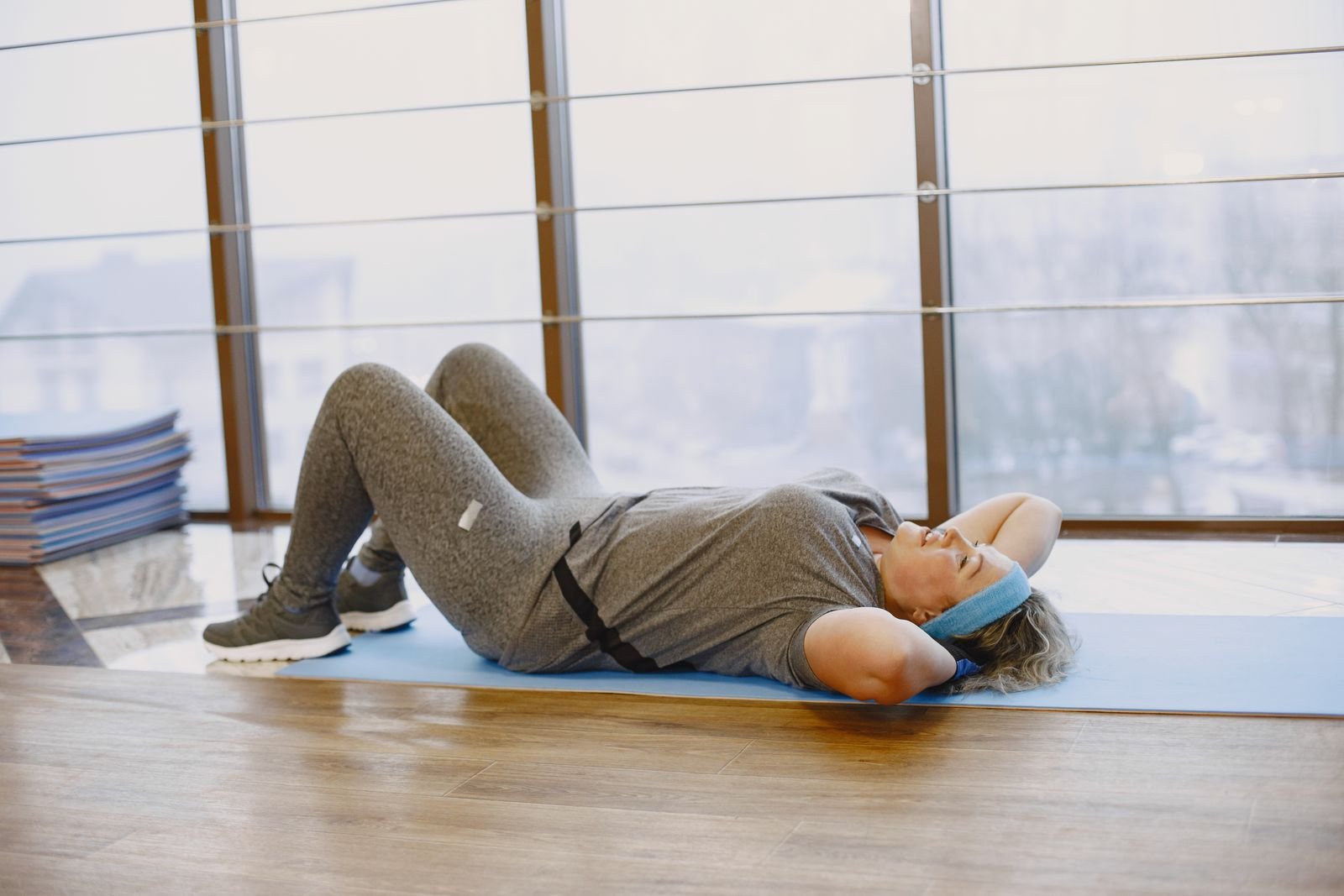
For most adults, back training fits best into the bigger picture of weekly activity. The CDC recommends at least 150 minutes of moderate-intensity activity each week plus muscle-strengthening work on at least 2 days per week, and the back counts as one of the major muscle groups you should train. Mayo Clinic also notes that many people can build strength effectively with a weight or resistance level that makes about 12 to 15 repetitions challenging while still allowing proper form.
What Are Back Exercises for Beginners?
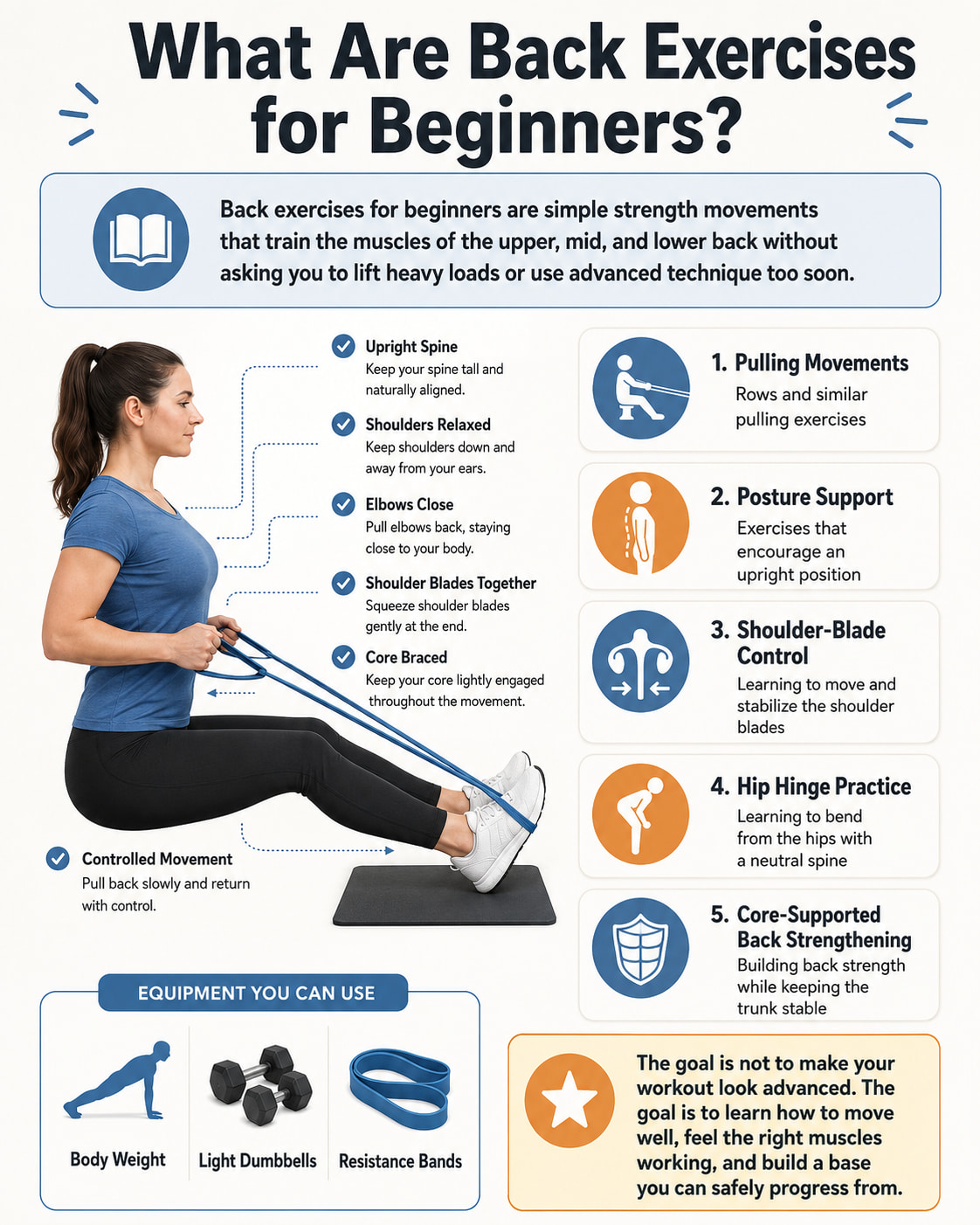
Back exercises for beginners are simple strength movements that train the muscles of the upper, mid, and lower back without asking you to lift heavy loads or use advanced technique too soon. A beginner-friendly back routine usually focuses on:
- pulling movements such as rows
- posture-support exercises
- shoulder-blade control
- hip hinge practice
- core-supported back strengthening
These exercises can be done with body weight, light dumbbells, or resistance bands. The goal is not to make your workout look advanced. The goal is to learn how to move well, feel the right muscles working, and build a base you can safely progress from.
Why Back Exercises for Beginners Matter
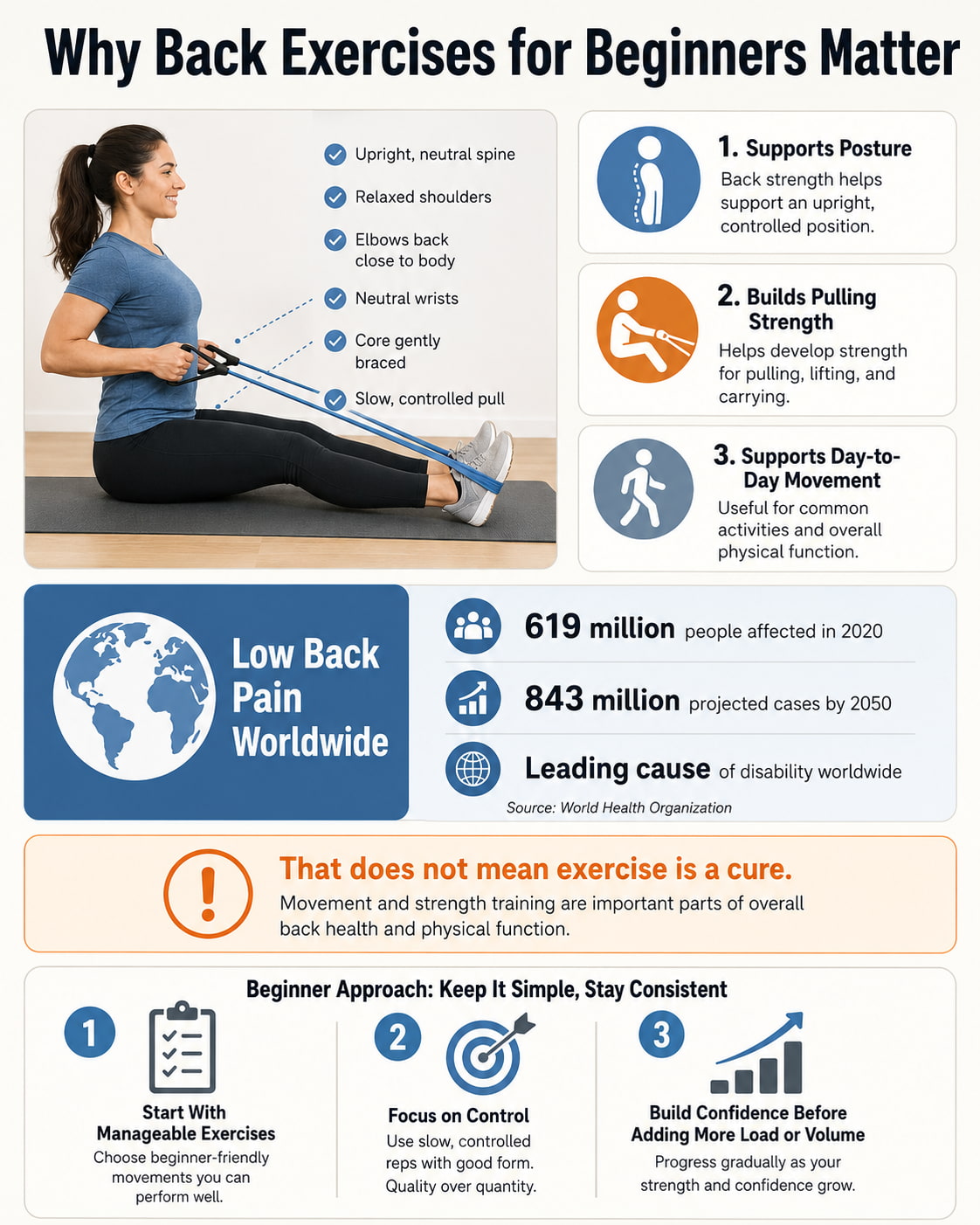
Back strength supports more than workouts. It helps with posture, pulling strength, and day-to-day movement. That matters because low back pain is extremely common worldwide. According to the World Health Organization, low back pain affected 619 million people globally in 2020 and is projected to reach 843 million cases by 2050. The same source also describes low back pain as the leading cause of disability worldwide.
That does not mean exercise is a cure. It means movement and strength training are important parts of overall back health and physical function. For beginners, the best approach is to start with manageable exercises, focus on control, and build confidence before adding more load or volume.
Muscles Worked During Beginner Back Exercises
A well-designed beginner back workout can train several important muscle groups at once:
- latissimus dorsi
- rhomboids
- middle and lower trapezius
- rear deltoids
- spinal erectors
- deep core and trunk stabilizers
You do not need to isolate every muscle perfectly as a beginner. In most cases, learning a few solid movement patterns will already train much of the back effectively.
Before You Start Back Exercises for Beginners
Before you jump into your first set, set yourself up properly. The AAOS Spine Conditioning Program recommends warming up with 5 to 10 minutes of low-impact activity before back exercises, and notes that doing the exercises 2 to 3 days per week can help maintain strength and range of motion. NHS guidance also says exercises and stretches can help, but you should stop if pain gets worse and get medical advice when needed.
Use these beginner rules before you start:
- warm up for 5 to 10 minutes with walking, marching, arm swings, or easy mobility
- choose a resistance level you can control
- move slowly enough to feel the target area working
- keep breathing instead of holding your breath
- stop and modify if you feel sharp, unusual, or worsening pain
10 Best Back Exercises for Beginners
Build strength safely with these beginner-friendly back exercises that support better posture, stability, and everyday movement. Each move is simple to learn, easy to scale, and designed to help you start strong with proper form.
1. Bird Dog
How to do it:
- Start on your hands and knees with your hands under your shoulders and knees under your hips.
- Brace your midsection lightly.
- Extend your right arm forward and your left leg backward.
- Keep your hips level and avoid twisting.
- Pause briefly.
- Return to the start position.
- Repeat on the other side.
Why it works: Bird dog is one of the best beginner back exercises because it teaches trunk control, balance, and gentle back stability without heavy loading. It trains the muscles that help support your spine while also challenging coordination through opposite arm-and-leg movement.
Muscles worked: This exercise mainly works the lower back stabilizers, core, glutes, and shoulders.
Trainer Tip: Do not lift your arm or leg higher than needed. Long and level is better than high and wobbly.
2. Wall Angels
How to do it:
- Stand with your back against a wall.
- Keep your head, upper back, and hips lightly touching the wall.
- Raise your arms into a goalpost shape.
- Slide your arms upward as far as you can comfortably go.
- Lower them with control.
- Repeat slowly.
Why it works: Wall angels help beginners improve posture awareness and shoulder-blade control, especially if they spend a lot of time sitting. This exercise reinforces upper-back engagement and encourages smoother overhead movement.
Muscles worked: This move mainly targets the upper back, rear shoulders, and postural muscles.
Trainer Tip: Move only through a pain-free range. Small, clean reps are fine.
3. Resistance Band Row
How to do it:
- Anchor a resistance band at chest height.
- Hold one end in each hand and step back to create tension.
- Stand tall with your chest up.
- Pull your elbows back toward your sides.
- Squeeze your shoulder blades gently together.
- Return to the start slowly.
- Repeat for controlled reps.
Why it works: A resistance band row is one of the simplest ways to teach pulling mechanics. It helps beginners learn how to pull with the back instead of shrugging everything into the neck and shoulders.
Muscles worked: This exercise works the lats, rhomboids, middle traps, rear delts, and biceps.
Trainer Tip: Think about driving your elbows back, not yanking with your hands.
4. Seated Band Row
How to do it:
- Sit on the floor with your legs extended or slightly bent.
- Loop a resistance band around your feet.
- Hold the handles or ends with both hands.
- Sit tall and pull your elbows backward.
- Pause briefly when your hands reach your sides.
- Return slowly.
- Repeat.
Why it works: This is another beginner-friendly row variation, especially for home workouts. It gives you a stable position and helps you focus on posture and shoulder-blade movement.
Muscles worked: This move mainly trains the mid-back, lats, rear shoulders, and biceps.
Trainer Tip: Do not round your lower back to get extra range.
5. Dumbbell Bent-Over Row
How to do it:
- Hold a dumbbell in each hand.
- Hinge at your hips with a flat back and soft knees.
- Let the weights hang below your shoulders.
- Pull your elbows up and back.
- Lower the weights slowly.
- Repeat without jerking.
Why it works: This is a classic back exercise for beginners once you can hinge safely and control light weights. It builds practical pulling strength and teaches your back to work while your hips stay hinged.
Muscles worked: This exercise mainly works the lats, rhomboids, traps, rear delts, and core stabilizers.
Trainer Tip: Start light. A clean hinge matters more than heavier dumbbells.
6. Single-Arm Dumbbell Row
How to do it:
- Place one hand and one knee on a bench or stable support.
- Hold a dumbbell in the free hand.
- Keep your back flat and neck neutral.
- Row the dumbbell toward your hip.
- Lower it with control.
- Finish all reps, then switch sides.
Why it works: This is a strong beginner option because the bench or support hand makes the movement more stable. It lets you focus on one side at a time and can help you notice strength differences between sides.
Muscles worked: This move targets the lats, rhomboids, traps, rear delts, and biceps.
Trainer Tip: Pull toward your hip, not straight up to your chest.
7. Reverse Fly
How to do it:
- Hold light dumbbells and hinge slightly forward.
- Keep a soft bend in your elbows.
- Raise your arms out to the sides.
- Stop when your upper arms are about in line with your torso.
- Lower slowly.
- Repeat.
Why it works: The reverse fly is lighter than many row variations, but it is excellent for upper-back awareness. It targets smaller upper-back and rear-shoulder muscles that support posture and shoulder control.
Muscles worked: This exercise mainly works the rear delts, rhomboids, and middle traps.
Trainer Tip: Use less weight than you think you need. This move gets sloppy fast when it is too heavy.
8. Glute Bridge
How to do it:
- Lie on your back with your knees bent and feet flat.
- Keep your arms by your sides.
- Brace your midsection lightly.
- Push through your heels and lift your hips.
- Pause at the top.
- Lower with control.
- Repeat.
Why it works: Glute bridge is not just a glute exercise. It also supports better lower-back training by teaching hip extension and trunk control. It helps beginners build strength around the hips so the lower back does not try to do everything alone.
Muscles worked: This move works the glutes, hamstrings, core, and lower-back support muscles.
Trainer Tip: Do not overarch your lower back at the top. Think ribs down and hips up.
9. Superman Hold
How to do it:
- Lie face down on the floor.
- Keep your neck neutral.
- Lift your arms and legs slightly off the floor.
- Hold briefly.
- Lower slowly.
- Repeat for short holds or controlled reps.
Why it works: This is a simple body-weight back exercise that can work well in small amounts for beginners. It trains the muscles along the back of the body to work together.
Muscles worked: This exercise mainly targets the lower back, glutes, upper back, and shoulders.
Trainer Tip: Small lifts are enough. Do not force height.
10. Dead Bug
How to do it:
- Lie on your back with your arms up and knees bent to 90 degrees.
- Press your lower back gently toward the floor.
- Lower one arm and the opposite leg slowly.
- Return to the start.
- Repeat on the other side.
- Alternate sides for controlled reps.
Why it works: Dead bug is more of a core stability exercise, but it belongs in many beginner back programs because trunk control helps support the spine. It teaches you to move your arms and legs while keeping your torso steady.
Muscles worked: This move works the core, deep trunk stabilizers, hip flexors, and the lower-back support system.
Trainer Tip: Only lower your arm and leg as far as you can without losing control through your trunk.
A Simple Beginner Back Workout Plan
Here is a practical sample routine you can use 2 to 3 times per week:
- Bird Dog: 2 sets of 6 to 8 reps per side
- Resistance Band Row: 2 to 3 sets of 10 to 15 reps
- Single-Arm Dumbbell Row: 2 sets of 8 to 12 reps per side
- Reverse Fly: 2 sets of 10 to 12 reps
- Glute Bridge: 2 to 3 sets of 10 to 15 reps
- Dead Bug: 2 sets of 6 to 10 reps per side
This fits well with general beginner guidance from Mayo Clinic, which notes that one set of 12 to 15 good repetitions can be effective for many people, especially when learning strength work.
How Often Should Beginners Train Their Back?
For most beginners, 2 to 3 sessions per week is a strong starting point. That lines up well with the CDC recommendation for muscle-strengthening work on at least 2 days per week and with AAOS guidance that back-conditioning exercises performed 2 to 3 days weekly can help maintain strength and range of motion.
A simple schedule could look like this:
- Monday: back workout
- Wednesday or Thursday: back workout
- Saturday: optional light back or full-body session
Try not to train the same area hard on back-to-back days when you are just starting.
Common Mistakes Beginners Should Avoid
Using too much weight too soon
Beginners often try to make back exercises feel harder by loading them too quickly. That usually leads to momentum, shrugging, or poor positioning.
Rushing the reps
A fast rep often turns a back exercise into a whole-body swing. Slow down and own each position.
Letting the neck do the work
If your shoulders creep up toward your ears, your upper traps may be taking over too much.
Rounding excessively during rows
A small natural curve is normal, but you should not collapse through the torso just to move the weight.
Holding your breath
NIA guidance for strength exercise safety says not to hold your breath during strength work. Breathe out during the effort and breathe in as you relax.
Who Should Be Careful Before Starting?
Back exercises for beginners are often appropriate when scaled properly, but some people should get medical guidance first, especially if they have:
- recent back, shoulder, or hip surgery
- severe or worsening pain
- pain that travels down the leg
- weakness, numbness, or tingling
- major balance limitations
- a medical condition that affects safe exercise tolerance
NHS advises stopping exercises if pain gets worse and seeking medical advice when needed.
How to Progress Safely
Once the exercises feel steady and controlled, progress gradually by changing only one thing at a time:
- add a few reps
- add one extra set
- use slightly more resistance
- slow the lowering phase
- improve range of motion without losing form
This gradual approach matches the broader guidance from Mayo Clinic and NIA to use proper form, start with manageable resistance, and build up slowly.
FAQ About Back Exercises for Beginners
What are the best back exercises for beginners at home?
Some of the best options are bird dog, resistance band rows, seated band rows, glute bridges, reverse flys, and dead bugs. They are simple, scalable, and do not require advanced equipment.
How many back exercises should a beginner do in one workout?
Most beginners do well with 4 to 6 exercises in one session, especially when learning technique.
Can beginners train back without weights?
Yes. Body-weight and band exercises can work very well at the start. You can build skill first, then add dumbbells later.
How many reps should beginners do?
A practical beginner range is often 8 to 15 reps, depending on the movement. Mayo Clinic notes that many people can build strength effectively with resistance that makes about 12 to 15 reps challenging while allowing good form.
Are back exercises good for posture?
They can support better posture because they strengthen the muscles that help hold your shoulders and trunk in better alignment. They are most useful when paired with regular movement and good everyday habits.
Should beginners do back exercises every day?
Usually no. Most beginners recover better with 2 to 3 sessions per week rather than hard daily back training.
What if a back exercise hurts?
Stop that movement and check your form, range of motion, and exercise selection. If pain gets worse or feels unusual, get medical guidance. NHS specifically advises stopping if back pain worsens during exercises.
Conclusion
Back exercises for beginners do not need to be complicated to be effective. Start with simple movements, clean technique, and a schedule you can actually keep. Focus on rows, posture work, trunk stability, and gradual progression. Over time, those basics can help you build a stronger back, better movement control, and more confidence in the gym or at home.
A good next step is to choose 4 to 6 exercises from this list and follow them 2 to 3 times per week with manageable resistance and steady form.