
Breathing exercises are simple, structured ways to control your breath to support relaxation, focus, and emotional balance. Breathing exercises can help calm your mind within minutes by slowing your breathing rate and reducing stress responses in the nervous system.
Understanding how to use breathing exercises correctly matters because they are free, accessible, and can be practiced anywhere—at home, work, or before sleep. When done gently and consistently, they may help support stress management, sleep quality, and overall well-being.
Below is a clear, science-informed guide to the 12 best breathing exercises, how to do them safely, and who they may benefit.
What Are Breathing Exercises?
Breathing exercises are intentional breathing patterns designed to regulate how fast, deep, or rhythmically you breathe. Many approaches focus on slower breathing, longer exhales, or diaphragmatic (belly) breathing.
How Breathing Exercises Help Calm the Mind
Breathing exercises may support calm through several mechanisms:
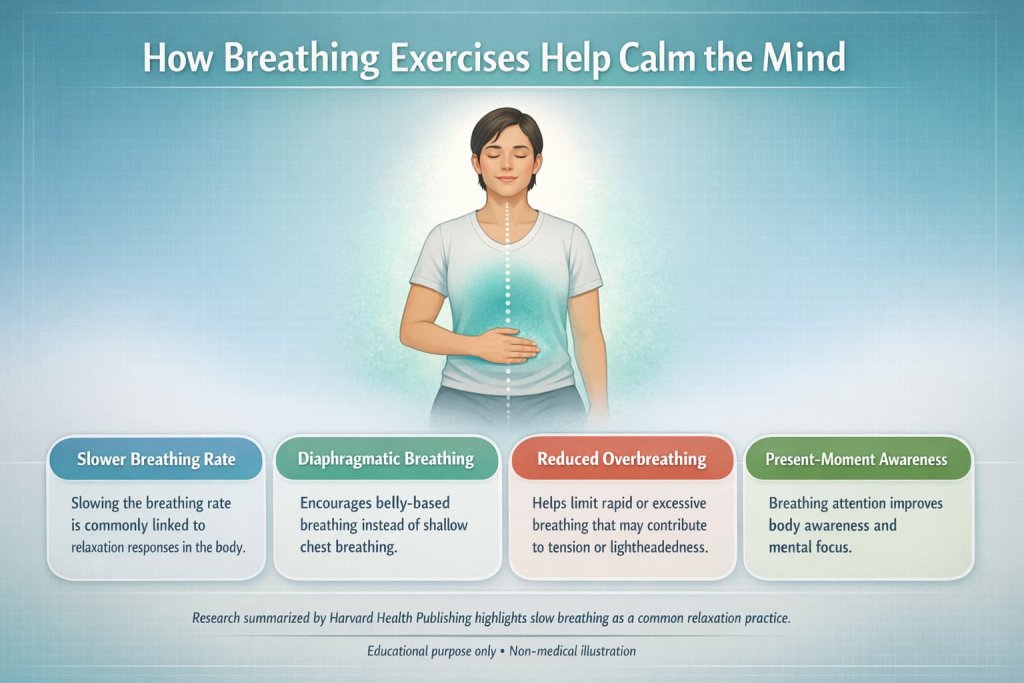
- Slowing the breathing rate, which is linked to relaxation responses
- Encouraging diaphragmatic movement instead of shallow chest breathing
- Reducing overbreathing that can contribute to tension or lightheadedness
- Improving awareness of the body and present moment
Research summarized by Harvard Health Publishing notes that slow breathing practices are commonly used to support relaxation and stress management.
12 Best Breathing Exercises
These 12 breathing exercises are simple, effective techniques designed to help calm your mind within minutes. Each exercise focuses on slow, controlled breathing patterns that support relaxation, focus, and stress regulation.
1. Diaphragmatic (Belly) Breathing
How to do it
- Sit or lie in a comfortable position with your spine supported
- Place one hand on your chest and the other on your belly
- Inhale slowly through your nose, allowing your belly to rise while your chest stays relatively still
- Exhale gently through your nose or mouth, letting the belly fall naturally
- Continue for 5–10 minutes at a relaxed, unforced pace
Why it works
Diaphragmatic breathing shifts breathing away from shallow chest movement toward deeper, slower abdominal breathing. This pattern is commonly associated with relaxation responses and reduced physical tension linked to stress.
2. Box Breathing (4-4-4-4)
How to do it
- Inhale through your nose for a slow count of 4
- Hold the breath comfortably for 4 seconds
- Exhale through your nose or mouth for 4 seconds
- Hold again for 4 seconds before starting the next cycle
- Repeat for several rounds while maintaining relaxed posture
Why it works
Equal breathing phases create a predictable rhythm that may help steady attention, reduce mental overload, and support a calmer breathing pattern during stressful moments.
3. 4-7-8 Breathing
How to do it
- Inhale quietly through your nose for 4 seconds
- Hold the breath gently for 7 seconds without straining
- Exhale slowly through your mouth for 8 seconds, keeping the jaw relaxed
- Complete 3–6 cycles, resting if needed
Why it works
The longer exhale phase increases the exhale-to-inhale ratio, a breathing pattern often associated with relaxation and reduced physiological arousal.
4. Extended Exhale Breathing
How to do it
- Inhale through your nose for about 4 seconds
- Exhale slowly for 6–8 seconds, allowing the body to soften
- Pause briefly before the next inhale if it feels comfortable
- Continue for several minutes
Why it works
Prolonging the exhale may help slow overall breathing rate and reduce tension by emphasizing the calming phase of the breath cycle.
5. Resonant (Paced) Breathing
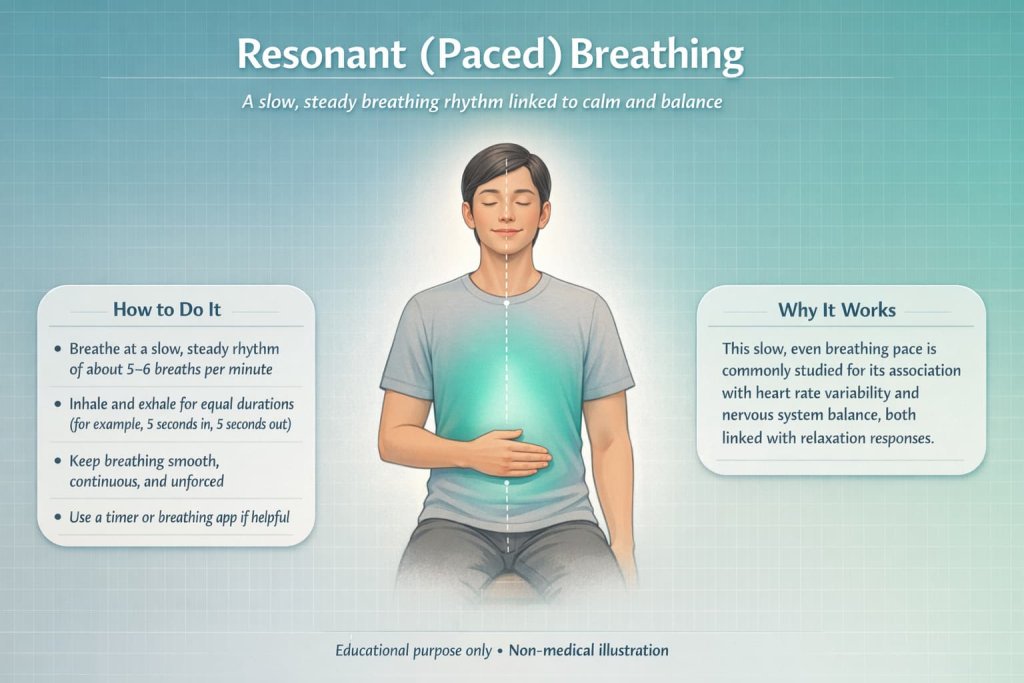
How to do it
- Breathe at a slow, steady rhythm of roughly 5–6 breaths per minute
- Inhale and exhale for equal lengths of time (for example, 5 seconds each)
- Keep breathing smooth, continuous, and unforced
- Use a timer or breathing app if helpful
Why it works
This breathing pace is frequently studied in relation to heart rate variability and nervous system balance, both commonly linked with relaxation responses.
6. Pursed-Lip Breathing
How to do it
- Inhale slowly through your nose
- Purse your lips as if gently blowing out a candle
- Exhale slowly through pursed lips, making the exhale longer than the inhale
- Repeat at a comfortable pace
Why it works
Pursed-lip breathing helps slow airflow and breathing rate, which may reduce the sensation of breathlessness and promote more controlled breathing.
7. Alternate Nostril Breathing
How to do it
- Sit comfortably with relaxed shoulders
- Gently close one nostril and inhale through the open nostril
- Switch sides and exhale through the opposite nostril
- Continue alternating sides for several cycles
- Keep breathing slow and smooth
Why it works
The alternating pattern encourages mindful attention to breathing and naturally slows the breath, which may support a sense of calm and balance.
8. Counted Breathing
How to do it
- Inhale through your nose for a slow count (such as 4)
- Exhale for a slightly longer count (such as 6)
- Maintain the same counts for each breath
- Continue for several minutes
Why it works
Counting provides structure and focus, helping regulate breathing pace while gently shifting attention away from stress-related thoughts.
9. Coherent Breathing
How to do it
- Inhale smoothly for 6 seconds
- Exhale smoothly for 6 seconds
- Avoid breath holding or forceful breathing
- Maintain the rhythm for 5–10 minutes
Why it works
Equal inhale and exhale timing creates a balanced breathing rhythm that may support emotional regulation and a calmer internal state.
10. Breathing With a Pause
How to do it
- Inhale gently through your nose
- Exhale slowly and fully
- Pause briefly at the end of the exhale before inhaling again
- Keep the pause short and comfortable
Why it works
The brief pause naturally slows breathing frequency and may help reduce habitual rapid breathing patterns.
11. Slow Nasal Breathing
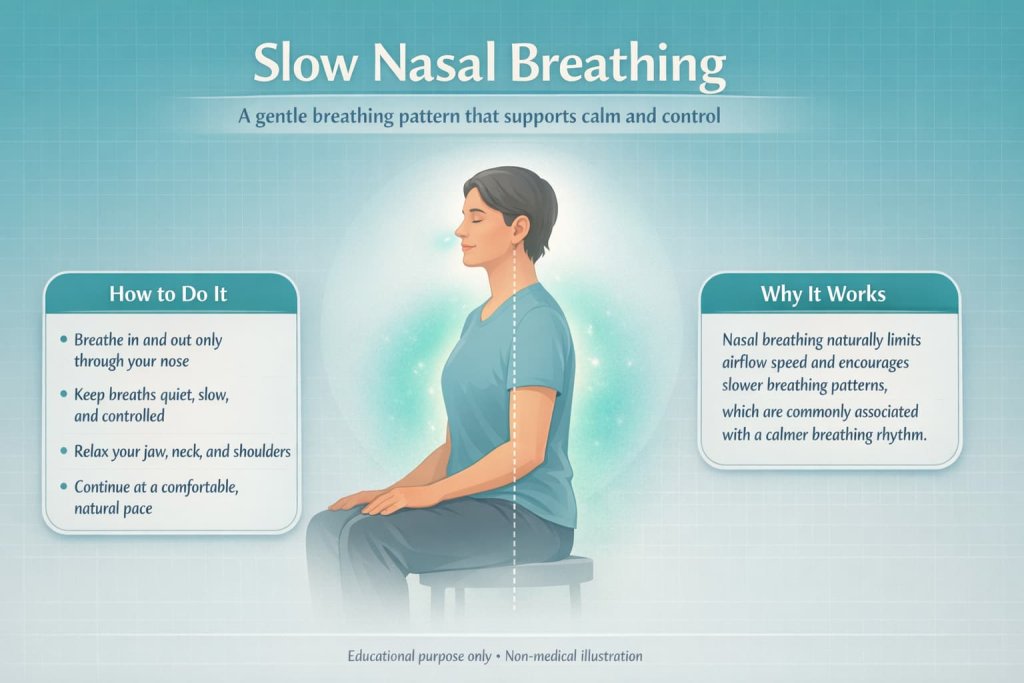
How to do it
- Breathe in and out only through your nose
- Keep breaths quiet, slow, and controlled
- Relax your jaw, neck, and shoulders
- Continue at a comfortable pace
Why it works
Nasal breathing limits airflow speed and promotes slower breathing, which is often associated with calmer breathing patterns.
12. Guided Relaxation Breathing
How to do it
- Use an audio recording or written guide
- Follow the timing and cues provided
- Focus on breathing comfortably rather than deeply
- Stop or adjust if you feel strained
Why it works
Guided instruction reduces decision-making and mental effort, making it easier—especially for beginners—to maintain a steady, calming breathing rhythm.
How Long Should You Practice Breathing Exercises?
For most people, 5–10 minutes per session is enough to experience a calming effect from breathing exercises. Short sessions can be done once or several times a day, depending on comfort and routine.
Helpful tips for duration and frequency:
- Start with 2–5 minutes if you’re new, then build gradually
- Focus on quality and comfort, not breath-holding or depth
- Use breathing exercises during natural pauses—before sleep, after work, or during stressful moments
- Stop or slow down if you feel lightheaded or uncomfortable
Consistency matters more than length. Even brief, regular practice can support relaxation over time.
When to Be Cautious or Seek Professional Guidance
Breathing exercises are generally safe when practiced gently, but caution is important in certain situations. You should pause or modify practice and consider professional guidance if you experience:
- Persistent dizziness, tingling, or faintness
- Shortness of breath that feels uncomfortable or worsening
- Chest tightness or unusual discomfort
- Anxiety or panic symptoms that intensify during breathing practice
Extra care is also advised if you:
- Have a diagnosed lung or heart condition
- Experience frequent breathlessness
- Are recovering from illness or surgery
In these cases, breathing techniques should be discussed with a qualified healthcare professional to ensure they are appropriate for your individual situation.
Common Mistakes to Avoid
- Forcing deep breaths
- Breathing too quickly
- Tensing the shoulders or jaw
- Holding the breath longer than comfortable
- Practicing while distracted or rushed
Gentle, comfortable breathing is key.
Who Can Benefit From Breathing Exercises?
Breathing exercises may be helpful for:
- People experiencing everyday stress
- Individuals seeking better sleep routines
- Those looking for non-equipment relaxation tools
- People wanting quick calming techniques during busy days
Anyone with ongoing breathing conditions should follow medical guidance appropriate to their situation.
Frequently Asked Questions
Do breathing exercises work immediately?
Many people notice a calming effect within a few minutes, especially with slow or extended-exhale techniques.
How many times a day should I do breathing exercises?
1–3 short sessions per day is common, depending on comfort and goals.
Can breathing exercises help with sleep?
They are often used as part of a bedtime wind-down routine to support relaxation.
What is the best breathing exercise for beginners?
Diaphragmatic breathing and slow nasal breathing are usually easiest to start with.
Can breathing exercises lower blood pressure?
Some studies suggest slow breathing may support short-term blood pressure reductions, but results vary.
Is it normal to feel lightheaded?
Mild dizziness can occur if you breathe too deeply or quickly. Slow down and breathe comfortably.
Conclusion
Breathing exercises are simple, practical tools you can use anytime to help calm your mind and reset your focus. Start with one or two techniques, practice gently, and build consistency over time. If you want a fast, accessible way to support relaxation, breathing exercises are a great place to begin.
References
- NIH (NCCIH) — Relaxation Techniques: What You Need To Know
- Cleveland Clinic — Diaphragmatic Breathing: Exercises & Benefits
- Harvard Health Publishing — Take a Tactical Breather (Box Breathing)
- Cleveland Clinic — How to Do the 4-7-8 Breathing Exercise
- Zaccaro et al. (2018) — How Breath-Control Can Change Your Life (Systematic Review), Frontiers in Human Neuroscience
- Steffen et al. (2017) — Resonance Frequency Breathing and HRV (PMC)