
Chair exercises for abs are a safe, effective way to strengthen your core while staying seated—no floor work required. They are especially helpful if you have limited mobility, joint discomfort, are short on space, or want an accessible core workout at home or the office. Understanding how these exercises work helps you train your abs consistently, safely, and in line with current physical activity guidelines.
Chair-based ab exercises use controlled leg lifts, knee drives, and torso movements to activate the abdominal muscles while reducing strain on the lower back and joints. When performed with proper posture and tension, they can support core strength, stability, and daily functional movement.
What Are Chair Exercises for Abs?
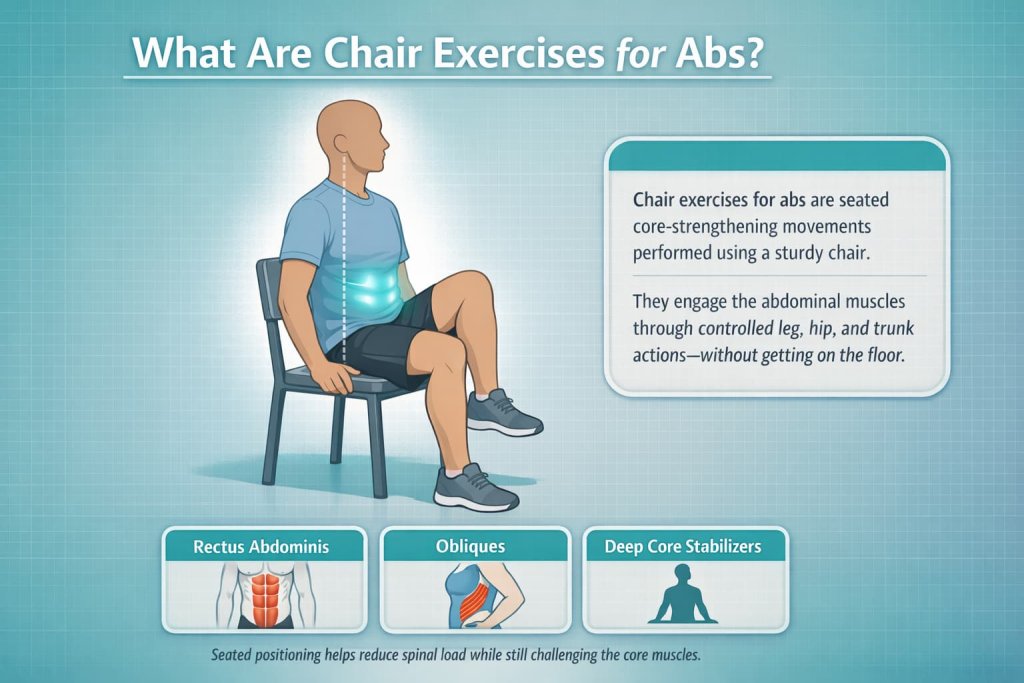
Chair exercises for abs are seated core-strengthening movements performed using a sturdy chair for support. Instead of lying on the floor, you stay upright while engaging your abdominal muscles through controlled leg, hip, and trunk actions.
These exercises typically target:
- Rectus abdominis (front abs)
- Obliques (side abs)
- Deep core stabilizers that support posture and balance
Because your upper body stays supported, chair exercises reduce spinal load while still challenging the core muscles.
10 Best Chair Exercises for Abs
Below are the most effective chair exercises for abs, selected for safety, accessibility, and muscle engagement.
1. Seated Knee Lifts
How to do it:
- Sit near the front edge of a sturdy chair with feet flat on the floor
- Sit tall with your chest lifted and shoulders relaxed
- Brace your core by gently tightening your abs
- Lift one knee toward your chest without leaning back
- Lower with control and alternate sides
Why it works:
Seated knee lifts challenge your abs to stabilize the torso while the hips move. This creates active core engagement without spinal flexion, making it a joint-friendly option for beginners.
Muscles worked:
- Rectus abdominis
- Hip flexors
- Deep core stabilizers
Trainer Tip:
Move slowly on the way down—eccentric control increases abdominal activation.
2. Seated Double Knee Tucks
How to do it:
- Sit upright with hands lightly gripping the sides of the chair
- Lean back slightly while keeping your spine neutral
- Lift both knees toward your chest together
- Pause briefly at the top
- Lower your feet slowly back to the floor
Why it works:
Lifting both knees increases load on the abs and requires greater trunk stability, making this more challenging than single-leg lifts.
Muscles worked:
- Rectus abdominis
- Lower ab region emphasis
- Hip flexors
Trainer Tip:
Avoid rounding your lower back—think “brace, then lift.”
3. Seated Leg Extensions
How to do it:
- Sit tall with knees bent and feet on the floor
- Brace your core
- Extend one leg straight out in front of you
- Hold briefly, then lower with control
- Alternate legs or extend both legs together for more difficulty
Why it works:
Holding the torso upright while extending the legs forces the abs to resist spinal movement, building endurance and control.
Muscles worked:
- Rectus abdominis
- Hip flexors
- Quadriceps (secondary)
Trainer Tip:
The slower the extension, the harder your core works.
4. Seated Bicycle Crunch
How to do it:
- Sit tall and lean back slightly
- Lift one knee while rotating your torso toward it
- Alternate sides in a controlled, pedaling motion
- Keep movements slow and deliberate
Why it works:
This movement combines rotation and knee lift, which effectively targets the obliques while maintaining core stability.
Muscles worked:
- Obliques
- Rectus abdominis
- Hip flexors
Trainer Tip:
Rotate through the ribs, not the shoulders or neck.
5. Seated Oblique Crunch
How to do it:
- Sit upright with hands resting lightly on the chair
- Lift one knee while leaning slightly toward that side
- Crunch the side of your torso downward
- Return to center and switch sides
Why it works:
Side-bending combined with knee lift increases tension on the obliques without twisting the spine excessively.
Muscles worked:
- Internal and external obliques
- Rectus abdominis
Trainer Tip:
Think “shorten the side,” not “collapse the shoulder.”
6. Chair Marches
How to do it:
- Sit tall with feet flat
- Brace your core
- Slowly lift one knee, then lower
- Alternate sides in a steady marching rhythm
Why it works:
Chair marches train the abs isometrically as they stabilize the torso against repeated leg movement.
Muscles worked:
- Rectus abdominis
- Deep core stabilizers
- Hip flexors
Trainer Tip:
Pause briefly at the top of each march for more core activation.
7. Seated Toe Taps
How to do it:
- Sit upright with knees bent
- Brace your abs
- Lightly tap one toe forward or downward
- Return to start and alternate sides
Why it works:
This subtle movement keeps continuous tension on the core, improving endurance and control without high fatigue.
Muscles worked:
- Deep core stabilizers
- Lower ab region
- Hip flexors (light)
Trainer Tip:
This is about tension, not speed—slow taps are more effective.
8. Seated V-Hold
How to do it:
- Sit near the edge of the chair
- Lean back slightly while keeping your chest open
- Lift both feet off the floor
- Hold the position while breathing normally
Why it works:
Holding the V position creates sustained abdominal tension, improving core endurance and postural strength.
Muscles worked:
- Rectus abdominis
- Deep core stabilizers
- Hip flexors
Trainer Tip:
If it feels too easy, extend your legs farther from your body.
9. Seated Heel Slides
How to do it:
- Sit tall with heels on the floor
- Brace your core
- Slide both heels forward slowly
- Pull them back under control
Why it works:
The abs must stay engaged to prevent the torso from leaning or collapsing during leg movement.
Muscles worked:
- Rectus abdominis
- Transverse core stabilizers
Trainer Tip:
Imagine your torso is “glued” in place as the legs move.
10. Isometric Seated Core Brace
How to do it:
- Sit upright with feet flat
- Gently tighten your abs as if preparing to cough
- Hold the brace for time while breathing steadily
Why it works:
Isometric bracing strengthens the deep core muscles responsible for spinal stability and posture.
Muscles worked:
- Transverse abdominis
- Rectus abdominis
- Postural stabilizers
Trainer Tip:
You should be able to breathe—if you’re holding your breath, ease the tension slightly.
How Often Should You Do Chair Exercises for Abs?
For most adults:
- 2–3 days per week is sufficient for core strength
- Perform 8–12 controlled reps or 20–40 second holds
- Rest 30–60 seconds between sets
The World Health Organization recommends regular muscle-strengthening activity as part of overall physical activity for adults and older adults.
How to Perform Chair Exercises for Abs Safely
Follow these guidelines to reduce injury risk:
- Use a stable, non-rolling chair
- Sit near the front edge with feet flat unless lifting
- Keep your spine tall—avoid slouching
- Move slowly and avoid swinging the legs
- Stop if you feel sharp pain or dizziness
The American Council on Exercise emphasizes controlled tempo and posture to ensure the core—not momentum—does the work.
How to Prepare Before Chair Ab Exercises
Proper preparation helps protect your lower back and ensures your abs—not momentum—do the work.
- Use a stable chair: Choose a firm, non-rolling chair on a flat surface.
- Set your posture: Sit tall near the edge, feet flat, chest lifted, shoulders relaxed.
- Brace your core lightly: Gently tighten your abs as if preparing to cough.
- Breathe steadily: Exhale during effort and avoid holding your breath.
- Warm up briefly: Do 1–2 minutes of light marching or gentle seated movements.
This quick setup improves safety, control, and overall effectiveness.
Who Benefits Most From Chair Ab Exercises?
Chair exercises for abs are especially suitable for:
- Beginners starting core training
- Seniors seeking joint-friendly workouts
- Office workers who sit for long hours
- People recovering from lower-body limitations (with medical clearance)
- Anyone who prefers low-impact, accessible exercise
They can be easily modified to increase or decrease difficulty.
Common Mistakes to Avoid
- Slouching or collapsing the chest
- Holding your breath during movements
- Rushing repetitions
- Using momentum instead of muscle control
- Ignoring discomfort in the lower back
Correct form is more important than high repetitions.
FAQs About Chair Exercises for Abs
Are chair exercises for abs effective?
Yes. When performed with proper form and muscle engagement, chair exercises can strengthen the core muscles and improve functional stability.
Can chair exercises reduce belly fat?
Chair exercises help build muscle and support overall activity levels, but fat loss depends on total daily movement and nutrition—not spot reduction.
Are chair ab exercises safe for seniors?
Generally yes, especially when movements are slow and controlled. Always consult a healthcare professional if you have medical conditions.
Do chair exercises work lower abs?
They can engage the lower portion of the abdominal muscles, especially with knee lifts and leg extensions.
Can I do chair exercises every day?
Light core activation can be done daily, but strength-focused sessions should allow rest days.
Do I need equipment?
No. A sturdy chair is enough, though ankle weights or resistance bands can add challenge later.
Conclusion
Chair exercises for abs offer a practical, low-impact way to build core strength without getting on the floor. Whether you’re a beginner, senior, or simply want a convenient seated workout, these exercises can support posture, stability, and daily movement when done consistently.
Start with controlled movements, focus on form, and gradually progress your routine. If you’re unsure where to begin, choose 3–5 exercises from this list and practice them two to three times per week.
References
- Physical Activity Guidelines for Americans, 2nd edition (U.S. HHS, 2018) — PDF
- WHO Guidelines on Physical Activity and Sedentary Behaviour (World Health Organization, 2020)
- The Effect of Chair-Based Exercise on Physical Function in Older Adults: Systematic Review and Meta-Analysis (Klempel et al., IJERPH, 2021)