
A chest and bicep workout builds upper-body size and strength by pairing heavy presses for the chest with smart curl variations for the biceps. Understanding the right exercise choices (and how to progress them) helps you grow faster, avoid junk volume, and train consistently.
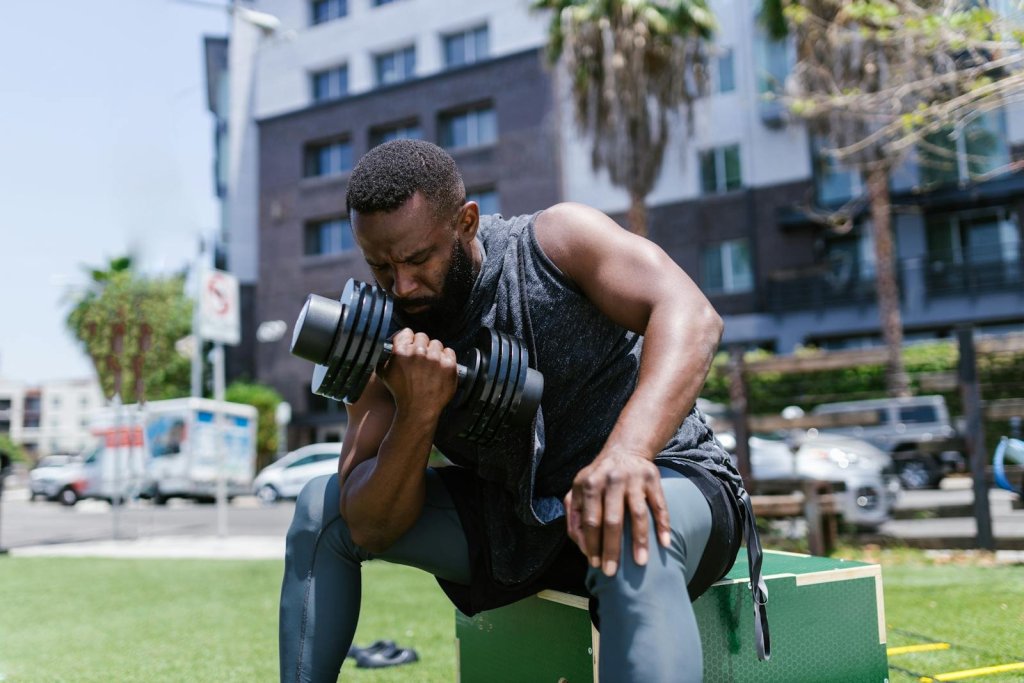
For evidence-based programming basics (sets, reps, progression), strength organizations like the American College of Sports Medicine (ACSM) and the American Heart Association (AHA) summarize practical resistance-training guidance.
What Is a Chest and Bicep Workout?
A chest and bicep workout is an upper-body session that trains chest pressing movements first (bigger lifts), then finishes with biceps curls (direct arm work).
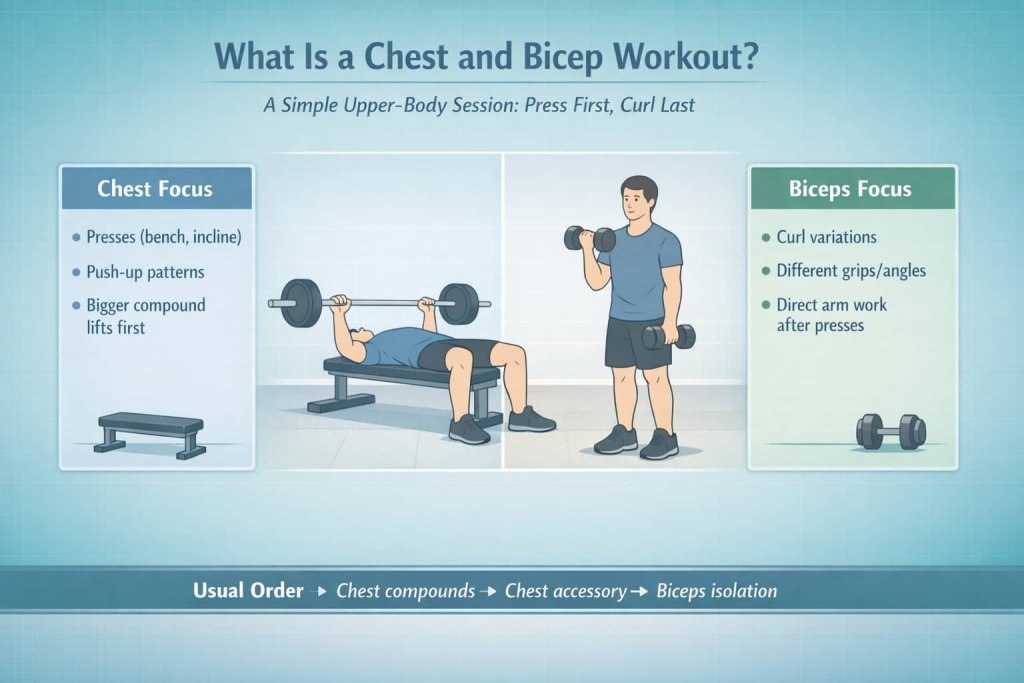
- Chest focus: presses + push-up patterns
- Biceps focus: curl variations (different grips/angles)
- Usual order: chest compounds → chest accessory → biceps isolation
8 Best Chest and Bicep Exercises for Size and Strength
Build a bigger chest and stronger biceps with these 8 best exercises chosen for muscle growth and measurable strength gains. Each move includes simple form cues and a clear way to progress week to week.
1) Barbell Bench Press
How to do it:
- Lie on the bench with eyes under the bar and feet planted
- Grip slightly wider than shoulder-width and brace your upper back
- Lower the bar to mid-chest with control
- Press up while keeping wrists stacked over elbows
- Stop 1–2 reps before form breaks down
Why it works: It’s the most efficient “loadable” chest builder for progressive overload, which is a cornerstone of strength and hypertrophy programming.
Muscles worked: Pectoralis major, anterior deltoids, triceps.
Trainer Tip: Think “chest up, shoulders down and back.” If your shoulders feel cranky, reduce range slightly and slow the lowering phase.
2) Incline Dumbbell Press (about 30 degrees)
How to do it:
- Set the bench to a low incline (around 30 degrees)
- Start dumbbells near the outer chest with forearms vertical
- Press up and slightly inward without clanking the bells
- Lower slowly until you feel a controlled chest stretch
- Keep shoulders packed (don’t shrug)
Why it works: A modest incline tends to increase upper-pec emphasis without turning it into a front-delt lift; bench-angle EMG research supports that angle changes can shift where you feel the work (see an open-access paper on PubMed Central).
Muscles worked: Upper chest (clavicular pec), anterior deltoids, triceps.
Trainer Tip: If you only feel shoulders, lower the incline and tuck elbows slightly (about 30–45° from your torso).
3) Push-Up (load it when it gets easy)
How to do it:
- Hands slightly wider than shoulders, body in a straight line
- Lower until your chest is close to the floor (no sagging hips)
- Press up while keeping ribs down and core tight
- Progress by elevating feet or using a weighted vest/backpack
- Keep reps smooth and controlled
Why it works: Push-ups can produce meaningful chest/triceps activation and are easy to scale with load, tempo, and range of motion (supported by push-up research available on PubMed Central).
Muscles worked: Chest, triceps, front delts, core stabilizers.
Trainer Tip: Use “hands screw into the floor” tension to keep shoulders stable.
4) Dumbbell Flye (controlled stretch, not ego weight)
How to do it:
- Lie on a flat bench with dumbbells above your chest
- Slight bend in elbows; keep that bend fixed
- Open arms in a wide arc until you feel a chest stretch
- Bring dumbbells back together over your chest (no bouncing)
- Use lighter loads and slower tempo than presses
Why it works: Flyes add a long-range chest stimulus and pair well after pressing, but pressing variations are typically better for heavy progressive overload—so flyes work best as a controlled accessory.
Muscles worked: Pectoralis major, anterior deltoids (stabilizing).
Trainer Tip: Stop the descent when you can’t keep shoulders “packed” and ribs down.
5) Standing Dumbbell Curl
How to do it:
- Stand tall with dumbbells at your sides, palms forward
- Curl without swinging; keep elbows close to your torso
- Pause briefly at the top, then lower slowly
- Keep wrists neutral (don’t crank them back)
- End sets with strict reps, not momentum
Why it works: It’s the most straightforward biceps builder and easy to progressively overload, especially when you control the lowering phase.
Muscles worked: Biceps brachii, brachialis, brachioradialis.
Trainer Tip: If you have to sway, the weight is too heavy for hypertrophy-quality reps.
6) Incline Dumbbell Curl
How to do it:
- Set a bench to a moderate incline and sit back
- Let arms hang slightly behind the body
- Curl without letting elbows drift forward
- Lower slowly to a full stretch at the bottom
- Keep shoulders down (no shrugging)
Why it works: Changing shoulder position can change biceps contribution; incline curls start the biceps long head in a more lengthened position compared to many curl setups (supported by biceps/shoulder-position research from the Journal of Sports Science & Medicine).
Muscles worked: Biceps brachii (long head emphasis), brachialis.
Trainer Tip: Use lighter weight than standing curls—this one is about stretch + strict control.
7) Preacher Curl (EZ-bar or dumbbells)
How to do it:
- Set upper arms on the pad; keep armpits lightly against it
- Start from a near-straight elbow (don’t slam lockout)
- Curl up smoothly, then lower under control
- Keep shoulders relaxed and down
- Stop before you lose pad contact
Why it works: The setup reduces body English and keeps tension on the biceps through a consistent path—great when you want strict, repeatable reps.
Muscles worked: Biceps brachii, brachialis.
Trainer Tip: Don’t chase a huge stretch at the bottom if your elbows feel irritated—use a slightly shorter range.
8) Concentration Curl
How to do it:
- Sit and brace your elbow against your inner thigh
- Curl up slowly, squeezing hard at the top
- Lower for 2–3 seconds
- Keep shoulder still; only the elbow moves
- Aim for clean, high-tension reps
Why it works: An EMG comparison from the American Council on Exercise (ACE) found the concentration curl produced very high biceps activation among variations tested, making it a strong finisher.
Muscles worked: Biceps brachii (strong peak contraction).
Trainer Tip: Use it as your final “finisher” after heavier curls—think tension, not load.
How to use these exercises in a chest and bicep workout
If your goal is size and strength, the simplest approach is:
- Start with 1–2 chest compounds (heavier)
- Add 1 chest “pump” movement (controlled)
- Finish with 2–3 biceps variations that change your arm angle or grip
- Progress weekly by adding a rep, then small weight increases
Training a muscle group more than once per week can support hypertrophy when total volume is managed well, which is why many programs repeat chest and biceps exposures across the week (supported by a training frequency meta-analysis indexed on PubMed).
Sets, Reps, and Weekly Frequency for Size and Strength
Frequency
- Chest + biceps: 1–2x per week (many lifters grow well splitting volume across two days, supported by research indexed on PubMed)
Weekly sets (start here)
- Chest: 8–12 hard sets/week
- Biceps: 6–12 hard sets/week
Rep ranges
- Main press (bench/incline): 4–8 reps
- Secondary press/push-up: 8–12 reps
- Flye/accessory: 10–15 reps
- Main curl: 8–12 reps
- Curl finisher: 10–15 reps
Progression
- Add reps first, then small weight increases (progression principles summarized by the American College of Sports Medicine (ACSM))
Sample chest and bicep workout plan (45–60 minutes)
Option A: Straight sets (strength + size)
- Barbell Bench Press: 4 sets of 4–8 reps, rest 2–3 min
- Incline Dumbbell Press: 3 sets of 8–12 reps, rest 90 sec
- Dumbbell Flye: 2–3 sets of 10–15 reps, rest 60–90 sec
- Standing Dumbbell Curl: 3 sets of 8–12 reps, rest 60–90 sec
- Incline Dumbbell Curl: 2–3 sets of 10–15 reps, rest 60 sec
- Concentration Curl: 2 sets of 12–15 reps, rest 60 sec
Option B: Time-saving supersets (pump + efficiency)
- Superset 1: Bench Press (4–8) + Standing Curl (8–12) for 3–4 rounds
- Superset 2: Incline DB Press (8–12) + Incline Curl (10–15) for 3 rounds
- Superset 3: Push-Ups (AMRAP clean reps) + Concentration Curl (12–15) for 2 rounds
Key progression rules (so you actually grow)
- Add reps first, then weight. Example: hit 8–8–8 on a lift, then add 2.5–5 lb next week.
- Keep 1–3 reps in reserve on most sets to maintain quality and recover.
- Control the lowering phase (about 2 seconds). It keeps tension where it belongs.
- If joints hurt, adjust range and grip (EZ-bar often feels friendlier for elbows/wrists).
Who Should Do a Chest and Bicep Workout (And Who Should Avoid It)?
Good fit for:
- Beginners who want a simple upper-body day
- Lifters training for size and strength
- Anyone who prefers “press + arms” sessions
Modify or avoid if you have:
- Sharp shoulder pain during pressing or a recent shoulder injury
- Elbow/wrist pain that flares during curls
- A medical condition where heavy lifting needs clearance (see guidance from the American Heart Association)
Safety tips for chest and bicep training
- Warm up with 5–8 minutes of easy movement plus 1–2 lighter ramp sets for your first press.
- Avoid extreme shoulder flare on pressing and flyes; keep elbows slightly tucked.
- If you feel sharp pain (not normal muscle burn), stop and swap the exercise.
- If you have a medical condition (especially heart-related), follow clearance guidance described in the resistance training statement from the American Heart Association.
FAQs
Can I train chest and biceps on the same day?
Yes. It’s a common pairing because chest training is press-focused while biceps work is local and usually doesn’t interfere much with pressing for most people.
How many sets should I do for chest and biceps?
A practical starting point is 8–14 total hard sets per week per muscle, split across 1–2 sessions. Adjust based on recovery and progress.
What reps are best for size and strength?
Use a mix: 4–8 reps on your main press for strength, and 8–15 reps on most accessories for hypertrophy-focused volume.
Should I do flyes or push-ups if I already bench?
Both can work. Push-ups are a scalable volume builder, while flyes add a stretch-focused accessory—keep flyes light and controlled.
What’s the single best biceps exercise?
There’s no single best for everyone, but concentration curls are a strong finisher when you want strict tension and a hard squeeze at the top.
How often should I repeat this chest and bicep workout?
Many people do well repeating it 1–2 times per week, depending on total weekly volume and how sore you get.
Conclusion
If you want a chest and bicep workout that actually delivers, build it around heavy pressing (bench and incline), add one controlled chest accessory, then finish with strict curl variations that hit the biceps from different angles. Track reps, progress slowly, and prioritize clean form—your results will follow.