
The clamshell exercise is a low-impact, side-lying movement that strengthens the hip stabilizers—especially the gluteus medius—to support better balance, alignment, and joint control.
Understanding how to perform the clamshell correctly matters because weak hip stabilizers are commonly linked to knee pain, poor posture, and reduced lower-body stability. This exercise is widely used by physical therapists because it is joint-friendly, easy to scale, and effective when done with proper form.
What Is the Clamshell Exercise?
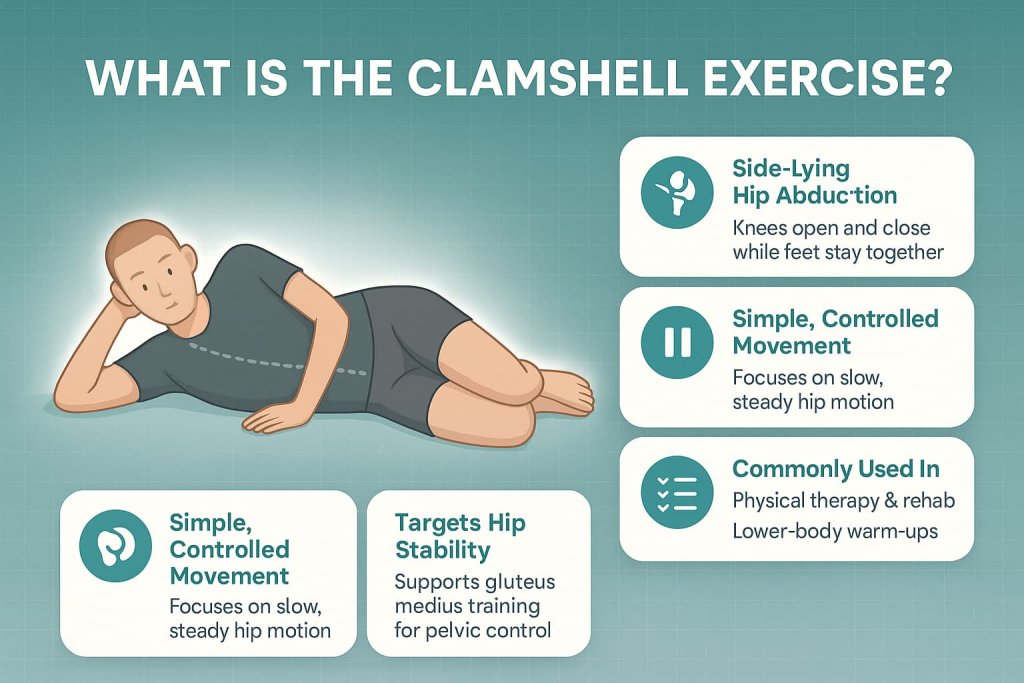
The clamshell exercise is a side-lying hip abduction movement where the knees open and close while the feet stay together. The motion resembles a clamshell opening, which is where the exercise gets its name.
This exercise is commonly included in:
- Physical therapy and rehabilitation programs
- Warm-ups for lower-body workouts
- Home workouts focused on hip and glute activation
According to the American Council on Exercise (ACE), exercises that emphasize controlled hip abduction are essential for training the gluteus medius, a muscle critical for pelvic stability.
How to Do the Clamshell Exercise Correctly
How to do it
- Lie on your side with hips and shoulders stacked
- Bend your knees to about 45 degrees
- Keep feet together and spine neutral
- Gently brace your core
- Lift the top knee without rolling your hips back
- Pause briefly, then lower with control
- Perform all reps before switching sides
Quality of movement matters more than range of motion. A smaller, controlled lift is often more effective than opening the knees as wide as possible.
Muscles Worked in the Clamshell Exercise
Primary muscle
- Gluteus medius – supports hip stability, pelvic control, and side-to-side movement
Secondary muscles
- Gluteus maximus (assists with hip control)
- Deep hip external rotators
- Core stabilizers (light engagement to maintain posture)
Research published in the Journal of Orthopaedic & Sports Physical Therapy has shown that properly performed clamshell variations can activate the gluteus medius while limiting compensation from the tensor fasciae latae (TFL), a muscle that often dominates when form breaks down.
Why the Clamshell Exercise Matters
Strong hip stabilizers play a key role in how your entire lower body functions. Adding clamshells to your routine may help support:
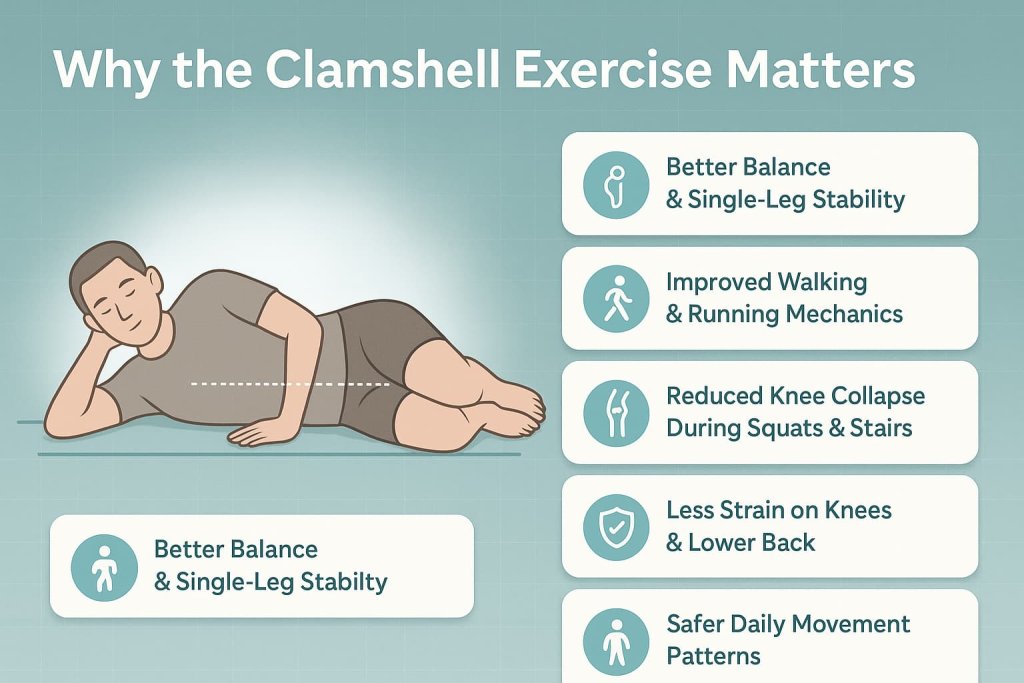
- Better balance and single-leg stability
- Improved walking and running mechanics
- Reduced inward knee collapse during squats and stairs
- Less strain on knees and lower back
- Safer movement patterns during daily activities
Common Clamshell Exercise Mistakes
Even though the movement looks simple, form errors are common.
Watch out for:
- Rolling the hips backward to lift the knee higher
- Arching the lower back instead of stabilizing the pelvis
- Rushing through repetitions
- Using momentum rather than muscle control
If you feel the exercise mainly in the front of your hip instead of the side of your glutes, reduce the range of motion and slow down.
How Often Should You Do the Clamshell Exercise?
General rehab-style guidelines often suggest:
- 2–3 sets of 10–15 controlled reps
- 3–4 times per week
Clamshell Exercise Variations
Easier options
Why it works:
Reducing range of motion or support demands helps beginners maintain proper pelvic alignment.
How to do it:
- Perform smaller knee lifts
- Place your back against a wall for feedback
- Pause for shorter holds
Trainer tip:
Focus on feeling tension on the side of the hip, not the front.
More challenging options
Why it works:
Added resistance or longer tension increases muscular demand without joint stress.
How to do it:
- Add a light resistance band above the knees
- Hold the top position for 3–5 seconds
- Perform slow tempo reps
Trainer tip:
Progress only when you can keep hips stacked throughout the movement.
Breathing and Core Bracing During Clamshells
Proper breathing helps maintain pelvic control.
Exhale gently as you lift the knee, and maintain light abdominal tension to prevent hip or spine movement. Avoid holding your breath or over-bracing.
Who Should Avoid or Modify the Clamshell Exercise?
The clamshell exercise is generally safe for most people, but modifications may be needed if you:
- Have acute hip or lower-back pain
- Experience pain during side-lying positions
- Have been advised by a healthcare professional to avoid hip abduction movements
If discomfort persists, consult a licensed physical therapist or qualified professional before continuing.
Frequently Asked Questions
Is the clamshell exercise good for knee pain?
It may help support knee alignment by strengthening hip stabilizers, which can reduce inward knee movement during daily activities.
Does the clamshell exercise build muscle?
It supports strength and activation rather than maximal muscle size, especially when used without heavy resistance.
Should I feel clamshells in my lower back?
No. You should feel the exercise mainly on the side of your hip. Lower-back tension usually indicates loss of pelvic control.
Are resistance bands necessary?
No. Bands increase difficulty, but bodyweight clamshells are effective when performed correctly.
Can seniors do the clamshell exercise?
Yes, with appropriate range of motion and support. It is commonly used in senior fitness and balance programs.
How long does it take to see results?
Many people notice improved hip awareness and control within a few weeks when performed consistently.
Conclusion
The clamshell exercise is a simple yet highly effective movement for improving hip stability, balance, and lower-body control. When performed with proper form and progression, it fits seamlessly into rehabilitation programs, warm-ups, and home workouts. Start slow, prioritize control, and build consistency for the best results.
If you’re building a stronger, more stable lower body, the clamshell exercise is a smart place to begin.
References
- 6 Glute Medius Exercises for Strength & Stability (includes clamshell cues) — ACE Fitness
- Which exercises target the gluteal muscles while minimizing TFL activation? (Selkowitz et al., 2013) — PubMed
- Hip muscle activity review (EMG) for common exercises (Macadam et al., 2015) — Full text (PMC)
- Patellofemoral Pain Clinical Practice Guidelines (Willy et al., 2019) — JOSPT
- Exercises for Patellofemoral Pain Syndrome (runner’s knee) — Cleveland Clinic (includes clamshell)
- Piriformis syndrome stretches and exercises — Cleveland Clinic (includes clamshell)
- Piriformis syndrome (professional overview; includes clamshell-style exercise guidance) — MSD Manuals