
Compound back exercises are multi-joint pulls and hip-hinge lifts that train your lats, mid-back, and lower back (plus glutes/hamstrings and grip) in fewer, more effective moves.
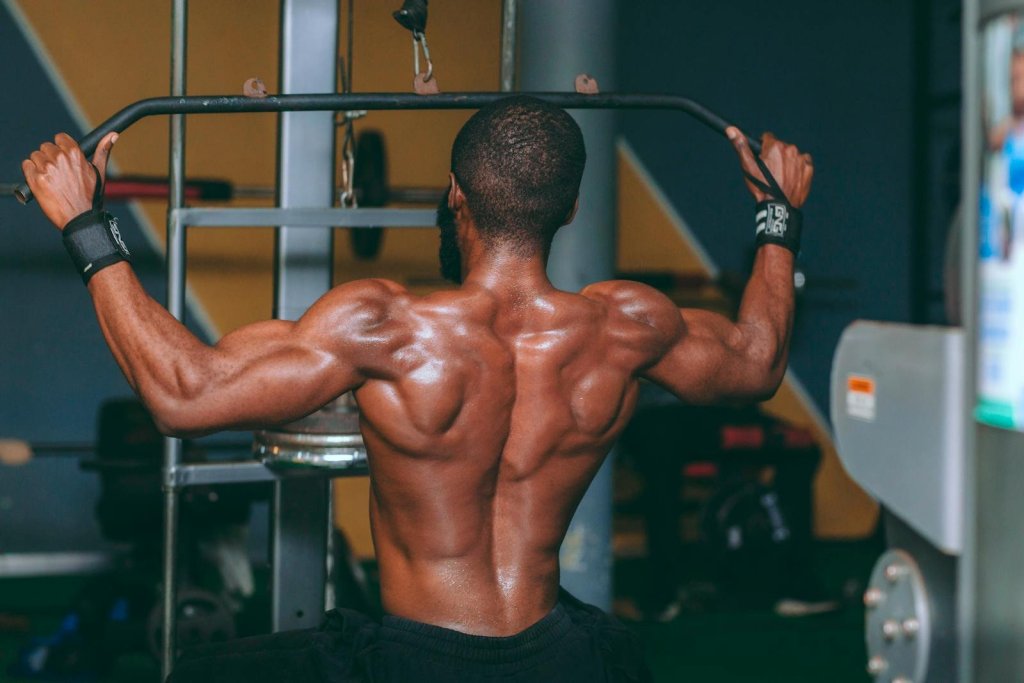
If you want a bigger, stronger back without doing endless isolation work, compound lifts are one of the most efficient ways to build total pulling strength, posture support, and back muscle thickness.
What are compound back exercises?
Compound back exercises are movements where more than one joint and multiple muscle groups work together—usually involving the hips, spine, shoulders, and elbows at the same time.
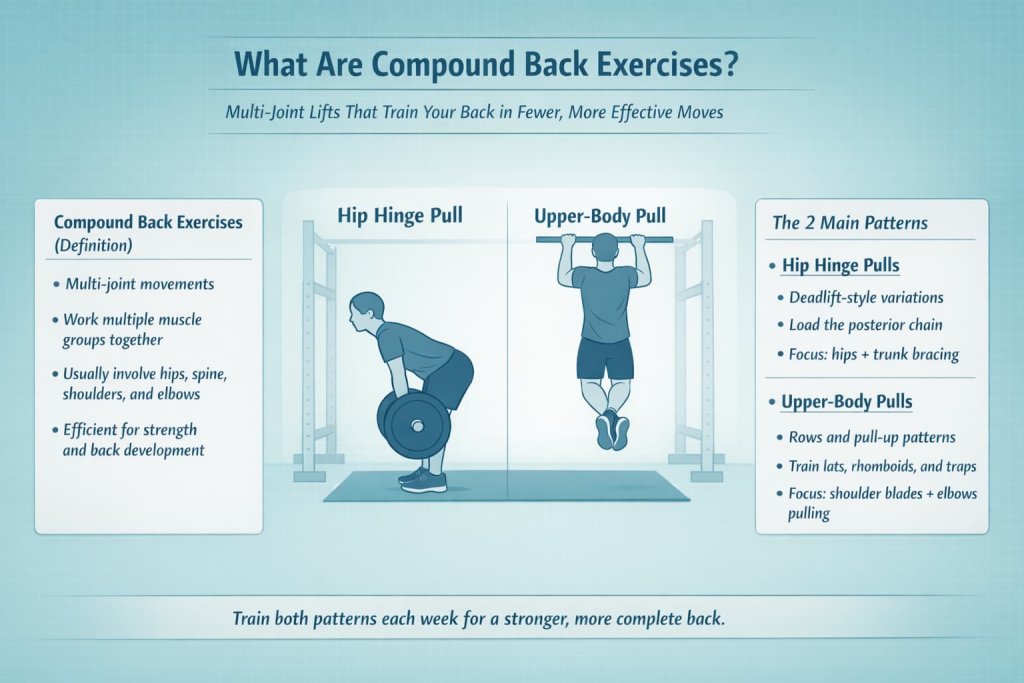
They typically fall into two big patterns:
- Hip hinge pulls: deadlift variations that load the entire posterior chain
- Upper-body pulls: rows and pull-up patterns that load lats, rhomboids, traps, and biceps together
Why compound back exercises work so well
Compound back exercises deliver results because they let you:
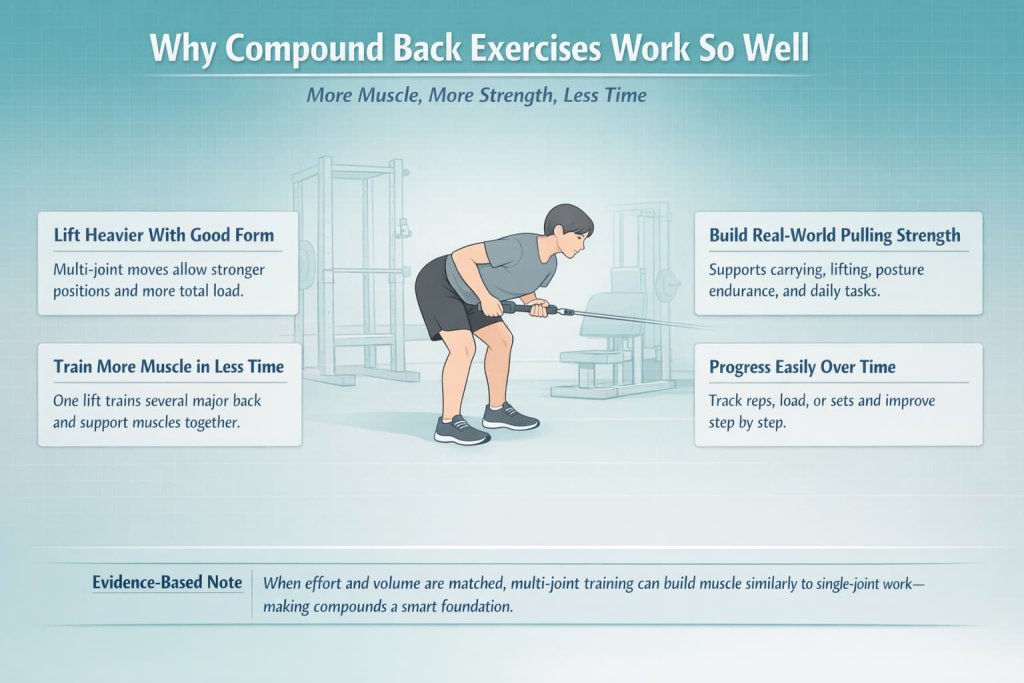
- Lift heavier loads with good form (more total stimulus)
- Train more muscle in less time (high efficiency)
- Build “real-world” pulling strength (carrying, lifting, posture endurance)
- Progress easily (add reps, load, or sets over time)
Research comparing single-joint vs multi-joint training suggests hypertrophy can be similar when effort and volume are matched, which supports building your program around compound lifts and adding isolation only if needed.
The 12 best compound back exercises
Build a bigger, stronger back with these 12 compound lifts that train multiple muscles at once. Focus on controlled reps and steady progression for the best results.
1) Conventional Deadlift
How to do it:
- Stand mid-foot under the bar, feet about hip-width.
- Hinge down, grip the bar, and set your back neutral.
- Brace your trunk, push the floor away, and stand tall.
- Lower with control by hinging back first, then bending knees.
Why it works: A full posterior-chain hinge that builds total-body strength while heavily loading spinal erectors, glutes, and upper-back bracing.
Muscles worked: Spinal erectors, glutes, hamstrings, traps, lats (as stabilizers), forearms/grip.
Trainer Tip: If your lower back gets cranky, reduce load, pull from blocks, or use a trap bar (if available).
2) Trap Bar Deadlift (Hex Bar)
How to do it:
- Step into the trap bar and align handles over mid-foot.
- Hinge and grab handles with a firm grip.
- Brace, then stand up smoothly without jerking.
- Lower under control and reset for the next rep.
Why it works: Often feels more back-friendly for many lifters because the load is closer to your center of mass, while still training the hinge hard.
Muscles worked: Glutes, quads, hamstrings, spinal erectors, traps, grip.
Trainer Tip: Think “push the floor away” to keep the lift leg-driven and smooth.
3) Romanian Deadlift (RDL)
How to do it:
- Start standing with bar/dumbbells at thighs.
- Slight knee bend, then hinge hips back.
- Keep the weight close to your legs as you lower.
- Stop when you lose hamstring tension or your back position changes.
- Stand by driving hips forward.
Why it works: A hinge that emphasizes hamstrings and glutes while teaching strong hip control and back bracing—great for back thickness and posterior-chain strength.
Muscles worked: Hamstrings, glutes, spinal erectors, upper back (stabilizers), grip.
Trainer Tip: “Reach hips back” more than you “drop the weight down.”
4) Rack Pull (Below Knee or Knee Height)
How to do it:
- Set bar on safeties/blocks at a controlled height.
- Hinge to grip, brace hard, and pull to stand tall.
- Pause briefly at the top (no leaning back).
- Lower back to the pins with control.
Why it works: Lets you load heavy while shortening the range, often making it easier to maintain position and build lockout strength.
Muscles worked: Traps, spinal erectors, glutes, hamstrings, grip.
Trainer Tip: Start higher, then lower the pins over weeks as form improves.
5) Pull-Up (Overhand)
How to do it:
- Grip the bar slightly wider than shoulder width.
- Start from a dead hang with controlled shoulders.
- Pull elbows down and back as you lift your chest.
- Lower slowly to a full hang you can control.
Why it works: One of the best vertical pulls for lat width and upper-back strength using your bodyweight.
Muscles worked: Lats, lower traps, rhomboids, biceps, forearms, core.
Trainer Tip: If you can’t get 3–5 clean reps yet, use a band or assisted machine.
6) Chin-Up (Underhand)
How to do it:
- Use an underhand grip about shoulder width.
- Pull smoothly until chin clears the bar.
- Lower with control (don’t drop).
Why it works: Still a big lat builder, but often allows more reps because biceps contribute more.
Muscles worked: Lats, biceps, rhomboids, forearms, core.
Trainer Tip: Keep ribs down and avoid turning it into a “swing.”
7) Lat Pulldown
How to do it:
- Sit tall and lock thighs under pads.
- Pull bar down toward upper chest with elbows driving down.
- Pause briefly, then return with control.
Why it works: A scalable vertical pull that mimics pull-ups while letting you choose the load and stay strict.
Muscles worked: Lats, teres major, rhomboids, biceps, rear delts.
Trainer Tip: If you feel it mostly in arms, reduce load and slow the lowering phase.
8) Barbell Bent-Over Row
How to do it:
- Hinge to a strong torso angle and keep spine neutral.
- Brace, then row the bar toward lower ribs/upper stomach.
- Lower under control without losing torso position.
Why it works: A high-signal horizontal pull for mid-back thickness and overall pulling strength—when done strictly.
Muscles worked: Rhomboids, mid traps, lats, rear delts, biceps, spinal erectors (isometric).
Trainer Tip: If you “stand up” to finish reps, the weight is too heavy today.
9) One-Arm Dumbbell Row
How to do it:
- Support one hand/knee on a bench (or use a staggered stance).
- Row elbow toward your hip, not straight up to your shoulder.
- Lower slowly to a controlled stretch.
Why it works: Great for lat focus, range of motion, and side-to-side strength balance.
Muscles worked: Lats, rhomboids, traps, biceps, core (anti-rotation).
Trainer Tip: Keep shoulders square—don’t twist the torso to “cheat” the rep.
10) Chest-Supported Row (Dumbbells or Machine)
How to do it:
- Set bench/machine so chest is supported and neck neutral.
- Row elbows back with a brief squeeze.
- Lower slowly, keeping shoulders controlled.
Why it works: Lets you row hard while reducing lower-back fatigue, making it great for higher-quality back volume.
Muscles worked: Rhomboids, mid traps, rear delts, lats, biceps.
Trainer Tip: Think “pull shoulder blades back and down,” then row.
11) Seated Cable Row
How to do it:
- Sit tall with neutral spine and soft knees.
- Pull handle toward your torso without leaning far back.
- Pause, then return until arms are straight with shoulders controlled.
Why it works: Smooth resistance and easy setup make it perfect for controlled mid-back work and consistent progression.
Muscles worked: Rhomboids, mid traps, lats, biceps, rear delts.
Trainer Tip: If you have to rock your body, drop the load and slow down.
12) Inverted Row (Bodyweight Row)
How to do it:
- Set a bar in a rack or use TRX/rings.
- Keep body straight (glutes tight, ribs down).
- Row chest toward bar/handles, then lower with control.
Why it works: A joint-friendly horizontal pull you can scale by changing body angle—excellent for posture and back endurance.
Muscles worked: Rhomboids, mid traps, lats, rear delts, biceps, core.
Trainer Tip: Walk feet closer under the bar to make it harder; elevate feet to progress.
Best compound back exercises by goal
For back size and thickness
- Bent-over row
- Chest-supported row
- Seated cable row
- Romanian deadlift
For lat width
- Pull-ups
- Chin-ups
- Lat pulldown
- One-arm dumbbell row (elbow-to-hip)
For total-body strength and posterior chain
- Conventional deadlift
- Trap bar deadlift
- Rack pull
- Romanian deadlift
How to program compound back exercises (sets, reps, frequency)
A simple, practical approach used in many strength templates:
- Train back 2 times per week (or 1 heavier + 1 lighter day)
- Use 2–4 compound moves per session
- Aim for 8–14 hard sets per week for back (adjust to recovery)
Practical rep ranges:
- Strength focus: 3–6 reps on hinges/rows for some sets
- Muscle focus: 6–12 reps on rows/pulldowns; 6–10 on hinges for many lifters
- Control focus: 10–15 reps on supported rows/inverted rows
Progression idea:
- Add 1 rep each week until you hit the top of your rep range, then add a small amount of load.
Sample compound back workout (simple and effective)
Option A: Gym back day (45–60 minutes)
- Trap bar deadlift: 3 sets of 4–6
- Lat pulldown or pull-up: 3 sets of 6–10
- Chest-supported row: 3 sets of 8–12
- Seated cable row or one-arm dumbbell row: 2–3 sets of 10–12
Option B: Home/minimal equipment
- Inverted row (table/TRX/rings): 4 sets of 6–12
- One-arm dumbbell row: 3 sets of 8–12
- Romanian deadlift (dumbbells): 3 sets of 6–10
- Band pulldown or band row (if available): 2–3 sets of 12–15
Common mistakes (and quick fixes)
Letting momentum do the work
Fix: Slow the lowering phase and pause briefly at the top of rows/pulldowns.
Turning rows into a lower-back exercise
Fix: Use chest support or reduce load and keep your torso angle consistent.
Pulling with arms only (no back)
Fix: Initiate by setting shoulders “down and back,” then row/pull.
Going too heavy on hinges too soon
Fix: Build with RDLs and trap bar first; keep reps clean and braced.
FAQs about compound back exercises
Are compound back exercises enough to build a big back?
For most people, yes—especially if you include both vertical pulls and rows and progress over time. Isolation work is optional, not required.
How many compound back exercises should I do per workout?
Usually 2–4 is plenty: one hinge (optional), one vertical pull, and one to two row variations.
Should I do deadlifts on back day?
You can, but deadlifts are a whole-body hinge. Many lifters do them on back day or leg day—choose the day that best fits your recovery.
What’s the best compound back exercise for beginners?
Lat pulldown, chest-supported row, and inverted row are beginner-friendly because they’re easier to keep strict.
What if rows hurt my lower back?
Use chest-supported rows, seated cable rows, or lighter dumbbell rows with a bench for support, and reduce hinge volume temporarily.
How often should I train back?
Most people grow well training back 1–2 times per week with consistent volume and recovery.
Can I build back muscle with just bodyweight?
Yes. Inverted rows and pull-up progressions can build serious back strength if you progress leverage, reps, and control.
Conclusion
Compound back exercises are the smartest way to train your back because they hit the most muscle with the fewest movements. Build your program around one strong pull pattern (vertical) and one strong row pattern (horizontal), add a hinge if recovery allows, and progress gradually with clean form.
References
- American College of Sports Medicine (ACSM) — Position Stand: Progression Models in Resistance Training for Healthy Adults (PubMed)
- ACSM — Resistance Training for Health and Fitness (PDF)
- NSCA — Exercise Technique: Deadlift
- National Library of Medicine (PMC) — Single vs. Multi-Joint Resistance Training (Paoli et al., 2017)
- CDC — Adult Physical Activity Guidelines Overview
- NIH MedlinePlus — Exercise and Physical Fitness
- PubMed — EMG Analysis of Pull-Up Grip Variations (Dickie et al., 2017)