
The dragon flag exercise is one of the most challenging bodyweight core exercises, designed to build exceptional abdominal strength, total-body tension, and control. It gained worldwide recognition after being popularized by Bruce Lee and is now widely used in advanced strength and calisthenics training.
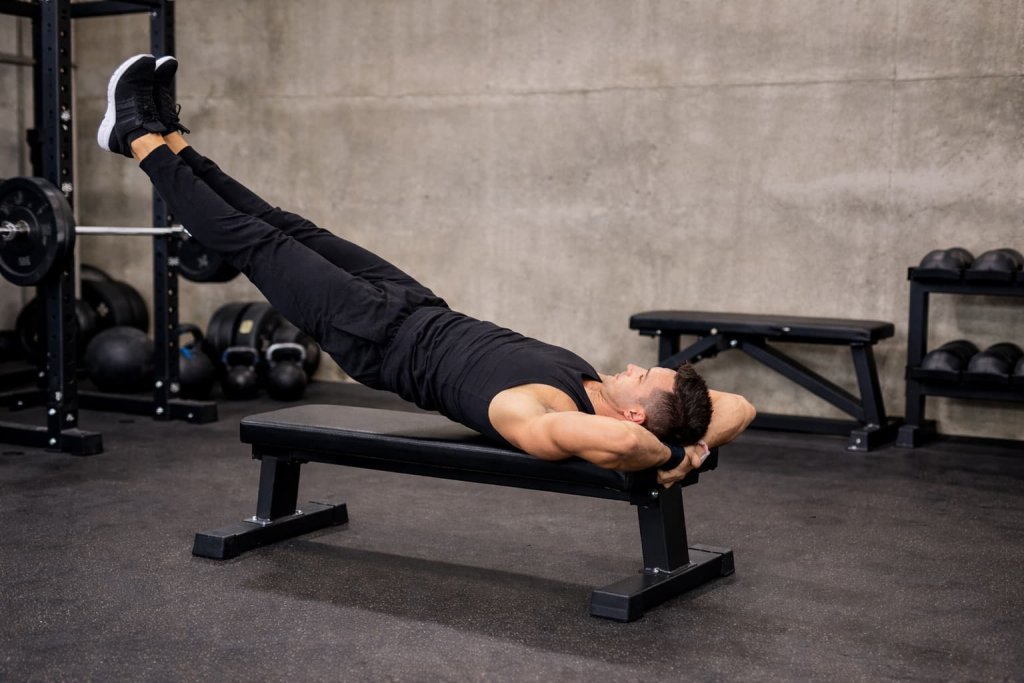
Understanding how to perform the dragon flag correctly matters because poor technique can overload the lower back and shoulders. When done with proper progression, bracing, and control, it can significantly improve core stability and full-body strength without equipment.
This guide explains exactly how the dragon flag exercise works, the muscles involved, correct form, progressions, safety tips, and frequently asked questions—so you can train it safely and effectively.
What Is the Dragon Flag Exercise?
The dragon flag exercise is an advanced core movement performed on a bench, floor, or sturdy surface where the upper back and shoulders remain in contact while the rest of the body stays rigid and elevated.
Unlike crunches or sit-ups, the dragon flag requires:
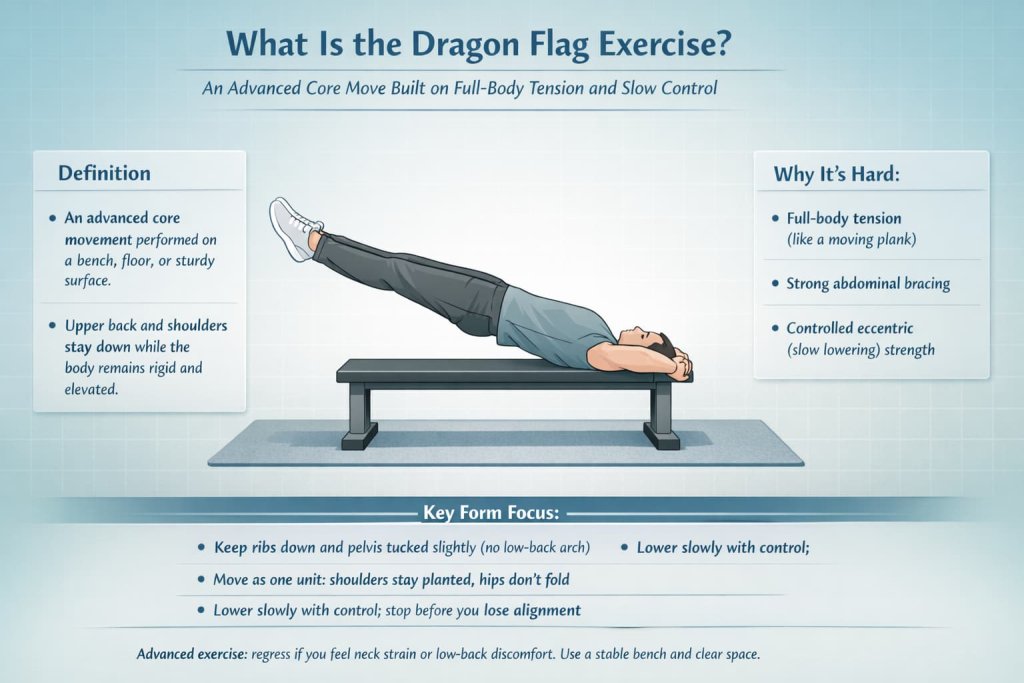
- Full-body tension
- Strong abdominal bracing
- Controlled eccentric (lowering) strength
How to Do the Dragon Flag Exercise Correctly
How to do it
- Lie on a flat bench or floor and grip a sturdy object behind your head
- Press your upper back and shoulders into the surface
- Brace your core as if preparing for a heavy lift
- Lift your legs and hips together, forming a straight line from shoulders to feet
- Slowly lower your body while maintaining full-body tension
- Stop before your lower back arches
- Reverse the movement with control to return to the top
Why it works
The slow lowering phase forces the abs to resist spinal extension under load, which is a key function of real-world core strength.
Trainer tip
If you cannot lower slowly without arching your lower back, shorten the range of motion or regress the movement.
Dragon Flag Exercise Variations (Beginner to Advanced)
Dragon flag variations allow you to scale difficulty, improve control, and progress safely toward full reps. Each variation changes leverage, range of motion, or time under tension to match your current core strength level.
1. Bent-Knee Dragon Flag (Beginner)
Why it works
Bending the knees shortens the lever arm, reducing stress on the lower back while still training core bracing and control.
How to do it
- Set up in a standard dragon flag position
- Bend knees toward the chest
- Lift and lower hips and legs together
- Keep shoulders planted and core braced
- Move slowly through a controlled range
Trainer tip
Focus on keeping the ribs down and pelvis slightly tucked throughout the movement.
2. Tuck Dragon Flag Hold (Beginner)
Why it works
Isometric holds build foundational core stiffness without dynamic movement.
How to do it
- Lift into a tucked position with knees close to chest
- Hold body steady with hips elevated
- Maintain full-body tension
- Breathe under control
Trainer tip
Start with 10–15 second holds and increase time gradually.
3. Negative (Eccentric) Dragon Flag (Beginner to Intermediate)
Why it works
Eccentric training builds strength faster and teaches proper lowering mechanics.
How to do it
- Start at the top position with body straight
- Slowly lower for 5–10 seconds
- Stop before losing spinal control
- Reset at the top for each rep
Trainer tip
Quality matters more than depth—stop before the lower back arches.
4. One-Leg Dragon Flag (Intermediate)
Why it works
Removing one leg reduces leverage while challenging rotational stability.
How to do it
- Perform dragon flag with one leg straight
- Bend the opposite knee slightly
- Switch legs between sets or reps
- Keep hips square and stable
Trainer tip
If the hips twist, regress to negatives or bent-knee versions.
5. Partial Range Dragon Flag (Intermediate)
Why it works
Partial reps strengthen the hardest portion of the movement without excessive strain.
How to do it
- Lower only halfway down
- Pause briefly
- Return to the top under control
- Maintain rigid body alignment
Trainer tip
Use slow tempo to increase time under tension.
6. Full Dragon Flag (Advanced)
Why it works
This is the complete expression of the exercise, requiring maximal core strength and total-body tension.
How to do it
- Keep body straight from shoulders to toes
- Lower slowly without arching
- Reverse with control
- Avoid momentum at all times
Trainer tip
If reps become fast or sloppy, end the set.
7. Paused Dragon Flag (Advanced)
Why it works
Pauses increase difficulty by eliminating momentum and increasing core demand.
How to do it
- Lower into the hardest position
- Pause for 2–5 seconds
- Continue lowering or return to top
- Maintain constant tension
Trainer tip
Even short pauses dramatically increase intensity.
8. Weighted Dragon Flag (Elite / Optional)
Why it works
Added load increases resistance once bodyweight becomes manageable.
How to do it
- Use ankle weights or light dumbbell between feet
- Perform only if strict form is mastered
- Lower slowly and under control
Trainer tip
Use minimal weight—small increases go a long way.
Why the Dragon Flag Exercise Is So Effective
The dragon flag stands out because it trains the core as a stabilizer, not just a flexor.
Well-performed dragon flags may help support:
- High levels of abdominal strength
- Improved trunk stiffness and control
- Better force transfer between upper and lower body
- Advanced bodyweight skill development
Muscles Worked During the Dragon Flag Exercise
The dragon flag is a true full-core exercise with additional stabilizer involvement.
Primary muscles
- Rectus abdominis
- Transverse abdominis (deep core stabilizer)
Secondary and stabilizing muscles
- Hip flexors
- Glute muscles
- Latissimus dorsi (for anchoring)
- Shoulder stabilizers and upper back
This combination is why the movement feels intense even with very low repetitions.
Dragon Flag Exercise Progressions (Beginner to Advanced)
The dragon flag should be trained progressively.
Beginner progressions
- Bent-knee dragon flags
- Tuck holds
- Reverse crunches with controlled pelvic lift
Intermediate progressions
- One-leg dragon flags
- Partial-range straight-leg lowers
- Slow eccentric-only reps
Advanced progressions
- Full straight-body dragon flags
- Paused holds near the bottom
- Tempo-controlled reps
Common Dragon Flag Mistakes to Avoid
The most frequent errors reduce effectiveness and increase strain.
- Arching the lower back during the descent
- Using momentum instead of control
- Letting the hips drop faster than the shoulders
- Skipping progressions and rushing to full reps
- Holding breath excessively instead of controlled bracing
Maintaining alignment is more important than lowering all the way to the floor.
How to Program the Dragon Flag Exercise
The dragon flag is best treated as a skill-based strength movement, not a high-rep ab exercise.
General programming guidelines:
- 2–4 sets
- 2–6 controlled reps or 10–30 second holds
- 1–3 minutes rest between sets
- Train 1–2 times per week
Who Should Avoid or Modify the Dragon Flag Exercise?
You should modify or avoid dragon flags if you have:
- Active lower back pain
- Shoulder instability
- Poor core control during basic exercises
In these cases, start with reverse crunches, dead bugs, or hollow body holds before progressing.
Frequently Asked Questions About the Dragon Flag Exercise
Is the dragon flag exercise safe?
When performed with proper progressions and control, it is considered safe for advanced trainees. Rushing the movement increases injury risk.
Is the dragon flag better than planks?
They serve different purposes. Planks build endurance and stability, while dragon flags emphasize maximal core strength.
How long does it take to master the dragon flag?
For most people, several months of progressive core training are needed before full reps are possible.
Can beginners do dragon flags?
Beginners should start with regressions such as bent-knee variations or eccentric-only lowers.
Does the dragon flag build abs?
It strongly challenges the abdominal muscles and may help improve visible abdominal definition when combined with proper nutrition.
Can I do dragon flags at home?
Yes. A sturdy bed frame, couch, or heavy object can be used as an anchor.
Conclusion
The dragon flag exercise is one of the most demanding and effective bodyweight core movements available. When trained progressively and performed with strict control, it can help build elite-level abdominal strength, full-body tension, and stability.
If your goal is advanced core performance—not just aesthetics—the dragon flag deserves a place in your training plan. Start with regressions, prioritize form, and progress patiently.