
If concentration curls aren’t giving you results—or you find them uncomfortable—there are several smarter alternatives that can still maximize biceps activation and growth.
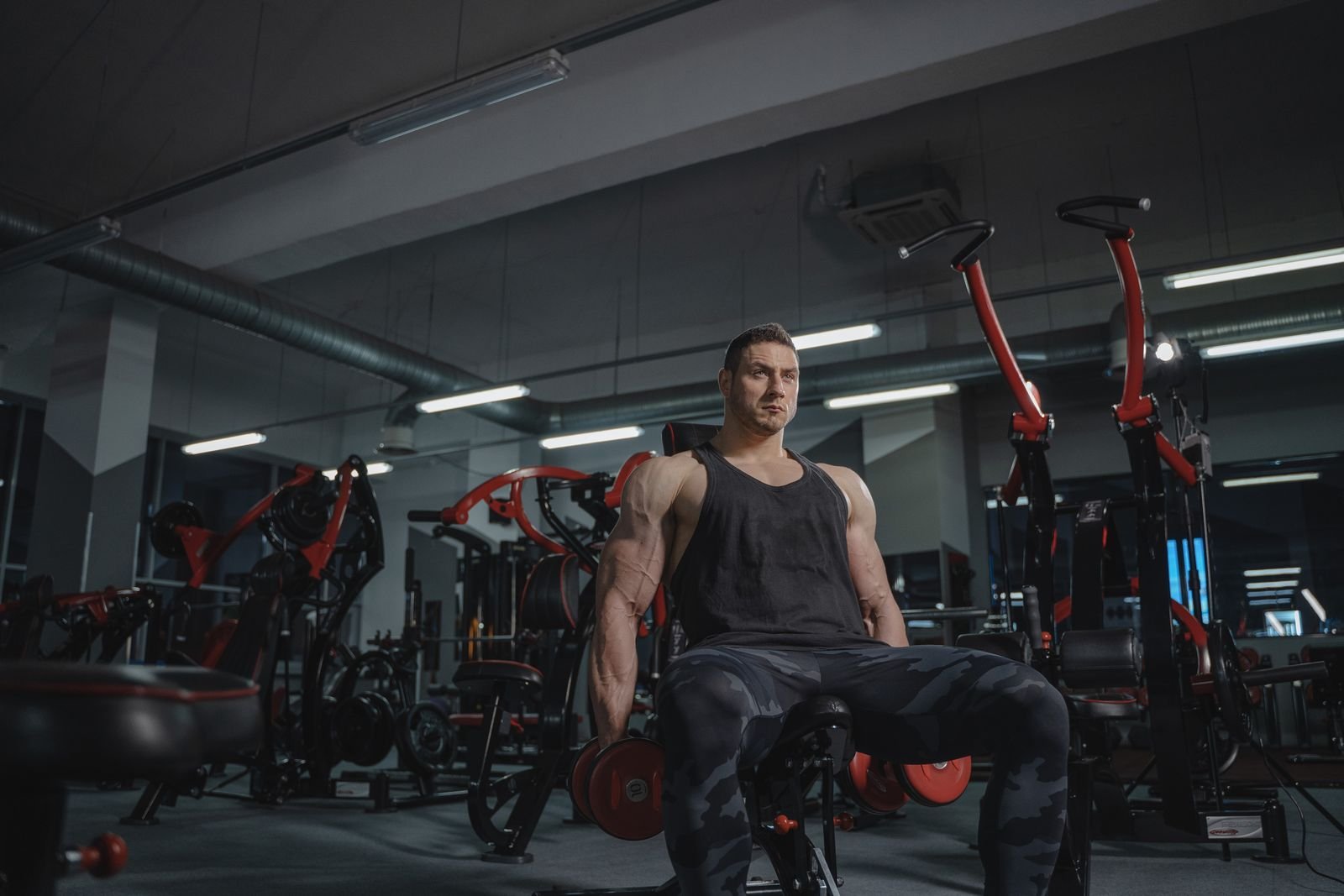
Research shows that while concentration curls elicit high EMG activity, other curl variations can build equal or greater strength through different angles, grip positions, and resistance profiles. Understanding these options helps you train your arms more effectively, avoid overuse, and keep progressing even without traditional isolation setups.
According to the American Council on Exercise (ACE), concentration curls top the list for biceps activation, but studies in the Journal of Sports Science & Medicine and Frontiers in Physiology confirm that variations like incline, cable, and hammer curls also provide high activation across the full range of motion.
Let’s explore 12 proven concentration curl alternatives that target your biceps from every angle.
Why Replace the Concentration Curl?
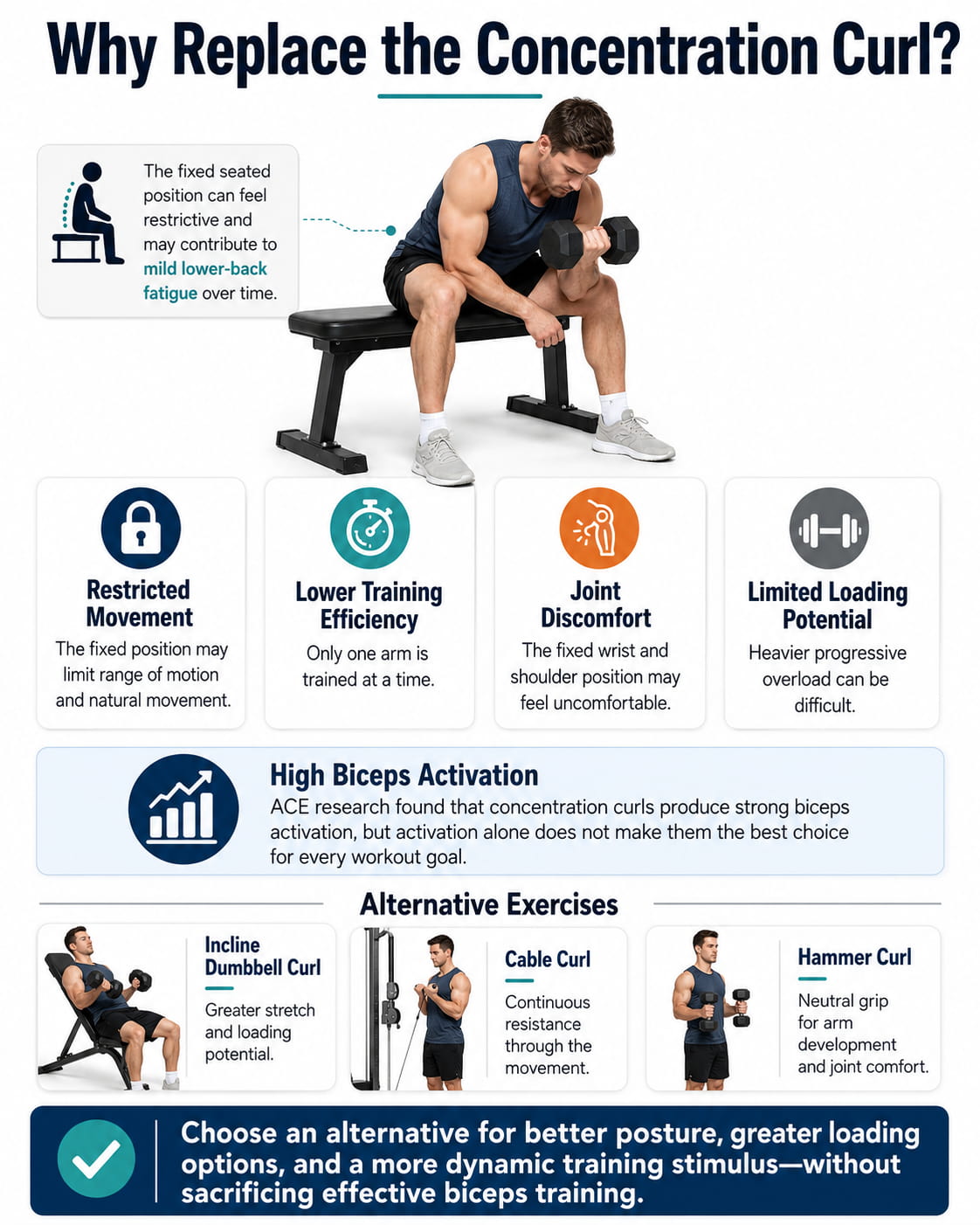
The concentration curl is excellent for isolating the biceps, but it’s not always the most efficient or sustainable choice.
An ACE (American Council on Exercise, 2014) study confirmed it produces the highest biceps activation, yet its seated position limits progressive overload and functional carryover.
Leaning forward with your elbow pressed into your thigh locks the torso and disengages stabilizing muscles like the core and shoulders. Over time, this posture can cause fatigue or lower-back tension, especially during high-rep sets.
You might replace the concentration curl if you:
- Feel restricted in movement or range of motion.
- Want to train both arms simultaneously for efficiency.
- Experience wrist or shoulder discomfort from the fixed position.
- Need greater loading potential for size and strength gains.
Recent Journal of Strength & Conditioning Research (2023) findings show that alternating grip types and curl angles leads to better overall biceps hypertrophy and comfort.
That’s why smart substitutes—like incline dumbbell curls, cable curls, or hammer curls—can offer full muscle engagement with better posture and joint safety.
In short: Replace the concentration curl if you want improved posture, more load options, and a dynamic training stimulus—without sacrificing biceps activation.
12 Best Concentration Curl Alternatives
Each of these exercises targets the biceps through different angles, grips, and resistance profiles to build strength and size more effectively than the seated curl. They replicate the isolation benefits of the concentration curl while improving posture, stability, and progressive overload potential.
1. Incline Dumbbell Curl
Why it works:
By reclining on an incline bench, your arms extend behind your torso, lengthening the biceps long head. This stretch places the muscle under constant tension through a full range of motion, which enhances hypertrophy stimulus.
Muscles worked:
Biceps brachii (long head), brachialis.
How to do it:
- Sit on a 45–60° incline bench with a dumbbell in each hand.
- Allow arms to hang fully extended, palms facing forward.
- Curl both dumbbells upward while keeping elbows fixed.
- Slowly lower back to full extension.
Trainer Tip:
Control the eccentric phase (3–4 seconds) to maximize time under tension and growth.
2. Cable Curl (Standing or Seated)
Why it works:
Cables maintain constant resistance through the curl’s full range, unlike dumbbells that lose tension near the top. Ideal for steady muscle engagement and joint-friendly training.
Muscles worked:
Biceps brachii, brachialis, forearms.
How to do it:
- Attach a straight or EZ bar to a low pulley.
- Grip with palms up, shoulder-width apart.
- Curl the bar up toward your shoulders.
- Lower slowly, keeping elbows close to your body.
Trainer Tip:
Don’t let the stack touch—keeping continuous tension boosts activation.
3. Zottman Curl
Why it works:
This hybrid curl combines a supinated (biceps-focused) concentric phase with a pronated (forearm-focused) eccentric phase. It’s one of the best ways to develop both biceps size and forearm strength.
Muscles worked:
Biceps brachii, brachioradialis, forearm extensors.
How to do it:
- Hold dumbbells with palms up and curl up smoothly.
- Rotate wrists to palms-down at the top.
- Lower the dumbbells slowly in that pronated position.
Trainer Tip:
Take 3–5 seconds on the lowering phase to overload the forearms and improve grip endurance.
4. Hammer Curl
Why it works:
The neutral grip decreases wrist strain and emphasizes the brachialis, a key muscle for arm thickness that lies beneath the biceps.
Muscles worked:
Brachialis, biceps brachii, brachioradialis.
How to do it:
- Hold dumbbells at your sides, thumbs pointing up.
- Curl until hands reach shoulder height.
- Lower under full control.
Trainer Tip:
Keep wrists neutral—don’t rotate—for pure brachialis isolation.
5. Preacher Curl (Dumbbell or EZ-Bar)
Why it works:
The fixed upper-arm position isolates the biceps, limiting shoulder assistance. It’s especially effective for the short head, which contributes to the “peak” appearance.
Muscles worked:
Biceps brachii (short head).
How to do it:
- Sit on a preacher bench, upper arms resting on the pad.
- Curl the bar or dumbbell up slowly until elbows are flexed.
- Lower until arms are nearly straight.
Trainer Tip:
Avoid jerking from the bottom—keep tension constant to prevent elbow strain.
6. Spider Curl
Why it works:
By lying face-down, gravity provides resistance through the entire curl, emphasizing the top half of the movement and creating peak contraction.
Muscles worked:
Biceps brachii (both heads).
How to do it:
- Lie chest-down on an incline bench with arms hanging vertically.
- Curl dumbbells up, keeping elbows stationary.
- Squeeze at the top, then lower slowly.
Trainer Tip:
Perform in a slow tempo (2–1–3) to enhance muscle control and prevent swinging.
7. Chin-Up (Underhand Grip)
Why it works:
This compound move challenges the biceps under heavy load, producing greater strength and hypertrophy while also recruiting the lats for stability.
Muscles worked:
Biceps brachii, lats, forearms.
How to do it:
- Use an underhand grip, hands shoulder-width apart.
- Pull your body until the chin clears the bar.
- Lower slowly until arms are straight.
Trainer Tip:
Engage your core—avoid kipping to keep the focus on biceps.
8. Resistance Band Curl
Why it works:
The elastic resistance increases with stretch, offering progressive overload similar to cables—excellent for home workouts.
Muscles worked:
Biceps brachii, brachialis.
How to do it:
- Stand on the center of a resistance band.
- Grip handles with palms up.
- Curl upward until hands reach shoulder level.
- Lower slowly.
Trainer Tip:
Increase resistance by widening your stance or using thicker bands.
9. Bayesian Cable Curl
Why it works:
A biomechanically superior alternative that trains the biceps in a lengthened position—vital for hypertrophy per recent research.
Muscles worked:
Biceps brachii (long head).
How to do it:
- Attach a single handle to a low pulley.
- Face away, step forward to create tension.
- Curl forward without moving the upper arm.
Trainer Tip:
Slightly extend your shoulder back during each rep to maintain constant tension.
10. Barbell Curl (Straight or EZ-Bar)
Why it works:
Allows heavier loading, promoting strength progression and mass. The EZ-bar version reduces wrist strain while maintaining high biceps activation.
Muscles worked:
Biceps brachii, brachialis, forearms.
How to do it:
- Grip bar shoulder-width, palms up.
- Curl up under control—no swinging.
- Lower slowly to full extension.
Trainer Tip:
Stop just short of lockout to keep tension constant and prevent elbow stress.
11. Cross-Body Dumbbell Curl
Why it works:
Curling diagonally across your torso emphasizes the brachialis, enhancing arm width and helping correct imbalances between sides.
Muscles worked:
Brachialis, biceps brachii.
How to do it:
- Hold dumbbells with palms facing your body.
- Curl one arm across toward the opposite shoulder.
- Lower and repeat with the other arm.
Trainer Tip:
Keep your elbow near your ribs—avoid twisting your torso.
12. Cable Overhead Curl
Why it works:
This variation positions the biceps in their shortened state, maximizing peak contraction while cables ensure constant resistance.
Muscles worked:
Biceps brachii (short head).
How to do it:
- Attach handles to two high pulleys.
- Stand centered, arms extended to sides.
- Curl hands toward your ears, squeezing hard.
- Return slowly to the start.
Trainer Tip:
Perform with light to moderate weight—control is key to maintaining joint safety.
How to Program These Alternatives for Maximum Growth
To build bigger, stronger biceps, structure your workouts with the right balance of volume, frequency, and intensity.
Research from Schoenfeld et al. (2016) and the ACSM Position Stand recommends moderate loads and controlled tempo for best results.
Quick Programming Guide:
- Frequency: 2 sessions per week (48 hrs apart).
- Sets/Reps: 3–4 sets of 8–12 reps per exercise.
- Rest: 60–90 seconds between sets.
- Tempo: 1–2 seconds up, 2–3 seconds down.
- Pairing: Combine a stretch-based move (e.g., Incline Curl) with a peak-tension exercise (e.g., Cable Overhead Curl).
- Progression: Add small load or rep increases weekly.
In short: Focus on control, gradual overload, and varied angles for steady biceps growth.
Common Mistakes When Replacing Concentration Curls
Even great alternatives can fail if form and structure are ignored.
Avoid these common errors:
- Using momentum — swinging reduces tension.
- Half reps — shorten range, reduce gains.
- Too heavy, poor control — sacrifices technique.
- Same grip every time — causes imbalance.
- Skipping slow eccentrics — limits growth stimulus.
In short: Keep reps slow, posture stable, and grips varied for maximum results and joint safety.
FAQs
1. Are concentration curl alternatives as effective for biceps growth?
Yes. Research from the ACE and Journal of Sports Science & Medicine shows several curls produce comparable EMG activation when form and tension are controlled.
2. Which alternative is best for beginners?
Hammer curls or cable curls—they’re simple, joint-friendly, and easy to control.
3. How often should I train biceps?
Two sessions per week with at least 48 hours rest between is optimal for recovery and growth.
4. Should I use heavy or light weights?
Use moderate weights (8–12 reps) with strict form for hypertrophy; increase weight gradually.
5. Are cables or dumbbells better for isolation?
Cables maintain constant tension, but dumbbells allow natural wrist rotation—both are excellent when alternated.
6. Can I replace concentration curls entirely?
Yes. As long as you include one or more isolation movements targeting both heads of the biceps.
7. What’s the best exercise for overall arm thickness?
Hammer curls—because they build both the biceps and the deeper brachialis muscle.
Conclusion
You don’t need concentration curls to build impressive arms. Mixing in variations like incline curls, cable curls, and hammer curls can activate your biceps through new angles and improve muscle balance. Focus on strict form, slow eccentric control, and consistent progression to see maximum growth.
Try adding 2–3 of these alternatives into your next arm workout and track your results for 4–6 weeks.
References
- ACE EMG Study — Best Biceps Exercises (Concentration Curl ranked #1)
- Shoulder Position & Biceps EMG (Incline vs Standard vs Preacher Curl) — Journal of Sports Science & Medicine
- Handgrip Effects on Biceps Activation (Supinated vs Neutral vs Pronated) — MDPI Sports (2023)
- EZ-Bar vs Straight Bar vs Dumbbells — EMG Comparison — Marcolin et al., 2018 (Open-access full text)
- Training at Longer Muscle Lengths May Enhance Hypertrophy (incl. biceps) — Frontiers in Physiology (2025)
- ACSM Position Stand — Progression Models in Resistance Training (load, reps, progression; gold-standard programming)
- Resistance Training Frequency & Hypertrophy — Systematic Review & Meta-analysis (Schoenfeld et al., 2016)
- Inter-set Rest Durations >60 s Show Small Hypertrophy Benefit — Frontiers in Sports and Active Living (2024, Bayesian meta-analysis)