
The dip exercise is a powerful bodyweight pressing move that builds triceps size and strength while also training your chest and shoulders. If you learn the right setup, control your depth, and progress the load gradually, dips can be one of the fastest ways to upgrade your upper-body strength with minimal equipment.

Because dips place your shoulder in extension at the bottom, technique matters. This guide covers correct form, safer progressions, sets and reps for muscle growth, and the most common mistakes to avoid.
What Is the Dip Exercise?
A dip is a bodyweight press where you support yourself on parallel bars (or rings), lower your body by bending your elbows, then press back up to lockout. Depending on your torso angle and elbow path, dips can feel more triceps-focused or more chest-focused.
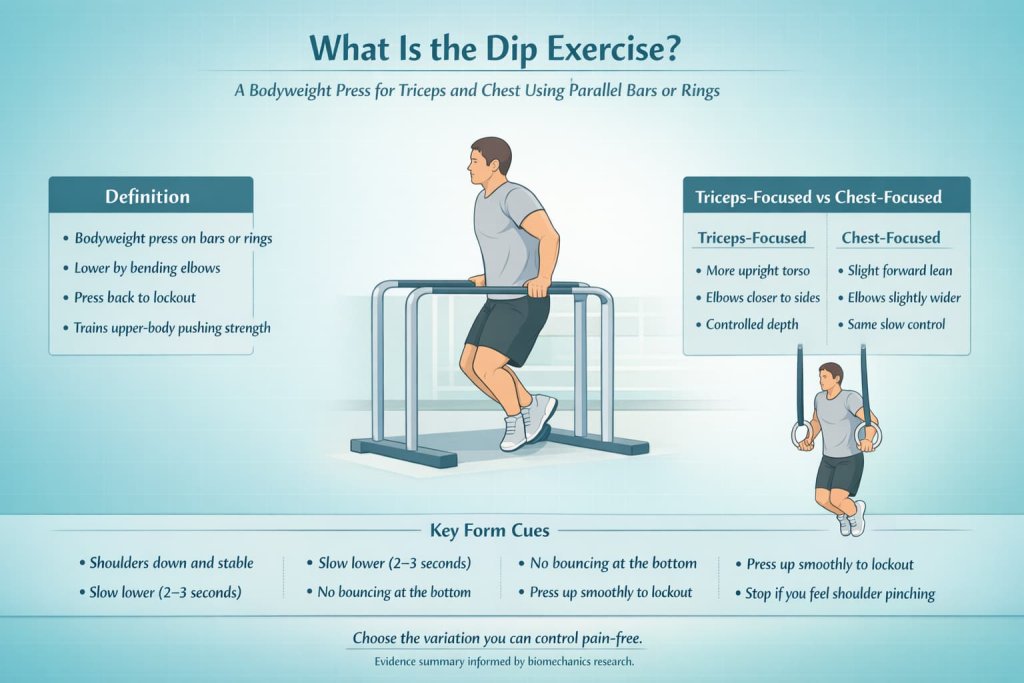
A biomechanics and muscle-activation study comparing bench, bar, and ring dips shows that dip variations change joint positions and muscle demands, which is why choosing the right version matters, as explained by the PubMed Central paper on upper-body dip variations.
How to Do the Dip Exercise Correctly
Use this as your “non-negotiable” technique checklist.
Parallel-Bar Dip Setup
- Grip the bars firmly and jump/step into a tall support position.
- Lock in your shoulder blades by keeping them “down” (avoid shrugging).
- Keep your ribs stacked over your pelvis (don’t over-arch your lower back).
- Bend your knees slightly or cross your ankles to stay stable.
Descent and Depth
- Lower slowly for 2–3 seconds.
- Keep your elbows tracking naturally (not flared aggressively).
- Stop at a depth you can control without shoulder discomfort or bouncing.
- Your forearms should stay close to vertical from the side view.
Press Back Up
- Drive through your palms and press until elbows are straight.
- Keep your shoulders down (don’t shrug at the top).
- Finish with control—no lockout “slam.”
Best Dip Exercise Variations (Easiest to Hardest)
1. Assisted Dip Machine
Why it works: The machine lets you practice the dip pattern with less bodyweight, so you can learn smooth control and consistent depth without grinding reps. It’s one of the fastest ways to build dip strength safely because you can increase the load gradually.
How to do it:
- Set the assistance so you can perform smooth reps without bouncing.
- Grip the handles, get into a tall support position, and keep shoulders down.
- Lower slowly until your upper arms are about parallel (or a comfortable depth).
- Press up with control until elbows are straight, without shrugging.
Trainer Tip: Treat the machine like “practice reps.” If your shoulders roll forward at the bottom, shorten the range and slow the descent.
2. Band-Assisted Parallel-Bar Dips
Why it works: Bands reduce the load most at the bottom (where dips are hardest), helping you train full-range control while still using your own bodyweight pattern on bars.
How to do it:
- Loop a sturdy band over both bars and place one knee or foot into the band.
- Start tall with ribs stacked over pelvis and shoulders down.
- Lower slowly, keeping elbows tracking naturally (not flaring aggressively).
- Press back up to a controlled lockout.
Trainer Tip: Use the smallest band that allows clean reps. If the band “slingshots” you up, slow down and pause for a second at the bottom.
3. Negative-Only Dips (Eccentric Dips)
Why it works: The lowering phase builds strength quickly because your muscles can handle more load eccentrically than concentrically. This is ideal when you can’t yet press back up with good form.
How to do it:
- Step or jump into the top support position on parallel bars.
- Lower for 3–5 seconds, staying controlled and keeping shoulders down.
- Stop at a comfortable depth, then step back up to the top (don’t press up yet).
- Reset and repeat.
Trainer Tip: Keep reps low and crisp. If your shoulders feel “pinchy,” reduce depth and slow down more.
4. Full Parallel-Bar Dips (Bodyweight)
Why it works: This is the classic dip that builds real triceps and chest strength using full bodyweight. Once you can do clean reps, it becomes an efficient upper-body builder with easy progression through reps, tempo, and load.
How to do it:
- Start tall with a firm grip, shoulders down, and body steady.
- Lower under control for 2–3 seconds.
- Keep elbows tracking naturally and avoid bouncing at the bottom.
- Press up smoothly to full lockout without shrugging.
Trainer Tip: Think “control first, depth second.” A slightly shorter, pain-free range beats forcing deep reps that irritate your shoulders.
5. Weighted Dips (Dip Belt or Dumbbell)
Why it works: Adding weight allows progressive overload, which is a major driver of strength and muscle growth. Weighted dips can be especially effective for triceps development once your bodyweight form is locked in.
How to do it:
- Use a dip belt with a plate or hold a dumbbell safely between your feet.
- Set up tall and stable before starting the first rep.
- Lower with the same controlled tempo you use for bodyweight.
- Press up hard but smooth—no bouncing or twisting.
Trainer Tip: Add load slowly. Start with small jumps (5–10 lb) and stop the set if your shoulder position changes or you lose depth control.
6. Ring Dips (Advanced)
Why it works: Rings add instability, forcing your shoulders, core, and upper back to work harder to stabilize each rep. This can build impressive control and strength, but it also demands slower progress and stricter technique.
How to do it:
- Start in a stable top support with rings close to your sides.
- Keep rings steady as you lower slowly (avoid letting them drift wide).
- Stop at a depth you can control without shoulder discomfort.
- Press back up while keeping rings close and shoulders down.
Trainer Tip: If rings shake or flare out, regress. Practice ring support holds and slow negatives before trying full reps.
7. Bench Dips (Use Carefully)
Why it works: Bench dips are easy to set up and can train the triceps, but they often place the shoulder in a more extended position, which some people find uncomfortable. They’re best treated as optional, not required.
How to do it:
- Place hands on the bench behind you and walk feet forward.
- Keep chest lifted and shoulders down (avoid rounding forward).
- Lower only to a comfortable depth, then press back up.
Trainer Tip: If you feel shoulder pinching, skip bench dips and use assisted, band-assisted, or parallel-bar dips instead.
Dip Exercise Muscles Worked
Dips train multiple upper-body muscles at once:
- Triceps (primary driver as you press up)
- Chest (especially with a slight forward lean)
- Front deltoids (assist pressing and shoulder control)
- Upper back and shoulder stabilizers (help keep the shoulder blades controlled)
The more stable the setup (machine or parallel bars), the easier it is to focus on pressing strength. The less stable the setup (rings), the more stabilization demand you’ll feel.
How to Make Dips More Triceps-Focused vs Chest-Focused
Small form changes shift the emphasis.
For More Triceps
- Keep your torso more upright.
- Keep elbows closer to your sides.
- Use a slightly shallower, controlled depth if your shoulders feel stressed deep.
For More Chest
- Add a slight forward lean (think “sternum forward,” not lower-back arch).
- Allow a bit more elbow flare (still controlled).
- Only go deeper if you can keep shoulder position stable and pain-free.
Dip Exercise Safety and Shoulder-Friendly Rules
Dips aren’t “bad,” but they can irritate shoulders when you force depth or lose control.
The National Strength and Conditioning Association notes that end-range shoulder extension (dropping too deep) can be a vulnerable position for some people, which is why depth control and proper progression are essential, as discussed by the NSCA.
Stop and scale the dip if you notice
- Sharp or pinching pain in the front of the shoulder
- Shoulder rolling forward at the bottom
- Neck/upper trap shrugging you can’t control
- Bouncing to escape the bottom position
Safer swaps if dips bother your shoulders
- Assisted dip machine (most stable)
- Band-assisted dips (reduces load at the hardest point)
- Push-ups or close-grip push-ups
- Cable or dumbbell pressing variations
Beginner Dip Progression That Works Fast
If you can’t do clean bodyweight dips yet, use this simple plan 2 times per week:
- Assisted dips: 3 sets of 6–10 reps (stop 1–2 reps before form breaks)
- Negative dips: 2 sets of 3–5 slow lowers (3–5 seconds down)
- Push-up variation: 2 sets of 8–15 reps
When you can do 3 sets of 10 assisted with perfect control, reduce assistance and repeat.
Sets, Reps, and Programming for Muscle Growth
To build bigger triceps and chest, prioritize consistent weekly volume and gradual progression.
A widely cited resistance-training position stand explains evidence-based frequency and progression strategies for strength and hypertrophy, which you can reference from PubMed when discussing programming.
Simple dip programming for hypertrophy
- Frequency: 2 times per week
- Sets: 3–5 working sets per session
- Reps: 6–12 reps for most sets
- Rest: 90–150 seconds between sets
- Effort: stop 1–2 reps before failure until form is locked in
Common Dip Exercise Mistakes That Kill Results
Avoid these and your dips will feel better and build faster:
- Going too deep too soon: depth should be earned, not forced
- Shrugging at the top: turns the set into a trap/neck grind
- Bouncing out of the bottom: increases joint stress and reduces muscle tension
- Elbows flaring wildly: often leads to shoulder discomfort for many lifters
- Lower-back over-arching: makes the “chest dip” look deeper than it is
- Progressing load before control: weighted dips are great—when you’re ready
A fatigue-focused bar dip study helps explain why technique often breaks late in sets, reinforcing the value of stopping before form falls apart, as described in this PubMed Central research.
Who Should Be Careful With the Dip Exercise?
Be extra cautious (or choose a different press) if you have:
- Current shoulder pain or a history of shoulder instability
- Recent pec, biceps tendon, or AC joint irritation
- Elbow pain that flares with deep pressing
If you’re unsure, start with assisted dips and a smaller range of motion, or work with a qualified coach or clinician to find a shoulder-friendly press.
Frequently Asked Questions About the Dip Exercise
Are dips better for triceps or chest?
Both. A more upright torso usually feels more triceps-focused, while a slight forward lean tends to increase chest involvement.
How many dips should I do to build muscle?
A common hypertrophy target is 6–12 reps for 3–5 working sets, 2 times per week, while gradually increasing reps, control, or load over time.
Are dips bad for your shoulders?
Not automatically. They can be uncomfortable if you force deep range or lose shoulder control. Keep depth controlled and progress slowly, especially if you’ve had shoulder issues.
Should beginners do dips?
Yes—if they start with assistance (machine or bands), focus on control, and avoid painful depth. Negative-only dips can also help build strength safely.
What’s the difference between bench dips and parallel-bar dips?
Bench dips often place the shoulder in more extension with a different arm angle. Parallel-bar dips usually allow more natural pressing mechanics for many people.
Can I do dips at home without dip bars?
Yes. Options include sturdy parallel surfaces (like secure dip handles) or using resistance bands and a stable setup. The key is safety: the bars must not wobble or tip.
When should I start adding weight to dips?
When you can do multiple sets of clean reps (for example, 3 sets of 8–12) with consistent depth and no shoulder irritation for a few weeks.
Conclusion
Dips work because they load the triceps hard while also challenging your chest and shoulders through a deep pressing pattern. Keep your shoulders controlled, earn your depth, and progress gradually—then add load only after your reps look identical from start to finish.