
The donkey kick exercise is a beginner-friendly, bodyweight movement that targets the glute muscles by training hip extension while keeping the spine stable.
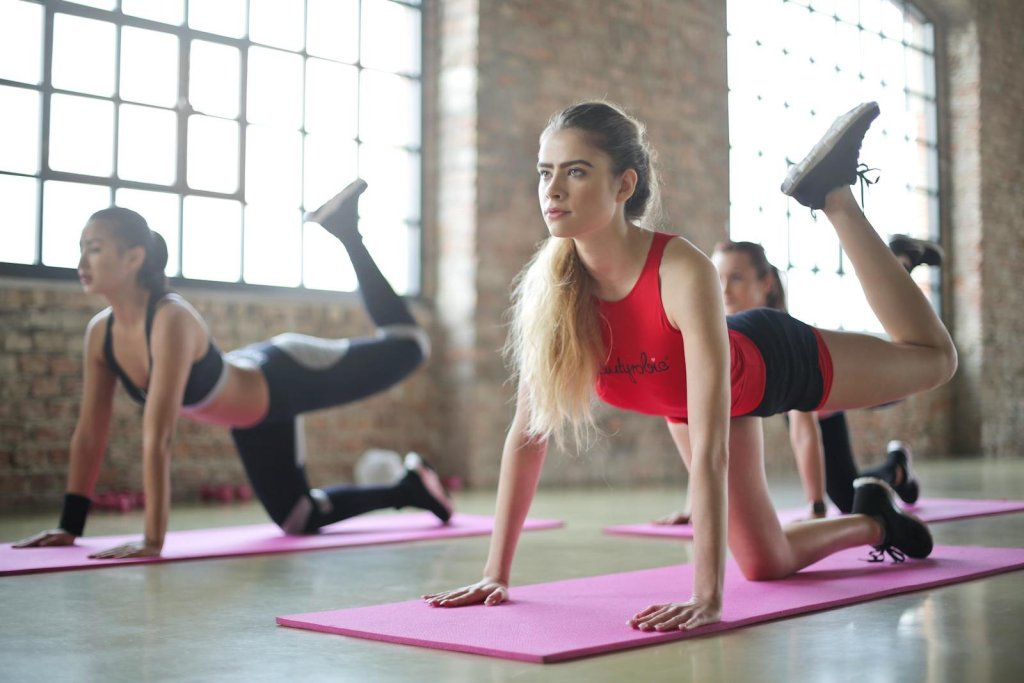
It is widely used in strength training, physical therapy, and home workouts because it helps activate the glutes with low joint stress and minimal equipment.
Understanding how to perform the donkey kick exercise correctly matters because poor form can shift the workload to the lower back instead of the glutes. With proper technique, this simple move can support stronger hips, better posture, and improved lower-body control.
What Is the Donkey Kick Exercise?
The donkey kick exercise, also known as quadruped hip extension, is performed on all fours with one knee lifting upward while staying bent.
Unlike squats or lunges, donkey kicks:
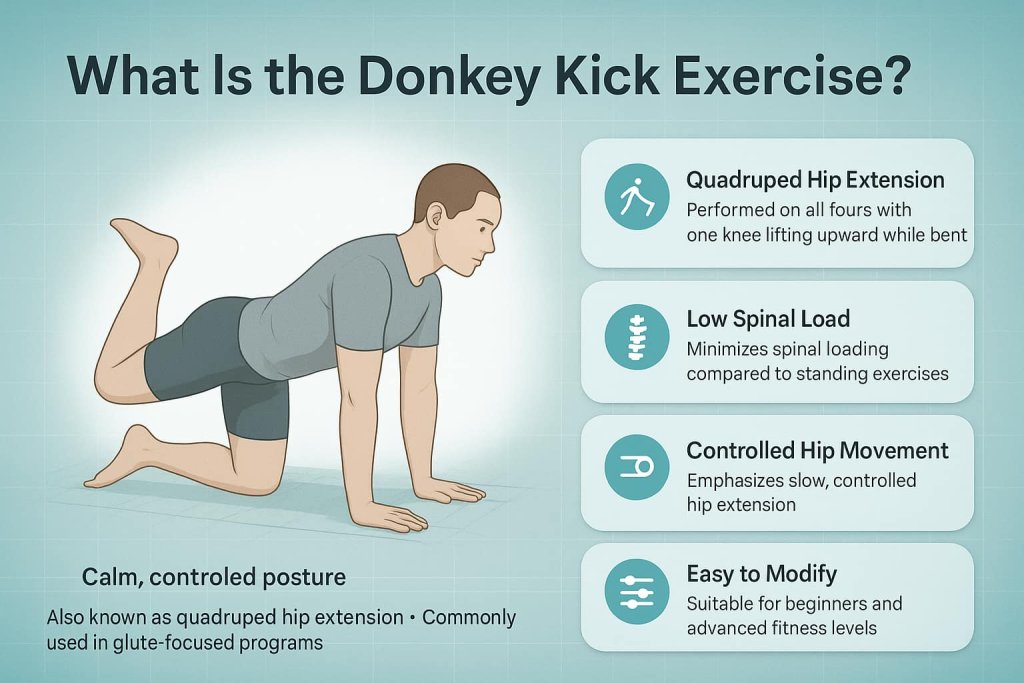
- Minimize spinal loading
- Emphasize controlled hip movement
- Are easy to modify for different fitness levels
Fitness organizations such as the American Council on Exercise (ACE) include quadruped hip extensions in glute-focused programs due to their effectiveness and accessibility.
How to Do the Donkey Kick Exercise Correctly
How to do it
- Start on all fours with hands under shoulders and knees under hips
- Brace your core and keep your spine neutral
- Bend one knee to about 90 degrees
- Lift that leg upward by squeezing the glute, not arching the back
- Stop lifting when your pelvis starts to move
- Lower slowly with control
- Repeat on both sides
Trainer Tip
Think “heel to the ceiling, ribs down.” If your lower back arches, reduce the range of motion.
Donkey Kick Exercise Variations
Below are common donkey kick exercise variations, explained in a clear, physiotherapy-inspired format. Each variation targets the glutes slightly differently while maintaining low spinal stress when performed correctly.
1. Straight-Leg Donkey Kick
Why it works:
Extending the leg straight increases the lever length, which raises torque at the hip. This can increase glute demand without adding external load, while also challenging pelvic stability.
Muscles worked:
The gluteus maximus remains the primary mover, with assistance from the hamstrings. The gluteus medius and core muscles work isometrically to stabilize the pelvis and spine.
How to do it:
- Start in a quadruped position with hands under shoulders and knees under hips
- Brace your core and maintain a neutral spine
- Extend one leg straight back, keeping toes pointing toward the floor
- Lift the leg only as high as you can without arching the lower back
- Lower slowly and repeat before switching sides
Trainer Tip:
If your hips start to rotate or your ribs flare, shorten the range of motion.
2. Donkey Kick Pulses
Why it works:
Pulses increase time under tension in the glutes and emphasize control near end-range hip extension, which can enhance glute activation without heavy resistance.
Muscles worked:
Primarily the gluteus maximus, with secondary involvement of the gluteus medius and deep core stabilizers.
How to do it:
- Perform a standard donkey kick and hold the leg just below your max lift height
- Pulse the leg upward 1–2 inches in a slow, controlled manner
- Keep the pelvis steady and core braced
- Complete all pulses on one side before switching
Trainer Tip:
Think “small and controlled.” Large pulses usually turn into lower-back movement.
3. Resistance Band Donkey Kick
Why it works:
Adding a resistance band increases external load through the hip extension range, making this variation more effective for strength progression.
Muscles worked:
Gluteus maximus (primary), gluteus medius, hamstrings, and core stabilizers.
How to do it:
- Loop a resistance band around one foot and anchor the other end under your hands or opposite knee
- Set up in a quadruped position
- Kick the banded leg upward while maintaining a neutral spine
- Lower slowly against the band’s tension
Trainer Tip:
Use a light band first. If your back arches, the resistance is too heavy.
4. Dumbbell Donkey Kick (Bent-Knee)
Why it works:
Placing a dumbbell behind the knee adds direct load to the glutes while keeping the knee bent, which helps limit hamstring dominance.
Muscles worked:
Primarily gluteus maximus, with support from hamstrings and spinal stabilizers.
How to do it:
- Start on all fours and carefully secure a light dumbbell behind one knee
- Keep the knee bent at about 90 degrees
- Lift the leg upward using the glute, not momentum
- Lower with control
Trainer Tip:
Only attempt this variation if you can maintain perfect control without shifting or arching.
5. Fire Hydrant Donkey Kick Combo
Why it works:
Combining hip extension with slight abduction challenges both the gluteus maximus and medius, improving multi-planar hip strength.
Muscles worked:
Gluteus maximus, gluteus medius, and deep hip stabilizers.
How to do it:
- Begin in quadruped position
- Lift the knee outward slightly (fire hydrant motion)
- From there, extend the leg backward into a donkey kick
- Return to start and repeat
Trainer Tip:
Move slowly and deliberately. Speed reduces control and muscle engagement.
Muscles Worked in the Donkey Kick Exercise
The donkey kick exercise primarily works the muscles responsible for hip extension and pelvic stability.
Primary muscles
- Gluteus maximus (main target)
- Hamstrings (assisting role)
Secondary muscles
- Gluteus medius (hip stability)
- Core muscles (spinal control)
- Erector spinae (isometric stabilization)
EMG research published in the Journal of Orthopaedic & Sports Physical Therapy found that bent-knee quadruped hip extension activates the gluteal muscles more than the tensor fasciae latae (TFL), which is important for balanced hip training.
Benefits of the Donkey Kick Exercise
The donkey kick exercise may help support several aspects of lower-body strength and movement quality.
Key benefits
- Improves glute activation, especially for beginners
- Supports hip stability and pelvic control
- Helps reduce reliance on the lower back during leg movements
- Suitable for home workouts and rehabilitation-style training
- Easy to scale with tempo, reps, or light resistance
ACE’s EMG-based analysis of glute exercises shows quadruped hip extensions produce meaningful glute activation when performed with proper control.
Common Donkey Kick Exercise Mistakes to Avoid
Even though the movement looks simple, form errors are common.
Watch out for
- Over-arching the lower back
- Swinging the leg instead of lifting with control
- Shifting weight excessively to one side
- Lifting the leg too high
How Often Should You Do the Donkey Kick Exercise?
For general fitness:
- Sets & reps: 2–4 sets of 8–15 reps per side
- Tempo: Slow and controlled to keep tension on the glutes
- Frequency: 2–3 times per week
- Best use: Warm-up before lower-body workouts or as a finisher
The CDC and WHO recommend muscle-strengthening activities at least two days per week, making donkey kicks a safe addition to lower-body routines.
Who Should Modify or Avoid Donkey Kicks?
Donkey kicks are generally safe, but some people should proceed with caution.
Modify if you have:
- Difficulty keeping a neutral spine
- Mild lower-back or hip discomfort
Avoid or seek guidance if you have:
- Acute lower-back or hip pain
- Recent spine, hip, or pelvic surgery
- Pain that worsens during the movement
If symptoms persist, consult a qualified professional before continuing.
Frequently Asked Questions (FAQs)
Is the donkey kick exercise good for glutes?
Yes. When performed correctly, the donkey kick exercise effectively targets the gluteus maximus and supports hip stability.
Are donkey kicks safe for beginners?
Yes. They are commonly recommended for beginners due to low joint stress and easy control.
Can donkey kicks help with lower-back pain?
They may help support better glute engagement, but poor form can worsen back strain. Proper technique is essential.
Do donkey kicks build muscle?
They can contribute to muscle development when programmed with sufficient volume, tempo control, and progression.
Should I feel donkey kicks in my lower back?
No. You should primarily feel them in your glutes. Lower-back sensation usually indicates over-arching.
Can I do donkey kicks every day?
They can be done frequently at low intensity, but strength gains typically require rest days.
Conclusion
The donkey kick exercise proves that simple movements can still be highly effective. With correct form and smart progression, it can help activate and strengthen your glutes, support hip stability, and improve movement control—whether you train at home or in the gym.
Add donkey kicks to your lower-body routine 2–3 times per week and focus on control over height for the best results.
References
- ACE (PDF): Glutes to the Max (EMG Study)
- PubMed: Selkowitz et al. (2013) Fine-Wire EMG Study Record
- PMC Full Text: Macadam et al. (2019) Systematic Review on Gluteus Maximus EMG in Bodyweight Hip-Extension Exercises
- PMC Full Text: Neto et al. (2020) Gluteus Maximus Activation During Common Strength/Hypertrophy Exercises (Systematic Review)