
The butt kicks exercise is a simple, equipment-free cardio drill that raises heart rate, activates the hamstrings and glutes, and prepares your legs for faster, more efficient movement.
Understanding how to perform butt kicks correctly matters because they are widely used in warm-ups, running drills, and home workouts to improve coordination, leg turnover, and lower-body readiness with minimal joint stress.
This guide explains what the butt kicks exercise is, how it works, the muscles involved, benefits, safety tips, and how to include it in your routine—using current, evidence-based guidance.
What Is the Butt Kicks Exercise?
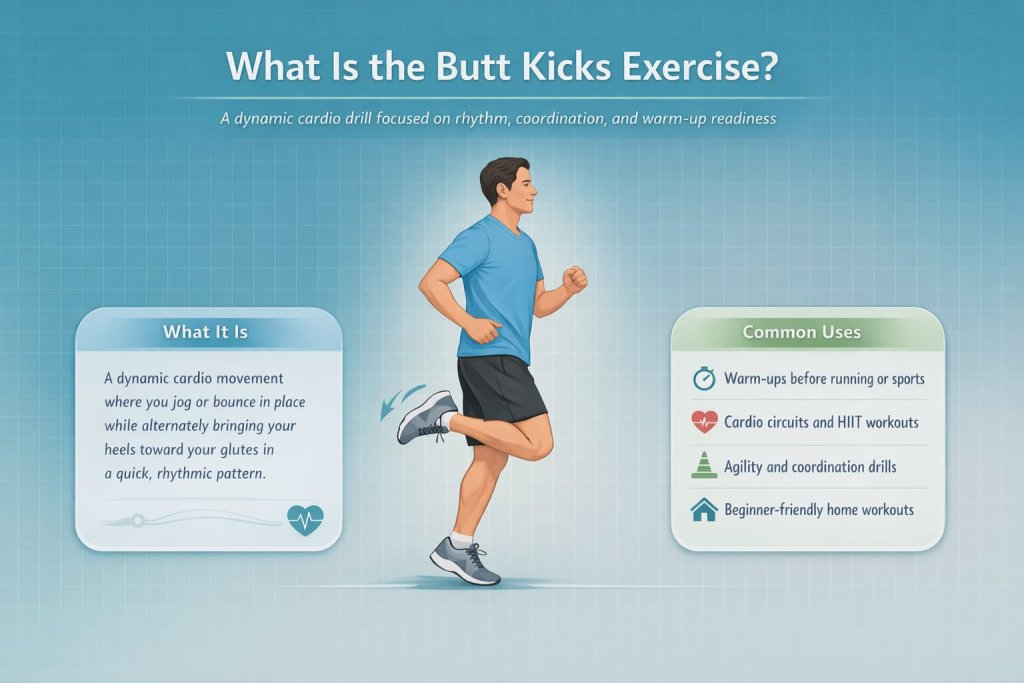
The butt kicks exercise is a dynamic cardio movement where you jog or bounce in place while alternately bringing your heels up toward your glutes. The motion is quick and rhythmic, with an upright torso and light, springy foot contact.
Butt kicks are commonly used in:
- Warm-ups before running or sports
- Cardio circuits and HIIT workouts
- Agility and coordination drills
- Beginner-friendly home workouts
How to Do the Butt Kicks Exercise Correctly
How to do it
- Stand tall with feet hip-width apart
- Begin jogging lightly in place
- Bend one knee and bring your heel toward your glutes
- Quickly switch legs in a smooth, alternating rhythm
- Keep your torso upright and core lightly engaged
- Land softly on the balls of your feet
- Continue for the desired time or distance
Proper posture and light foot contact help keep the movement efficient and reduce unnecessary strain.
Muscles Worked During the Butt Kicks Exercise
The butt kicks exercise primarily targets muscles responsible for knee flexion and hip extension while supporting full-body movement.
Primary muscles
- Hamstrings
- Gluteus maximus
Secondary muscles
- Quadriceps (dynamic lengthening)
- Calves
- Hip flexors
- Core stabilizers
Because the movement is repetitive and rhythmic, these muscles work together to support coordination, balance, and leg turnover rather than maximal strength.
Why the Butt Kicks Exercise Works
Butt kicks are effective because they combine dynamic movement with muscle activation rather than static stretching. This aligns with modern warm-up principles that emphasize preparing the body for activity instead of passively holding positions.
According to guidance summarized by Mayo Clinic, dynamic movements are commonly recommended before exercise to gradually raise heart rate and prepare muscles and joints for activity. Butt kicks fit this model by:
- Increasing blood flow to the lower body
- Activating the hamstrings through repeated knee flexion
- Encouraging coordination and rhythm
- Gently elevating heart rate without high impact
Benefits of the Butt Kicks Exercise
Regularly including the butt kicks exercise in your routine may help:
- Improve warm-up quality before cardio or sports
- Support running cadence and leg turnover
- Increase heart rate efficiently in a short time
- Activate hamstrings and glutes before harder efforts
- Enhance coordination and lower-body rhythm
- Add variety to home or bodyweight workouts
Organizations such as the American Heart Association emphasize gradual warm-ups to prepare the cardiovascular system for exercise, which supports the use of light cardio drills like butt kicks at the start of workouts.
How Butt Kicks Improve Speed and Leg Power
The butt kicks exercise may help support speed and leg power by reinforcing fast, coordinated lower-body movement rather than by building maximal strength. This makes it especially useful as a preparatory drill in warm-ups and athletic training.
Key ways butt kicks contribute to speed and leg power include:
- Faster leg turnover: The quick heel-to-glute action encourages rapid knee flexion, which can help reinforce efficient leg cycling patterns used in sprinting and running drills.
- Hamstring activation under light load: Repeated heel lift engages the hamstrings dynamically, supporting muscle readiness for faster movements without excessive strain.
- Improved neuromuscular timing: Performing butt kicks at a controlled but brisk pace helps train the nervous system to coordinate hip, knee, and ankle motion smoothly.
- Elastic lower-body rhythm: The light, springy foot contact encourages reactive movement, which may help prepare the legs for explosive or higher-intensity efforts later in a workout.
Coaches and conditioning programs often include butt kicks before speed or power work—not to replace strength training, but to prime the legs for faster, more efficient movement.
Butt Kicks Exercise for Warm-Ups and Cardio
The butt kicks exercise is flexible and can be used in different ways depending on your goal.
As a warm-up
- Perform for 20–40 seconds
- Keep the pace moderate and controlled
- Focus on posture and smooth movement
As a cardio drill
- Perform for 30–60 seconds
- Increase speed gradually
- Use in circuits or interval training
As a running drill
- Perform in place or moving forward
- Focus on quick heel recovery and light steps
- Combine with high knees or skips for variety
Common Mistakes to Avoid
- Leaning forward excessively
- Slamming the feet into the ground
- Letting knees drift forward instead of lifting heels back
- Moving too fast before establishing control
- Holding breath during the movement
Clean, controlled form is more important than speed—especially for beginners.
Safety Guidelines and Who Should Be Cautious
Butt kicks are generally low-risk, but caution is advised if you:
- Have acute knee, ankle, or hamstring injuries
- Experience pain during hopping or jogging movements
- Are returning to exercise after a long break
In these cases, start with slower marching-style butt kicks or perform the movement at a reduced pace. If discomfort persists, consult a qualified healthcare or fitness professional.
Programming Tips
- Include butt kicks near the beginning of your workout
- Pair with other dynamic drills like marching or skipping
- Start slow and build intensity over time
- Use short bouts to maintain good form
- Focus on quality movement rather than exhaustion
Consistency and control matter more than duration.
Frequently Asked Questions
Are butt kicks a cardio exercise?
Yes. Butt kicks elevate heart rate and breathing, making them a light-to-moderate cardio movement depending on speed and duration.
Do butt kicks work glutes or hamstrings more?
Butt kicks primarily activate the hamstrings, with the glutes assisting in hip extension and posture control.
Can beginners do the butt kicks exercise?
Yes. Beginners can perform butt kicks at a slower pace or reduce impact by minimizing the bounce.
Are butt kicks good for runners?
They are commonly used in running warm-ups to support leg turnover, coordination, and readiness.
How long should I do butt kicks?
Most people perform them for 20–60 seconds per set, depending on fitness level and purpose.
Can I do butt kicks at home?
Yes. Butt kicks require no equipment and minimal space, making them ideal for home workouts.
Conclusion
The butt kicks exercise is a simple yet effective movement that fits easily into warm-ups, cardio routines, and running drills. By activating key lower-body muscles and gradually increasing heart rate, it helps prepare your body for more demanding activity without unnecessary complexity.
If you’re building a balanced workout or warm-up routine, butt kicks are an easy, accessible place to start.
References
- American Heart Association: Warm Up and Cool Down
- Physical Activity Guidelines for Americans, 2nd Edition (health.gov PDF)
- Mayo Clinic Press: Does Stretching Prevent Injuries?
- Mayo Clinic: Aerobic Exercise—How to Warm Up and Cool Down
- American Academy of Orthopaedic Surgeons: Warm Up, Cool Down and Be Flexible
- PubMed Central: Effects of Dynamic and Static Stretching Within Warm-Up Protocols (Samson et al., 2012)
- PubMed Central: Potential Effects of Dynamic Stretching on Injury Incidence (Behm et al., 2023)