
Dumbbell lunges are one of the best simple exercises for building stronger legs, glutes, and better balance at the same time. Because each leg has to work more independently, they train strength, coordination, and side-to-side control in a way bilateral lifts do not always match. The American Council on Exercise (ACE) describes the dumbbell lunge as a loaded lunge done with one dumbbell in each hand at your sides, while the Physical Activity Guidelines for Americans recommend muscle-strengthening work for all major muscle groups on 2 or more days per week.
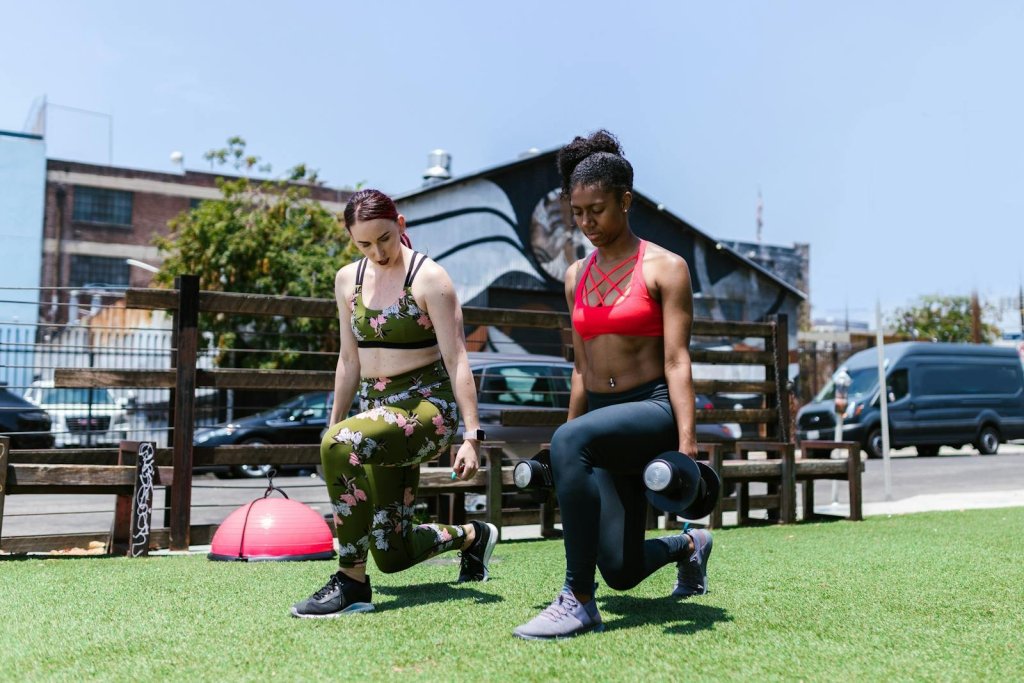
Understanding how to do dumbbell lunges correctly matters because a small change in step length, torso control, or knee tracking can make the exercise feel much better and more effective. The good news is that you do not need fancy equipment or advanced skill to start. With manageable weight, controlled reps, and a stable setup, dumbbell lunges can fit into most home or gym strength routines.
What Are Dumbbell Lunges?
A dumbbell lunge is a lower-body strength exercise where you hold a dumbbell in each hand, step into a lunge, lower under control, and return to standing. In ACE’s official exercise library, the standard setup is feet hip-width apart with the dumbbells hanging at your sides and the palms facing in.
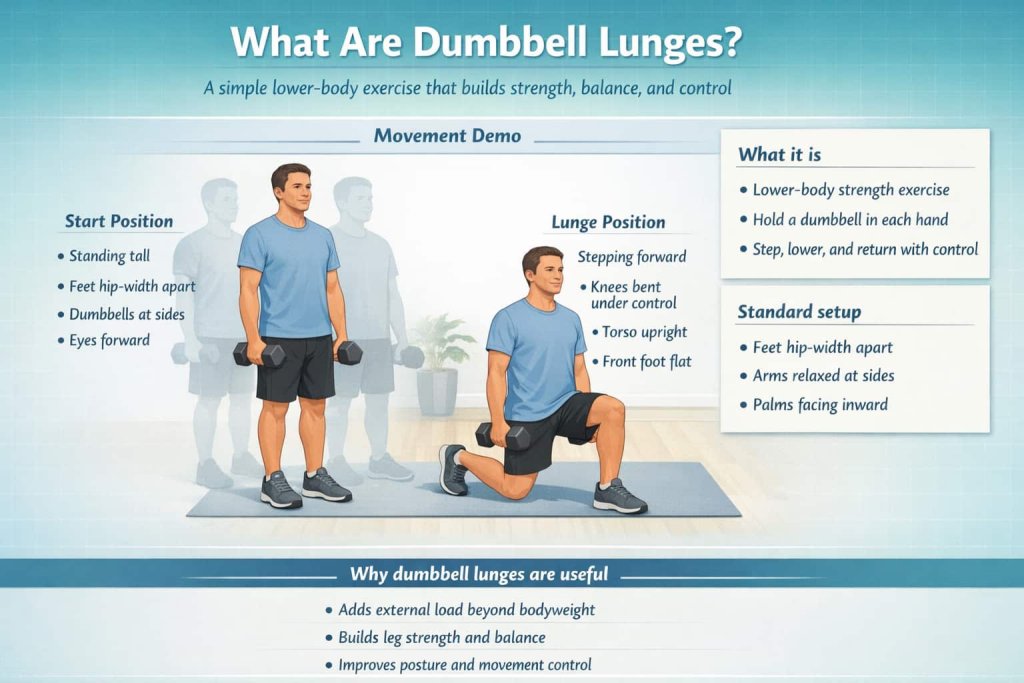
Compared with bodyweight lunges, dumbbell lunges add external load. That extra load can help you build more lower-body strength over time, but it also makes posture, control, and balance more important. This is one reason lunges are often considered a high-value exercise for both general fitness and performance training.
How to Do Dumbbell Lunges Properly
Setup
Stand tall with your feet about hip-width apart. Hold one dumbbell in each hand with your arms relaxed by your sides. Brace your midsection and keep your chest tall without over-arching your lower back. This matches the general setup described in ACE’s lunge guidance.
Step-by-step form
- Stand tall with a dumbbell in each hand.
- Step forward with one leg.
- Lower your body under control until both knees bend comfortably.
- Keep the front foot flat and the torso steady.
- Push through the front foot to return to the start.
- Repeat on the same side or alternate sides.
ACE’s forward-lunge instructions emphasize staying tall through the torso, keeping the step controlled, and avoiding a rushed descent.
Best Dumbbell Lunge Variations and When to Use Them
1. Forward Dumbbell Lunge
Why it works:
This is the most recognizable dumbbell lunge variation and a solid starting point for building lower-body strength, coordination, and control. Because you step forward into the rep, it also trains your ability to decelerate your body and stay stable as you lower.
Muscles worked:
Quadriceps, glutes, hamstrings, calves, and core stabilizers.
How to do it:
- Stand tall with a dumbbell in each hand at your sides.
- Step forward with one leg.
- Lower under control until both knees bend comfortably.
- Keep your chest tall and front foot flat.
- Push through the front foot to return to standing.
- Repeat all reps on one side or alternate sides.
Trainer Tip:
Do not rush the step forward. A controlled step usually improves balance, depth, and overall form.
2. Reverse Dumbbell Lunge
Why it works:
The reverse dumbbell lunge is often easier to control than the forward version because stepping backward can make it simpler to keep your balance and organize your body position. It is a strong option for beginners or anyone who wants a smoother, more deliberate lunge pattern.
Muscles worked:
Glutes, quadriceps, hamstrings, calves, and core stabilizers.
How to do it:
- Stand tall holding a dumbbell in each hand.
- Step one foot back under control.
- Lower until both knees bend comfortably.
- Keep most of your control over the front leg.
- Push through the front foot to return to the start.
- Repeat on the same side or switch sides.
Trainer Tip:
Think about stepping back quietly, not reaching far behind you. A controlled step-back usually feels more stable than an oversized one.
3. Walking Dumbbell Lunge
Why it works:
Walking dumbbell lunges add continuous movement, which increases the balance, coordination, and work-capacity demand. Because you keep moving forward rep after rep, this variation can feel more athletic and more challenging than staying in place.
Muscles worked:
Quadriceps, glutes, hamstrings, calves, hip stabilizers, and core.
How to do it:
- Hold a dumbbell in each hand at your sides.
- Step forward into a lunge and lower under control.
- Push through the front foot and bring the back leg through into the next step.
- Continue alternating sides as you move forward.
- Keep each rep steady rather than rushing.
- Use a clear path with enough space in front of you.
Trainer Tip:
Keep your steps smooth and consistent. If the movement starts feeling sloppy, shorten the set before your balance breaks down.
4. Static Split Squat With Dumbbells
Why it works:
This variation keeps your feet planted, so you can focus more on strength, alignment, and controlled depth without worrying as much about stepping and re-balancing each rep. It is one of the best regressions for learning the positions needed for full dumbbell lunges.
Muscles worked:
Quadriceps, glutes, hamstrings, calves, and core stabilizers.
How to do it:
- Stand in a split stance with one foot forward and one foot back.
- Hold a dumbbell in each hand by your sides.
- Lower straight down under control.
- Bend both knees comfortably while keeping your torso tall.
- Push through the front foot to rise back up.
- Complete all reps, then switch sides.
Trainer Tip:
Set your feet and keep them there for the whole set. That fixed stance helps you focus on clean reps and controlled lowering.
Dumbbell Lunges Benefits
Dumbbell lunges are popular for a reason. They challenge several useful qualities in one movement.
They build lower-body strength
Dumbbell lunges mainly train the quads and glutes, while the hamstrings, calves, and core also contribute to control and position. ACE notes the quadriceps and gluteus maximus as key muscles involved in lunge patterns.
They improve balance and coordination
Because you are working in a split stance and shifting weight from one leg to the other, lunges challenge stability more than many machine-based leg exercises. The Mayo Clinic notes that balance exercises can help at any age and are especially important for older adults.
They can expose side-to-side weaknesses
Each leg must do its own work. That makes dumbbell lunges useful for spotting strength differences, balance issues, or movement control problems from one side to the other.
They fit well into general health-focused training
The Physical Activity Guidelines for Americans recommend muscle-strengthening activity for all major muscle groups at least 2 days per week, and dumbbell lunges can be one of the leg exercises that helps you meet that target. Mayo Clinic also notes that strength training for all major muscle groups at least twice weekly supports health and fitness.
Muscles Worked in Dumbbell Lunges
The main muscles worked during dumbbell lunges include:
- Quadriceps
- Gluteus maximus
- Hamstrings
- Calves
- Core and trunk stabilizers
- Hip stabilizers
The exact emphasis changes slightly based on how you perform the rep. A slightly longer step can shift more demand toward the glutes and hips, while a shorter step often feels more quad-dominant. Your torso angle, depth, and control also influence which areas feel the work most. This is why two people can both do lunges correctly and still feel them a bit differently.
Form Tips That Make Dumbbell Lunges Feel Better
Keep the step controlled
Do not throw your foot forward and crash into the bottom of the rep. A smoother step usually makes the movement feel more stable and easier to control.
Use a stance width that helps balance
Walking on a tightrope is harder than standing on train tracks. Many people feel more stable when their feet stay roughly hip-width apart rather than landing too close together. ACE’s dumbbell lunge setup starts from a hip-width stance.
Let depth match your mobility and control
You do not need to force the deepest possible lunge on day one. Reduce the range if you cannot stay balanced, keep your front foot planted, or control the descent well. The physical activity guidelines advise people to start low and go slow, then increase gradually over time.
Start lighter than you think
A load that feels easy in a squat can feel much harder in a lunge because balance is part of the challenge. Choose weights that let you keep clean reps from start to finish. The Mayo Clinic fitness guide notes that, for general fitness, even one set can provide benefits when the resistance is challenging enough to fatigue muscles around 12 to 15 reps.
Common Dumbbell Lunge Mistakes
Stepping too narrow
This can make balance harder and cause you to wobble more than necessary. A slightly wider base often feels more natural.
Rushing the lowering phase
Dropping too quickly reduces control and can make the rep feel sloppy. Slower lowering usually improves alignment and stability.
Using too much weight too early
When the dumbbells are too heavy, people often shorten the step, lose posture, or cut the range too much. Progress load only after technique stays steady. The guidelines’ “start low and go slow” advice applies well here.
Letting balance determine everything
A little wobble is normal, but if balance is the main limit, scale the exercise. Use lighter weights, shorten the range, or try a split squat first so the movement pattern becomes easier to own. This is often a better progression than forcing unstable reps.
Are Dumbbell Lunges Better Than Squats?
Squats are usually easier to load heavily and can be simpler for beginners to learn because both feet stay planted. Dumbbell lunges, on the other hand, ask each leg to work more independently and add more balance demand. That makes lunges especially useful for improving unilateral strength, coordination, and control. Many strong programs use both.
A simple way to think about it is this: squats are excellent for overall lower-body strength, while dumbbell lunges add a useful single-leg challenge that can round out your training.
Dumbbell Lunges vs Reverse Lunges
Forward dumbbell lunges are not the only option. Reverse lunges are another common variation.
A forward lunge usually creates a slightly more dynamic braking demand because you are stepping forward into the rep. A reverse lunge often feels easier to control for beginners because you step backward and keep your weight more centered over the front leg. Neither is automatically best for everyone. The better choice is the one you can perform with clean control and no sharp pain. ACE’s lunge library includes both forward and reverse patterns in its broader exercise resources.
How Many Reps and Sets Should You Do?
For many people, 2 to 4 sets of 6 to 12 reps per leg is a practical range for dumbbell lunges, depending on your goal and the weight used. For general health-focused strength training, Mayo Clinic notes that one set can already provide benefits, while loads that fatigue muscles around 12 to 15 reps can work well for health and fitness.
A simple starting point looks like this:
- Beginners: 2 to 3 sets of 6 to 8 reps per leg
- Intermediate: 3 sets of 8 to 10 reps per leg
- Strength-focused: 3 to 4 sets of 6 to 8 reps per leg with heavier dumbbells
- Control or conditioning focus: 2 to 3 sets of 10 to 12 reps per leg with lighter-to-moderate dumbbells
The key is not chasing a perfect number. Use a rep range that lets you keep solid form and finish with effort, not breakdown. The American College of Sports Medicine (ACSM) also supports resistance training as part of a balanced health routine.
Who Should Do Dumbbell Lunges?
Dumbbell lunges can be a good fit for:
- People who want stronger legs and glutes
- Lifters who want more single-leg training
- Home exercisers with just a pair of dumbbells
- Athletes who want better lower-body control
- Adults trying to build strength as part of a well-rounded routine
They are especially useful when you want one exercise that builds strength and challenges balance together. Mayo Clinic notes that balance work and strength work both matter, especially as people age.
Who Should Be Careful With Dumbbell Lunges?
You may need to modify, regress, or get professional guidance first if you have:
- Ongoing knee, hip, ankle, or balance issues
- Recent lower-body injury
- Sharp pain during lunging patterns
- Major difficulty controlling bodyweight lunges first
The physical activity guidelines note that people with chronic conditions or symptoms should work with a healthcare professional or physical activity specialist on safe activity choices, and that everyone should choose activities that match their current fitness level and goals.
Quick Safety Checklist for Dumbbell Lunges
Before you add load, check these basics:
- You can do bodyweight lunges with control
- You can keep the front foot flat
- You can lower without crashing down
- You can stay balanced without twisting
- You can stop the set before form falls apart
That last point matters. Good lunges are controlled lunges. More weight is only helpful when the movement still looks clean. The guidelines’ advice to progress gradually is one of the best safety rules for this exercise.
How to Progress Dumbbell Lunges Over Time
A smart progression often looks like this:
1. Master bodyweight lunges first
Learn balance, depth, and posture without load.
2. Add light dumbbells
Use weights that let you keep the same clean pattern.
3. Increase range or reps
You can build volume before making the dumbbells much heavier.
4. Progress load gradually
Add weight only when your current reps stay controlled.
5. Try more advanced variations later
Walking lunges, paused lunges, or heavier sets can come after you own the basics.
This gradual approach matches the official “start low and go slow” safety advice in the Physical Activity Guidelines.
Frequently Asked Questions
Are dumbbell lunges good for beginners?
Yes, but beginners should usually start with bodyweight lunges or very light dumbbells first. The goal is to learn balance and control before chasing load.
Do dumbbell lunges work glutes or quads more?
They work both. In most lunges, the quads and gluteus maximus are major contributors, but exact emphasis changes with step length, torso position, and depth.
How heavy should dumbbells be for lunges?
Use a weight that lets you complete all reps with steady balance and clean form. For many people, lunges require less weight than squats because the movement is more demanding on control. Mayo Clinic’s general guidance suggests using resistance heavy enough to tire muscles around 12 to 15 reps for health-focused training.
Should your knee go over your toes in a dumbbell lunge?
Some forward knee travel can happen naturally depending on your body and the variation. What matters more is that the rep feels controlled, the foot stays planted, and there is no sharp pain. Avoid forcing an unnatural position just to match a single visual rule. This is a coaching-based interpretation supported by ACE’s focus on controlled mechanics rather than a rigid single cue.
Are walking lunges better than regular dumbbell lunges?
Walking lunges are not automatically better. They simply add more continuous movement and coordination demand. Regular in-place lunges are often easier to learn first.
How often should you do dumbbell lunges?
For many people, 1 to 3 times per week can work, depending on the rest of the program, recovery, and total leg volume. U.S. guidelines recommend muscle-strengthening work on 2 or more days per week overall.
Are dumbbell lunges good for balance?
Yes. Because they challenge split-stance control and weight shifting, dumbbell lunges can help train balance along with leg strength. Mayo Clinic specifically recommends including balance work as part of physical activity, especially for older adults.
Conclusion
Dumbbell lunges earn their place in a training program because they do a lot with very little. They build leg and glute strength, challenge balance, improve control, and fit easily into home or gym workouts. Start with a version you can control, keep the weights manageable, and progress gradually as your form improves. That simple approach is usually what turns dumbbell lunges from frustrating to highly effective.
If you are building a lower-body routine, dumbbell lunges are one of the smartest exercises to keep in rotation.