
The dumbbell pullover exercise is a chest-and-back accessory move that can help train the upper body through shoulder extension when you use a controlled range of motion and keep your ribs and spine stable. It is commonly grouped with vertical pulling patterns, but it does not work like a pure lat exercise, so form and expectations matter. The NSCA classifies the pullover under vertical pull patterns, and research indexed by PubMed found that the pullover emphasized the pectoralis major more than the latissimus dorsi in the tested setup.
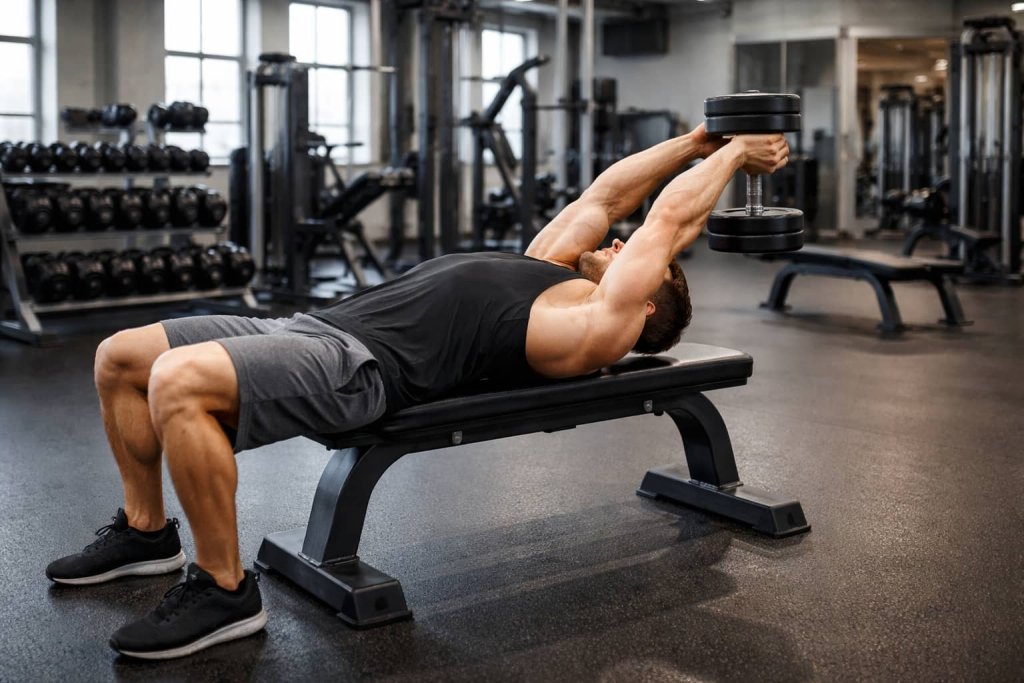
Understanding that difference is important because many lifters use the dumbbell pullover exercise for lat gains alone. In reality, it is better used as a supportive upper-body movement alongside rows, pulldowns, presses, and pull-ups. That makes it useful in a balanced routine, especially since the CDC recommends muscle-strengthening activity on at least 2 days per week for adults.
What Is the Dumbbell Pullover Exercise?
The dumbbell pullover exercise is a lying upper-body strength exercise where you hold one dumbbell over your chest, lower it back overhead in a controlled arc, then pull it back to the start.
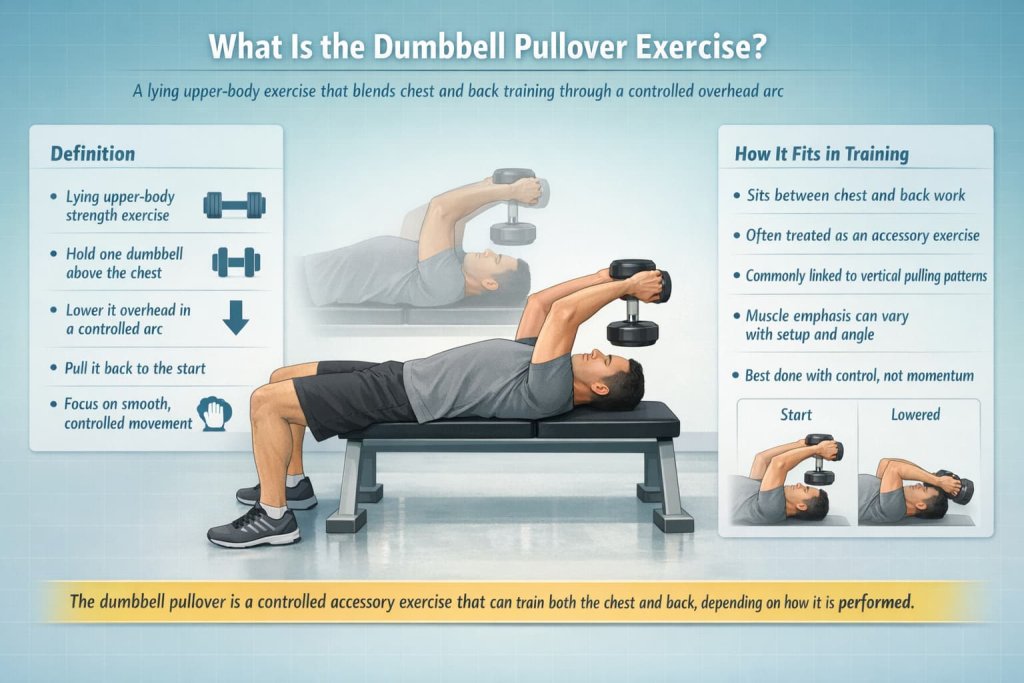
In practical training, the movement sits somewhere between chest work and back work. NSCA programming material places the pullover in the vertical pull category, while research shows muscle emphasis can shift depending on setup, joint angle, and the version being used.
How to Do the Dumbbell Pullover Exercise Correctly
Start with a light dumbbell and practice the motion before trying to make it hard.
Setup
Lie across a flat bench or lengthwise on it with your head and upper back supported. Plant your feet firmly on the floor. Hold one dumbbell with both hands above your chest. Keep a soft bend in your elbows and brace your midsection.
Movement
Lower the dumbbell slowly back behind your head in a controlled arc. Stop when you feel a stretch you can control without losing rib position, flaring hard through the chest, or arching your low back. Then pull the dumbbell back to the starting position above your chest.
Breathing
The Mayo Clinic advises breathing out as you lift and breathing in as you lower the weight. That cue works well here: inhale on the way down, exhale as you bring the dumbbell back up.
Dumbbell Pullover Exercise Muscles Worked
The dumbbell pullover exercise can involve several upper-body muscles at once. The main ones usually include:
- Pectoralis major
- Latissimus dorsi
- Serratus anterior
- Long head of the triceps
- Posterior shoulder stabilizers
- Core muscles that help keep the rib cage and spine controlled
The important takeaway is that the dumbbell pullover is not always a lat-dominant lift. A 2011 study on PubMed reported greater pectoralis major activity than latissimus dorsi activity during the pullover in the tested conditions. A 2022 study in PubMed Central also noted that pullover and pulldown variations can stress similar muscle groups differently depending on shoulder position and exercise mechanics.
Dumbbell Pullover Exercise Variations
1. Bench Dumbbell Pullover
Why it works:
This is the classic dumbbell pullover variation and the one most people should learn first. It gives you the fullest range of motion, which can help you train the chest, lats, serratus anterior, and long head of the triceps in one smooth arc. It also teaches the basic pullover pattern clearly, so it is a good starting point for building technique, control, and shoulder confidence.
Muscles worked:
The bench dumbbell pullover mainly works the pectoralis major, latissimus dorsi, serratus anterior, and long head of the triceps. The core and upper back also help stabilize the torso and shoulder position throughout the rep.
How to do it:
- Lie lengthwise on a flat bench with your head, upper back, and hips supported
- Plant your feet firmly on the floor
- Hold one dumbbell with both hands above your chest
- Keep a slight bend in your elbows and brace your midsection
- Lower the dumbbell back in a slow arc behind your head
- Stop when you feel a controlled stretch without flaring your ribs or arching your lower back
- Pull the dumbbell back to the starting position over your chest
- Repeat for smooth, controlled reps
Trainer Tip:
Use a lighter dumbbell than you think you need at first. This variation works best when the movement stays smooth and controlled, not when the weight pulls you into a deeper range than your shoulders can manage well.
2. Floor Dumbbell Pullover
Why it works:
The floor dumbbell pullover is a shorter-range version that can feel more manageable for people who are not comfortable with a deep overhead stretch. Because the floor naturally limits how far the weight can travel, this variation can make it easier to control the bottom position and reduce the urge to overextend through the shoulders or low back. It is often a smart regression for beginners or for anyone easing back into training.
Muscles worked:
This variation still works the chest, lats, serratus anterior, and triceps, but with a reduced range of motion. The core also stays active to help control rib position and prevent excessive arching.
How to do it:
- Lie on your back on the floor with your knees bent and feet flat
- Hold one dumbbell with both hands above your chest
- Keep a soft bend in your elbows
- Slowly lower the dumbbell back overhead as far as you can control
- Let the floor limit the range instead of forcing extra depth
- Pull the dumbbell back to the starting position above your chest
- Keep your ribs down and your lower back from over-arching
- Repeat with steady reps
Trainer Tip:
This is a great choice if the full bench version feels too deep or unstable. Treat it as a technique-building variation, not a lesser version. Cleaner reps in a safe range are more useful than forcing extra motion.
3. Single-Dumbbell Pullover With Pause
Why it works:
Adding a pause near the bottom of the movement increases control and reduces momentum. Instead of dropping the dumbbell back and swinging it up, the pause makes you own the hardest part of the rep. That can improve body awareness, reinforce rib control, and help you feel whether you are truly staying in a stable range. It is especially useful for lifters who rush through the lowering phase.
Muscles worked:
This version still trains the chest, lats, serratus anterior, and triceps, but the pause increases time under tension and challenges the stabilizing muscles of the shoulders, upper back, and core even more.
How to do it:
- Set up for a standard bench dumbbell pullover
- Lower the dumbbell slowly behind your head
- Stop at your deepest controlled position
- Hold that position for 1 to 2 seconds without letting your ribs flare
- Pull the dumbbell back to the starting position above your chest
- Keep your elbows softly bent throughout the rep
- Repeat for controlled repetitions without bouncing
Trainer Tip:
Do not pause in a position that feels unstable or uncomfortable. The pause should happen where you still feel strong and in control. Even a very short pause can make the exercise much more effective.
4. Cable Pullover or Straight-Arm Pulldown
Why it works:
This variation is not the same as a dumbbell pullover, but it is a very useful alternative when your goal is a more lat-focused shoulder-extension pattern. The cable gives you more consistent resistance through the movement, and many people find it easier to feel the lats working without worrying as much about bench position or overhead depth. It can also be easier to adjust for comfort and control.
Muscles worked:
The cable pullover or straight-arm pulldown mainly targets the latissimus dorsi, with help from the teres major, long head of the triceps, rear shoulder stabilizers, and core. The serratus anterior and upper back also contribute to shoulder control.
How to do it:
- Attach a straight bar or rope to a high cable pulley
- Stand tall and hold the handle with straight or slightly bent arms
- Step back slightly to create tension in the cable
- Brace your core and keep your chest tall
- Pull the handle down in an arc toward your thighs
- Stop when your hands reach your upper thighs or hips
- Return slowly to the starting position with control
- Avoid shrugging or bending your elbows too much
Trainer Tip:
Think about pulling from your shoulders, not your hands. If your elbows bend too much, the movement starts turning into a different exercise. Use a load that lets you feel your lats without leaning or swinging.
Benefits of the Dumbbell Pullover Exercise
It trains chest and back together
This is one of the biggest reasons people keep the pullover in their program. You get a blended upper-body stimulus rather than a strict isolation exercise. That can make it useful at the end of a push day, pull day, or upper-body session.
It adds variety without a lot of equipment
You only need a bench or stable surface and one dumbbell. That makes the dumbbell pullover exercise practical for home workouts and simple gym programs. ACE’s exercise library also shows a straightforward dumbbell version that does not require cables or machines.
It may help you train shoulder extension strength
Because the movement takes the shoulder through a long arc, the pullover can add useful training variety for lifters who already do presses and rows. It should still be treated as an accessory, not a replacement for heavier compound pulling.
It fits well in a balanced routine
The CDC advises adults to do muscle-strengthening work for all major muscle groups at least 2 days per week. A pullover can help cover chest, back, shoulders, and arms as part of that broader plan, though it should not be the only upper-body exercise you use.
Dumbbell Pullover Exercise Form Tips
Use these cues to make the movement cleaner and safer:
- Keep a slight bend in the elbows instead of locking them rigidly
- Move slowly, especially on the lowering phase
- Keep your ribs down instead of turning the rep into a big back arch
- Stop the range where you still feel in control
- Think “reach and pull” rather than “drop the weight back”
- Use a load you can control for the full rep
These points matter because changing joint position changes force demands and muscle contribution. The 2022 PMC study supports the idea that shoulder angle affects how the exercise behaves.
Common Dumbbell Pullover Exercise Mistakes
Going too deep
A deeper range is not always a better range. If the weight drifts too far back and you lose shoulder control, the rep stops being productive.
Turning it into a low-back exercise
Excessive rib flare and lumbar arching are common errors. Mayo Clinic’s general weight-training guidance emphasizes good technique and balanced training, which applies here.
Using too much weight
The dumbbell pullover exercise usually works better with controlled moderate loads than with sloppy heavy reps.
Expecting it to replace rows or pulldowns
The pullover is helpful, but it is not a complete back program by itself. Rows and pulldowns still do important work for the upper back and lats that the pullover does not fully replace.
Is the Dumbbell Pullover Exercise Better for Chest or Back?
For most people, the most accurate answer is both, but often with more chest involvement than expected.
That does not mean your lats are not working. It means the exercise is better viewed as a mixed accessory movement than as a pure lat builder. The 2011 EMG study found greater pectoralis major activity than latissimus dorsi activity in the barbell pullover setup they tested, and the 2022 PMC study further showed that pullover and pulldown demands vary by position and mechanics.
Best Rep Range for the Dumbbell Pullover Exercise
For most general fitness goals, these ranges make sense:
- 8 to 12 reps for controlled hypertrophy-focused work
- 10 to 15 reps for lighter technique practice
- 2 to 4 sets after your main pressing or pulling lifts
The dumbbell pullover exercise usually works best as accessory work, not as your first max-effort movement of the session. That recommendation is an evidence-based programming inference from its accessory nature and from broader resistance-training guidance on balanced muscle-group training.
Who Should Do the Dumbbell Pullover Exercise?
This exercise can be a good fit for:
- Lifters who want extra chest-and-back accessory volume
- People training with limited equipment
- Intermediate exercisers who can control shoulder range well
- Anyone wanting more upper-body movement variety
Who Should Be Careful With Dumbbell Pullovers?
Be more cautious if you have:
- Current shoulder pain
- A history of shoulder instability
- Trouble controlling rib flare or low-back arching
- Pain when your arms move overhead
If the motion causes pain, stop and get individual guidance from a qualified clinician or trainer. That is especially important because the pullover places the shoulder in a long overhead arc, which may not suit everyone. Mayo Clinic’s guidance on proper weight-training technique also supports adjusting or stopping movements that are not being performed with good control.
Where the Dumbbell Pullover Exercise Fits in a Workout
A simple upper-body order could look like this:
- Main press or main row
- Secondary push or pull
- Dumbbell pullover exercise
- Smaller arm or shoulder accessories
This sequencing works because the pullover is usually more effective after your heavier compound lifts, when you use it for controlled volume instead of maximum load. That is a coaching recommendation based on exercise role and general strength-program structure rather than a pullover-specific policy.
Frequently Asked Questions
Is the dumbbell pullover exercise good for beginners?
Yes, but only with a light load and a shortened range if needed. Beginners should learn to keep the ribs and spine stable before trying deeper reps.
Does the dumbbell pullover exercise build lats?
It can train the lats, but it is not the most direct lat exercise. Research suggests the pullover often involves significant chest contribution too.
Can I do dumbbell pullovers on chest day?
Yes. Many lifters place them on chest day, pull day, or upper-body day because they overlap both regions.
Should I bend my elbows during a dumbbell pullover?
A slight elbow bend is usually best. It helps you control the movement without turning it into a triceps extension.
How heavy should dumbbell pullovers be?
Use a weight you can lower and return with full control. For most people, this is an accessory lift, so chasing heavy numbers is usually less important than smooth reps.
Are dumbbell pullovers bad for shoulders?
Not automatically, but they are not ideal for everyone. People with shoulder pain or limited overhead comfort should be cautious and avoid forcing depth.
What is a good alternative to dumbbell pullovers?
A cable pullover or straight-arm pulldown can be a strong alternative if you want a similar shoulder-extension pattern with different loading mechanics.
Conclusion
The dumbbell pullover exercise can be a useful addition to your program when you treat it as a controlled chest-and-back accessory movement, not a magic lat-builder. Focus on shoulder-friendly range, steady reps, and clean rib position. Then place it alongside rows, pulldowns, presses, and other basics for a more complete upper-body routine.