
Dumbbell walking lunges are one of the best lower-body exercises for building stronger legs and glutes while also challenging balance, coordination, and core control. They train one leg at a time, make your hips and trunk work harder to stay stable, and are easy to scale with lighter or heavier dumbbells. This matters because current U.S. activity guidance from the CDC recommends muscle-strengthening work at least 2 days per week, and older adults are also encouraged to include balance-focused activity.
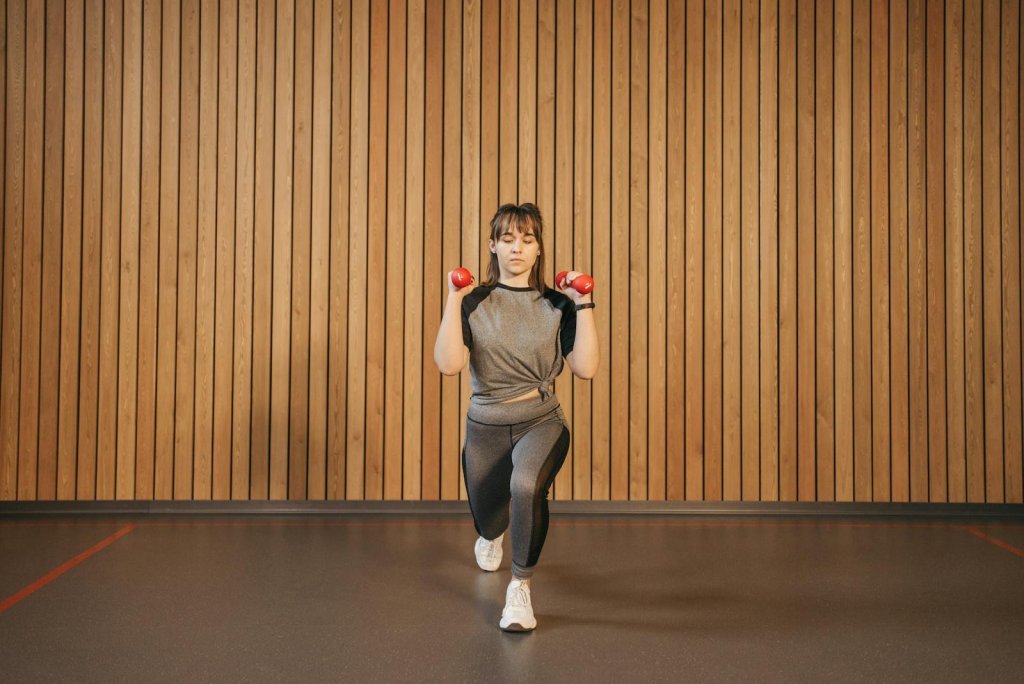
Used correctly, dumbbell walking lunges can fit many goals: strength, muscle-building, athletic control, and general functional fitness. The key is using clean form, a manageable stride length, and a load you can control without wobbling or leaning. As the NSCA explains in its educational guidance on lunges, the movement is valuable for lower-body strength, stability, and function.
What Are Dumbbell Walking Lunges?
A dumbbell walking lunge is a moving lunge variation where you hold dumbbells, step forward into a lunge, rise up, and continue directly into the next step instead of returning to the same starting position. That continuous forward pattern increases the demand on single-leg control and balance compared with many stationary lower-body exercises. The lunge family is widely used because it strengthens the lower body, improves core stability and balance, and carries over well to real-world movement.
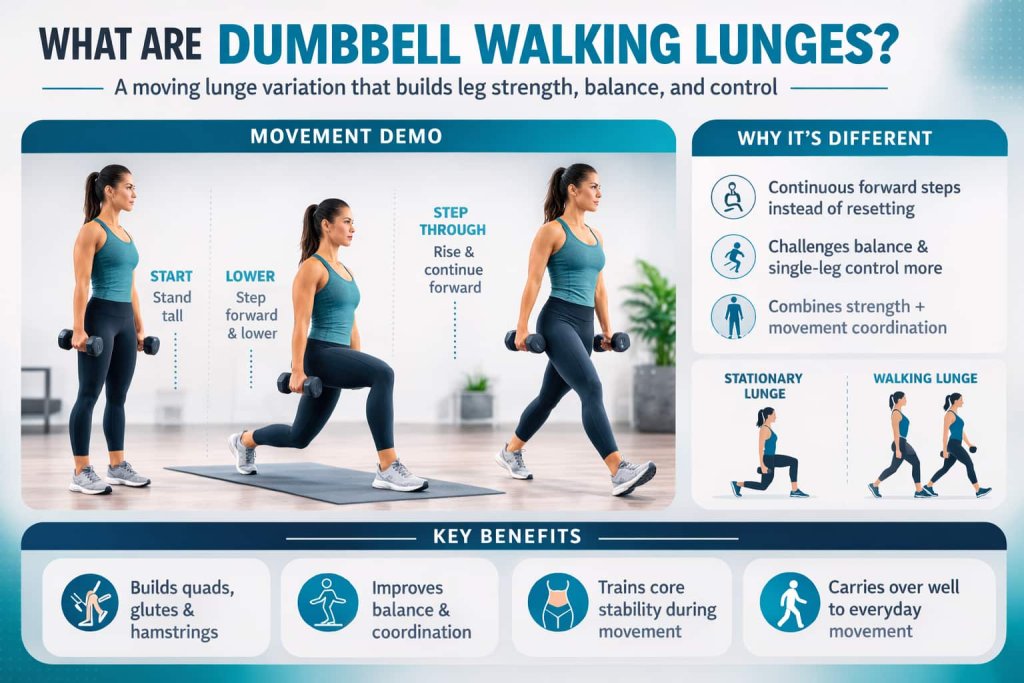
In simple terms, this exercise combines strength and movement quality. You are not just lifting weight. You are also controlling your body through each step.
How to Do Dumbbell Walking Lunges Properly
Setup
Stand tall with a dumbbell in each hand at your sides. Keep your chest up, ribs stacked, and shoulders relaxed. Start with a weight you can fully control.
Step-by-step form
- Stand tall with feet about hip-width apart and a dumbbell in each hand.
- Brace your core gently and keep your torso upright.
- Step forward with one leg, landing under control.
- Lower until both knees bend comfortably, with the back knee moving toward the floor.
- Push through the front foot to rise.
- Bring the back leg through and step into the next rep.
- Continue alternating sides as you walk forward.
- Stop when form starts to break down.
Form cues that help most
Keep your stride natural, not exaggerated. A very long step can make the movement awkward, while a very short step can crowd the knees. Stay tall through the torso and avoid slamming the back knee down. These coaching points line up with general lunge guidance from the NSCA and other reputable exercise education sources.
Dumbbell Walking Lunges Muscles Worked
Dumbbell walking lunges mainly train the quadriceps, glutes, and hamstrings. They also involve the calves, adductors, and trunk muscles that help you stay upright and stable while moving. The Cleveland Clinic notes that lunges challenge the quads, glutes, hamstrings, adductors, and stabilizing muscles, which makes them useful as both a leg and stability exercise.
The front leg usually does the most work during each rep. Research published in PubMed Central shows that the lunge is strongly hip-driven from a kinetic standpoint, and adding external load tends to increase demand most notably at the hip and ankle.
Primary muscles
- Quadriceps
- Gluteus maximus
- Hamstrings
Secondary support muscles
- Gluteus medius
- Adductors
- Calves
- Core and trunk stabilizers
Best Dumbbell Walking Lunge Variations and When to Use Them
Choose the variation that matches your current control, strength level, and training goal. Some versions are better for learning balance and rhythm, while others increase strength, stability, or time under tension.
1. Bodyweight Walking Lunge
Best for beginners learning balance, step length, and depth before adding load.
Why it works:
This is the best place to learn the movement pattern without the extra challenge of holding weights. It helps you build coordination, control your stride, and get comfortable lowering into each rep with steady balance. It also lets you notice whether one side feels less stable than the other before you add resistance.
Muscles worked:
Quads, glutes, hamstrings, calves, and core stabilizers.
How to do it:
- Stand tall with feet about hip-width apart
- Step forward with one leg under control
- Lower until both knees bend comfortably
- Push through the front foot to rise
- Bring the back leg forward into the next step
- Continue alternating sides with smooth, steady reps
Trainer Tip:
Do not rush the walk. Smooth, controlled steps teach better balance than trying to cover distance quickly.
2. Heavy Dumbbell Walking Lunge
Best for advanced lifters who already control the pattern and want more strength stimulus.
Why it works:
Heavier dumbbells increase the demand on the quads, glutes, grip, and trunk. This variation is useful for building more lower-body strength and making walking lunges a serious strength-focused accessory. Because the load is higher, it also forces you to stay more organized through the torso and hips.
Muscles worked:
Quads, glutes, hamstrings, calves, core stabilizers, upper back, and grip.
How to do it:
- Hold heavier dumbbells at your sides with a firm grip
- Brace your core before each step
- Step forward with control and avoid overstriding
- Lower until both knees bend comfortably
- Drive through the front foot to stand tall
- Step through into the next lunge without losing posture
- Keep each rep smooth and controlled
Trainer Tip:
Heavy walking lunges should still look clean. Once the load changes your stride, posture, or depth too much, it stops being productive.
3. Paused Walking Lunge
Pause at the bottom for 1 to 2 seconds. This increases control and time under tension.
Why it works:
The pause removes momentum and makes each rep more honest. It improves balance, reinforces control in the bottom position, and increases muscular tension in the quads and glutes. This variation is especially useful for people who tend to rush through lunges or bounce out of the bottom.
Muscles worked:
Quads, glutes, hamstrings, calves, and deep core stabilizers.
How to do it:
- Perform a normal walking lunge step
- Lower into the bottom position with control
- Hold the bottom for 1 to 2 seconds
- Stay tall and balanced during the pause
- Push through the front foot to rise
- Step into the next rep and repeat
Trainer Tip:
Keep the pause quiet and steady. Do not sink lower or wobble around once you reach the bottom.
4. Reverse-to-Walking Lunge Combo
Best for people who want a slightly more deliberate pattern before continuous forward steps.
Why it works:
This combo variation slows the rhythm and helps you organize your balance before moving forward again. Starting with a reverse lunge can feel easier to control for some people, so combining it with a walking lunge gives you a useful transition between more stable and more dynamic patterns. It is a good teaching option for people who are not yet fully confident with nonstop forward lunges.
Muscles worked:
Quads, glutes, hamstrings, calves, adductors, and core stabilizers.
How to do it:
- Stand tall with bodyweight or dumbbells at your sides
- Step one leg back into a reverse lunge
- Push back to standing with control
- Step forward with the same leg into a walking lunge
- Rise up and continue the sequence on the other side
- Keep the movement smooth and balanced throughout
Trainer Tip:
Think of this as a control drill, not a speed drill. The goal is to own both directions without losing posture or rhythm.
Why Dumbbell Walking Lunges Work So Well
Dumbbell walking lunges are effective because they train several useful qualities at once. They build lower-body strength, improve single-leg stability, and force you to control your torso while moving forward. This is one reason the movement is commonly used in performance training, general fitness, and functional strength programs.
They are also practical. Walking lunges look more like real movement than many fixed-machine leg exercises. NSCA commentary on unilateral training notes that exercises such as walking lunges can have strong carryover to movement performance because they demand more core and ankle stability and relate more closely to gait.
Benefits of Dumbbell Walking Lunges
Builds unilateral leg strength
Because each step makes one leg handle a large share of the work, walking lunges can help expose and reduce side-to-side differences in strength and control. That makes them valuable for both general fitness and athletic programming.
Trains glutes and quads together
Walking lunges challenge both knee extension and hip extension. That is one reason they are commonly used for leg and glute development. The movement gives both the front thigh and the hip extensors a meaningful training role.
Improves balance and coordination
Unlike bilateral exercises where both feet stay planted, walking lunges require controlled transitions from one step to the next. A study available through PubMed Central found meaningful balance demands across lunge variations, supporting their role as more than just a basic strength exercise.
Challenges the core without a crunch
Your trunk has to resist excessive leaning, twisting, and wobbling while the legs move under load. Another PubMed Central study on load distribution during lunges found changes in trunk muscle activation when dumbbells are used, reinforcing the idea that the exercise is not only for legs.
Easy to progress
You can make dumbbell walking lunges harder by increasing dumbbell weight, total reps, distance, tempo, or pauses. You can also make them easier by using bodyweight first or shortening the range. This makes them suitable for a wide range of training levels.
Common Dumbbell Walking Lunge Mistakes
Using too much weight
If the dumbbells pull you forward, make you rush, or cause balance loss, the load is too heavy. Walking lunges are a control-based movement, not a race.
Taking unstable steps
A narrow or wobbly line of travel can make the exercise harder than needed. Give yourself enough space between feet to stay balanced.
Letting the torso collapse
Leaning too far forward often shifts the pattern into a sloppy rep. A slight natural hinge can happen, but your trunk should stay organized and controlled.
Rushing the lowering phase
Dropping quickly into the bottom position reduces control. Lower with intention, then drive up through the front leg.
Forcing depth you cannot control
You do not need your back knee to hit the floor. Use the deepest range you can manage with clean alignment and steady balance.
Dumbbell Walking Lunges vs Stationary Lunges
Stationary lunges are often easier for beginners because you reset between reps. Dumbbell walking lunges add a moving transition, which raises the demand on balance, coordination, and trunk control. Both are useful, but walking lunges usually feel more athletic and more challenging even with the same dumbbell weight.
A simple way to choose:
- Pick stationary lunges if you are learning form or rebuilding control.
- Pick dumbbell walking lunges if you want more challenge, more movement skill, and a stronger balance component.
How Many Reps and Sets Should You Do?
For many people, 2 to 4 sets of 8 to 12 steps per leg works well for strength and muscle-building. Lighter loads can also work for longer sets, such as 12 to 20 total steps per side, as long as form stays solid.
A practical guideline:
- Beginners: 2 to 3 sets of 6 to 8 steps per leg
- Intermediate: 3 to 4 sets of 8 to 12 steps per leg
- Advanced: 3 to 5 sets with heavier dumbbells or slower tempo
Your exact dose depends on your goal, training age, and how stable your reps look.
Where Dumbbell Walking Lunges Fit in a Workout
Dumbbell walking lunges usually work best after your warm-up and before very fatiguing accessories. You can place them:
- In a leg day workout after primary compound lifts
- In a full-body workout as your main unilateral leg exercise
- In a conditioning-strength circuit with controlled reps
- In a general fitness session focused on strength plus balance
Because they are moderately demanding, they usually work better before extreme fatigue sets in.
Who Should Be Careful With Dumbbell Walking Lunges?
This exercise is not wrong for most people, but it is not ideal for everyone in every phase.
Use extra caution if you currently have:
- Significant balance limitations
- A recent lower-body injury
- Sharp knee, hip, or ankle pain during stepping patterns
- Trouble controlling bodyweight lunges first
In those cases, a split squat, supported lunge, or bodyweight reverse lunge may be a better entry point. For persistent pain, it is smart to check with a qualified clinician or physical therapist rather than pushing through symptoms.
Quick Safety Checklist for Dumbbell Walking Lunges
- Start with a weight you can fully control
- Use a clear, non-slippery path
- Keep steps smooth and deliberate
- Stop the set when balance becomes sloppy
- Reduce load if your torso tips or you cannot control depth
- Progress from bodyweight before going heavy
Dumbbell Walking Lunges FAQ
Are dumbbell walking lunges good for glutes?
Yes. Dumbbell walking lunges train the gluteus maximus strongly, especially because the front leg has to extend the hip to bring you back up and forward into the next step. Research on lunge mechanics also supports the strong hip contribution of the movement.
Do dumbbell walking lunges build balance?
They can help improve balance and single-leg control because each rep includes a moving transition and requires stabilization under load. The CDC also highlights the value of balance-focused activity in overall fitness, especially for older adults.
Are walking lunges better than squats?
Not better in every case. Squats are excellent for bilateral strength, while walking lunges add more unilateral control, coordination, and balance demand. Many programs benefit from both.
How heavy should dumbbells be for walking lunges?
Use the heaviest weight that still lets you keep clean, repeatable reps without wobbling, collapsing, or rushing. For many people, lighter dumbbells than expected work better because the exercise is more demanding than it looks.
Are dumbbell walking lunges bad for knees?
Not automatically. Technique, stride length, load, and your current tolerance all matter. Pain-sensitive individuals should still scale carefully and avoid forcing uncomfortable depth.
Should beginners do dumbbell walking lunges?
Beginners can do them, but many people learn faster by mastering bodyweight lunges or stationary lunges first. Once you can control your steps and depth well, adding dumbbells makes more sense.
How often should I do dumbbell walking lunges?
For many training plans, 1 to 3 times per week is enough, depending on total lower-body volume. This fits well within broader guidance that adults should include muscle-strengthening activity at least 2 days per week.
Conclusion
Dumbbell walking lunges are a highly effective exercise for building stronger legs and glutes while also improving balance, coordination, and single-leg control. They are simple, scalable, and useful for beginners and experienced lifters alike when form comes first.
Start lighter than you think, move with control, and progress only when your reps stay clean. That approach gives you the strength benefits without turning the exercise into a messy balance drill.