
The deadlift exercise is one of the most effective ways to build total-body strength by training multiple large muscle groups at the same time. It targets the hips, legs, back, and core through a functional “hip-hinge” pattern used in daily life and sport.
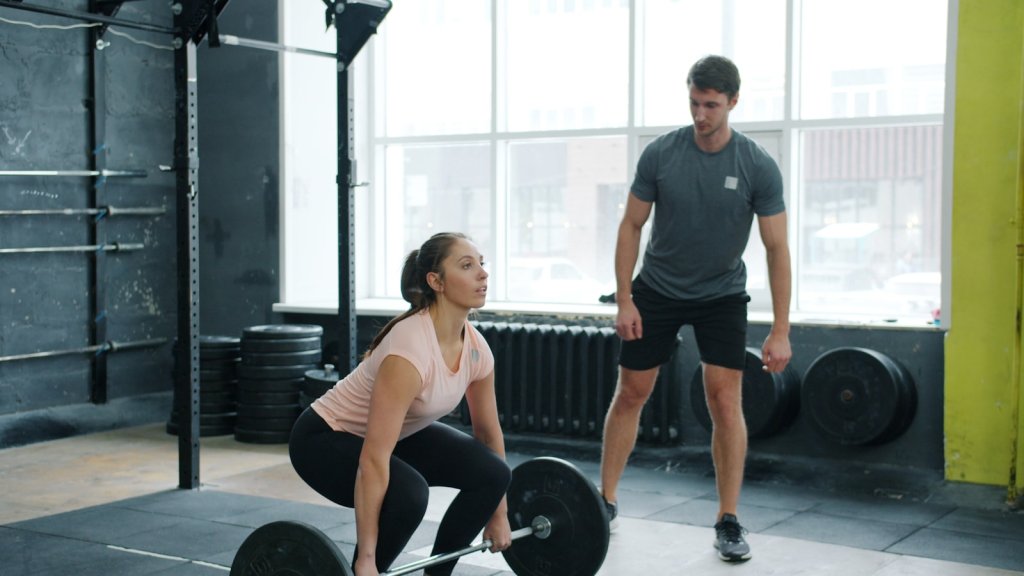
Understanding how the deadlift exercise works, how to perform it correctly, and how to program it safely helps you gain strength while reducing unnecessary stress on the body.
What Is the Deadlift Exercise?
The deadlift exercise is a compound resistance movement where a weight is lifted from the floor to a standing position using coordinated hip, knee, and trunk extension. Unlike isolation exercises, the deadlift trains the body as a connected system.
Key characteristics of the deadlift exercise include:
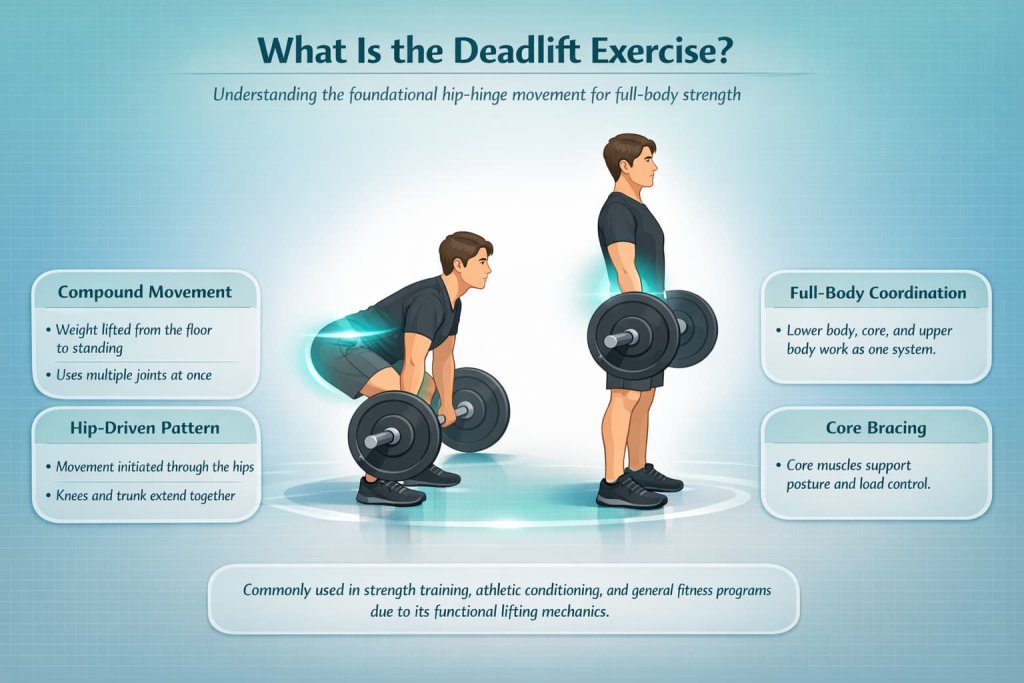
- Weight starts on the floor (or just above it)
- Movement is driven primarily by the hips
- Multiple joints and muscle groups work together
- Core muscles brace to support posture and load control
Because it mimics everyday lifting mechanics, the deadlift exercise is widely used in strength training, athletic conditioning, and general fitness programs.
How to Do the Deadlift Exercise Properly
How to do it
- Stand with feet about hip-width apart and the barbell over mid-foot
- Bend at the hips and knees to grip the bar with a neutral spine
- Brace your core and keep your chest tall
- Push the floor away as you extend hips and knees together
- Stand tall at the top without leaning back
- Lower the bar with control by hinging at the hips
Trainer tip
Focus on moving the bar in a straight line close to your body. If the bar drifts forward, stress on the lower back may increase.
Deadlift Exercise Variations
Adding variations allows you to adjust training focus and accommodate different body types or goals.
1. Conventional Deadlift
Why it works
The conventional deadlift is the most widely taught version and closely resembles everyday lifting mechanics. It balances hip and knee extension, making it effective for building total-body strength and reinforcing proper lifting technique.
Muscles worked
This variation strongly engages the glutes and hamstrings, with significant involvement from the quadriceps, erector spinae, core muscles, upper back, and grip.
How to do it
- Stand with feet about hip-width apart and the bar over mid-foot
- Hinge at the hips and bend the knees to grip the bar just outside the legs
- Brace the core and keep the spine neutral
- Push through the floor as hips and knees extend together
- Stand tall at the top, then lower the bar with control
Trainer tip
Think “push the floor away” rather than “pull the bar up” to maintain balanced leg and hip drive.
2. Romanian Deadlift
Why it works
The Romanian deadlift reduces knee bend and places greater emphasis on hip hinge mechanics. This makes it especially effective for targeting the posterior chain while reinforcing hamstring length and control.
Muscles worked
Primary emphasis is on the hamstrings and gluteus maximus, with the erector spinae and core providing continuous stabilization.
How to do it
- Start standing with the bar in your hands
- Keep a slight bend in the knees throughout
- Hinge at the hips while keeping the bar close to the legs
- Lower until you feel a stretch in the hamstrings
- Drive the hips forward to return to standing
Trainer tip
Stop lowering the bar when your spine would begin to round—range of motion matters more than depth.
3. Sumo Deadlift
Why it works
The wider stance of the sumo deadlift reduces forward torso lean and can decrease stress on the lower back for some lifters. It also allows greater contribution from the hips and inner thighs.
Muscles worked
Glutes and quadriceps play a larger role compared to conventional deadlifts, with strong involvement from the adductors, hamstrings, and core.
How to do it
- Take a wide stance with toes slightly turned out
- Position hands inside the knees on the bar
- Keep the chest upright and spine neutral
- Drive knees outward as you extend hips and knees
- Stand tall, then lower under control
Trainer tip
Actively push your knees out during the lift to maintain hip alignment and power.
4. Trap (Hex) Bar Deadlift
Why it works
The trap bar places the load closer to the body’s center of mass, which often reduces spinal shear forces. This variation is commonly used for beginners and for power-focused training.
Muscles worked
This version increases quadriceps involvement while still heavily recruiting the glutes, hamstrings, core, and upper-body stabilizers.
How to do it
- Step inside the hex bar with feet hip-width apart
- Grip the handles and brace your core
- Push through the floor to stand up tall
- Keep shoulders stacked over hips at the top
- Lower the bar with controlled hip and knee flexion
Trainer tip
Use the trap bar to focus on smooth, powerful movement rather than maximal load when learning the deadlift pattern.
Muscles Worked in the Deadlift Exercise
The deadlift exercise emphasizes the posterior chain, while also engaging stabilizing muscles throughout the body.
Primary muscles involved:
- Gluteus maximus
- Hamstrings
- Erector spinae (spinal support muscles)
Secondary and stabilizing muscles:
- Quadriceps
- Core muscles (abdominals and obliques)
- Upper back and grip muscles
Muscle activation varies slightly depending on the deadlift variation, load, and technique, but overall involvement remains full-body in nature.
Why the Deadlift Exercise Matters for Strength
The deadlift exercise matters because it allows you to load large muscle groups efficiently. Research summarized in strength and conditioning literature shows that multi-joint exercises like deadlifts support greater overall strength development than single-joint movements.
Deadlift exercise benefits may include:
- Supporting full-body strength development
- Training coordinated muscle action rather than isolation
- Reinforcing proper lifting mechanics
- Improving force production through the hips
Public-health guidance from organizations such as the American College of Sports Medicine and the World Health Organization encourages adults to include muscle-strengthening activities involving major muscle groups at least two days per week.
Common Deadlift Exercise Mistakes to Avoid
Even though the deadlift exercise is effective, technique errors can reduce its benefits.
Common mistakes include:
- Rounding the lower back during the lift
- Jerking the bar off the floor instead of applying steady force
- Letting the bar drift away from the legs
- Using excessive weight before mastering form
Strength-training guidance from the Centers for Disease Control and Prevention emphasizes gradual progression and proper technique to reduce injury risk.
How to Program the Deadlift Exercise Safely
For most adults, the deadlift exercise is best programmed as part of a balanced strength routine.
General programming guidelines:
- Perform 1–3 sessions per week
- Use moderate loads with controlled technique
- Allow rest days between heavy sessions
- Combine with complementary exercises such as squats and presses
Who Should Modify or Be Cautious With Deadlifts?
Some individuals may need to modify the deadlift exercise or seek professional guidance:
- Beginners without prior strength-training experience
- People with active back pain or recent injury
- Those with limited hip mobility
In these cases, lighter loads, elevated starting positions, or alternative hinge exercises may be appropriate.
Frequently Asked Questions About the Deadlift Exercise
Is the deadlift exercise safe for beginners?
Yes, when performed with light loads and proper instruction, the deadlift exercise can be suitable for beginners.
Does the deadlift exercise work the whole body?
Yes. It trains the lower body, core, and upper-body stabilizers together.
How much weight should I start with?
Start with a load that allows perfect form for all repetitions, often just the bar or light resistance.
How many reps are best for deadlifts?
Most programs use 3–8 repetitions per set, depending on goals and experience.
Can deadlifts replace other leg exercises?
Deadlifts are effective but work best alongside other lower-body movements rather than as a sole exercise.
Are deadlifts only for athletes?
No. Deadlift exercises are used in general fitness, rehabilitation-informed training, and athletic programs.
Conclusion
The deadlift exercise is a foundational strength movement that trains the body as a unified system. When performed with proper technique and sensible programming, it supports full-body strength, functional movement, and long-term fitness progression. Start light, focus on form, and integrate deadlifts into a balanced training plan for best results.
References
- CDC: Adult Physical Activity Guidelines (Adults)
- WHO: Physical Activity Recommendations (Be Healthy initiative)
- Physical Activity Guidelines for Americans, 2nd edition (PDF)
- Electromyographic Activity in Deadlift Exercise and Its Variants: Systematic Review (2020, PMC)
- Low Back Biomechanics During Repetitive Deadlifts: Narrative Review (2022, PMC)
- Injuries in Weightlifting and Powerlifting: Updated Review (2024, PMC)