
Pilates ab exercises are one of the best low-impact ways to strengthen your core, improve control, and support better posture. They do not directly “burn belly fat,” but they can help build a stronger, more stable midsection that supports daily movement, balance, and full-body training. Pilates is worth understanding because it trains more than just your visible abs. It also challenges deeper trunk muscles that help stabilize your spine and improve movement quality. Cleveland Clinic describes Pilates as a low-impact training method that can improve strength, stability, flexibility, and endurance.
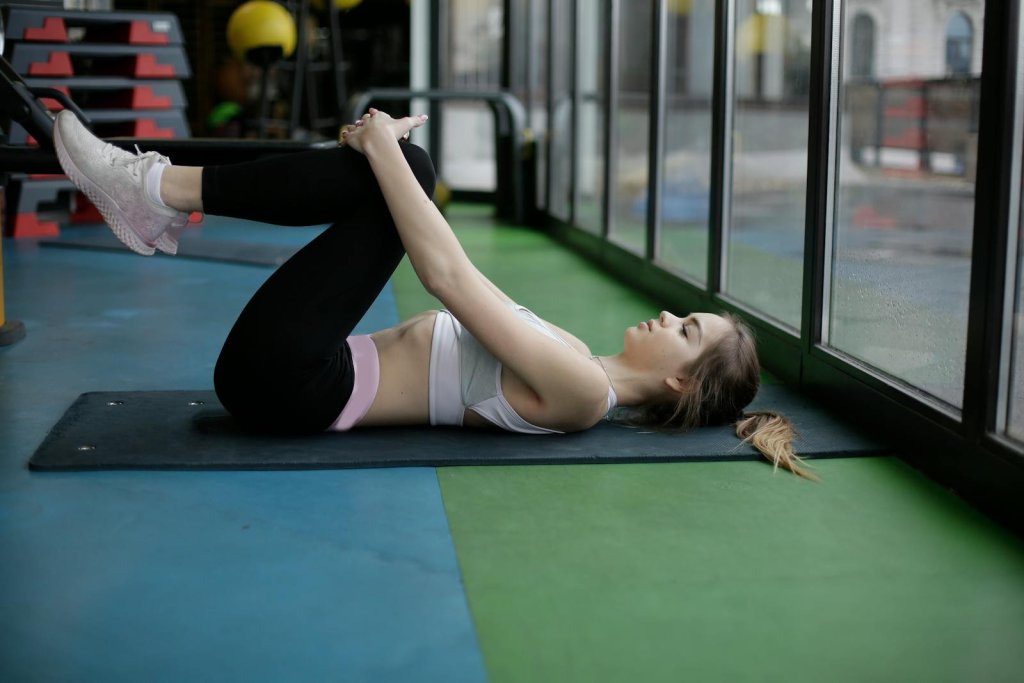
A good Pilates ab routine usually blends controlled curling, leg-lowering, tabletop work, anti-rotation control, and plank variations. That matters because the abdominal muscles work as a system, not as isolated “upper” and “lower” parts. Done consistently, Pilates can fit well into the general guideline of muscle-strengthening work at least 2 days per week. ACE explains that the abdominals function as an integrated system rather than as separate isolated parts.
Why Pilates ab exercises work so well
Pilates is commonly described as a low-impact, full-body training method that emphasizes strength, stability, alignment, control, and endurance. That makes it a strong fit for core training, especially for beginners and home exercisers who want more than endless crunches. Recent research also supports Pilates-based core work for improving core muscle function and movement quality, although results still depend on the program and the person doing it.
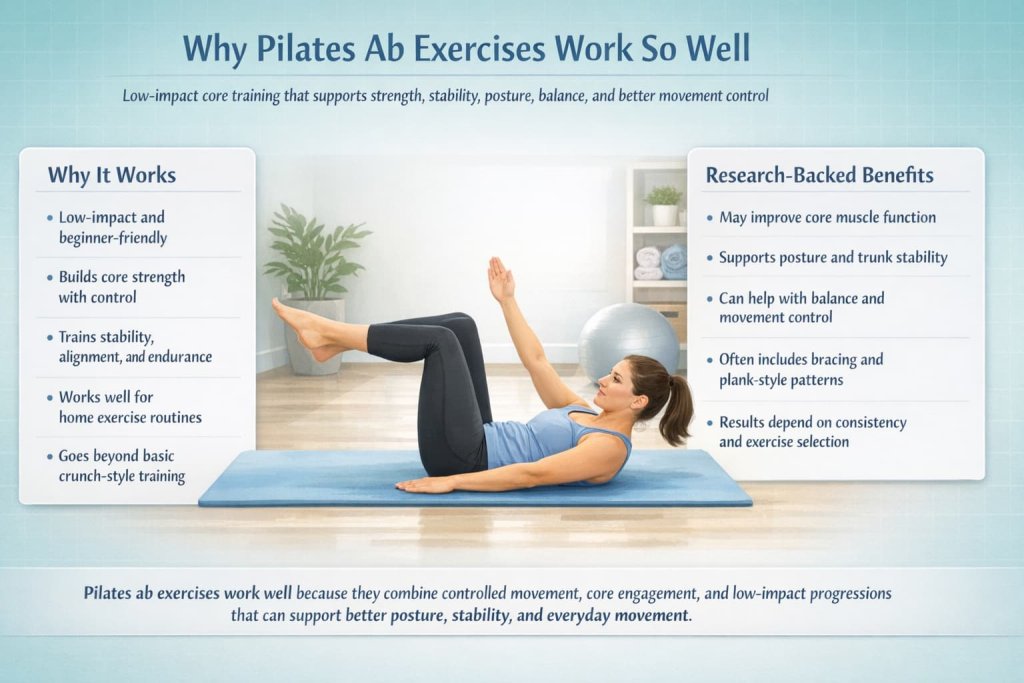
A stronger core can support posture, mobility, balance, and safer movement in daily life. Harvard Health notes that modern core training should go beyond sit-ups alone, which is exactly why Pilates ab exercises often include bracing, control, and plank-style patterns.
12 Best Pilates Ab Exercises
Build a stronger core with these 12 best Pilates ab exercises designed to improve stability, posture, and control.
From beginner-friendly mat moves to classic Pilates staples, these exercises can help strengthen your abs at home with low-impact training.
1. Pilates Imprint and March
Why it works: This is one of the best beginner Pilates ab exercises because it teaches deep core control without high spinal stress. It helps you learn how to brace gently while moving one leg at a time.
Muscles worked: Transverse abdominis, rectus abdominis, obliques, hip flexors.
How to do it:
- Lie on your back with knees bent and feet flat.
- Gently tighten your abs and keep your ribs relaxed.
- Lift one foot into tabletop position.
- Lower it back down with control.
- Repeat on the other side.
- Alternate slowly without letting your pelvis rock.
Trainer Tip: Think about keeping your pelvis quiet. The smaller the wobble, the more your core is working.
2. Toe Taps
Why it works: Toe taps build on tabletop control and teach you to resist arching through the low back as the legs move.
Muscles worked: Transverse abdominis, rectus abdominis, obliques, hip flexors.
How to do it:
- Lie on your back and bring both legs into tabletop.
- Brace your core gently.
- Lower one foot to tap the floor.
- Bring it back to tabletop.
- Repeat on the other side.
- Keep alternating with slow control.
Trainer Tip: Only lower as far as you can without your low back popping off the mat.
3. Dead Bug Pilates Style
Why it works: This exercise trains opposite arm-and-leg coordination while keeping the trunk stable. It is excellent for learning how to move your limbs without losing core position. Harvard Health highlights the dead bug as a practical core exercise because strong core function supports posture, spinal stability, and safer everyday movement.
Muscles worked: Deep core muscles, rectus abdominis, obliques, shoulder stabilizers, hip flexors.
How to do it:
- Lie on your back with both legs in tabletop and arms reaching up.
- Tighten your core gently.
- Extend one arm overhead and the opposite leg forward.
- Return to the start position.
- Switch sides slowly.
- Keep your rib cage from flaring.
Trainer Tip: Move slowly enough that your abs do the work, not momentum.
4. Pilates Hundred
Why it works: The Hundred is a classic Pilates ab exercise that challenges abdominal endurance, breath control, and trunk stability all at once.
Muscles worked: Rectus abdominis, transverse abdominis, obliques, hip flexors, shoulder stabilizers.
How to do it:
- Lie on your back and lift your legs to tabletop or keep feet on the mat for an easier version.
- Curl your head and shoulders up if comfortable.
- Reach your arms long by your sides.
- Pump your arms up and down in small controlled motions.
- Inhale for 5 arm pumps.
- Exhale for 5 arm pumps until you reach 100 pumps or stop earlier if form fades.
Trainer Tip: Keep your chin slightly tucked and your shoulders away from your ears.
5. Single Leg Stretch
Why it works: This move trains abdominal control while your legs alternate, which helps build coordination and midline stability.
Muscles worked: Rectus abdominis, obliques, transverse abdominis, hip flexors.
How to do it:
- Lie on your back and bring both knees toward your chest.
- Curl your head and shoulders up if comfortable.
- Extend one leg out while holding the other knee lightly.
- Switch legs in a smooth, controlled rhythm.
- Keep your trunk steady.
- Continue alternating sides.
Trainer Tip: Do not pull hard on the knee. Your hands guide the movement, but your core should stay in charge.
6. Double Leg Stretch
Why it works: Double leg stretch increases the challenge because both arms and legs move away from the center at the same time, creating a longer lever and bigger stability demand.
Muscles worked: Rectus abdominis, transverse abdominis, obliques, hip flexors, shoulder stabilizers.
How to do it:
- Start on your back with knees bent toward your chest.
- Curl your head and shoulders up if comfortable.
- Extend both legs forward as both arms reach overhead.
- Circle your arms around as you pull the knees back in.
- Repeat with smooth breathing.
- Keep your low back controlled against the mat.
Trainer Tip: Bend the knees more or keep the head down if this feels too intense on your neck or low back.
7. Single Straight Leg Stretch
Why it works: This variation adds more hamstring mobility demand and greater abdominal tension than bent-knee versions.
Muscles worked: Rectus abdominis, obliques, transverse abdominis, hip flexors.
How to do it:
- Lie on your back and raise both legs upward as tolerated.
- Curl your head and shoulders up if comfortable.
- Hold one leg lightly while lowering the other a little.
- Switch legs in a controlled rhythm.
- Keep your pelvis steady.
- Use a smaller range if your hamstrings feel tight.
Trainer Tip: The goal is control, not forcing straight legs.
8. Criss-Cross
Why it works: Criss-cross adds rotational control and makes the obliques work harder. It is one of the most useful Pilates ab exercises for training the sides of the trunk.
Muscles worked: Obliques, rectus abdominis, transverse abdominis, hip flexors.
How to do it:
- Lie on your back with both knees bent in.
- Curl your head and shoulders up if comfortable.
- Rotate your torso toward one knee as the other leg extends.
- Return through center.
- Rotate to the other side.
- Alternate slowly without yanking the neck.
Trainer Tip: Rotate from your rib cage, not by pulling your head with your hands.
9. Roll-Up
Why it works: The roll-up trains abdominal control through a larger range of motion and can also improve body awareness and segmental spinal control.
Muscles worked: Rectus abdominis, transverse abdominis, obliques, hip flexors.
How to do it:
- Lie on your back with legs straight or knees slightly bent.
- Reach your arms overhead or toward the ceiling.
- Nod your chin gently and peel your upper body off the mat.
- Continue rolling up until you reach a seated position.
- Reverse the movement slowly back down.
- Move one section of the spine at a time as best you can.
Trainer Tip: Bend your knees or anchor your feet lightly under something stable if the full roll-up is too hard.
10. Pilates Leg Lowers
Why it works: Leg lowers create a strong anti-extension demand, which means your abs must work to stop the low back from over-arching.
Muscles worked: Transverse abdominis, rectus abdominis, obliques, hip flexors.
How to do it:
- Lie on your back with both legs raised.
- Tighten your core gently.
- Lower both legs a small amount.
- Pause before your back arches.
- Lift the legs back up with control.
- Repeat using only the range you can control.
Trainer Tip: Smaller range is better than losing your low-back position.
11. Forearm Plank
Why it works: Planks fit well in a Pilates ab routine because they train full-core stiffness, shoulder stability, and spinal control. Harvard Health recommends plank-style core training as a practical alternative to relying only on sit-ups, and Cleveland Clinic notes that planks help develop core stability.
Muscles worked: Rectus abdominis, transverse abdominis, obliques, shoulders, glutes.
How to do it:
- Place your forearms on the mat with elbows under shoulders.
- Step your legs back into a straight line.
- Brace your abs and squeeze your glutes gently.
- Keep your body long from head to heels.
- Hold for time while breathing steadily.
- Rest before your form starts to sag.
Trainer Tip: A shorter, high-quality hold beats a long, sloppy plank.
12. Side Plank
Why it works: Side plank is one of the best Pilates ab exercises for lateral core strength and anti-rotation control. It is especially helpful for the obliques and trunk stability. Cleveland Clinic specifically notes that side planks help stabilize the spine and improve spine and oblique strength.
Muscles worked: Obliques, transverse abdominis, glute medius, shoulders.
How to do it:
- Lie on one side with your forearm on the mat.
- Stack your shoulders and hips.
- Lift your hips off the floor.
- Hold your body in a straight line.
- Lower with control.
- Repeat on the other side.
Trainer Tip: Bend the bottom knee for an easier version if the full side plank is too advanced.
How often should you do Pilates ab exercises?
For most people, doing Pilates ab exercises 2 to 4 times per week works well. That gives you enough repetition to improve control and endurance without overdoing the same movement pattern every day. This also fits well with U.S. physical activity guidance that recommends muscle-strengthening work at least 2 days per week. ODPHP supports that general guideline.
A simple starting plan is 6 to 8 exercises per session, 1 to 3 sets each, with slow reps and good form. Beginners usually do better with fewer exercises and better control rather than very long ab circuits.
Sample beginner Pilates ab workout
Try this simple beginner-friendly sequence:
- Imprint and March
- Toe Taps
- Dead Bug Pilates Style
- Single Leg Stretch
- Leg Lowers
- Forearm Plank
Do each exercise for 8 to 12 slow reps per side when applicable, or 15 to 30 seconds for planks. Rest briefly between moves. Repeat the circuit 1 to 3 times.
Common mistakes to avoid with Pilates ab exercises
One of the biggest mistakes is turning every move into a fast ab workout instead of a controlled core session. Pilates works best when you move with control, maintain alignment, and breathe normally. Cleveland Clinic emphasizes that Pilates is built around control, precision, and stability, not random speed.
Other common mistakes include pulling on the neck, arching the low back during leg work, holding your breath, and choosing advanced exercises too early. Regressions are not a step backward. They are often the smartest way to build a stronger core safely.
Are Pilates ab exercises good for beginners?
Yes. Pilates ab exercises are often a strong choice for beginners because they are low impact and easy to scale. You can keep your head down, shorten the leg range, bend the knees more, or reduce the number of reps. Research and clinical sources consistently describe Pilates as adaptable and useful for improving core function and control across different levels. Cleveland Clinic supports that beginner-friendly approach.
Can Pilates ab exercises help flatten your stomach?
Pilates ab exercises can help strengthen and tone your core, improve posture, and build better muscular control, which may make your midsection look firmer over time. But they do not selectively remove belly fat from one area. A flatter stomach usually depends on the bigger picture, including overall activity, nutrition, sleep, and body-fat reduction habits. Cleveland Clinic explains Pilates as part of a broader fitness approach, not a spot-reduction method.
FAQ About Pilates Ab Exercises
Are Pilates ab exercises better than crunches?
They can be better for many people because they usually train the whole core with more control and variety, not just repeated trunk flexion. Harvard Health specifically recommends broad core training rather than relying only on sit-ups.
How long does it take to see results from Pilates ab exercises?
Many people notice better control and endurance within a few weeks, while visible body-composition changes usually take longer and depend on several factors beyond ab training alone.
Can I do Pilates ab exercises every day?
You can do light core work often, but most people do best with 2 to 4 focused sessions per week so the muscles can recover and the quality stays high.
Which Pilates ab exercise is best for lower abs?
There is no true isolated lower-ab exercise, because the abdominal system works together. Exercises like toe taps, leg lowers, and tabletop control drills may feel more intense in the lower part of the abs, but they still train the core as a whole. ACE explains that the abdominals function as an integrated system.
Are planks part of Pilates ab training?
Yes. While planks are broader than Pilates alone, they fit very well into Pilates-style core training because they build trunk stiffness, shoulder stability, and control. Harvard Health supports plank-style core training as part of a practical core routine.
Should beginners start with the Hundred?
Usually not. Most beginners do better starting with imprint work, marching, or toe taps before moving into the Hundred.
Conclusion
Pilates ab exercises are a practical, low-impact way to build a stronger core, improve posture, and train better control. The best results come from mastering simple moves first, using slow reps, and progressing only when your form stays solid. Start with the basics, stay consistent, and build your routine around quality rather than speed.