
Plyometric exercises are powerful, explosive movements that help you jump higher, move faster, and build athletic power efficiently. They train your muscles to produce force quickly by using rapid stretching and contracting actions, which is why they’re widely used in sports performance, fitness conditioning, and functional training.
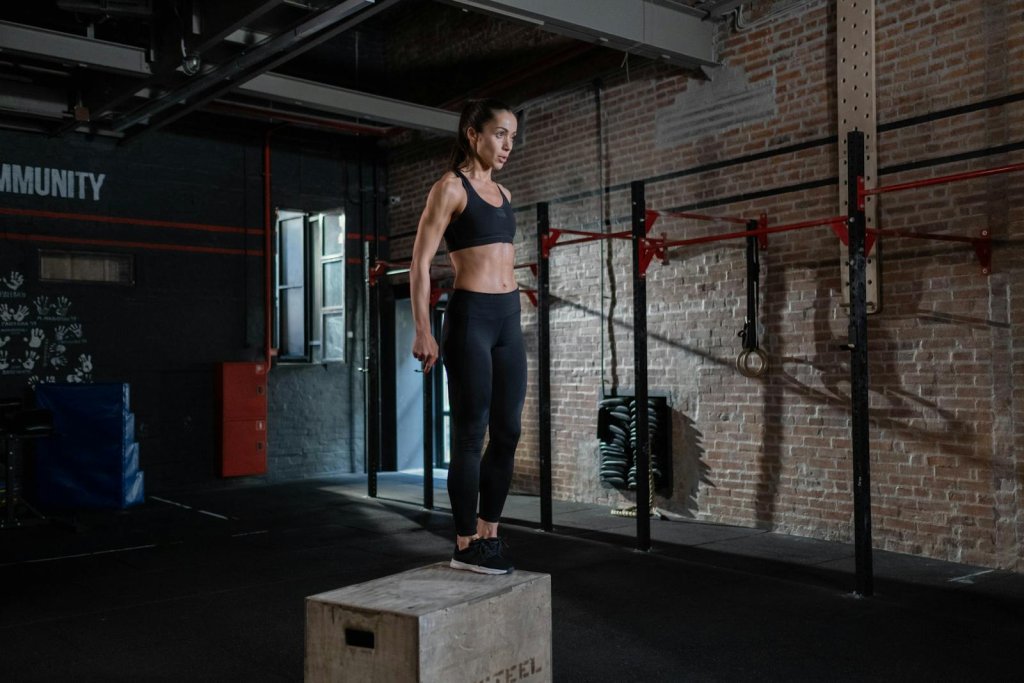
Understanding plyometric exercises matters because they improve power, coordination, and movement efficiency in a short amount of time. When programmed correctly, they can support speed, agility, and full-body strength while complementing traditional strength training.
What Are Plyometric Exercises?
Plyometric exercises are high-intensity movements that involve a rapid stretch of a muscle followed immediately by a powerful contraction. This process is known as the stretch-shortening cycle.
Common characteristics include:
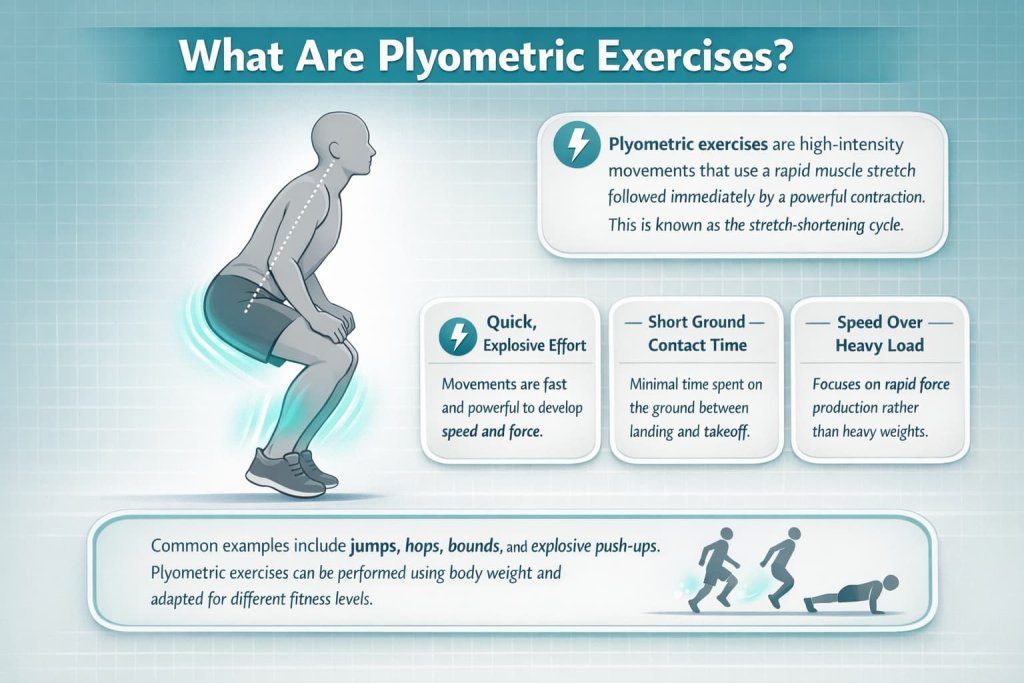
- Quick, explosive effort
- Short ground-contact time
- Emphasis on speed and force, not heavy loads
Typical examples include jumps, hops, bounds, and explosive push-ups. Plyometrics can be performed with body weight alone and adapted for different fitness levels.
15 Best Plyometric Exercises
Plyometric exercises are explosive, high-intensity movements that train your muscles to produce force quickly. The 15 exercises below focus on building power, improving speed, and supporting better athletic movement when performed with proper technique.
1. Squat Jumps
Why it works:
Squat jumps train the stretch-shortening cycle in the hips, knees, and ankles. By rapidly transitioning from a squat into an explosive jump, the body learns to produce force quickly, which supports vertical jump height and overall lower-body power.
Muscles worked:
Quadriceps, gluteus maximus, hamstrings, calves, core stabilizers
How to do it:
- Stand with feet shoulder-width apart
- Lower into a controlled squat with chest tall
- Drive forcefully through the floor to jump upward
- Land softly on the mid-foot with knees slightly bent
- Reset before the next repetition
Trainer Tip:
Focus on a quiet, controlled landing. If you hear loud impact, reduce jump height and improve landing mechanics.
2. Box Jumps
Why it works:
Box jumps emphasize explosive power while reducing landing impact compared to ground jumps. The elevated target encourages maximal intent without excessive joint stress.
Muscles worked:
Glutes, quadriceps, hamstrings, calves, core
How to do it:
- Stand facing a sturdy box or platform
- Perform a shallow squat to load the hips
- Jump explosively onto the box
- Land softly with knees and hips bent
- Step down carefully before repeating
Trainer Tip:
Use a box height that allows clean landings. Power quality matters more than box height.
3. Jump Lunges
Why it works:
Jump lunges combine unilateral strength, balance, and explosive hip extension. They improve coordination and power in split-stance positions common in sports.
Muscles worked:
Quadriceps, glutes, hamstrings, calves, hip stabilizers
How to do it:
- Start in a lunge position
- Lower until both knees are bent
- Explosively jump and switch legs mid-air
- Land softly into the opposite lunge
- Stabilize before the next rep
Trainer Tip:
Control the descent before exploding upward to protect the knees and hips.
4. Tuck Jumps
Why it works:
Tuck jumps demand rapid force production and coordination, improving reactive strength and neuromuscular control at high speeds.
Muscles worked:
Quadriceps, glutes, hip flexors, calves, core
How to do it:
- Stand tall with feet hip-width apart
- Jump vertically as high as possible
- Pull knees toward the chest mid-air
- Land softly with bent knees
- Pause briefly before the next rep
Trainer Tip:
Quality beats quantity. Stop the set if jump height or knee control declines.
5. Broad Jumps
Why it works:
Broad jumps emphasize horizontal force production, which is essential for sprint acceleration and athletic power.
Muscles worked:
Glutes, hamstrings, quadriceps, calves, core
How to do it:
- Stand with feet shoulder-width apart
- Swing arms back while loading the hips
- Jump forward explosively
- Land with hips back and knees bent
- Reset between repetitions
Trainer Tip:
Measure distance occasionally to track progress, but prioritize smooth, controlled landings.
6. Skater Jumps
Why it works:
Skater jumps develop lateral power and single-leg stability, supporting agility and injury resilience.
Muscles worked:
Glutes (especially glute medius), quadriceps, hamstrings, calves, ankles
How to do it:
- Start standing on one leg
- Jump laterally to the opposite leg
- Land softly and stabilize
- Keep chest tall and hips level
- Alternate sides
Trainer Tip:
Hold each landing briefly to reinforce balance and control.
7. Single-Leg Hops
Why it works:
Single-leg hops improve unilateral power and help correct side-to-side strength imbalances.
Muscles worked:
Glutes, quadriceps, calves, hamstrings, ankle stabilizers
How to do it:
- Stand on one leg
- Perform small, controlled hops
- Keep knee aligned over toes
- Land softly each time
- Switch legs after the set
Trainer Tip:
Start with low hops and progress gradually to avoid excessive ankle stress.
8. Depth Jumps
Why it works:
Depth jumps train reactive strength by minimizing ground contact time, improving the body’s ability to absorb and reapply force rapidly.
Muscles worked:
Glutes, quadriceps, hamstrings, calves, core
How to do it:
- Step off a low box
- Land briefly on both feet
- Immediately jump upward
- Focus on quick, explosive takeoff
- Reset fully between reps
Trainer Tip:
This is an advanced exercise. Only perform it if you already have good strength and landing mechanics.
9. Plyometric Push-Ups
Why it works:
Plyometric push-ups build upper-body explosive strength by training rapid force production through the arms and chest.
Muscles worked:
Chest, shoulders, triceps, core
How to do it:
- Start in a push-up position
- Lower under control
- Push explosively so hands leave the floor
- Land softly and stabilize
- Reset before the next rep
Trainer Tip:
If full plyometric push-ups are too challenging, elevate hands on a bench.
10. Medicine Ball Chest Pass
Why it works:
This movement develops upper-body power without joint strain, making it ideal for explosive training.
Muscles worked:
Chest, shoulders, triceps, core
How to do it:
- Hold a medicine ball at chest height
- Lower into a slight athletic stance
- Explosively throw the ball forward
- Catch or retrieve the ball
- Reset between reps
Trainer Tip:
Use a ball that allows maximum speed, not slow grinding throws.
11. Medicine Ball Slams
Why it works:
Slams integrate total-body power and coordination while reinforcing forceful hip extension.
Muscles worked:
Lats, shoulders, core, glutes, legs
How to do it:
- Raise the medicine ball overhead
- Extend hips and arms forcefully
- Slam the ball into the ground
- Catch or retrieve it safely
- Reset posture before repeating
Trainer Tip:
Brace your core before each slam to protect the lower back.
12. Jump Rope (Fast Intervals)
Why it works:
Fast jump-rope intervals enhance reactive strength, foot speed, and coordination with relatively low impact.
Muscles worked:
Calves, quadriceps, hip flexors, shoulders, forearms
How to do it:
- Hold rope handles with relaxed grip
- Jump lightly on the balls of the feet
- Keep jumps low and quick
- Maintain rhythmic breathing
- Rest briefly between intervals
Trainer Tip:
Think “quick and light,” not high jumps.
13. Bounding
Why it works:
Bounding improves stride length, running power, and coordination through exaggerated explosive steps.
Muscles worked:
Glutes, hamstrings, quadriceps, calves, hip flexors
How to do it:
- Begin jogging slowly
- Drive one knee forward explosively
- Push off the opposite leg
- Alternate legs with long, powerful strides
- Maintain upright posture
Trainer Tip:
Use bounding sparingly and focus on smooth rhythm rather than speed.
14. Lateral Box Jumps
Why it works:
This exercise builds side-to-side power and improves agility in frontal-plane movement.
Muscles worked:
Glutes, quadriceps, calves, hip stabilizers
How to do it:
- Stand beside a box
- Load hips slightly
- Jump laterally onto the box
- Land softly with both feet
- Step down before repeating
Trainer Tip:
Control the landing first, then progress speed and height.
15. Explosive Step-Ups
Why it works:
Explosive step-ups develop functional power in a joint-friendly pattern similar to climbing or sprinting.
Muscles worked:
Glutes, quadriceps, hamstrings, calves
How to do it:
- Place one foot on a bench or box
- Drive forcefully through the lead leg
- Lift the body upward explosively
- Step down under control
- Switch sides after the set
Trainer Tip:
Avoid pushing off excessively with the trailing leg to keep the focus on power.
How to Program Plyometric Exercises Safely
To get the most benefit while reducing risk:
- Perform plyometric exercises 2–3 days per week
- Allow 48–72 hours of recovery between intense plyometric sessions
- Keep repetitions low and focus on quality (for example, 2–5 reps per set)
- Rest fully between sets so each rep stays explosive
- Pair plyometrics with strength training for balanced development
The American College of Sports Medicine emphasizes that proper technique and gradual progression are essential when adding power training to a routine.
Why Plyometric Exercises Matter
Well-designed plyometric exercises may help support:
- Improved lower- and upper-body power
- Faster sprinting and directional changes
- Better coordination and neuromuscular control
- Higher calorie expenditure during workouts
- Carryover to daily movements and athletic performance
Public health guidance from the Centers for Disease Control and Prevention and the World Health Organization encourages muscle-strengthening activities at least two days per week, which can include power-based movements like plyometrics when performed safely.
Who Should and Should Not Do Plyometric Exercises
Plyometric exercises can be effective for improving power and movement speed, but they are not appropriate for everyone in all situations.
Plyometric exercises may be suitable for people who:
- Have a basic foundation of strength and movement control
- Can squat, hinge, and land with good alignment
- Participate in sports or activities that involve jumping, sprinting, or quick direction changes
- Are already physically active and free from uncontrolled joint pain
Plyometric exercises may not be appropriate (or should be modified) for people who:
- Are new to exercise or returning after a long period of inactivity
- Have unresolved knee, ankle, hip, or lower-back pain
- Lack balance, coordination, or basic strength
- Are recovering from surgery or a recent musculoskeletal injury
For general populations, professional guidance from organizations such as the American College of Sports Medicine emphasizes gradual progression and individual readiness rather than jumping straight into high-impact training.
How to Prepare for Plyometric Exercises
Proper preparation helps reduce unnecessary joint stress and supports better performance during plyometric training.
Before starting plyometric exercises, it is generally recommended to:
- Perform a dynamic warm-up to raise body temperature
- Mobilize key joints such as ankles, hips, and thoracic spine
- Activate major muscle groups including glutes and core
- Practice basic landing mechanics (soft knees, hips back, upright torso)
Many training frameworks suggest building strength first with movements like squats, lunges, and step-ups before adding explosive variations.
Common Plyometric Training Mistakes to Avoid
Avoiding common errors can help keep plyometric training effective and lower unnecessary risk.
Some frequent mistakes include:
- Performing too many repetitions, leading to fatigue and poor landing control
- Skipping warm-ups or mobility work
- Focusing on jump height instead of controlled takeoff and landing
- Using plyometrics as a replacement for strength training rather than a complement
- Training explosively on consecutive days without adequate recovery
Plyometric exercises are most effective when performed with full effort, low volume, and adequate rest. Quality movement and recovery time matter more than the number of jumps completed.
Plyometric Exercises vs Strength Training
Plyometric exercises focus on speed and power, while traditional strength training focuses on force production under load. Both are important and work best together.
A balanced program often includes:
- Strength exercises for muscle and joint support
- Plyometric exercises for speed and explosiveness
- Mobility and recovery work for long-term consistency
Frequently Asked Questions
Are plyometric exercises good for beginners?
They can be, but beginners should start with low-impact variations and master landing mechanics first.
How long should a plyometric workout be?
Most plyometric sessions last 15–30 minutes due to their high intensity.
Can plyometric exercises help with fat loss?
They may support higher calorie burn when combined with proper nutrition and regular training.
Do I need equipment for plyometric exercises?
Many plyometric exercises use body weight only. Boxes or medicine balls are optional.
How often should I do plyometrics?
Most people benefit from 2–3 sessions per week with adequate recovery.
Are plyometric exercises only for athletes?
No. When scaled properly, they can benefit recreational exercisers and active adults.
Conclusion
Plyometric exercises are a powerful way to improve speed, strength, and overall movement efficiency. By focusing on quality reps, proper technique, and smart programming, you can safely integrate plyometrics into your routine and see meaningful performance gains.
If you’re ready to move better, jump higher, and train with purpose, start with a few well-chosen plyometric exercises and progress gradually.
References
- CDC – Adult Physical Activity Guidelines (muscle-strengthening 2+ days/week)
- WHO – Physical Activity Recommendations (muscle-strengthening guidance)
- U.S. HHS – Physical Activity Guidelines for Americans (2nd edition, official PDF)
- NSCA – Plyometric Exercises (programming fundamentals)
- Davies et al. (2015) – Current Concepts of Plyometric Exercise (PMC)
- Markovic (2007) – Plyometric Training and Vertical Jump Height: Meta-Analytical Review (PMC)
- Zheng et al. (2025) – Plyometric Training Effects on Jump, Sprint, and Change of Direction (PLOS ONE)
- Staniszewski et al. (2024) – Rest Duration Between Sets and Recovery After Plyometric Exercise (PMC)