
Proprioception exercises improve balance, stability, and body control by training your body to sense joint position and movement more accurately. This ability—often called your body’s “internal GPS”—is essential for staying upright, reacting to uneven surfaces, and moving with confidence in daily life and sport.
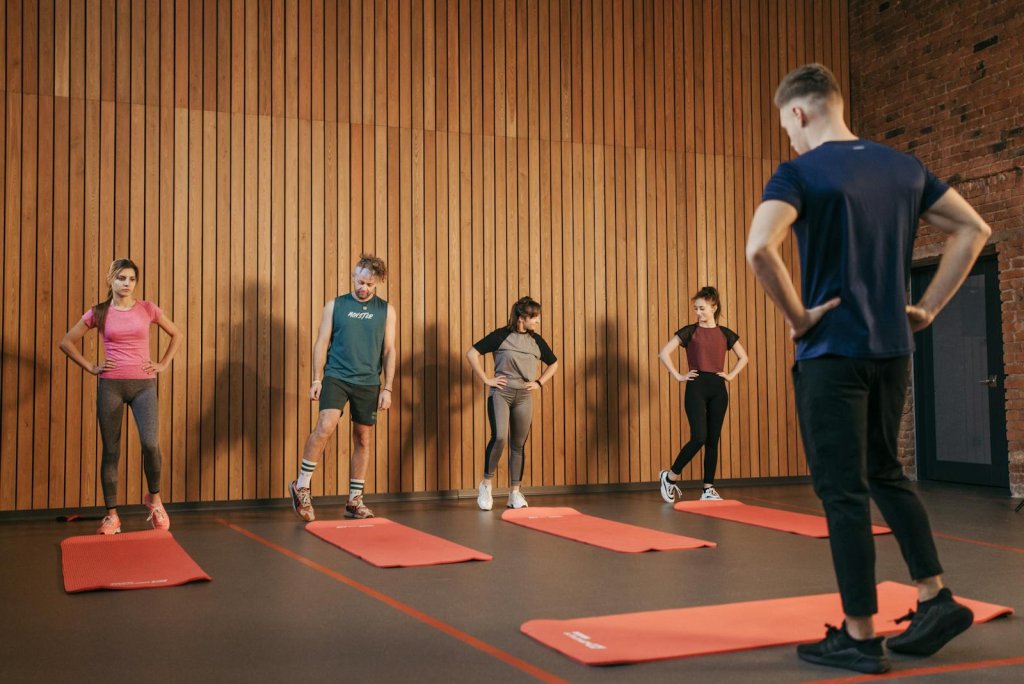
Understanding proprioception exercises matters because reduced body awareness is linked with falls, joint injuries, and inefficient movement patterns.
What Are Proprioception Exercises?
Proprioception exercises are movements that challenge your balance, coordination, and joint awareness by altering your base of support, movement speed, direction, or sensory input (such as vision).
They are commonly used in:
- Balance and fall-prevention programs
- Sports performance and injury-risk reduction
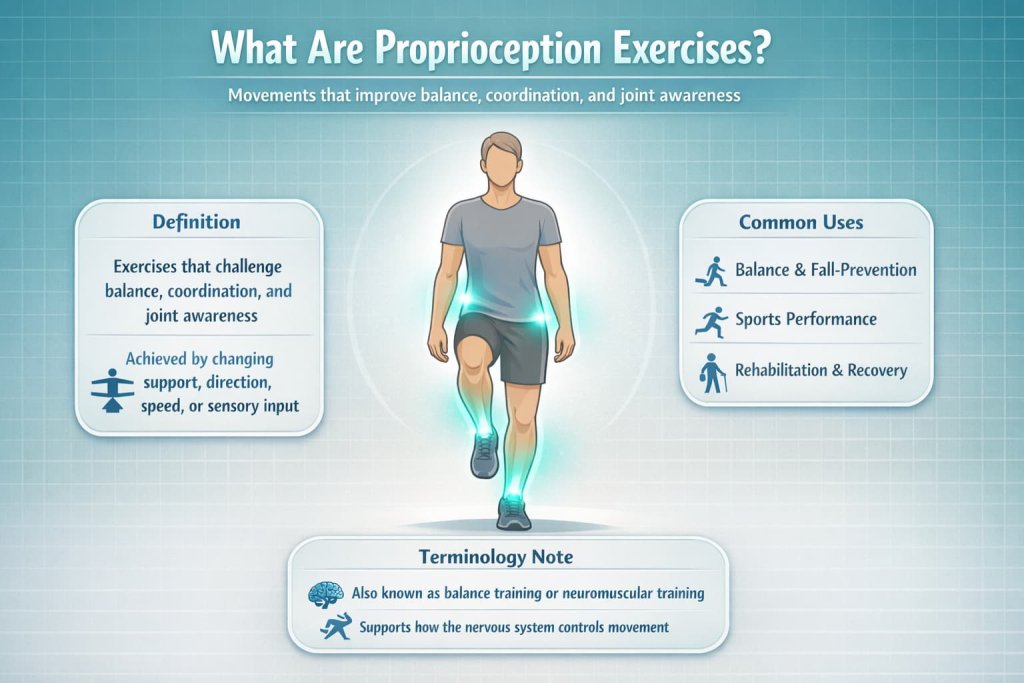
- Rehabilitation and return-to-activity routines
Clinical and sports-medicine literature often refers to this approach as balance training or neuromuscular training, highlighting its role in improving how the nervous system controls movement.
14 Best Proprioception Exercises
Proprioception exercises help improve balance, stability, and body awareness by training your body to sense joint position and movement more accurately. The following 14 exercises focus on safe, controlled balance challenges that support better coordination and confident everyday movement.
1. Single-Leg Stand
How to do it:
- Stand tall near a wall or chair for support
- Shift weight onto one leg
- Lift the opposite foot slightly off the floor
- Hold while keeping hips level and torso upright
Why it works:
Standing on one leg challenges the body to constantly adjust joint position at the ankle, knee, and hip. These small corrections improve balance control and body awareness.
Muscles worked:
Ankle stabilizers, quadriceps, hamstrings, gluteus medius, core stabilizers
Trainer Tip:
Start with short holds and gradually increase time before progressing to harder variations.
2. Tandem Stance (Heel-to-Toe)
How to do it:
- Stand with one foot directly in front of the other
- Keep both feet flat and aligned
- Hold balance while maintaining upright posture
Why it works:
The narrow base of support increases side-to-side balance demand, improving postural stability during standing and walking.
Muscles worked:
Ankle stabilizers, calves, hips, core
Trainer Tip:
Switch foot positions to train both sides equally.
3. Single-Leg Stand With Eyes Closed
How to do it:
- Perform a standard single-leg stand
- Once stable, gently close your eyes
- Maintain balance for the chosen duration
Why it works:
Removing visual input forces the nervous system to rely on proprioceptive and vestibular feedback, enhancing internal body awareness.
Muscles worked:
Ankle stabilizers, glutes, core, intrinsic foot muscles
Trainer Tip:
Only close your eyes when you feel stable and safe.
4. Heel-to-Toe Walk
How to do it:
- Walk forward placing the heel directly in front of the toes
- Keep steps slow and controlled
- Focus on posture and steady breathing
Why it works:
This drill trains dynamic balance and coordination during movement, closely mimicking real-world walking demands.
Muscles worked:
Calves, ankles, hips, core
Trainer Tip:
Use a hallway wall or countertop for light support if needed.
5. Weight Shifts (Forward, Backward, Side-to-Side)
How to do it:
- Stand with feet hip-width apart
- Slowly shift weight in one direction
- Pause briefly, then return to center
- Repeat in all directions
Why it works:
Controlled weight shifts teach the body how to manage changes in center of mass safely and efficiently.
Muscles worked:
Ankles, quadriceps, glutes, core
Trainer Tip:
Move slowly—speed reduces proprioceptive benefit.
6. Standing Marches
How to do it:
- Stand upright
- Lift one knee toward hip height
- Lower slowly and switch sides
Why it works:
Alternating single-leg support improves balance during gait-related movements.
Muscles worked:
Hip flexors, glutes, quadriceps, core
Trainer Tip:
Pause briefly at the top of each march for added balance challenge.
7. Single-Leg Reach
How to do it:
- Stand on one leg
- Reach the free leg or arm forward or sideways
- Return slowly to start
Why it works:
Reaching increases instability, forcing the nervous system to coordinate balance across multiple joints.
Muscles worked:
Gluteus medius, ankles, hamstrings, core
Trainer Tip:
Keep the knee softly bent, not locked.
8. Step-Back Lunges
How to do it:
- Stand tall
- Step one foot backward into a lunge
- Lower with control and return to standing
Why it works:
Backward stepping improves balance during deceleration and directional changes.
Muscles worked:
Quadriceps, glutes, hamstrings, calves
Trainer Tip:
Step back slowly to maintain control and balance.
9. Lateral Stepping
How to do it:
- Stand with feet hip-width apart
- Step sideways with control
- Bring the trailing foot to meet the lead foot
Why it works:
Side-to-side movements strengthen lateral stability required for real-world balance tasks.
Muscles worked:
Gluteus medius, hips, ankles
Trainer Tip:
Avoid letting knees collapse inward.
10. Sit-to-Stand Without Using Hands
How to do it:
- Sit on a chair with feet flat
- Lean slightly forward
- Stand up without pushing with hands
Why it works:
This functional movement improves proprioception during everyday transitions.
Muscles worked:
Quadriceps, glutes, core
Trainer Tip:
Use a higher chair if needed and progress gradually.
11. Single-Leg Mini Squat
How to do it:
- Stand on one leg
- Bend the knee slightly into a shallow squat
- Return to standing with control
Why it works:
Single-leg squatting enhances joint control through knee and hip movement.
Muscles worked:
Quadriceps, glutes, hamstrings, core
Trainer Tip:
Focus on knee alignment over the toes.
12. Balance on a Soft Surface
How to do it:
- Stand on a foam pad or folded towel
- Maintain upright posture
- Hold balance or perform small movements
Why it works:
Unstable surfaces increase sensory input demand at the ankle and foot.
Muscles worked:
Ankles, calves, intrinsic foot muscles
Trainer Tip:
Use support nearby until confident.
13. Clock Reach Exercise
How to do it:
- Stand on one leg
- Reach the free foot to different directions like a clock
- Return to center between reaches
Why it works:
Multi-directional reaching improves balance adaptability.
Muscles worked:
Glutes, ankles, hips, core
Trainer Tip:
Start with small reaches before increasing distance.
14. Controlled Toe and Heel Raises
How to do it:
- Stand upright
- Rise slowly onto toes
- Lower and then lift toes toward the ceiling
Why it works:
Slow ankle movements enhance proprioception during vertical motion.
Muscles worked:
Calves, tibialis anterior, foot stabilizers
Trainer Tip:
Control both the lifting and lowering phases.
How Often Should You Do Proprioception Exercises?
Evidence-based balance programs typically recommend:
- Frequency: 2–3+ days per week
- Duration: 10–20 minutes per session
- Progression: Gradually reduce support, slow movements, or add direction changes
World falls-prevention guidelines published in Age and Ageing emphasize that balance exercises should be progressively challenging and continued long term for meaningful benefit.
Why Proprioception Exercises Matter
Proprioception does not improve automatically with rest. Instead, it responds best to repeated, controlled balance challenges.
Research and public-health guidance show that balance-focused exercise may help by:
- Improving postural control and stability
- Supporting safer walking, stair use, and direction changes
- Reducing fall risk in older adults
- Lowering the likelihood of recurrent ankle sprains in active populations
The World Health Organization recommends multicomponent physical activity—including balance training—on three or more days per week for adults with poor mobility to support functional independence.
Who Can Benefit Most From Proprioception Training?
Proprioception exercises are valuable for:
- Older adults aiming to reduce fall risk
- Individuals returning to activity after lower-limb injury
- Athletes seeking better movement control
- Anyone who feels unsteady during walking, turning, or standing tasks
The Centers for Disease Control and Prevention highlights balance training as a key component of fall-prevention strategies, including its STEADI initiative.
Safety Guidelines Before You Start
- Use a stable surface or support (chair or wall) when learning new exercises
- Move slowly and with control—speed comes later
- Stop if you feel dizzy or unsafe
- Progress only when you can maintain good posture
If balance problems are sudden, severe, or worsening, professional assessment is recommended.
How to Progress Proprioception Exercises Safely
Progression should focus on better control, not rushing into harder drills. The goal is to gradually challenge your balance system while maintaining safety and confidence.
Safe progression strategies include:
- Reduce external support: Move from holding a wall or chair to hovering the hand nearby, then to no support
- Narrow the base of support: Progress from feet hip-width apart to tandem stance, then to single-leg positions
- Slow the movement: Performing exercises more slowly increases proprioceptive demand
- Add direction changes: Reach forward, sideways, and diagonally instead of straight-line movements
- Change sensory input: Progress from eyes open to eyes closed only when stable
- Increase duration, not intensity: Longer holds often provide more benefit than harder variations
Progress only one variable at a time and return to an easier version if balance quality declines.
Common Mistakes to Avoid During Proprioception Training
Avoiding common errors helps reduce unnecessary strain and improves results.
Frequent mistakes include:
- Moving too fast: Speed reduces body awareness and increases fall risk
- Holding breath: Proper breathing supports postural control
- Locking the joints: Slight knee and hip bend improves balance responses
- Skipping easier progressions: Foundational drills build the base for advanced balance
- Training while fatigued: Excess fatigue can compromise coordination
- Ignoring posture: Leaning or collapsing through the hips reduces effectiveness
Quality of movement matters more than difficulty level.
When to Seek Professional Guidance
While proprioception exercises are generally safe, professional input may be appropriate in certain situations.
Consider seeking guidance if you:
- Experience frequent falls or near-falls
- Have sudden or unexplained balance changes
- Feel dizziness, numbness, or weakness during balance tasks
- Are recovering from recent surgery or a significant joint injury
- Have a diagnosed neurological or inner-ear condition
- Feel unsafe performing balance exercises independently
A qualified healthcare or movement professional can help individualize exercise selection, progression, and safety considerations.
Frequently Asked Questions (FAQs)
1. What is proprioception in simple terms?
Proprioception is your body’s ability to know where your joints are and how they are moving without looking.
2. Are proprioception exercises only for athletes?
No. They are widely used for fall prevention, rehabilitation, and everyday movement confidence.
3. How long does it take to see improvement?
Many people notice better balance within 4–8 weeks of consistent practice.
4. Can proprioception exercises reduce fall risk?
Yes. Balance-focused exercise is strongly supported by international fall-prevention guidelines.
5. Are balance boards required?
No. Many effective proprioception exercises use only body weight and simple movements.
6. Can I do these exercises at home?
Yes. Most proprioception exercises are home-friendly and require minimal space.
7. Should proprioception exercises replace strength training?
No. They work best alongside strength and mobility training, not instead of them.
Conclusion
Proprioception exercises play a vital role in improving balance, stability, and body control across all ages. By practicing controlled, progressive balance challenges a few times per week, you can support safer movement, better coordination, and greater confidence in daily life. Start simple, progress gradually, and make balance training a consistent part of your routine.
References
- WHO Guidelines on Physical Activity and Sedentary Behaviour (2020)
- WHO 2020 Physical Activity Guidelines Paper (Bull et al., 2020) — Full Text (PMC)
- World Guidelines for Falls Prevention and Management for Older Adults (Age and Ageing, 2022)
- CDC STEADI: Older Adult Fall Prevention
- Cochrane Evidence: Exercise for Preventing Falls in Older People Living in the Community
- Exercise for Preventing Falls in Older People Living in the Community (Sherrington et al., 2019) — PubMed
- Proprioceptive Training for the Prevention of Ankle Sprains: Systematic Review and Meta-analysis — Full Text (PMC)