
The push press exercise is a powerful overhead lift that uses leg drive to help move heavier weight overhead while developing full-body power. Understanding how to perform it correctly matters because the push press bridges the gap between pure strength and explosive athletic performance—making it valuable for athletes, lifters, and anyone looking to improve overhead strength safely and efficiently.
This guide explains what the push press is, how it works, proper form, benefits, programming tips, safety considerations, and common mistakes—using clear, evidence-based guidance you can trust.
What Is the Push Press Exercise?
The push press exercise is a compound movement where the barbell (or dumbbells) starts at shoulder height, followed by a shallow knee dip and a forceful leg drive to assist the press overhead. Unlike a strict overhead press, the legs initiate the movement, allowing greater load and power output.
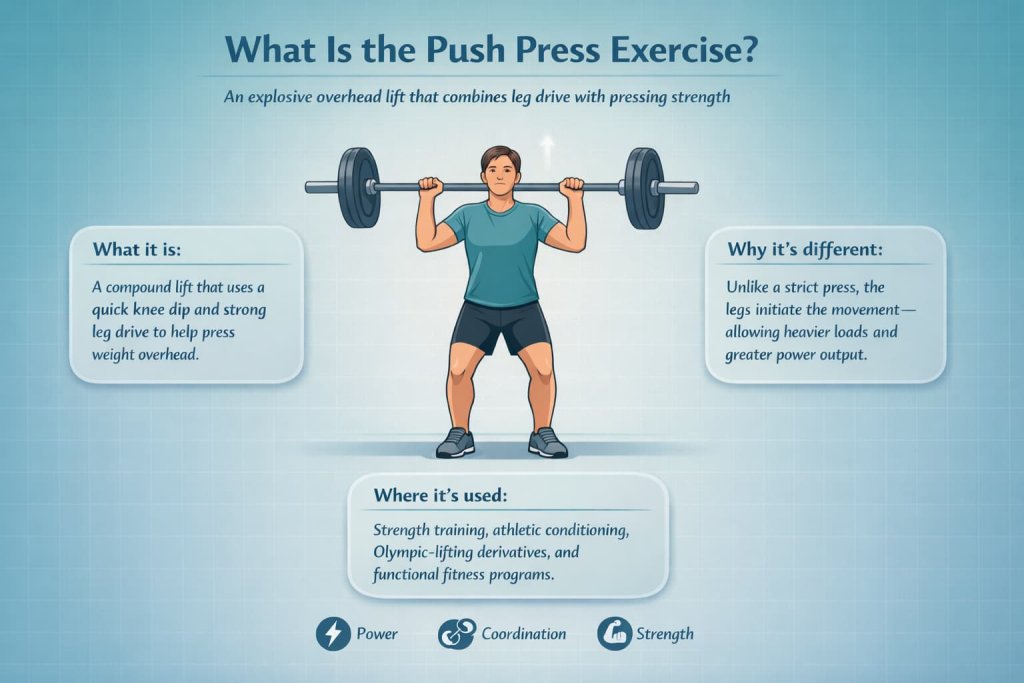
This lift is commonly used in strength training, Olympic-lifting derivatives, athletic conditioning programs, and functional fitness routines.
How to Do the Push Press Exercise Correctly
How to do it
- Start with the bar resting across the front of your shoulders
- Stand tall with feet about shoulder-width apart
- Brace your core and keep your chest upright
- Dip straight down by bending knees slightly
- Drive powerfully through your legs
- Press the bar overhead as your legs extend
- Lock out overhead with arms straight and core tight
- Lower the bar back to shoulder level under control
Trainer Tip: Think “dip straight, drive hard.” The dip should be quick and shallow—not a squat.
Push Press Exercise Variations and Equipment Options
Different push press variations allow you to tailor the movement to your experience level, available equipment, and training goals while maintaining the same core mechanics of dip, drive, and press.
1. Barbell Push Press
Why it works
The barbell push press allows the greatest total load, making it highly effective for developing maximal power and full-body force production. The fixed bar path reinforces efficient leg-to-arm power transfer.
How to do it
- Rest the barbell across the front of the shoulders in a secure front-rack position
- Stand tall with feet about shoulder-width apart
- Brace your core and keep the torso upright
- Perform a shallow knee dip straight down
- Drive explosively through the legs
- Press the bar overhead to full lockout
- Lower the bar back to the shoulders with control
Trainer Tip
Think “legs first, arms second.” If your shoulders fatigue too quickly, your leg drive is likely underused.
2. Dumbbell Push Press
Why it works
Dumbbells allow a more natural pressing path and independent arm movement, which may reduce joint stress and improve coordination. This variation is especially useful for beginners and home workouts.
How to do it
- Hold dumbbells at shoulder height with palms facing slightly inward
- Stand with feet shoulder-width apart
- Brace the core and keep the chest tall
- Dip slightly at the knees
- Drive upward through the legs
- Press the dumbbells overhead until arms are straight
- Lower back to shoulder height under control
Trainer Tip
Keep both dumbbells moving at the same speed to avoid shifting or twisting during the press.
3. Single-Arm Push Press
Why it works
Using one arm increases core and hip stabilization demands, helping address strength imbalances and improve anti-rotation control.
How to do it
- Hold one dumbbell or kettlebell at shoulder height
- Stand tall with feet slightly wider for balance
- Brace the core to prevent leaning
- Perform a shallow knee dip
- Drive upward through the legs
- Press the weight overhead with control
- Lower back to the shoulder and switch sides
Trainer Tip
Resist the urge to lean away from the weight—keep ribs down and torso stacked.
4. Kettlebell Push Press
Why it works
The offset load of a kettlebell challenges shoulder stability and grip strength while reinforcing controlled overhead positioning.
How to do it
- Hold the kettlebell in the rack position at shoulder height
- Stand with feet shoulder-width apart
- Brace your core and keep the elbow close to the body
- Dip slightly at the knees
- Drive upward through the legs
- Press the kettlebell overhead to lockout
- Lower smoothly back to the rack position
Trainer Tip
Keep the kettlebell close to your centerline to maintain balance and shoulder control.
How the Push Press Exercise Works
The push press combines lower-body force production with upper-body pressing strength.
- Dip: A short, controlled knee bend while keeping the torso upright
- Drive: Explosive extension of hips, knees, and ankles
- Press: Arms finish the movement as the weight travels overhead
This sequence allows efficient force transfer from the ground up, a key principle in athletic movement.
Benefits of the Push Press Exercise
Builds Explosive Power
The coordinated leg drive and press help develop rapid force production, which supports jumping, sprinting, and sport-specific movements.
Increases Overhead Strength
Because the legs assist the lift, you can safely handle heavier loads than with a strict press—stimulating greater strength adaptations.
Trains Multiple Muscle Groups
The push press is a true full-body movement, promoting efficient training sessions.
Improves Athletic Coordination
Timing the dip, drive, and press enhances neuromuscular coordination and total-body control.
Muscles Worked in the Push Press Exercise
The push press engages several major muscle groups:
- Shoulders (deltoids)
- Triceps
- Quadriceps
- Glutes
- Core stabilizers
- Upper back and traps
This wide muscle involvement is why the push press is often included in performance-based programs.
Push Press Exercise vs Overhead Press
The push press and strict press look similar but serve different goals.
- Push Press: Uses leg drive; focuses on power and heavier loads
- Overhead Press: No leg assistance; emphasizes strict shoulder strength
Both can coexist in a balanced strength program.
How to Program the Push Press Exercise
For general strength and power development:
- Reps: 3–6 per set
- Sets: 3–5
- Rest: 2–3 minutes
Begin with lighter loads to master timing before increasing weight. Major organizations such as the American College of Sports Medicine recommend progressive loading and proper recovery when performing compound lifts.
Common Mistakes to Avoid During the Push Press Exercise
- Turning the dip into a deep squat
- Leaning forward instead of staying upright
- Pressing with the arms before finishing leg drive
- Overarching the lower back at lockout
- Using too much weight too soon
Fixing these errors improves efficiency and reduces injury risk.
Safety Guidelines for the Push Press Exercise
- Warm up shoulders, hips, and ankles thoroughly
- Use proper footwear for stable leg drive
- Keep loads manageable until technique is consistent
- Stop if pain (not normal muscle fatigue) occurs
Public health guidelines from organizations like the Centers for Disease Control and Prevention emphasize strength training with proper technique at least two days per week for overall health.
Who Should Be Cautious With the Push Press Exercise?
Extra caution is advised if you have:
- Current shoulder or elbow pain
- Uncontrolled lower-back issues
- Balance limitations
If unsure, consult a qualified professional before adding the push press to your routine.
Frequently Asked Questions
Is the push press good for beginners?
Yes, when taught with light weight and proper coaching, it can help beginners learn power mechanics safely.
Can I do the push press with dumbbells?
Absolutely. Dumbbells reduce joint stress and allow unilateral control.
How heavy should I go on the push press?
Start lighter than your strict press max and increase gradually as technique improves.
Is the push press safe for shoulders?
When performed correctly and programmed appropriately, it can support shoulder strength and stability.
Should I use the push press for muscle growth?
It supports strength and power; pair it with accessory hypertrophy work for best results.
How often should I do push presses?
1–2 times per week is sufficient for most lifters.
Conclusion
The push press exercise is one of the most effective movements for building explosive power and overhead strength while training the entire body. When performed with good technique and smart programming, it delivers strength, coordination, and athletic carryover in a single lift.
If your goal is stronger shoulders, better power output, or improved athletic performance, the push press deserves a place in your training plan.
References
- Exercise Technique: The Push Press (NSCA Strength and Conditioning Journal)
- ACSM Position Stand: Progression Models in Resistance Training for Healthy Adults (PubMed)
- Physical Activity Guidelines for Americans, 2nd edition (health.gov PDF)
- CDC Adult Physical Activity Guidelines (Strength Training 2+ Days/Week)
- Weight Training: Do’s and Don’ts of Proper Technique (Mayo Clinic)
- Warm Up and Cool Down (American Heart Association)
- Rotator Cuff and Shoulder Conditioning Program (AAOS OrthoInfo PDF)