
Yes — resistance band exercises for women can effectively build strength, improve muscle tone, and support functional movement, often matching dumbbells when effort is equal. This makes bands a safe, joint-friendly, and accessible tool for women at any fitness level.
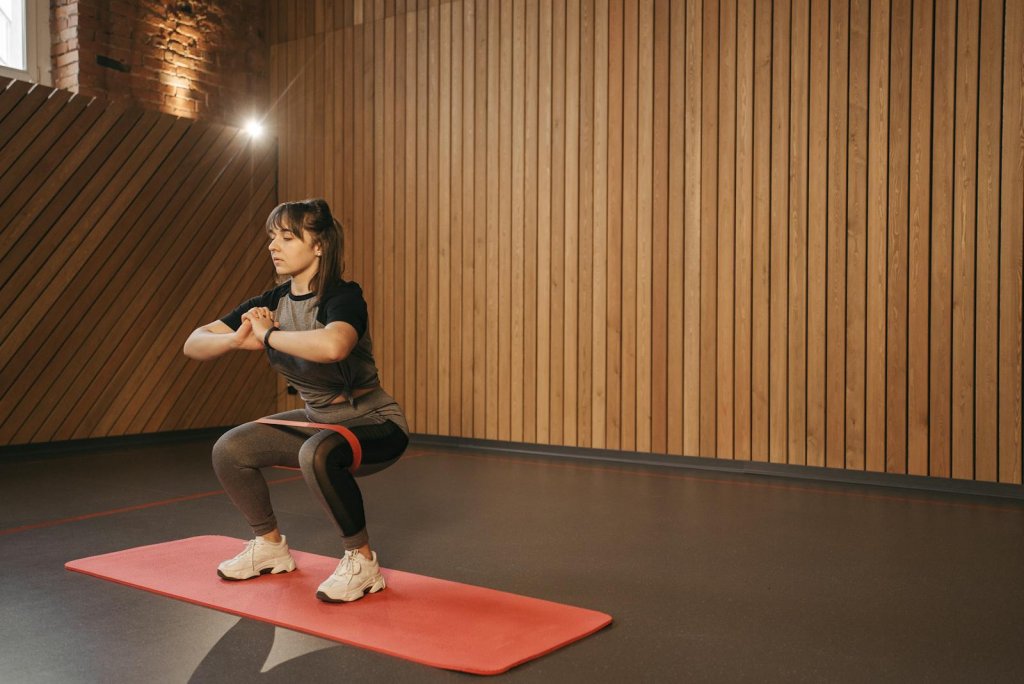
Understanding how resistance bands work is important because they offer variable tension, require core stability, and help train full-body strength without heavy equipment. You can use them at home, in small spaces, or while traveling.
In this guide, you’ll learn how resistance band workouts benefit women, how often to train, how to warm up safely, and the 15 best exercises with step-by-step instructions.
Why Are Resistance Band Exercises for Women Better?
Resistance band exercises are often a better choice for women because they provide effective strength training without the joint stress or heavy equipment required by weights. Bands create variable resistance, meaning the tension increases as you stretch them—helping muscles work harder through the full range of motion.
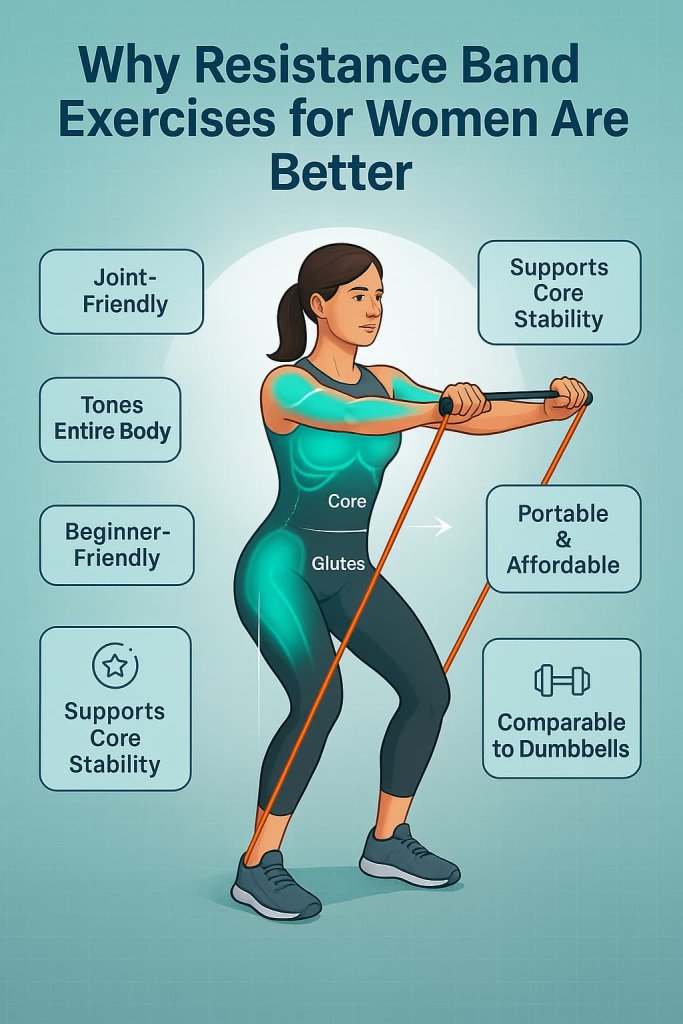
They are especially beneficial for women who want toning, stability, and functional strength while keeping workouts flexible, low-impact, and beginner-friendly.
Key reasons they’re better for many women:
- Gentle on joints while still building strength
- Excellent for toning arms, legs, glutes, and core
- Adaptable to all fitness levels from beginner to advanced
- Safer for home workouts with simple setup
- Support balance, posture, and core stability
- Portable and affordable, making consistency easier
- Match dumbbell results when effort and resistance are challenging
- Ideal for women over 40 or 50, providing strength without heavy loads
Resistance bands make strength training more accessible, safer, and practical—helping women build a strong, toned body with minimal risk and maximum versatility.
How Often Should Women Do Resistance Band Workouts?
According to CDC and ACSM guidelines:
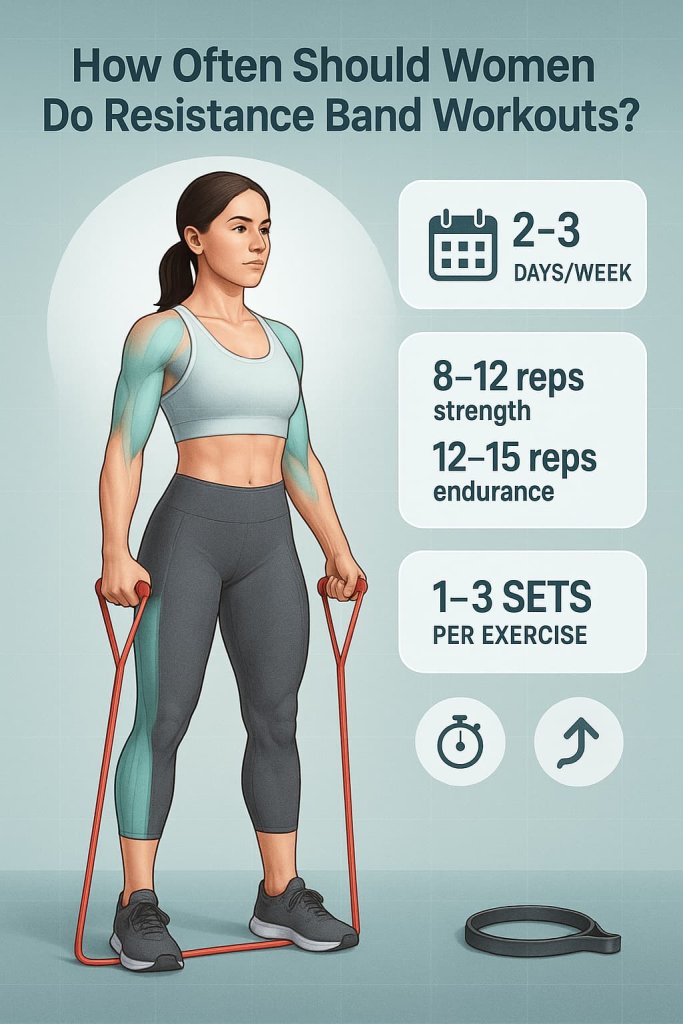
- Aim for 2+ days per week of full-body strength training.
- Use 8–12 reps for strength and 12–15 reps for endurance.
- Complete 1–3 sets per exercise.
- Rest 30–90 seconds between sets.
Always progress gradually and use bands that challenge the last 2–3 reps.
15 Best Resistance Band Exercises for Women
A simple but powerful move that strengthens the chest and improves pushing strength. Perfect for building upper-body tone at home.
Upper-Body Resistance Band Exercises for Women
1. Resistance Band Chest Press
Why it works:
This exercise strengthens the chest while also training the shoulders and triceps. The forward pressing motion mimics everyday pushing tasks and helps improve upper-body functional strength.
Muscles worked:
Pectorals, triceps, anterior deltoids, core stabilizers.
How to do it:
- Anchor the band behind you at chest height (door anchor or sturdy pole).
- Step forward to create tension and stand with one foot slightly ahead.
- Hold the handles at chest level with elbows bent and wrists straight.
- Press your arms forward until elbows extend comfortably.
- Pause, then return slowly while controlling the band’s tension.
Trainer Tip:
Keep your ribcage down and core braced to prevent lower-back arching.
2. Banded Seated Row
Why it works:
This move strengthens the upper and mid-back, helping counteract rounded shoulders from sitting or computer work. It also improves posture.
Muscles worked:
Lats, rhomboids, rear delts, biceps, mid-traps.
How to do it:
- Sit tall with legs extended and loop the band securely around your feet.
- Hold both handles, palms facing each other.
- Pull the handles toward your waist, keeping elbows close to your sides.
- Squeeze your shoulder blades together.
- Return slowly with full control.
Trainer Tip:
Avoid shrugging—keep shoulders down and away from ears.
3. Shoulder Press (Resistance Band)
Why it works:
Overhead pressing strengthens the shoulders while training your core to stabilize. This helps improve lifting ability in daily activities.
Muscles worked:
Deltoids, triceps, upper traps, core stabilizers.
How to do it:
- Stand on the band with feet hip-width apart.
- Bring the handles up to shoulder height, palms facing forward.
- Press overhead until arms extend without locking your elbows.
- Lower back down slowly.
Trainer Tip:
If your lower back arches, stagger your stance or slightly tuck your ribs.
4. Resistance Band Lateral Raise
Why it works:
Targets the side shoulder muscles, enhancing shoulder shape and upper-body symmetry.
Muscles worked:
Lateral deltoids.
How to do it:
- Stand on the band with arms resting by your sides.
- With a soft bend in your elbows, lift arms out to the sides until shoulder height.
- Lower with full control, avoiding momentum.
Trainer Tip:
Move slowly and avoid shrugging your traps.
5. Triceps Overhead Extension
Why it works:
This strengthens and tones the back of the arms, improving overall upper-arm definition.
Muscles worked:
Triceps (long head emphasized).
How to do it:
- Step on the band and bring the handles overhead.
- Bend your elbows to lower your hands behind your head.
- Extend your arms upward while keeping elbows pointed forward.
- Lower slowly.
Trainer Tip:
Keep elbows narrow to avoid shoulder strain.
6. Banded Biceps Curl
Why it works:
Builds stronger, more defined biceps while also training forearm tension control.
Muscles worked:
Biceps brachii, brachialis, forearm flexors.
How to do it:
- Stand on the band with arms down at your sides.
- Curl the handles upward toward your shoulders.
- Keep elbows pinned to your ribs.
- Lower slowly to maintain time under tension.
Trainer Tip:
Avoid rocking—keep your torso still and core engaged.
Lower-Body Resistance Band Exercises for Women
7. Banded Squats
Why it works:
Strengthens the quads and glutes while improving knee stability. Band resistance increases tension at the top of the squat for better muscle activation.
Muscles worked:
Quads, glutes, hamstrings, core.
How to do it:
- Stand on the band and bring handles to shoulder height.
- Lower into a squat, keeping knees aligned with toes.
- Push through heels to stand back up.
- Maintain tension throughout the movement.
Trainer Tip:
Gently push knees outward to prevent them from collapsing inward.
8. Glute Bridge with Band
Why it works:
Activates glutes more deeply than bodyweight alone, supporting hip strength and stability.
Muscles worked:
Glute max, glute medius, hamstrings.
How to do it:
- Place a loop band above your knees.
- Lie on your back with knees bent and feet flat.
- Lift hips until your body forms a straight line.
- Squeeze glutes, then lower slowly.
- Keep tension outward on the band.
Trainer Tip:
Don’t over-arch—keep ribs gently down.
9. Banded Lateral Walks
Why it works:
Strengthens the side glutes and hip stabilizers, improving pelvic alignment and shaping the outer hips.
Muscles worked:
Glute medius, glute minimus, hip stabilizers.
How to do it:
- Place band around thighs or ankles.
- Bend knees slightly and step sideways while keeping constant tension.
- Take small, controlled steps.
Trainer Tip:
Stay low in an athletic stance for best glute activation.
10. Standing Hamstring Curl
Why it works:
Targets the back of the legs safely and improves knee flexion strength.
Muscles worked:
Hamstrings.
How to do it:
- Anchor band low.
- Loop the free end around one ankle.
- Stand tall and bend your knee, curling your heel toward your glutes.
- Lower slowly and repeat.
Trainer Tip:
Keep hips still—don’t rotate your torso.
11. Banded Deadlift (Romanian Variation)
Why it works:
Strengthens the posterior chain and improves hip-hinging mechanics, crucial for safe lifting.
Muscles worked:
Hamstrings, glutes, erector spinae (lower back).
How to do it:
- Stand on the band with feet hip-width apart.
- Hinge at hips while keeping your back neutral.
- Stand tall by squeezing glutes at the top.
- Lower slowly with control.
Trainer Tip:
Maintain a long spine—avoid rounding your back.
Core & Full-Body Band Exercises for Women
12. Pallof Press
Why it works:
One of the best anti-rotation core exercises; it builds deep core stability and improves balance.
Muscles worked:
Obliques, transverse abdominis, core stabilizers.
How to do it:
- Anchor the band to your side at chest height.
- Hold the handle with both hands and step out to create tension.
- Press arms straight forward without letting your torso rotate.
- Bring hands back to your chest.
Trainer Tip:
Think “stay square”—don’t let your shoulders turn.
13. Banded Wood Chop
Why it works:
Trains rotational strength and improves core mobility and power.
Muscles worked:
Obliques, rectus abdominis, shoulders, hips.
How to do it:
- Anchor band high.
- Hold the handle with both hands above one shoulder.
- Pull diagonally downward across your body.
- Return slowly to starting position.
Trainer Tip:
Initiate with your core, not your arms.
14. Squat to Press (Band Thruster)
Why it works:
A powerful full-body move that boosts strength, endurance, and calorie burn in a single motion.
Muscles worked:
Glutes, quads, delts, triceps, core.
How to do it:
- Stand on the band with handles at shoulder height.
- Squat deeply, then stand up and press overhead.
- Lower back to shoulders before squatting again.
Trainer Tip:
Drive through your heels and let the press flow from the squat’s upward momentum.
15. Banded Reverse Lunge
Why it works:
Improves leg strength, balance, and hip stability while targeting the glutes and quads.
Muscles worked:
Quads, hamstrings, glutes, core stabilizers.
How to do it:
- Stand on the band with one foot and hold handles at your sides.
- Step back into a lunge, lowering your back knee toward the floor.
- Push through the front foot to stand.
- Repeat and switch sides.
Trainer Tip:
Keep your front knee aligned and your torso tall.
Sample 2-Day Training Plan for Women
Day 1 — Upper & Lower Mix
- Chest Press
- Seated Row
- Squat
- Glute Bridge
- Pallof Press
Day 2 — Sculpt & Tone
- Shoulder Press
- Lateral Raise
- Banded Deadlift
- Lateral Walk
- Squat to Press
Rest 48 hours between sessions.
Safety Tips for Women Using Resistance Bands
- Start with a light band and increase resistance gradually.
- Move slowly—avoid snapping or jerking the band.
- Check bands for cracks or thinning before every workout.
- Use a secure anchor point to prevent recoil.
- Keep your core engaged and avoid arching your lower back.
- Maintain neutral wrists and stable posture.
- Stop immediately if you feel sharp pain or dizziness.
- Breathe steadily—don’t hold your breath.
Who Should Avoid or Modify Resistance Band Workouts
You should talk to a healthcare professional before starting if you:
- Are pregnant or recently postpartum
- Have uncontrolled high blood pressure
- Have heart disease or recent surgery
- Have severe joint pain, instability, or arthritis
- Have chronic back issues or a herniated disc
- Experience frequent dizziness or balance problems
Modify exercises if you have limited mobility, discomfort during movement, or difficulty anchoring bands safely.
FAQs: Resistance Band Exercises for Women
1. Are resistance bands enough to build muscle?
Yes — when effort and resistance are challenging, bands can build strength similarly to weights.
2. Are resistance band workouts good for women over 40 or 50?
Yes. Bands are joint-friendly and support bone and muscle health.
3. What band strength should I start with?
Start light to medium. Increase tension gradually.
4. Can I replace dumbbells with resistance bands?
Yes for most movements — bands work well for strength, tone, and stability.
5. How long until results show?
Most women notice strength improvements within 3–6 weeks when training consistently.
Conclusion
Resistance band exercises for women offer a safe, versatile, and highly effective way to tone muscles, build strength, and stay active at home. You don’t need heavy equipment — just consistent effort and smart progression. Start with 2 days per week and gradually increase difficulty as you get stronger.
References
- de Oliveira PA et al. Effects of elastic resistance exercise on muscle strength and functional performance in healthy adults: a systematic review and meta-analysis. BMC Sports Science, Medicine and Rehabilitation.
- Martins WR et al. Elastic resistance training to increase muscle strength in elderly: a systematic review and meta-analysis. Archives of Gerontology and Geriatrics.
- Liu HW et al. Effects of resistance training with elastic bands on bone density, muscle quality and body fat in elderly patients with sarcopenic obesity syndrome. Journal of Clinical Orthopaedics and Trauma.
- Kocaoğlu Y et al. The effect of elastic resistance band training on postural control and body composition in sedentary women. Journal of Sports Science and Research.
- Lopez P et al. Resistance training effectiveness on body composition and metabolic health in individuals with overweight/obesity: a systematic review and meta-analysis. Sports Medicine – Open.
- American College of Sports Medicine. Progression models in resistance training for healthy adults (Position Stand). Medicine & Science in Sports & Exercise.
- Garber CE et al. Quantity and quality of exercise for developing and maintaining fitness in apparently healthy adults (ACSM Position Stand). Medicine & Science in Sports & Exercise.
- Centers for Disease Control and Prevention. Physical Activity Basics – Adult Activity Guidelines.