
Stability ball exercises are effective movements that use an unstable surface to engage your core, improve balance, and strengthen multiple muscle groups at once. Because the ball constantly challenges your stability, your body must coordinate and brace throughout each movement, making these exercises useful for full-body strength, posture support, and movement control.
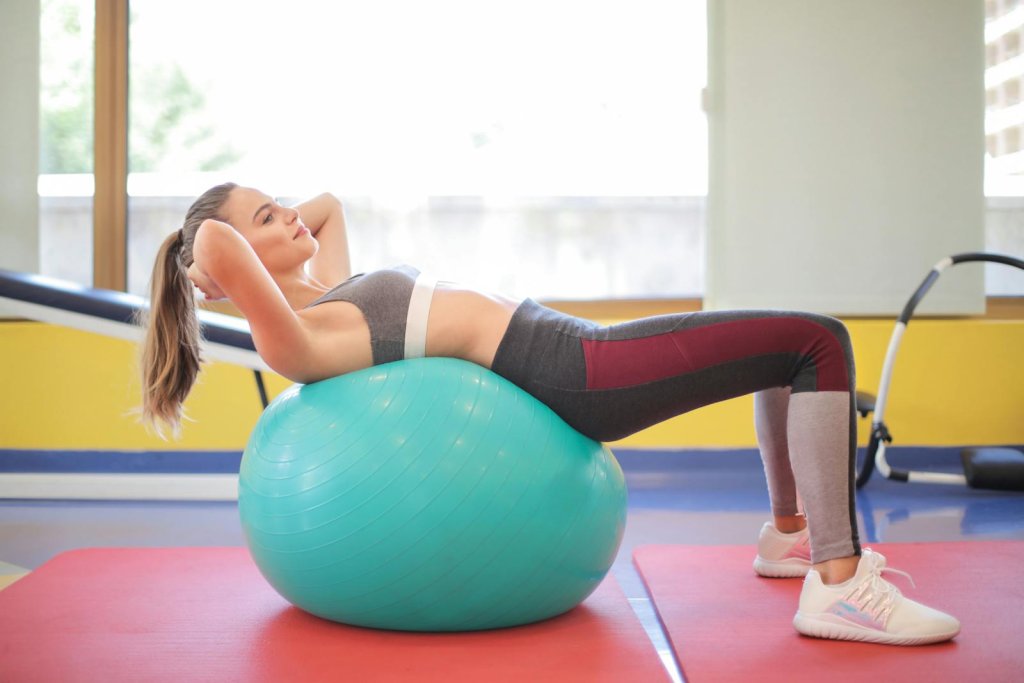
Understanding how to use a stability ball correctly matters. When programmed appropriately, these exercises can support core engagement, balance, and functional strength for daily activities, sports, and general fitness.
Below are the 12 best stability ball exercises organized for clarity and safe progression.
What Are Stability Ball Exercises?
Stability ball exercises are movements performed using an inflatable exercise ball (also called a Swiss ball or fitness ball). The unstable surface forces your body to activate stabilizing muscles—especially around the core, hips, and shoulders—more than many floor-based exercises.
These exercises are commonly used in:
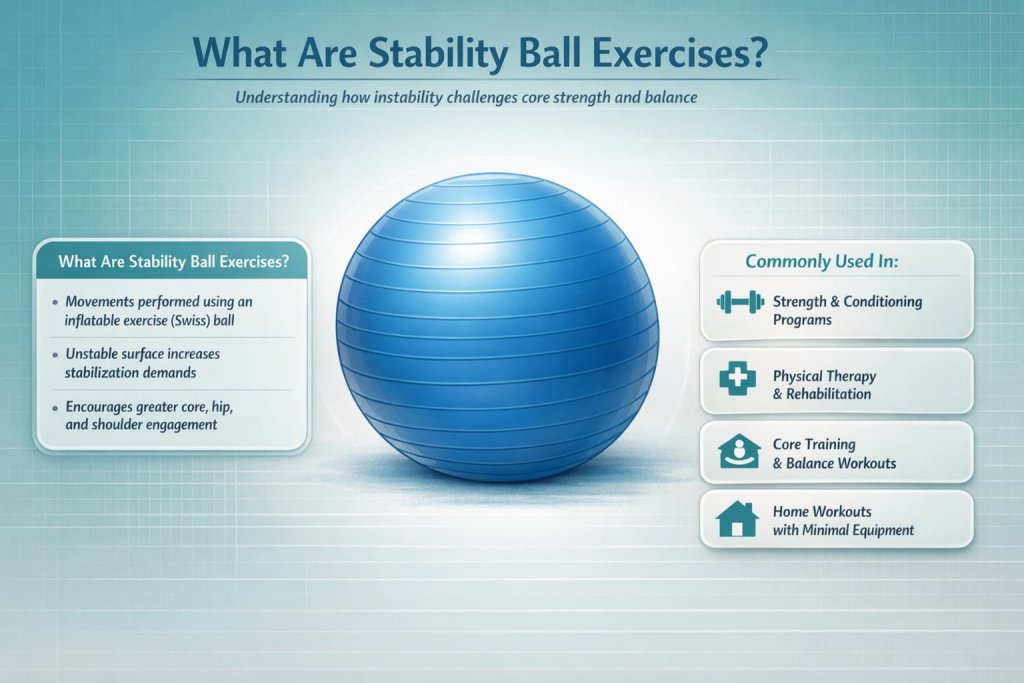
- Strength and conditioning programs
- Physical therapy and rehabilitation settings
- Core training and balance-focused workouts
- Home workouts with minimal equipment
12 Best Stability Ball Exercises
Stability ball exercises use controlled instability to challenge your core, balance, and total-body control.
Below are 12 effective movements that help build strength, improve coordination, and add variety to your workouts using a single piece of equipment.
1. Stability Ball Crunch
A foundational core exercise that increases abdominal engagement while supporting the spine.
How to do it
- Sit on the stability ball with feet flat on the floor, hip-width apart
- Slowly walk your feet forward until your lower and mid-back rest on the ball
- Keep hips lifted so knees and hips form roughly 90-degree angles
- Place hands across your chest or lightly behind your head without pulling
- Brace your core and gently lift your upper torso until ribs move toward the pelvis
- Pause briefly, then lower back down with control
Why it works
The curved surface of the ball allows a greater range of motion than floor crunches, encouraging controlled spinal flexion while requiring constant core stabilization to stay balanced.
Muscles worked
Rectus abdominis, internal and external obliques
Trainer tip
Think about curling your ribs toward your hips rather than lifting your head or neck.
2. Stability Ball Plank
A progression from the standard plank that significantly increases core demand.
How to do it
- Place forearms on top of the stability ball
- Extend your legs behind you into a straight plank position
- Keep your spine neutral and neck aligned with your torso
- Brace your core and squeeze your glutes
- Hold the position while breathing slowly and steadily
Why it works
The unstable surface challenges anti-extension strength, forcing the core to work continuously to prevent sagging or shifting.
Muscles worked
Deep core muscles, shoulders, glutes
Trainer tip
If shaking increases or form breaks down, shorten the hold rather than pushing through.
3. Stability Ball Wall Squat
A lower-body exercise that adds postural support and control.
How to do it
- Place the stability ball between your lower back and a wall
- Step your feet slightly forward, shoulder-width apart
- Lower into a squat while keeping chest upright
- Press through your heels to return to standing
Why it works
The ball supports spinal alignment while allowing the legs to move through a natural squat pattern with reduced forward lean.
Muscles worked
Quadriceps, glutes, hamstrings
Trainer tip
Maintain gentle pressure into the ball throughout the movement for consistent support.
4. Stability Ball Hamstring Curl
A classic posterior-chain exercise that combines strength and stability.
How to do it
- Lie on your back with heels resting on the stability ball
- Press arms into the floor for balance
- Lift hips into a bridge position
- Bend knees to roll the ball toward your body
- Extend legs slowly while keeping hips elevated
Why it works
The movement requires coordinated hip stability and knee flexion, increasing demand on both the hamstrings and core.
Muscles worked
Hamstrings, glutes, core stabilizers
Trainer tip
If hips drop during the curl, reduce the range of motion until strength improves.
5. Stability Ball Push-Up
An upper-body pushing exercise with increased stabilization demands.
How to do it
- Place hands on the ball (or feet on the ball for a harder variation)
- Extend your body into a straight plank position
- Lower chest toward the ball with control
- Press back up while maintaining alignment
Why it works
The unstable surface increases activation of the shoulders and core compared with floor push-ups.
Muscles worked
Chest, shoulders, triceps, core
Trainer tip
Start with hands-on-ball before progressing to feet-on-ball variations.
6. Stability Ball Back Extension
Targets the posterior chain while supporting controlled spinal movement.
How to do it
- Lie face down over the ball with feet anchored against a wall
- Keep hands lightly behind your head or crossed at your chest
- Lift your torso until your body forms a straight line
- Lower slowly back to the starting position
Why it works
The ball supports the hips while allowing controlled spinal extension without excessive loading.
Muscles worked
Erector spinae, glutes
Trainer tip
Lift only until your body is aligned—avoid overextending at the top.
7. Stability Ball Dead Bug
A coordination-based core control exercise.
How to do it
- Lie on your back holding the ball between your hands and knees
- Press gently into the ball to engage your core
- Extend one arm and the opposite leg away from the body
- Return to center and alternate sides
Why it works
This movement reinforces anti-rotation control and improves coordination between limbs and core.
Muscles worked
Deep core muscles, hip flexors
Trainer tip
Keep your lower back gently pressed into the floor throughout.
8. Stability Ball Pike
An advanced movement combining core and shoulder strength.
How to do it
- Start in a plank position with feet on the ball
- Engage your core and lift hips upward toward the ceiling
- Keep legs straight as the ball rolls toward your hands
- Lower back to plank under control
Why it works
The exercise challenges dynamic core stability and shoulder strength simultaneously.
Muscles worked
Core, shoulders
Trainer tip
Master stability ball planks before attempting this movement.
9. Stability Ball Chest Press
A pressing exercise that adds full-body stabilization.
How to do it
- Sit on the ball holding dumbbells at chest level
- Walk feet forward until shoulders and upper back rest on the ball
- Keep hips lifted and core engaged
- Press weights upward, then lower slowly
Why it works
Maintaining balance on the ball increases core engagement compared with bench pressing.
Muscles worked
Chest, shoulders, triceps
Trainer tip
Use lighter weights than you would on a bench to maintain control.
10. Stability Ball Rollout
A demanding anti-extension core exercise.
How to do it
- Kneel on the floor with forearms resting on the ball
- Brace your core and slowly roll the ball forward
- Stop before the lower back arches
- Pull the ball back to the start position
Why it works
The rollout places sustained tension on the anterior core muscles through a long lever.
Muscles worked
Abdominals, shoulders
Trainer tip
Shorten the rollout distance if spinal control is lost.
11. Stability Ball Hip Bridge
A beginner-friendly glute and core exercise.
How to do it
- Lie on your back with feet on the stability ball
- Press heels into the ball
- Lift hips until torso forms a straight line
- Lower slowly with control
Why it works
The unstable surface increases glute and core engagement compared with floor bridges.
Muscles worked
Glutes, hamstrings, core
Trainer tip
Focus on squeezing the glutes rather than pushing through the lower back.
12. Stability Ball Seated March
A balance-focused drill that reinforces upright posture.
How to do it
- Sit tall on the stability ball with feet flat
- Lift one foot a few inches off the floor
- Lower it back down and switch sides
- Keep torso upright throughout
Why it works
The movement challenges postural control and balance while engaging the core.
Muscles worked
Core stabilizers, hip flexors
Trainer tip
Move slowly and minimize upper-body movement for best results.
How to Choose the Right Stability Ball Size
According to guidance from the Mayo Clinic:
- 55 cm ball: approximately 4’11″–5’3″
- 65 cm ball: approximately 5’4″–5’11”
- 75 cm ball: approximately 6’0″ and taller
When seated, your hips and knees should be close to 90 degrees.
Are Stability Ball Exercises Safe?
Stability ball exercises are generally safe for most people when performed with proper technique, appropriate progression, and the correct ball size. The unstable surface increases balance demands, which can improve core engagement but also requires greater control and awareness.
Safety depends on:
- Choosing the correct ball size and proper inflation
- Using controlled, slow movements
- Maintaining neutral spine alignment
- Progressing gradually rather than rushing into advanced variations
Public health guidance from the Centers for Disease Control and Prevention emphasizes selecting exercises that match current ability levels, especially when balance and coordination are involved. If an exercise feels unstable beyond your control, it should be modified or replaced with a more stable option.
How to Warm Up Before Stability Ball Exercises
Warming up prepares your joints, muscles, and nervous system for the balance demands of stability ball training. A proper warm-up may help improve movement quality and reduce unnecessary strain.
A simple warm-up can include:
- 2–5 minutes of light cardio (walking, marching in place, or cycling)
- Gentle spinal mobility (pelvic tilts, cat–cow movements)
- Core activation drills (dead bugs, bird dogs, or seated ball balance holds)
- Hip and shoulder mobility exercises
The goal is not fatigue, but readiness—your core and stabilizing muscles should feel engaged before starting the main workout.
How to Program Stability Ball Exercises (Sets, Reps, Frequency)
Stability ball exercises work best when programmed as part of a balanced training plan rather than used exclusively.
General programming guidelines:
- Beginners:
- 1–2 sets per exercise
- 8–12 controlled repetitions or 15–30 second holds
- 2–3 sessions per week
- Intermediate:
- 2–3 sets per exercise
- 10–15 repetitions or 30–45 second holds
- 2–4 sessions per week
Rest 30–60 seconds between sets. Stability ball exercises are most effective when paired with traditional strength training and low-impact cardiovascular activity.
Progress by improving control and range of motion first—adding difficulty before mastering form increases injury risk.
Benefits of Stability Ball Exercises
Regularly practicing stability ball exercises may help:
- Increase core muscle engagement
- Improve balance and body awareness
- Support posture and spinal control
- Enhance coordination between the upper and lower body
- Add variety and challenge without heavy weights
According to guidance from Harvard Health Publishing, core-focused training supports balance and stability during everyday movement.
Common Mistakes to Avoid With Stability Ball Exercises
Avoiding common errors helps keep stability ball training safe and effective.
Frequent mistakes include:
- Using the wrong ball size, leading to poor alignment
- Moving too quickly and relying on momentum
- Allowing the lower back to arch excessively
- Progressing to advanced exercises too soon
- Holding the breath instead of breathing steadily
Stability ball exercises should feel challenging but controlled. If balance is lost repeatedly, scale back the movement until proper form can be maintained consistently.
Who Should Be Careful With Stability Ball Exercises?
Extra caution is advised for:
- People with recent back, hip, or knee injuries
- Individuals with balance or vestibular disorders
- Beginners who struggle with basic bodyweight exercises
Public health guidance from the Centers for Disease Control and Prevention emphasizes choosing exercises that match current ability levels, especially when balance is involved.
Frequently Asked Questions
Are stability ball exercises good for beginners?
Yes, many stability ball exercises are beginner-friendly when started with simple movements and proper supervision.
Do stability ball exercises replace traditional strength training?
No. They complement traditional training but should not fully replace stable strength exercises.
How often should I do stability ball exercises?
Two to three times per week is common for general fitness.
Can stability ball exercises help with balance?
They may help improve balance by challenging postural control.
Are stability balls safe?
They are generally safe when properly inflated and used with control.
Do I need weights with stability ball exercises?
Not necessarily. Bodyweight alone can be effective.
Conclusion
Stability ball exercises offer a practical way to challenge your core, improve balance, and add variety to your workouts without complex equipment. When performed with proper form and appropriate progression, they can support strength, coordination, and movement control at home or in the gym.
If you’re new, start with basic movements, focus on control, and gradually increase difficulty as confidence improves.
References
- Mayo Clinic – Fitness ball exercises (safety, technique, and examples)
- American Council on Exercise (ACE) – Stability Ball Sit-Ups & Crunches (exercise instructions)
- CDC – Physical Activity Guidelines for Older Adults (balance + strength guidance)
- U.S. Department of Health and Human Services – Physical Activity Guidelines for Americans (2nd edition PDF)
- Piercy KL, et al. (2018) – Physical Activity Guidelines for Americans (overview paper, PubMed)
- Bao Z, et al. (2025) – Unstable training and muscle activation (systematic review + meta-analysis, PMC)
- Oliva-Lozano JM, et al. (2020) – Core muscle activity during fitness exercises (systematic review, PMC)
- Liu S, et al. (2024) – Unstable surface training and balance/performance outcomes (systematic review + meta-analysis)