
A stationary bike workout for beginners is a low-impact cardio routine that uses easy pedaling, short moderate efforts, and a gradual cool-down to help you build fitness safely. If you are new to exercise, this 20-minute plan is a simple place to start because you control the speed, resistance, and effort level.
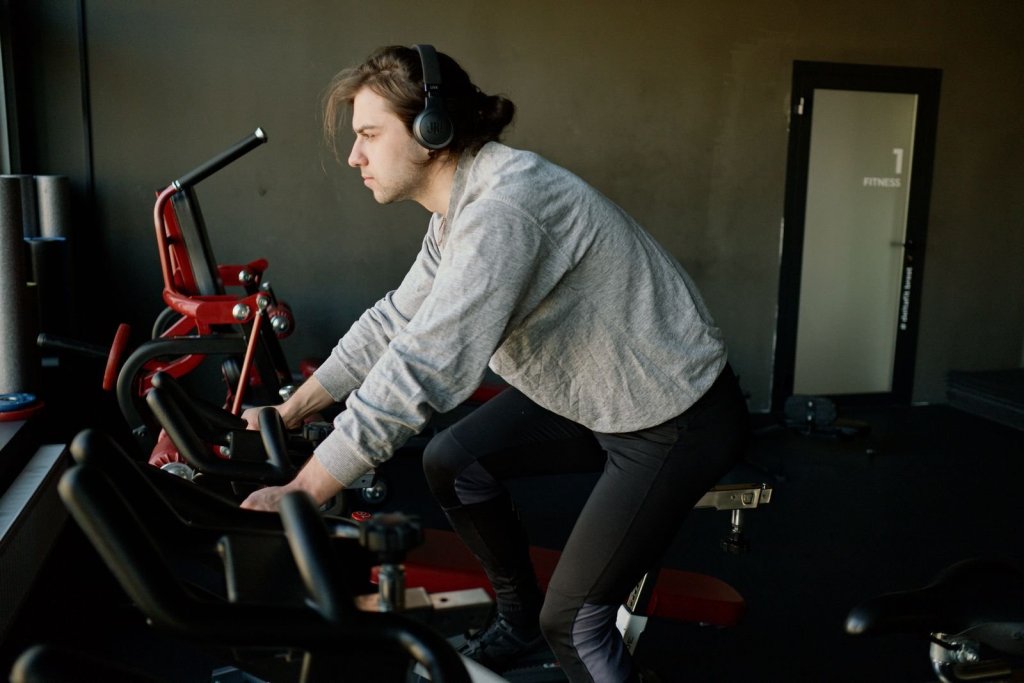
Stationary biking can support cardiovascular fitness, build exercise consistency, and feel easier on the joints than many high-impact workouts. The key is to start slowly, use comfortable resistance, and focus on steady progress instead of pushing too hard too soon.
According to the CDC adult physical activity guidelines, adults should aim for at least 150 minutes of moderate-intensity aerobic activity per week, plus 2 days of muscle-strengthening activity. A 20-minute beginner bike workout can be one practical step toward that weekly goal.
Stationary Bike Workout for Beginners: What to Know First
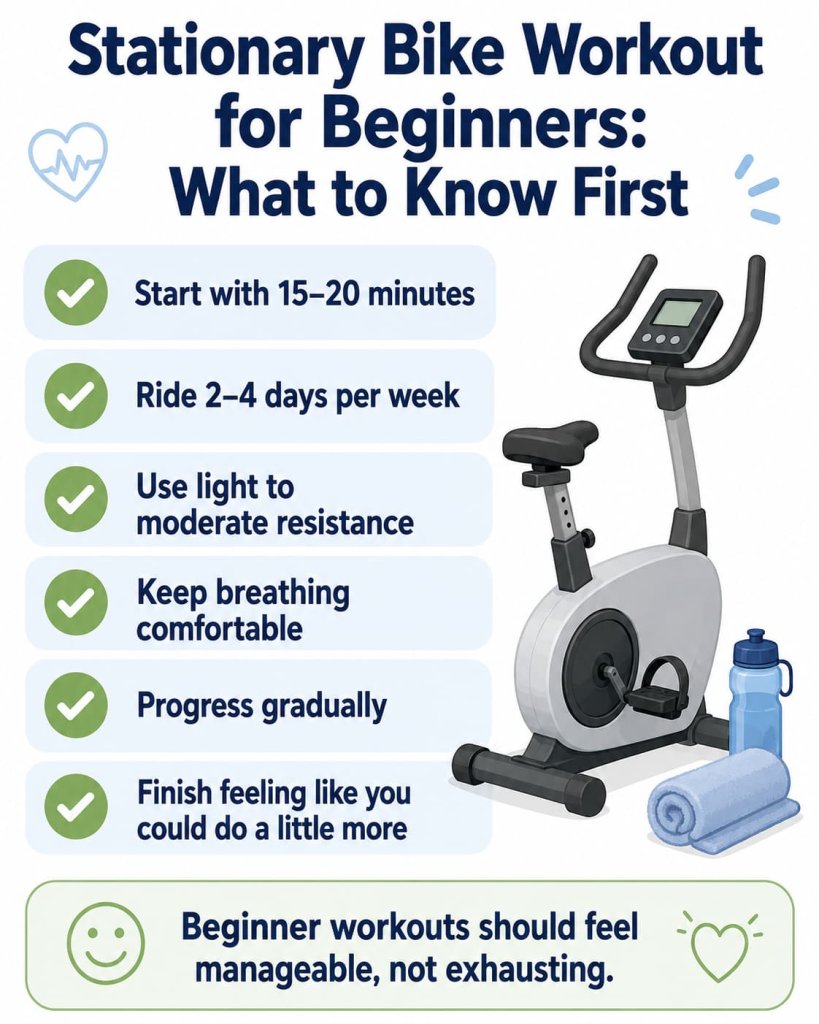
A beginner stationary bike workout should feel manageable, not exhausting. You should be able to pedal smoothly, breathe steadily, and finish feeling like you could do a little more.
For most beginners, the best starting goal is:
- 15–20 minutes per session
- 2–4 days per week
- Light to moderate resistance
- Comfortable breathing
- Gradual progress over time
You do not need to start with intense spin classes or advanced interval training. A beginner-friendly routine should help you build confidence first.
How to Set Up Your Stationary Bike Before You Start
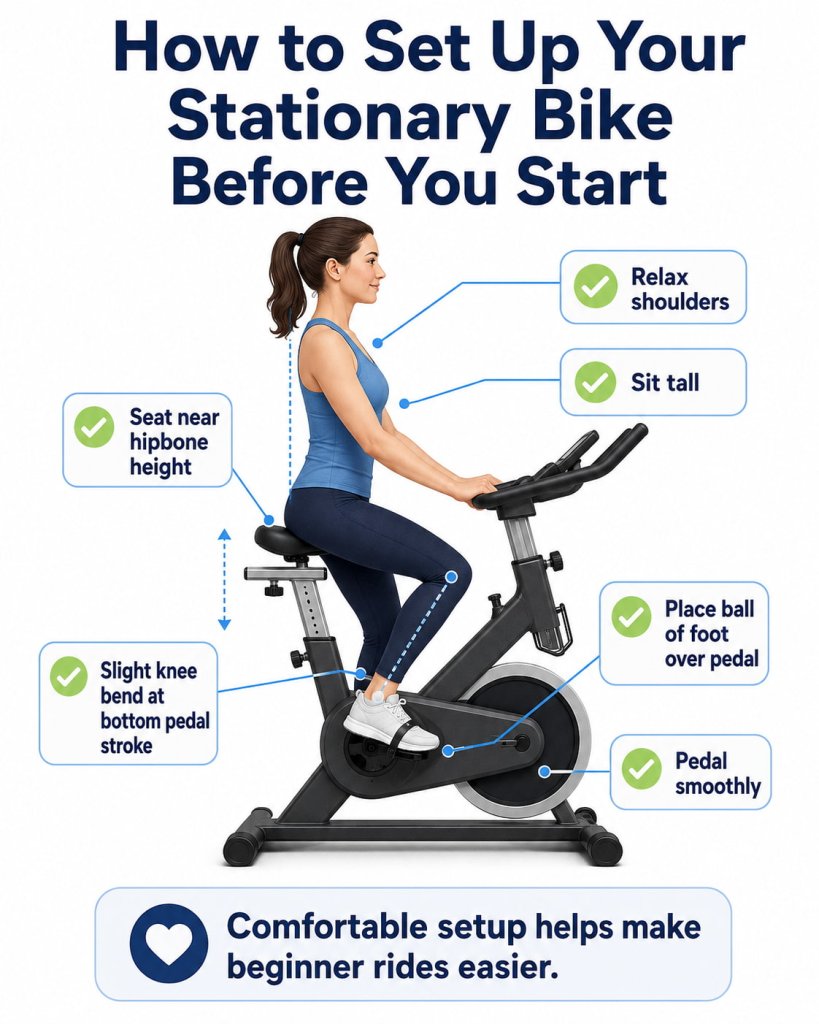
Good bike setup can make your ride more comfortable and may reduce unnecessary strain on your knees, hips, back, and shoulders.
Before starting this stationary bike workout for beginners, take a few minutes to adjust your bike.
Seat Height
Your seat should be high enough that your knee has a slight bend when your foot is at the bottom of the pedal stroke.
A simple starting point is to stand next to the bike and adjust the seat so it is around hipbone height. Hospital for Special Surgery recommends using this as a starting position, then checking that your knee is not overly bent or locked out when pedaling.
If the seat is too low, your knees may feel crowded. If it is too high, your hips may rock side to side.
Seat Position
If your bike allows front-and-back seat adjustment, sit on the bike with your feet on the pedals. When the pedals are level, your front knee should feel comfortable and not pushed too far forward.
You do not need a perfect racing setup. For beginners, comfort and smooth pedaling matter most.
Handlebar Position
Set the handlebars where you can sit tall with relaxed shoulders. If you feel pressure in your wrists, neck, or lower back, raise the handlebars or move your body position slightly.
Beginners usually do better with a more upright position instead of a deep forward lean.
Foot Placement
Place the ball of your foot over the center of the pedal. Keep your feet secure, but do not tighten straps so much that they feel uncomfortable.
Try to pedal in smooth circles instead of stomping down with each stroke.
20-Minute Stationary Bike Workout for Beginners
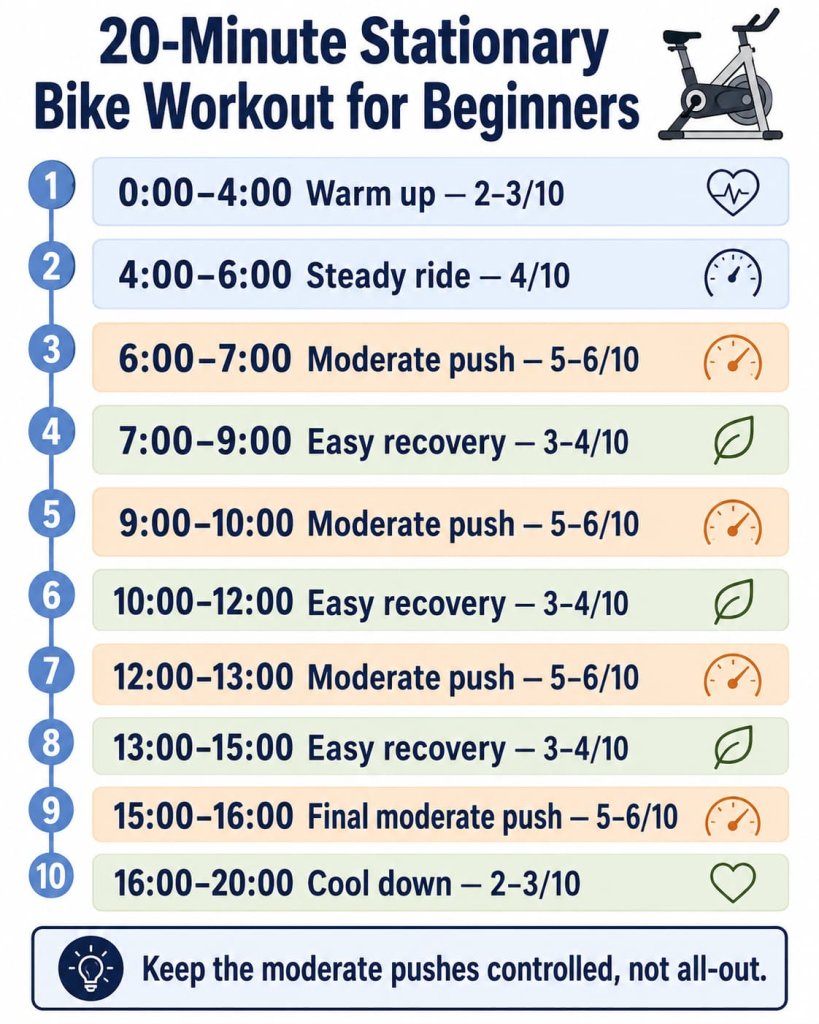
This beginner workout uses a warm-up, simple moderate efforts, easy recovery periods, and a cool-down.
You can do it on an upright bike, recumbent bike, spin bike, or basic exercise bike.
20-Minute Beginner Stationary Bike Plan
| Time | What to Do | Effort Level |
|---|---|---|
| 0:00–4:00 | Warm up with easy pedaling and light resistance | 2–3/10 |
| 4:00–6:00 | Ride at a comfortable steady pace | 4/10 |
| 6:00–7:00 | Add slight resistance or pedal a little faster | 5–6/10 |
| 7:00–9:00 | Recover with easy pedaling | 3–4/10 |
| 9:00–10:00 | Moderate push | 5–6/10 |
| 10:00–12:00 | Easy recovery | 3–4/10 |
| 12:00–13:00 | Moderate push | 5–6/10 |
| 13:00–15:00 | Easy recovery | 3–4/10 |
| 15:00–16:00 | Final moderate push | 5–6/10 |
| 16:00–20:00 | Cool down and gradually reduce effort | 2–3/10 |
Warm-Up
Start with 4 minutes of easy pedaling. Keep the resistance light and focus on smooth movement.
The American Heart Association recommends warming up for 5 to 10 minutes before exercise and cooling down afterward to help your body transition gradually. Since this is a short beginner workout, the warm-up and cool-down are built directly into the 20-minute plan.
Main Workout
The main section uses short 1-minute moderate efforts followed by easy recovery.
During the moderate pushes, you can either:
- Increase resistance slightly
- Pedal a little faster
- Use a mix of both
Do not sprint. The goal is controlled effort, not exhaustion.
Cool-Down
For the final 4 minutes, lower the resistance and slow your pace. Let your breathing return closer to normal.
Avoid stopping suddenly right after a harder effort. A gradual cool-down usually feels better and helps you finish the workout comfortably.
How Hard Should a Beginner Stationary Bike Workout Feel?
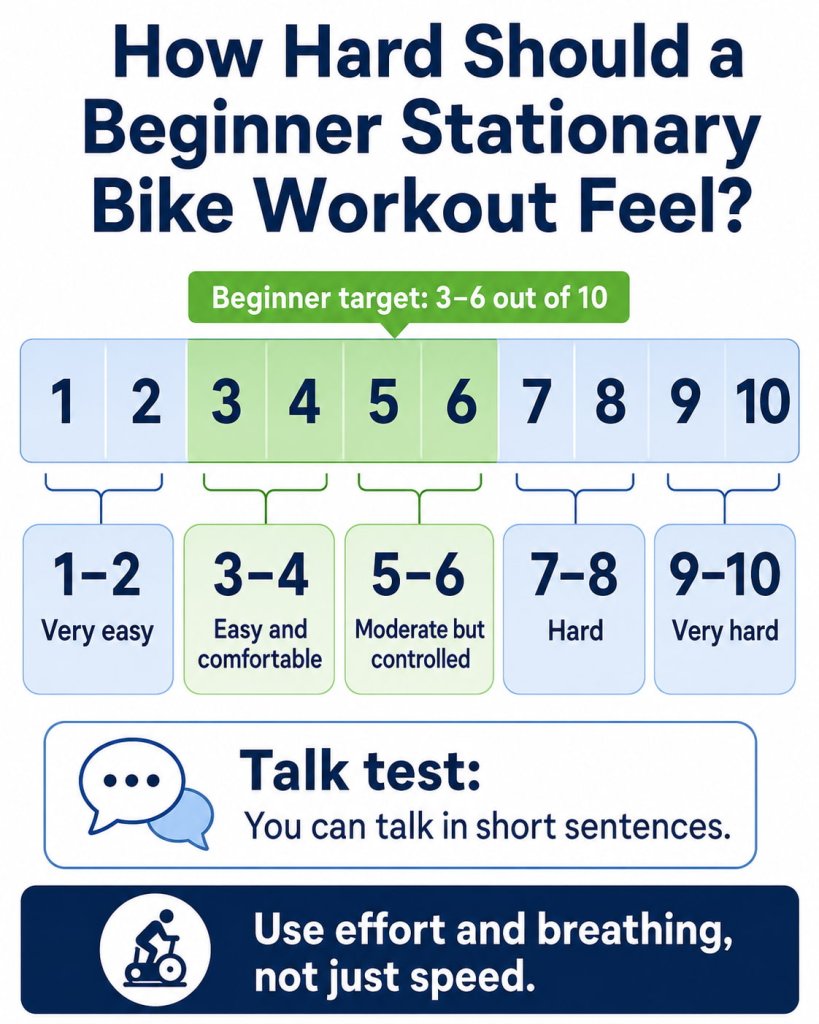
The easiest way to measure effort is with the talk test or a 1–10 effort scale.
You do not need complicated fitness equipment to start.
Use the Talk Test
The CDC guide to measuring physical activity intensity says that during moderate-intensity activity, you should be able to talk but not sing. During vigorous activity, you usually cannot say more than a few words without pausing for breath.
For this beginner workout, aim for a pace where you can still talk in short sentences.
Use the RPE Scale
RPE means “rate of perceived exertion.” It is a simple way to rate how hard you feel you are working.
Use this scale:
| Effort Level | How It Feels |
|---|---|
| 1–2/10 | Very easy |
| 3–4/10 | Easy and comfortable |
| 5–6/10 | Moderate but controlled |
| 7–8/10 | Hard |
| 9–10/10 | Very hard or maximum effort |
For this 20-minute stationary bike workout, most beginners should stay around 3–6 out of 10.
Optional Heart Rate Guide
Heart rate can be helpful, but it is not required. The American Heart Association target heart rate guide says moderate-intensity activity is generally about 50%–70% of maximum heart rate, while vigorous activity is about 70%–85%.
If you are new to exercise, taking medication that affects heart rate, pregnant, recovering from illness, or managing a medical condition, use perceived effort and ask a healthcare professional for personalized guidance.
Benefits of a Stationary Bike Workout for Beginners
Stationary bikes are popular for beginners because they are adjustable, accessible, and easy to use at home or in a gym.
A stationary bike workout may help you:
- Improve aerobic fitness over time
- Build lower-body endurance
- Add low-impact cardio to your routine
- Exercise indoors in any weather
- Control your pace and resistance
- Track time, distance, cadence, or heart rate
A systematic review on indoor cycling found that indoor cycling may improve aerobic capacity, blood pressure, lipid profile, and body composition, although the researchers noted that evidence should be interpreted carefully because more high-quality trials are needed.
For beginners, the biggest benefit is often consistency. If the workout feels simple enough to repeat, you are more likely to keep doing it.
What Resistance Should Beginners Use on a Stationary Bike?
Beginners should use a resistance level that feels smooth and controlled.
A good rule is:
- Your legs should feel some light tension.
- You should not bounce in the seat.
- Your knees should not feel strained.
- You should be able to keep pedaling without grinding or forcing each stroke.
If your bike has numbered resistance levels, start low. For many beginners, that may be around level 1–4, depending on the bike. Every bike feels different, so use effort level instead of chasing a specific number.
How Often Should Beginners Do This Workout?
Start with 2 or 3 days per week. Leave at least one rest day or easier movement day between sessions if your legs feel sore.
After 2–4 weeks, you can increase gradually.
A simple beginner schedule could look like this:
| Week | Frequency | Goal |
|---|---|---|
| Week 1 | 2 days | Learn the bike and finish comfortably |
| Week 2 | 3 days | Build consistency |
| Week 3 | 3 days | Add slightly smoother moderate efforts |
| Week 4 | 3–4 days | Add time or resistance gradually |
Mayo Clinic recommends starting slowly, building gradually, and increasing activity by no more than about 10% per week.
How to Progress After 2–4 Weeks
Once the 20-minute stationary bike workout feels comfortable, progress slowly. Do not increase everything at once.
Choose one option:
Option 1: Add Time
Add 2–5 minutes to the total workout.
Example:
- Week 1–2: 20 minutes
- Week 3–4: 22–25 minutes
- Week 5–6: 25–30 minutes
Option 2: Add One Extra Moderate Effort
Add one more 1-minute moderate push during the main workout.
Keep recovery periods easy.
Option 3: Add Slight Resistance
Increase resistance only a little. Your pedaling should still feel smooth.
If your knees, hips, or lower back feel uncomfortable, reduce resistance and check your bike setup.
Option 4: Add Another Weekly Ride
If you are riding 2 days per week, move to 3 days. If you are riding 3 days per week and recovering well, you may move to 4 days.
Rest and recovery still matter.
Common Beginner Mistakes to Avoid
A stationary bike is beginner-friendly, but small mistakes can make workouts feel harder than they need to be.
Starting Too Hard
Many beginners turn the resistance too high or pedal too fast in the first few minutes. This can make the workout feel overwhelming.
Start easy. You can always build later.
Skipping the Warm-Up
A warm-up prepares your body for movement. Even a few easy minutes can make the workout feel smoother.
Using Too Much Resistance
High resistance is not always better. If you are pushing hard with every pedal stroke, lower the resistance.
Beginner workouts should feel controlled.
Holding Your Breath
Try to breathe steadily. If you cannot talk at all, you may be working too hard for a beginner session.
Ignoring Discomfort
Muscle effort is normal. Sharp pain, chest pain, dizziness, or unusual shortness of breath is not something to push through.
Safety Tips Before You Ride
Stationary biking is low-impact, but it is still exercise. Safety matters, especially if you are new to working out.
Before you start:
- Wear comfortable shoes.
- Keep water nearby.
- Adjust the seat before riding.
- Start with low resistance.
- Stop if you feel dizzy, faint, or unwell.
- Talk to a healthcare professional if you have a heart condition, joint injury, chronic illness, or are unsure whether exercise is safe for you.
MedlinePlus notes that warning signs such as chest pain, shortness of breath, dizziness, or irregular heartbeat may signal that something is wrong and should not be ignored.
Is 20 Minutes on a Stationary Bike Enough?
Yes, 20 minutes can be enough for beginners to start building a consistent cardio habit. It is short enough to feel realistic but long enough to include a warm-up, steady riding, moderate effort, and a cool-down.
However, one 20-minute ride per week is not enough to meet general weekly activity guidelines. For better long-term fitness, repeat the workout several times per week and gradually build toward the recommended weekly amount of aerobic activity.
Beginner Stationary Bike Workout Tips
Use these simple tips to make your workouts easier to follow:
- Keep your first few rides easy.
- Use the talk test instead of guessing.
- Increase only one thing at a time: time, resistance, or frequency.
- Keep your shoulders relaxed.
- Sit tall and avoid gripping the handlebars too tightly.
- Track how you feel after each ride.
- Give your body time to adapt.
The best beginner workout is one you can repeat consistently.
Sample Weekly Plan for Beginners
Here is a simple weekly routine using the 20-minute stationary bike plan.
| Day | Workout |
|---|---|
| Monday | 20-minute beginner stationary bike workout |
| Tuesday | Rest or gentle walking |
| Wednesday | 20-minute beginner stationary bike workout |
| Thursday | Rest or light stretching |
| Friday | Optional strength training |
| Saturday | 20-minute beginner stationary bike workout |
| Sunday | Rest |
You can adjust the days based on your schedule. The goal is not perfection. The goal is consistency.
FAQs About Stationary Bike Workout for Beginners
Is a stationary bike good for beginners?
Yes. A stationary bike is a beginner-friendly cardio option because it is low-impact, adjustable, and easy to control. You can reduce resistance, slow down, or stop whenever needed.
How long should a beginner ride a stationary bike?
Many beginners can start with 10–20 minutes. If 20 minutes feels too hard, start with 10 or 15 minutes and build gradually.
What resistance should I use as a beginner?
Use light to moderate resistance. Your legs should feel like they are working, but you should still be able to pedal smoothly and talk in short sentences.
Can I do a stationary bike workout every day?
Some people can ride daily at an easy pace, but beginners usually do better with 2–4 days per week at first. Rest days help your body recover and adapt.
Is a stationary bike good for weight loss?
A stationary bike can support a healthy weight-management routine when combined with consistent movement, balanced eating habits, sleep, and other lifestyle factors. However, results vary by person, and no single workout guarantees weight loss.
Should beginners do HIIT on a stationary bike?
Beginners do not need HIIT right away. Start with easy-to-moderate riding first. Once you have built a base and can recover well, you can add short intervals if appropriate.
Why do my knees hurt on a stationary bike?
Knee discomfort can happen if the seat is too low, too high, or if resistance is too heavy. Check your bike setup, lower the resistance, and stop if pain continues. Speak with a healthcare professional if knee pain is persistent or sharp.
Conclusion
A stationary bike workout for beginners should be simple, comfortable, and easy to repeat. This 20-minute plan gives you a safe starting structure with a warm-up, short moderate efforts, recovery periods, and a cool-down.
Start with 2–3 rides per week, keep your effort controlled, and progress slowly. Over time, small consistent rides can help you build confidence, improve endurance, and make regular cardio feel more manageable.
Try the 20-minute plan this week, track how you feel, and adjust the resistance or pace so the workout fits your current fitness level.
This content is for informational purposes only and not medical advice.
References
- CDC: Adult Activity Guidelines
- CDC: How to Measure Physical Activity Intensity
- American Heart Association: Warm Up, Cool Down
- American Heart Association: Target Heart Rates
- Hospital for Special Surgery: How to Set Up an Exercise Bike Properly
- Mayo Clinic: Fitness Program — 5 Steps to Get Started
- PubMed: Health Benefits of Indoor Cycling — A Systematic Review
- MedlinePlus: Warning Signs and Symptoms of Heart Disease