
Theraband exercises are an effective, low-impact way to build full-body strength at home using elastic resistance instead of weights. They allow you to train every major muscle group, adjust intensity easily, and exercise safely with minimal equipment. Understanding how to use Therabands correctly matters because resistance training supports muscle strength, joint health, balance, and everyday movement at any age.

When done consistently, Theraband exercises can fit into home workouts, beginner programs, active-aging routines, and even rehab-inspired strength plans. Major health organizations recommend strength training at least twice per week, and resistance bands are a practical way to meet those guidelines without a gym.
What Are Theraband Exercises?
Theraband exercises are strength movements performed using elastic resistance bands that create tension as they stretch. Unlike free weights, bands provide variable resistance, meaning the load increases through the range of motion.
TheraBand® is a well-known brand of resistance bands; the exercises in this guide can be performed with TheraBand or any comparable resistance band that provides similar tension.
Therabands are commonly used in:
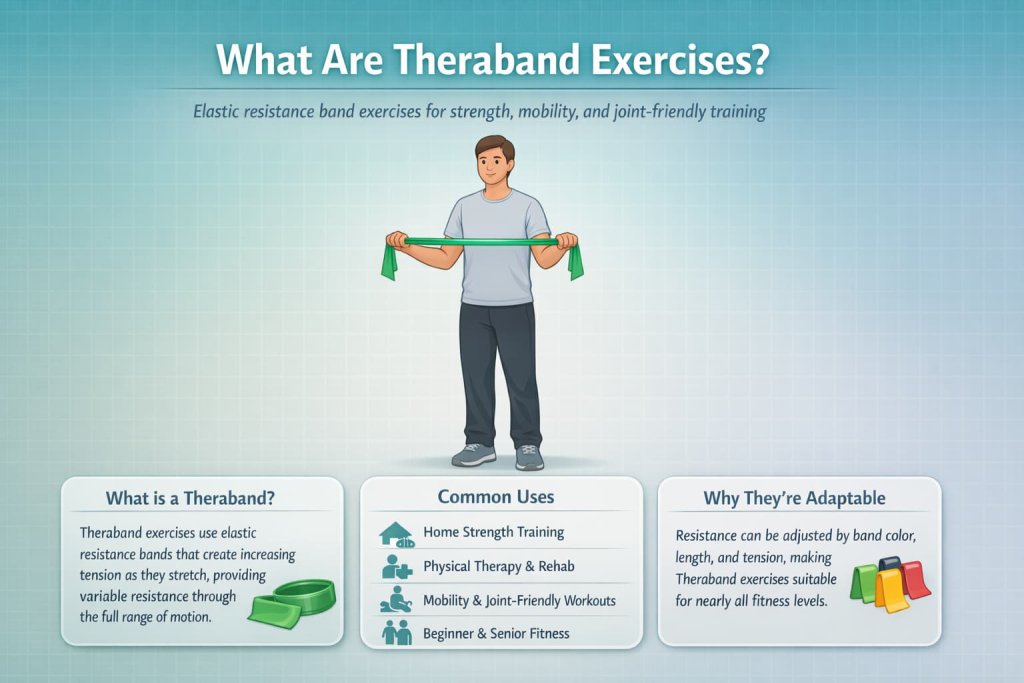
- Home strength training
- Physical therapy and rehab settings
- Mobility and joint-friendly workouts
- Beginner and senior fitness programs
Because resistance is adjustable by band color, length, and tension, Theraband exercises are adaptable for nearly all fitness levels.
12 Best Theraband Exercises for Full-Body Strength at Home
Build strength, mobility, and control using simple Theraband exercises you can do anywhere. This full-body list targets all major muscle groups with joint-friendly, adjustable resistance suitable for most fitness levels.
1. Theraband Squat
How to do it:
- Stand on the middle of the Theraband with feet shoulder-width apart
- Hold the band ends at shoulder height with elbows bent
- Sit the hips back and bend the knees to lower into a squat
- Keep chest tall and heels grounded
- Press through the feet to return to standing
Why it works:
The Theraband squat adds progressive resistance to a fundamental movement pattern used in daily life. The band increases tension as you stand, encouraging strong hip and knee extension while keeping joint stress relatively low.
Muscles worked:
Glutes, quadriceps, hamstrings, core stabilizers
Trainer Tip:
If knee comfort is a concern, reduce squat depth and focus on slow, controlled movement rather than resistance level.
2. Theraband Chest Press
How to do it:
- Anchor the band securely behind you at chest height
- Hold one end of the band in each hand
- Step forward to create light tension
- Press the hands forward until arms extend
- Slowly return to the start position
Why it works:
This exercise replicates a horizontal pushing pattern while allowing smooth, adjustable resistance. It strengthens the upper body without the need for a bench or floor work.
Muscles worked:
Chest, shoulders, triceps, core stabilizers
Trainer Tip:
Keep ribs down and avoid arching the lower back as the arms press forward.
3. Theraband Seated Row
How to do it:
- Sit tall with legs extended or knees slightly bent
- Loop the band around the feet
- Hold the ends with arms extended
- Pull elbows back while squeezing shoulder blades
- Return slowly to the starting position
Why it works:
Seated rows reinforce upper-back strength and postural control, which are essential for shoulder health and everyday pulling tasks.
Muscles worked:
Upper back, lats, biceps, rear shoulders
Trainer Tip:
Think “chest up, shoulders down” to avoid shrugging during the pull.
4. Theraband Glute Bridge
How to do it:
- Lie on your back with knees bent and feet flat on the floor
- Place the band across the hips and anchor it under the feet
- Press through the heels to lift the hips
- Pause briefly at the top
- Lower slowly with control
Why it works:
Adding band resistance increases hip-extension demand, helping activate the glutes while minimizing spinal loading.
Muscles worked:
Glutes, hamstrings, core
Trainer Tip:
Stop lifting when hips are level with the torso—avoid over-arching the lower back.
5. Theraband Overhead Shoulder Press
How to do it:
- Stand on the band with feet hip-width apart
- Hold the band ends at shoulder height
- Brace the core and press arms upward
- Extend until hands are overhead
- Lower slowly back to shoulder height
Why it works:
The band provides increasing resistance through the press, promoting shoulder strength and trunk stability without heavy loading.
Muscles worked:
Shoulders, triceps, upper core
Trainer Tip:
If overhead motion is limited, press slightly forward instead of straight up.
6. Theraband Deadlift
How to do it:
- Stand on the band with feet hip-width apart
- Hold the band ends with arms straight
- Push hips back while keeping the spine neutral
- Lower hands toward mid-shin
- Drive hips forward to stand tall
Why it works:
This movement reinforces proper hip-hinge mechanics, which are essential for lifting objects safely in daily life.
Muscles worked:
Glutes, hamstrings, lower back, core
Trainer Tip:
The movement should come from the hips, not the knees or lower back.
7. Theraband Lat Pulldown
How to do it:
- Anchor the band overhead securely
- Hold the ends with arms extended
- Pull elbows down toward the ribs
- Squeeze the shoulder blades at the bottom
- Return slowly to the start
Why it works:
Vertical pulling strengthens muscles involved in overhead control, posture, and shoulder stability.
Muscles worked:
Lats, upper back, biceps
Trainer Tip:
Avoid leaning backward—keep the torso upright throughout the movement.
8. Theraband Reverse Lunge
How to do it:
- Stand on the band and hold the ends at your sides
- Step one foot back into a reverse lunge
- Lower until the front thigh is nearly parallel
- Push through the front heel to stand
- Alternate sides
Why it works:
Reverse lunges reduce forward knee stress while improving leg strength and balance.
Muscles worked:
Glutes, quadriceps, hamstrings, balance stabilizers
Trainer Tip:
Move slowly during the step-back phase to improve control and stability.
9. Theraband Biceps Curl
How to do it:
- Stand on the band with arms at your sides
- Hold the band ends with palms facing forward
- Curl hands toward the shoulders
- Pause briefly at the top
- Lower with control
Why it works:
Band resistance provides continuous tension, which supports muscle engagement through the full range of motion.
Muscles worked:
Biceps, forearms
Trainer Tip:
Keep elbows close to your sides to prevent shoulder involvement.
10. Theraband Triceps Pressdown
How to do it:
- Anchor the band overhead
- Hold the ends with elbows bent at your sides
- Press hands downward until arms extend
- Keep elbows close to the torso
- Return slowly to the start
Why it works:
This isolation movement strengthens the triceps, which assist with pushing and getting up from seated positions.
Muscles worked:
Triceps
Trainer Tip:
Avoid locking the elbows forcefully at the bottom of the movement.
11. Theraband Pallof Press
How to do it:
- Anchor the band at chest height to one side
- Stand sideways to the anchor and hold the band at chest level
- Press the band straight forward
- Hold briefly, resisting rotation
- Return to the chest and repeat
Why it works:
The Pallof press trains the core to resist unwanted movement, supporting spinal stability during daily tasks.
Muscles worked:
Deep core stabilizers, obliques
Trainer Tip:
Widen your stance slightly if balance feels challenging.
12. Theraband Standing Wood Chop
How to do it:
- Anchor the band low or high depending on direction
- Stand sideways to the anchor
- Pull the band diagonally across the body
- Rotate through the torso and hips
- Return slowly to the start
Why it works:
This exercise integrates rotational strength, coordination, and core control in a functional movement pattern.
Muscles worked:
Core, shoulders, hips
Trainer Tip:
Control the rotation—speed should never override form.
How Often Should You Do Theraband Exercises?
Most people benefit from:
- 2–3 full-body sessions per week
- 1–3 sets per exercise
- 8–15 controlled repetitions
The American College of Sports Medicine recommends allowing rest days between strength sessions to support recovery and adaptation.
Why Theraband Exercises Are Effective for Full-Body Strength
Theraband training works because it challenges muscles in a controlled, joint-friendly way.
Key benefits include:
- Continuous muscle tension throughout each movement
- Reduced joint stress compared with heavy weights
- Easy progression by changing band resistance
- Improved coordination and movement control
According to guidance from the Centers for Disease Control and Prevention and the World Health Organization, muscle-strengthening activities should be performed at least two days per week to support overall health and function.
Safety Guidelines for Theraband Exercises
Follow these evidence-based safety principles:
- Inspect bands regularly for tears or thinning
- Anchor bands securely to stable objects
- Control the return phase—avoid snapping motions
- Breathe steadily; avoid breath-holding
- Choose latex-free bands if you have latex sensitivity
The Mayo Clinic emphasizes controlled movement and gradual progression when starting resistance training, especially for beginners or people returning from inactivity.
Who Should Be Cautious With Theraband Exercises?
Use caution and consider professional guidance if you:
- Are recovering from recent surgery or injury
- Experience sharp pain during band tension
- Have uncontrolled joint or nerve symptoms
Modifications and lighter resistance are often appropriate, but symptoms should guide progression.
Common Mistakes With Theraband Exercises
Theraband exercises are simple, but small errors can reduce effectiveness and increase injury risk. Watch for these common mistakes:
- Using too much resistance too soon, which can compromise form and strain joints
- Letting the band snap back instead of controlling the return phase
- Poor anchoring or unstable setup, increasing the risk of slipping
- Holding your breath during effort, which can raise unnecessary strain
- Rushing through repetitions rather than moving with control
- Ignoring worn or damaged bands, which may break under tension
- Skipping core engagement, placing extra stress on the lower back
Focusing on controlled movement, proper setup, and gradual progression helps keep Theraband training safe and effective.
Frequently Asked Questions About Theraband Exercises
Are Theraband exercises effective for building muscle?
Yes. When resistance is sufficient and exercises are progressed over time, Theraband exercises can support muscle strength and endurance.
Can beginners use Theraband exercises?
Absolutely. Bands are commonly recommended for beginners because resistance is easy to control and scale.
Are Theraband exercises good for seniors?
Yes. Resistance bands are widely used in older-adult fitness programs to support strength, balance, and daily function.
How long should a Theraband workout last?
Most full-body sessions last 20–40 minutes, depending on exercise selection and rest periods.
Can Theraband exercises replace weights?
For many people, yes—especially for home workouts, rehab-style strength training, and maintenance programs.
Do Theraband exercises help with joint health?
They may help support joint stability by strengthening surrounding muscles with low joint stress.
Conclusion
Theraband exercises offer a practical, affordable, and effective way to build full-body strength at home. With adjustable resistance, minimal equipment, and wide accessibility, they fit seamlessly into beginner routines, active-aging programs, and general strength training plans.
If you’re looking for a safe, flexible way to meet weekly strength-training guidelines without a gym, Theraband exercises are a smart place to start.
References
- CDC: Adult Activity Guidelines (Strength Training Included)
- WHO: Physical Activity Recommendations (Muscle-Strengthening Guidance)
- Physical Activity Guidelines for Americans, 2nd Edition (Official PDF)
- ACSM Position Stand: Progression Models in Resistance Training for Healthy Adults
- Mayo Clinic: Strength Training Basics and Safe Progression
- National Institute on Aging: Strength Training Benefits as We Age
- THERABAND Resistance Band and Tubing Instruction Manual (PDF)
- British Heart Foundation: Resistance Band Exercises and Home Routine Ideas