
TRX back exercises are suspension-based pulling movements that strengthen the upper and mid-back while also challenging core stability. They use your body weight and adjustable angles to train the lats, rhomboids, traps, and rear shoulders in a joint-friendly, scalable way.
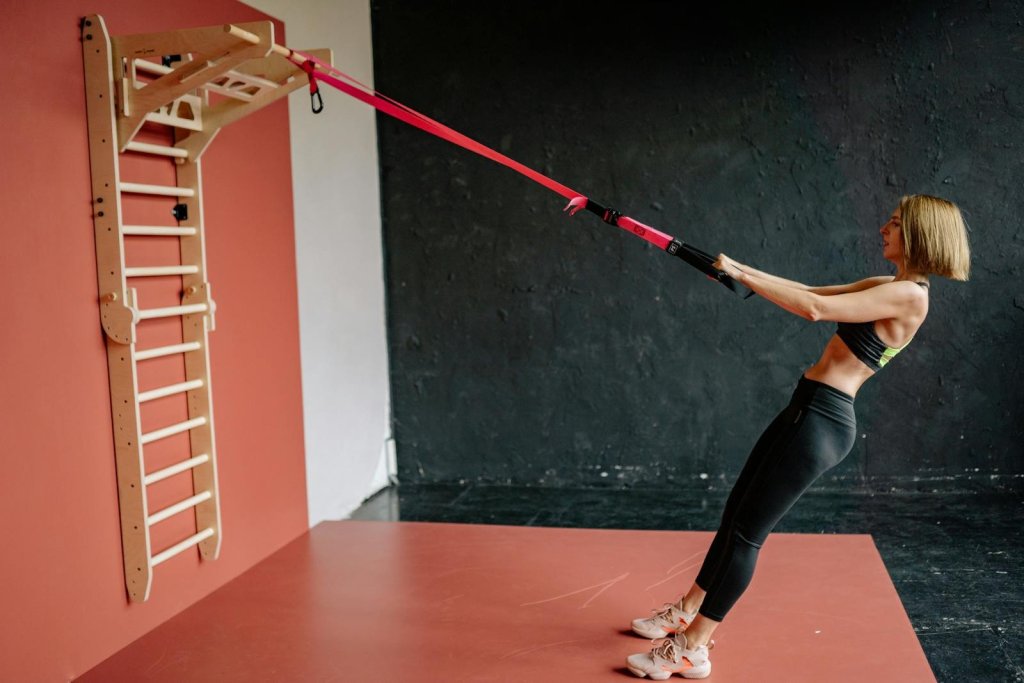
Understanding how TRX back exercises work is important because the back plays a key role in posture, pulling strength, and shoulder health. By adjusting foot position and body angle, you can make each exercise easier or more challenging without changing equipment. These movements are widely used in gyms, home workouts, and professional training settings because they support strength, control, and functional movement.
What Are TRX Back Exercises?
TRX back exercises are pulling and scapular-control movements performed using a TRX suspension trainer. The straps create controlled instability, requiring your back muscles and core to work together to maintain alignment.
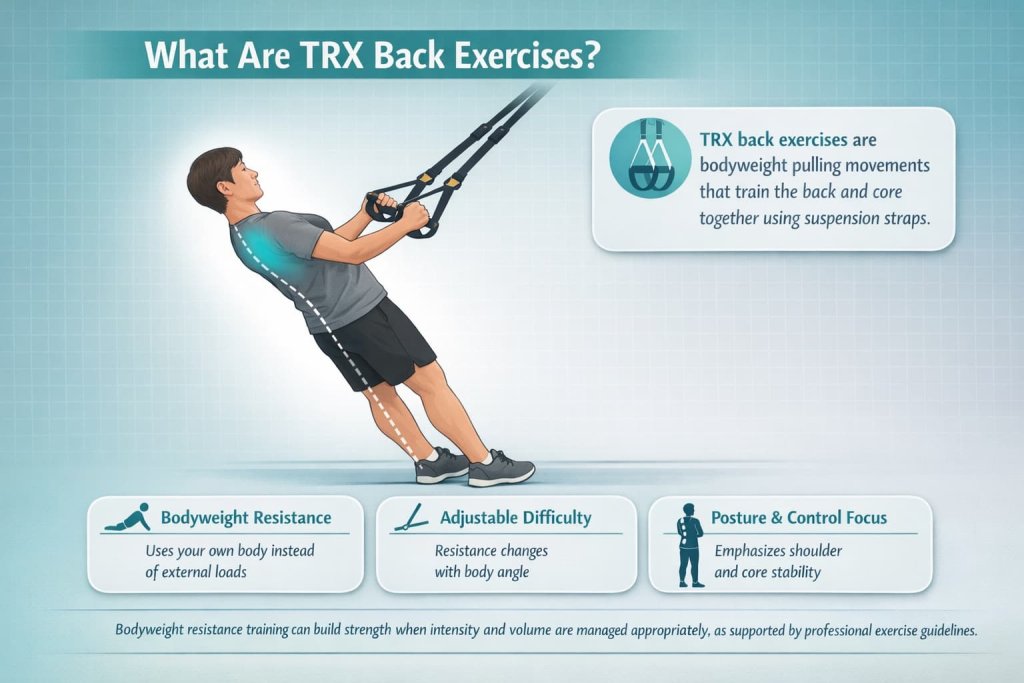
Common characteristics include:
- Bodyweight resistance instead of external loads
- Adjustable difficulty by changing body angle
- Emphasis on posture, shoulder control, and core engagement
According to guidance from American College of Sports Medicine, bodyweight resistance training can effectively build strength when intensity and volume are properly managed.
10 Best TRX Back Exercises
Below are the most effective TRX back exercises, organized from foundational to more advanced patterns.
1. TRX Row
How to do it:
- Hold the TRX handles with palms facing each other and arms fully extended
- Walk your feet forward and lean back so your body forms a straight line from head to heels
- Brace your core and keep your chest lifted
- Pull your chest toward the handles by driving elbows back and squeezing your shoulder blades
- Slowly extend your arms to return to the starting position with control
Why it works:
The TRX row is the foundational pulling movement in suspension training. It trains the back through a full range of motion while teaching proper scapular retraction and body alignment, making it highly effective for both strength and posture.
Muscles worked:
Latissimus dorsi, rhomboids, middle trapezius, biceps
Trainer Tip:
Adjust difficulty by foot placement—walking feet forward increases resistance, while bending the knees reduces load and improves control.
2. TRX Low Row
How to do it:
- Set up in a TRX row position with arms extended and palms facing each other
- Keep elbows close to your torso as you pull
- Draw the handles toward your lower ribs
- Maintain a tall chest and neutral spine throughout the movement
Why it works:
Keeping the elbows tucked shifts more emphasis onto the lats, reinforcing strong pulling mechanics and shoulder positioning commonly used in daily and athletic movements.
Muscles worked:
Latissimus dorsi, lower trapezius, biceps
Trainer Tip:
Think about pulling your elbows into your back pockets to avoid shoulder shrugging.
3. TRX High Row
How to do it:
- Lean back with arms extended and hands shoulder-width apart
- Initiate the pull by retracting your shoulder blades
- Pull handles toward your upper chest with elbows flared slightly outward
- Control the return to the starting position
Why it works:
The higher elbow path increases upper-back engagement and reinforces postural muscles responsible for keeping the shoulders back and chest open.
Muscles worked:
Rhomboids, upper trapezius, middle trapezius, rear deltoids
Trainer Tip:
Pause briefly at the top to reinforce scapular control and improve posture awareness.
4. TRX Reverse Fly
How to do it:
- Start leaning back with arms extended and palms facing each other
- Maintain a slight bend in your elbows
- Open your arms wide in a controlled arc
- Keep your chest lifted and core engaged as you return slowly
Why it works:
Reverse flys isolate the upper-back stabilizers and rear shoulders, areas often undertrained in traditional workouts but critical for shoulder balance and posture.
Muscles worked:
Rear deltoids, rhomboids, middle trapezius
Trainer Tip:
Use a more upright stance until you can control the movement without momentum.
5. TRX Face Pull
How to do it:
- Lean back with arms extended and palms facing down
- Pull the handles toward your face
- Raise elbows high and rotate hands so thumbs point behind you
- Keep your neck neutral and chest tall
Why it works:
Face pulls support shoulder balance by strengthening the upper back and muscles responsible for external rotation and scapular stability.
Muscles worked:
Rear deltoids, trapezius, rotator cuff stabilizers
Trainer Tip:
Move slowly and deliberately—this exercise is about control, not speed.
6. TRX Y Raise
How to do it:
- Begin with arms extended downward and body leaning slightly back
- Raise arms upward into a Y shape
- Keep shoulders relaxed and ribs pulled down
- Lower arms with control
Why it works:
The Y raise emphasizes lower-trap activation, which supports healthy shoulder mechanics and upright posture.
Muscles worked:
Lower trapezius, upper-back stabilizers
Trainer Tip:
If shoulders elevate, reduce your lean angle to maintain proper form.
7. TRX T Raise
How to do it:
- Start with arms extended in front of you
- Open arms out to the sides to form a T shape
- Keep palms facing forward or down
- Control the movement both up and down
Why it works:
T raises build endurance and stability in the mid-back, supporting scapular control during pulling and overhead activities.
Muscles worked:
Middle trapezius, rhomboids, rear deltoids
Trainer Tip:
Maintain a neutral spine and avoid arching your lower back during the lift.
8. TRX W Raise
How to do it:
- Pull elbows down and back to form a W shape with your arms
- Keep upper arms slightly below shoulder height
- Gently squeeze shoulder blades together
- Return to start under control
Why it works:
This movement reinforces postural muscles and shoulder stabilizers that help maintain safe joint alignment during pushing and pulling.
Muscles worked:
Upper back, rotator cuff support muscles
Trainer Tip:
Focus on quality movement rather than range—small, controlled reps are most effective.
9. TRX Power Pull
How to do it:
- Hold one TRX handle with one hand
- Perform a row while rotating your chest toward the pulling arm
- Extend the free arm upward for balance
- Return to neutral slowly before repeating
Why it works:
The power pull combines pulling strength with rotational control, engaging the back and core simultaneously.
Muscles worked:
Latissimus dorsi, rhomboids, obliques
Trainer Tip:
Move slowly to maintain balance and avoid excessive rotation.
10. TRX Inverted Row Hold
How to do it:
- Pull yourself into the top position of a TRX row
- Hold with chest close to the handles
- Keep shoulders down and core engaged
- Breathe steadily throughout the hold
Why it works:
Isometric holds build muscular endurance and reinforce strong postural positioning without excessive joint movement.
Muscles worked:
Mid-back, latissimus dorsi, core stabilizers
Trainer Tip:
Start with short holds (10–15 seconds) and increase time gradually as strength improves.
How to Program TRX Back Exercises
TRX back exercises should be programmed with a focus on control, posture, and gradual progression rather than speed or fatigue.
- Frequency: 2–3 days per week
- Exercises per session: 3–4
- Sets & reps: 2–3 sets of 8–15 controlled reps
- Rest: 45–60 seconds between sets
Increase difficulty by adjusting body angle or slowing tempo, not by rushing repetitions.
Beginner vs Advanced Progressions
TRX back exercises are easy to scale based on experience level.
Beginners:
- Upright body angle
- Knees bent during rows
- Two-arm movements
Advanced:
- More horizontal body position
- Straight legs or feet elevated
- Single-arm and rotational variations
Progress only when proper alignment and control are maintained.
Safety Tips for TRX Back Training
Following basic safety principles helps reduce strain and improve results.
- Keep your body in a straight line from head to heels
- Keep shoulders down and away from ears
- Engage your core throughout each movement
- Use slow, controlled reps—avoid momentum
- Stop if you feel sharp pain or joint discomfort
These versions now fit smoothly into your article without adding unnecessary length while maintaining clarity and safety.
Common Mistakes to Avoid
- Letting hips sag or arch
- Shrugging shoulders during pulls
- Using momentum instead of control
- Standing too upright, reducing resistance
Frequently Asked Questions
Are TRX back exercises effective without weights?
Yes. Adjusting body angle can significantly increase resistance, making bodyweight training effective for strength.
Can beginners do TRX back exercises?
Yes. Most movements are easily scaled by changing foot position.
Do TRX back exercises help posture?
They may help support posture by strengthening the upper back and scapular muscles.
Are TRX back exercises safe for shoulders?
When performed with proper form and control, they are generally shoulder-friendly.
How long should a TRX back workout last?
Most sessions range from 20–40 minutes, depending on volume and rest.
Can TRX replace barbell back training?
TRX can complement or temporarily replace weights, but both methods have unique benefits.
Conclusion
TRX back exercises offer a flexible, scalable way to build strength, posture, and upper-body control using just your body weight. Whether you train at home or in a gym, these movements can support a stronger, more balanced back when practiced consistently and with good technique.
If you’re ready to improve your pulling strength and posture, start by adding two or three of these exercises to your weekly routine and progress gradually.
References
- Suspension vs Conventional Row/Press Training Intensity (EMG + comparable intensity findings)
- Full-text (PMC): Suspension Training Study (EMG + TRX variation differences)
- CDC Guidelines: Muscle-Strengthening Recommendations for Adults
- Harvard Health: Effective Exercises for Building a Strong Back
- Harvard Health: Posture Improvement Guidance (Upper-back strengthening context)