
The wall sit exercise is a simple isometric hold that strengthens your quads, builds leg endurance, and trains full-body bracing without any equipment. If you want a lower-body finisher you can do anywhere (and scale up or down fast), wall sits are one of the most practical options.
What Is the Wall Sit Exercise
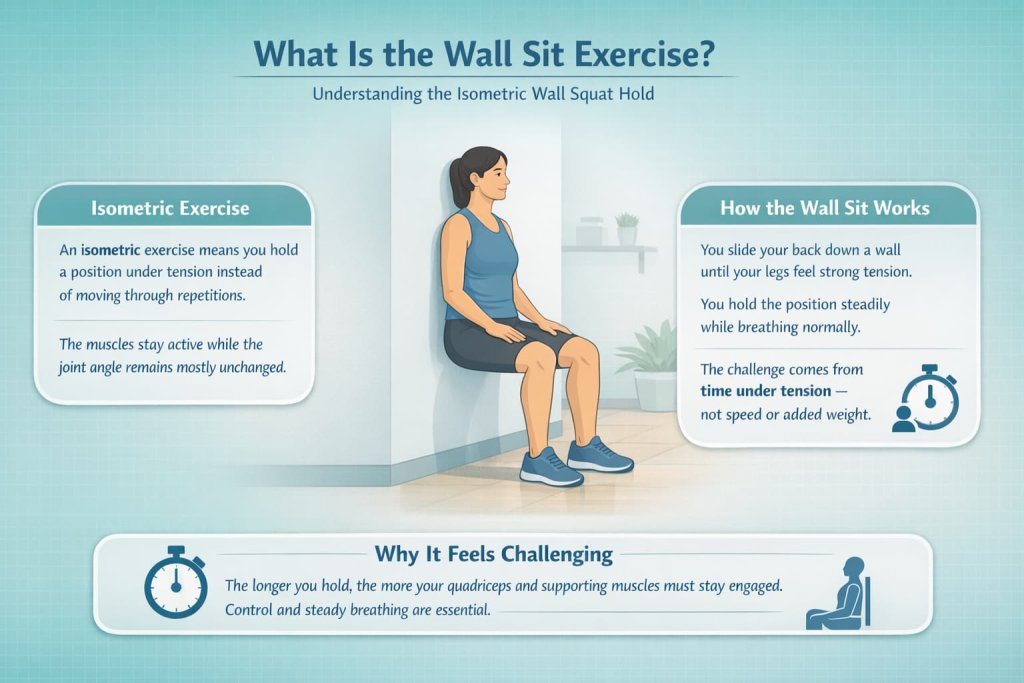
A wall sit (sometimes called a wall squat) is an isometric exercise, meaning you hold a position under tension instead of moving through reps. You slide your back down a wall until your legs are working hard, then hold while staying steady and breathing.
Because it’s isometric, the “work” comes from time under tension, not speed or load.
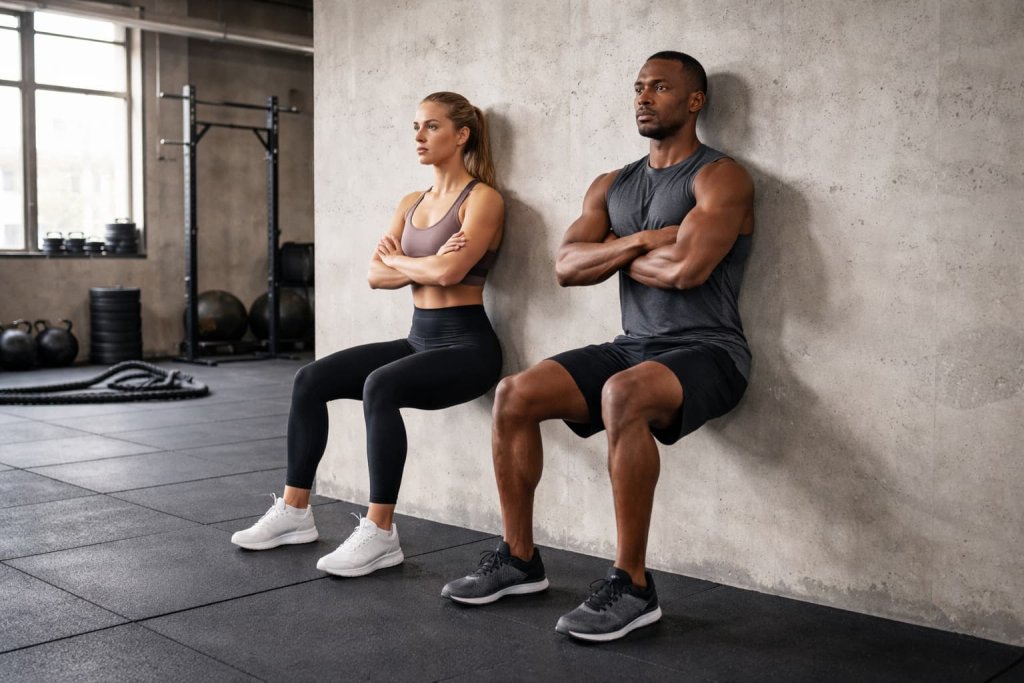
Wall Sit Exercise Proper Form
Good wall-sit form is about alignment, comfort, and control—not suffering in a deep angle you can’t hold well.
Setup Cues That Make Wall Sits Feel Better
- Choose a stable wall and flat shoes (or go barefoot if that feels steadier)
- Keep your back and shoulders in contact with the wall
- Set feet about hip- to shoulder-width, toes forward
- Walk feet slightly forward so knees can stack comfortably over ankles
- Brace your midsection as if someone is about to poke your sides
- Keep breathing evenly (avoid breath-holding)
How to Do a Wall Sit Exercise
- Stand tall with your back against a wall
- Step your feet forward a little and set them hip- to shoulder-width
- Slide down until you feel strong tension in the front of your thighs (start higher if needed)
- Keep knees tracking in line with toes (don’t let them cave inward)
- Press through your heels and keep your torso steady
- Hold for your target time, then slide up with control
Wall Sit Exercise Mistakes to Avoid
- Going too deep too soon, then losing position
- Knees collapsing inward instead of tracking over toes
- Feet too close to the wall (often forces knees forward)
- Holding your breath during the effort
- Letting your lower back over-arch off the wall
Muscles Worked in the Wall Sit Exercise
Wall sits primarily target:
- Quadriceps (front thighs)
- Glutes (hip support and stability)
- Adductors (inner-thigh stability)
- Calves (support and balance)
- Core muscles (bracing and posture)
Wall Sit Exercise Variations
Below are practical wall sit variations to make the exercise easier, harder, or more targeted.
1. High Wall Sit (Beginner-Friendly)
Why it works:
Holding a higher position reduces knee stress and allows you to build quad endurance with better alignment and control. It’s ideal for beginners or anyone rebuilding strength.
Muscles worked:
Quadriceps (primary), glutes, core stabilizers.
How to do it:
- Slide down only partway (stay above parallel)
- Keep knees tracking over toes
- Press weight through your heels
- Brace your core and keep your back flat against the wall
- Hold 15–40 seconds, then stand up smoothly
Trainer Tip:
Master longer hold times at a higher angle before increasing depth.
2. Wall Sit With a Stability Ball
Why it works:
The stability ball adds comfort and can help maintain a neutral spine while still challenging the quads and glutes.
Muscles worked:
Quadriceps, glutes, core stabilizers.
How to do it:
- Place a stability ball between your back and the wall
- Step feet forward to set knee-over-ankle alignment
- Slide down slowly while keeping the ball stable
- Hold your target time with steady breathing
- Slide back up under control
Trainer Tip:
Keep movement slow and controlled—avoid bouncing against the ball.
3. Weighted Wall Sit
Why it works:
Adding resistance increases time-under-tension demand without changing joint mechanics.
Muscles worked:
Quadriceps (greater intensity), glutes, adductors, core.
How to do it:
- Hold a dumbbell at chest level or place a light plate on your thighs
- Slide into your standard wall sit position
- Maintain knee alignment and heel pressure
- Hold 20–60 seconds while breathing steadily
- Stand up with control
Trainer Tip:
Increase load gradually. If posture shifts or breathing becomes strained, reduce weight.
4. Single-Leg Assisted Wall Sit (Advanced Control)
Why it works:
Shifts more load onto one leg, helping improve strength balance and stability without fully removing support.
Muscles worked:
Quadriceps and glutes of the working leg, core stabilizers.
How to do it:
- Set up in a standard wall sit
- Lightly unload one foot (heel barely touching or toe tap)
- Keep hips level and torso steady
- Hold 10–25 seconds per side
- Switch legs with control
Trainer Tip:
Avoid twisting or letting the working knee cave inward.
5. Heel-Elevated Wall Sit (More Quad Emphasis)
Why it works:
Elevating the heels shifts more tension to the quadriceps and increases knee flexion demand.
Muscles worked:
Quadriceps (higher emphasis), calves, glutes, core.
How to do it:
- Place heels on a small wedge or weight plate
- Slide down to a comfortable depth
- Keep knees aligned with toes
- Hold 15–45 seconds while maintaining steady breathing
- Return to standing smoothly
Trainer Tip:
If you feel increased knee discomfort, reduce depth or return to a flat-foot position.
Wall Sit Exercise Benefits
Wall sits are popular because they deliver a lot of training effect with very little setup time.
Stronger Quads and Better Leg Endurance
Wall sits heavily challenge the quadriceps and can build “stay strong” endurance that carries over to stairs, hiking, and long sets of squats. The Cleveland Clinic explains how wall sits strengthen the lower body through sustained muscle tension.
Joint-Friendly Strength When You Control the Depth
Because there’s no repeated up-and-down motion, wall sits can feel more manageable for some people than high-rep squats. The key is choosing a depth you can hold with steady alignment.
Core Bracing and Posture Control
Even though it’s a leg move, you’re practicing ribs-down bracing and stable posture the whole time. If your torso relaxes, the position usually falls apart quickly, which makes wall sits a strong anti-sloppy-form drill.
Possible Blood Pressure Support (Important Safety Note)
Isometric training has been studied for resting blood pressure outcomes. A large network meta-analysis of randomized trials published in the British Journal of Sports Medicine found isometric exercise training produced meaningful average reductions in resting blood pressure across studies, and this research is indexed in PubMed.
In addition, the Mayo Clinic Health System summarizes how isometric exercises like wall sits may support blood pressure management when performed consistently and safely.
Because blood pressure can rise during hard isometric holds, steady breathing matters. The American Heart Association emphasizes avoiding breath-holding during exercise to help manage pressure responses.
Wall Sit Exercise Progression Guide
Instead of chasing a longest-hold record, progress in a way that keeps form clean.
Simple Progression Options
- Increase time in small steps (5–15 seconds)
- Add more total holds (more sets)
- Decrease rest time between holds
- Slightly lower your position (only if alignment stays solid)
- Add load (light dumbbell or plate on thighs) once you own the bodyweight version
A Practical Wall Sit Plan
| Level | Sets | Hold Time | Rest |
|---|---|---|---|
| Beginner | 2–3 | 15–30 sec | 45–60 sec |
| Intermediate | 3–4 | 30–45 sec | 45–60 sec |
| Advanced | 4–6 | 45–75 sec | 30–60 sec |
Train wall sits 2–4 days per week, depending on your recovery and other leg training.
Who Should Modify or Avoid Wall Sits
Modify first—or seek professional guidance—if you have:
- Sharp knee pain during the hold
- Hip pain that worsens as you slide down
- Back pain that increases with bracing
- Known cardiovascular concerns, uncontrolled blood pressure, or dizziness during straining efforts
If any hold causes unusual or severe discomfort, stop and reassess your setup or choose a gentler variation.
Wall Sit Exercise FAQs
How long should I hold a wall sit?
Most people benefit from 20–60 seconds per set. Shorter holds with strong form are better than longer holds with poor alignment.
Are wall sits better than squats?
They serve different purposes. Wall sits build isometric endurance and bracing, while squats train strength through movement.
Do wall sits help knees?
They can support knee function by strengthening surrounding muscles, but depth and alignment matter. Reduce angle if discomfort appears.
How many wall sits should I do per week?
Two to four sessions per week is common, depending on your overall training load.
Can wall sits help lower blood pressure?
Isometric exercise has research support for improving resting blood pressure averages in study settings, but individual responses vary. Follow medical guidance if you have cardiovascular concerns.
What’s the best wall sit variation for beginners?
A higher wall sit is typically the safest starting point because it’s easier to control and still builds endurance.
Conclusion
Wall sits are one of the most effective no-equipment leg exercises because they’re simple, scalable, and highly efficient. Start with a manageable depth, build time under tension, and progress gradually while keeping your breathing steady and your alignment clean.
References
- BMJ Group. Static (isometric) exercise such as wall sits best for lowering blood pressure. BMJ Group
- Wiles JD, et al. Isometric exercise training and cardiovascular health: a review. PubMed Central
- Cohen DD, et al. Isometric squat (wall squat) vs isometric handgrip training for blood pressure: randomized controlled trial. PubMed