
Core exercises for women are essential for building strength, stability, and better posture—and the best core exercises for women strengthen the abs and back fast by training multiple deep core muscles at once. A strong core supports everyday movement, reduces strain on your spine, and helps improve balance, confidence, and overall mobility.
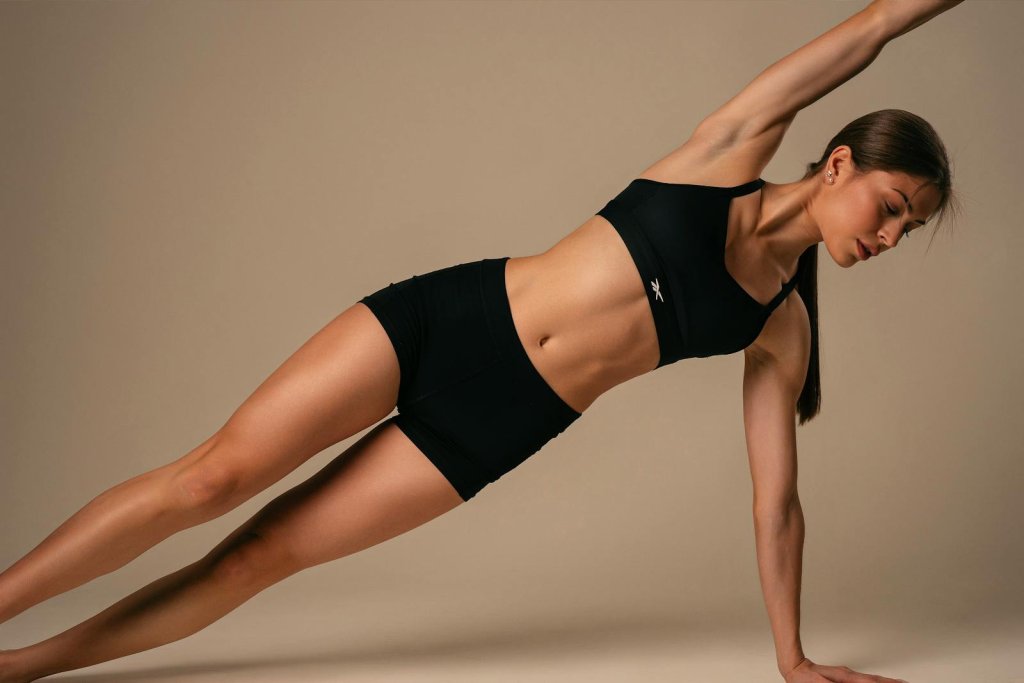
Understanding how to train your core properly helps prevent common issues like low back discomfort and poor posture. This guide walks you through the 22 best core exercises for women, including beginner-friendly, standing, and back-safe options.
Why Core Strength Matters for Women
A well-trained core supports:
- Better posture and reduced back strain
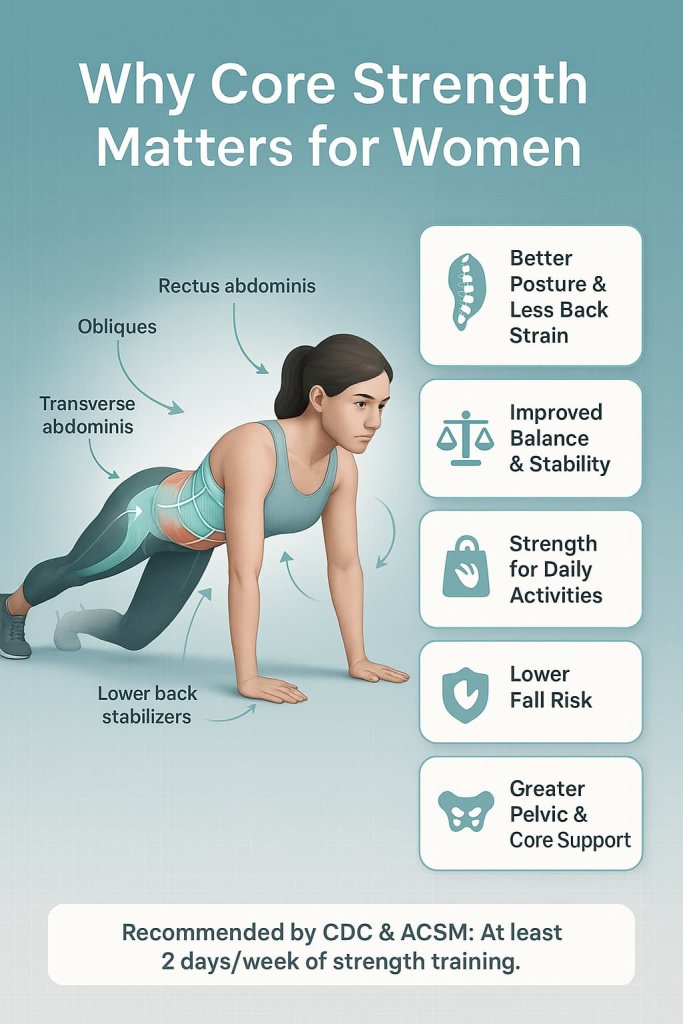
- Improved balance, stability, and walking efficiency
- Stronger support for daily activities (lifting, sitting, bending, carrying)
- Lower fall risk, especially for women over 40 or 50
- Greater pelvic stability and abdominal support
According to CDC and ACSM guidelines, women should perform at least 2 days per week of total-body strength training, including core work.
How Often Should Women Do Core Exercises?
Most women benefit from:
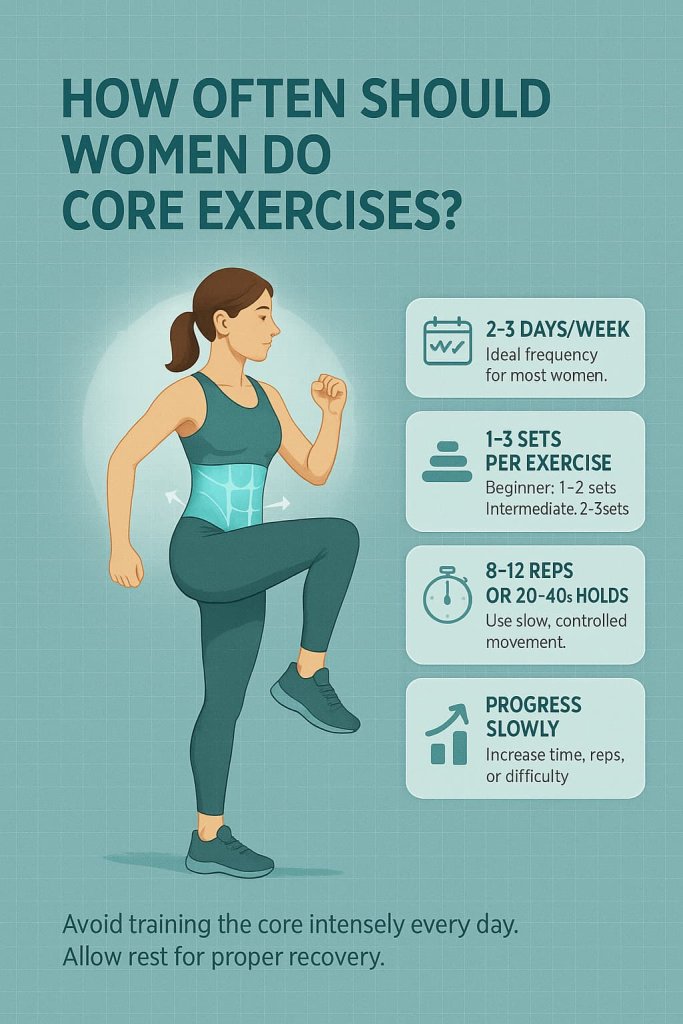
- 2–3 core workouts per week
- 1–2 sets per exercise for beginners; 2–3 sets for intermediate
- 8–12 reps or 20–40 second holds
- Progress by increasing time, difficulty, or resistance
Avoid training the core intensely every day—your muscles need time to recover.
How to Warm Up Before Core Workouts
A short warm-up prepares your core, hips, and spine for safe movement. It boosts blood flow and activates the deep abdominal muscles before harder exercises.
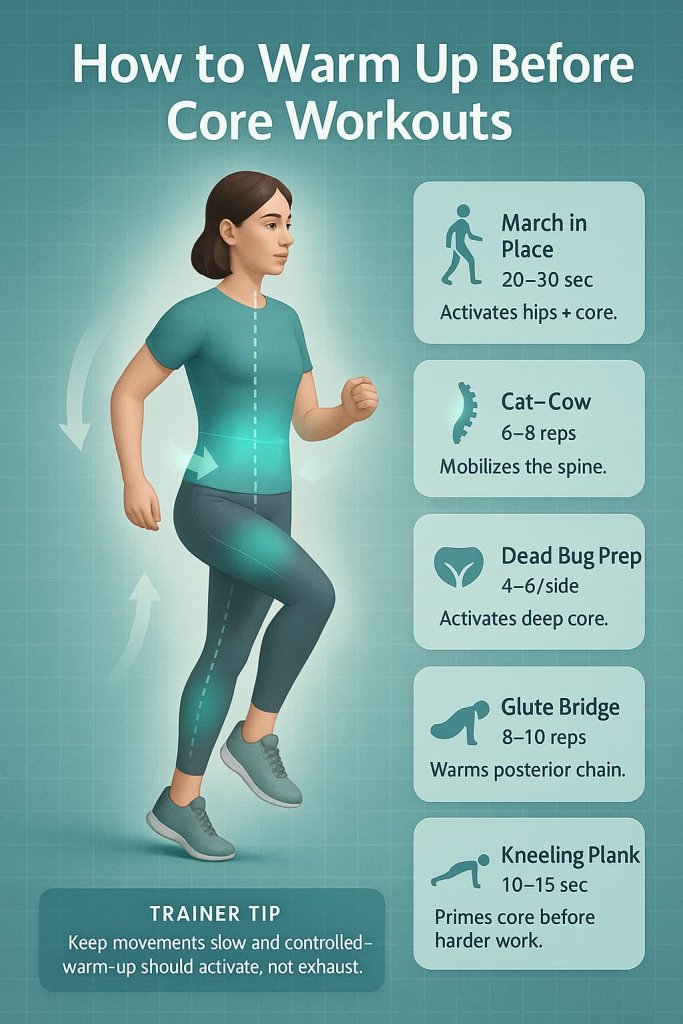
Try this quick 2–3 minute routine:
- March in place – 20–30 seconds: Light activation for hips and core.
- Cat–Cow – 6–8 reps: Gently mobilizes the spine.
- Dead bug prep – 4–6 reps per side: Activates deep core muscles.
- Glute bridge – 8–10 reps: Engages the posterior chain for stability.
- Kneeling plank hold – 10–15 seconds: Primes the core before full planks.
Trainer Tip:
Keep movements slow and controlled. Warm-up should activate, not exhaust.
The 22 Best Core Exercises for Women
Below you’ll find the most effective core exercises for women, organized by difficulty to help you build strength safely and progressively. Each move targets key abdominal and back muscles to improve stability, posture, and everyday functional strength.
Best Beginner Core Exercises for Women
1. Dead Bug
Why it works:
Strengthens the deep core while minimizing pressure on the lower back. Ideal for learning core stability and coordination.
Muscles worked:
Transverse abdominis, rectus abdominis, obliques, hip flexors.
How to do it:
- Lie on your back with arms extended toward the ceiling.
- Lift legs into a tabletop position (knees over hips).
- Slowly lower your right arm and left leg toward the floor.
- Return to center and switch sides.
- Keep your lower back gently pressed into the floor.
Trainer Tip:
Move slowly—speed reduces effectiveness. Keep ribs down to prevent arching.
2. Bird Dog
Why it works:
Improves spinal stability and strengthens core muscles without lying on the floor.
Muscles worked:
Core stabilizers, glutes, erector spinae, shoulders.
How to do it:
- Start on hands and knees in tabletop.
- Extend your right arm forward and left leg back.
- Hold briefly, keeping hips level.
- Switch sides with smooth, controlled movement.
Trainer Tip:
Avoid letting your hips rotate—imagine balancing a cup of water on your lower back.
3. Glute Bridge
Why it works:
Activates glutes and deep core muscles while reducing stress on the spine.
Muscles worked:
Glutes, hamstrings, lower back, deep abdominals.
How to do it:
- Lie on your back with knees bent and feet flat.
- Lift your hips until your body forms a straight line.
- Squeeze the glutes at the top.
- Lower slowly with control.
Trainer Tip:
Keep knees aligned with hips—don’t let them fall inward.
4. Forearm Plank
Why it works:
Builds strong, stable abdominal and back muscles through isometric contraction.
Muscles worked:
Rectus abdominis, transverse abdominis, shoulders, glutes.
How to do it:
- Set up on your forearms and toes.
- Keep your body in a straight line.
- Hold for 20–30 seconds.
Trainer Tip:
Tuck your tailbone slightly to avoid lower-back dipping.
5. Side Plank (Knees Bent Option)
Why it works:
Strengthens the obliques with reduced load, making it ideal for beginners.
Muscles worked:
Obliques, deep core stabilizers, shoulders, hips.
How to do it:
- Lie on your side with knees bent.
- Lift your hips off the floor, keeping your body aligned.
- Hold for 15–20 seconds.
- Switch sides.
Trainer Tip:
Push through your bottom forearm and keep chest lifted—not collapsing forward.
Best Core Exercises for Women (Intermediate Level)
6. High Plank
Why it works:
Improves full-core strength while building shoulder stability.
Muscles worked:
Abs, shoulders, chest, triceps, glutes.
How to do it:
- Place hands under shoulders.
- Step feet back into a straight-body line.
- Hold or add slow controlled breathing.
Trainer Tip:
Spread your fingers and press firmly into the floor for shoulder support.
7. Reverse Crunch
Why it works:
Targets the lower abs with less neck strain than traditional crunches.
Muscles worked:
Lower rectus abdominis, hip flexors.
How to do it:
- Lie on your back with legs lifted.
- Curl hips upward toward your ribcage.
- Lower slowly with control.
Trainer Tip:
Don’t swing your legs—use abdominal control only.
8. Bicycle Crunch (Slow Tempo)
Why it works:
Enhances rotational strength and improves torso control.
Muscles worked:
Obliques, rectus abdominis, hip flexors.
How to do it:
- Lie on your back with hands behind head.
- Bring opposite elbow to knee while extending the other leg.
- Move slowly for maximum muscle engagement.
Trainer Tip:
Keep your shoulder blades off the floor throughout.
9. Heel Taps
Why it works:
Strengthens lower abs and teaches pelvic stability.
Muscles worked:
Lower abs, pelvic stabilizers, hip flexors.
How to do it:
- Lie on your back with legs in tabletop.
- Lower one heel to the floor as you exhale.
- Switch sides smoothly.
Trainer Tip:
Keep your low back from arching by turning on deep abdominal muscles.
10. Hollow Hold
Why it works:
Builds deep core strength and teaches body tension.
Muscles worked:
Transverse abdominis, rectus abdominis, hip flexors.
How to do it:
- Lie on your back and lift arms, shoulders, and legs slightly.
- Keep lower back pressed into the floor.
- Hold 10–20 seconds.
Trainer Tip:
If your low back lifts, bend your knees to modify.
11. Hip Dips (Side Plank Version)
Why it works:
Improves oblique control and lateral core stability.
Muscles worked:
Obliques, transverse abdominis, shoulders.
How to do it:
- Hold a side plank.
- Lower hip slightly toward the floor.
- Lift back up with control.
- Repeat on both sides.
Trainer Tip:
Keep movement small—avoid collapsing into the shoulder.
12. Mountain Climbers
Why it works:
Engages the core dynamically while improving cardiovascular conditioning.
Muscles worked:
Abs, hip flexors, shoulders, legs.
How to do it:
- Start in high plank.
- Quickly alternate knee drives toward your chest.
- Keep hips level.
Trainer Tip:
Slow them down to increase core activation.
Standing Core Exercises for Women (Back-Friendly)
13. Standing Knee-to-Elbow
Why it works:
Strengthens abs with minimal spine loading and improves coordination.
Muscles worked:
Obliques, hip flexors, deep core stabilizers.
How to do it:
- Stand tall with hands behind head.
- Bring knee and opposite elbow together.
- Switch sides rhythmically.
Trainer Tip:
Keep chest lifted—avoid rounding forward.
14. Wood Chop (Bodyweight or Light Weight)
Why it works:
Trains rotational strength used in daily activities.
Muscles worked:
Obliques, abs, shoulders, hips.
How to do it:
- Stand with feet shoulder-width apart.
- Bring arms diagonally across the body as if chopping.
- Rotate through your torso, not your knees.
Trainer Tip:
Use light weight or no weight—control is more important than load.
15. Standing Side Bend (Controlled)
Why it works:
Strengthens the obliques through a safe range of motion.
Muscles worked:
Obliques, quadratus lumborum.
How to do it:
- Stand tall with hand on hip or holding a light weight.
- Lean to one side slowly.
- Return to center and repeat.
Trainer Tip:
Avoid leaning forward or twisting—bend directly sideways.
16. Marching with Core Tension
Why it works:
Activates deep core muscles while reinforcing posture and balance.
Muscles worked:
Deep core, hip flexors, stabilizers.
How to do it:
- Stand tall and gently brace your core.
- Lift one knee at a time as if marching.
- Move slowly and stay balanced.
Trainer Tip:
Imagine zipping your ribcage toward your hips to keep core engaged.
17. Pallof Press (with Band)
Why it works:
One of the best anti-rotation exercises, teaching the core to resist twisting.
Muscles worked:
Obliques, transverse abdominis, shoulders.
How to do it:
- Attach a band at chest height.
- Stand sideways to the anchor.
- Hold the band at your chest, then press straight out.
- Resist rotation as you hold.
Trainer Tip:
Keep shoulders level—don’t let the band pull you inward.
Advanced Core Exercises for Women
18. Decline Plank Hold
Why it works:
Increases core demand by elevating the feet above the hands.
Muscles worked:
Abs, shoulders, glutes, upper back.
How to do it:
- Place feet on a step or bench.
- Hold a plank with firm core bracing.
Trainer Tip:
Start with small elevation—3–6 inches is enough for many women.
19. V-Ups
Why it works:
Trains the entire front core chain in one explosive movement.
Muscles worked:
Rectus abdominis, hip flexors, obliques.
How to do it:
- Lie on your back with legs and arms extended.
- Lift both simultaneously to form a “V.”
- Lower with control.
Trainer Tip:
Exhale as you lift to reduce strain.
20. Plank Reach
Why it works:
Improves anti-rotation strength and shoulder stability.
Muscles worked:
Abs, obliques, shoulders, chest.
How to do it:
- Hold a high plank.
- Reach one arm forward without moving hips.
- Alternate arms.
Trainer Tip:
Widen your feet slightly for better balance.
21. Leg Drops (Slow and Controlled)
Why it works:
Strengthens lower abs while improving pelvic control.
Muscles worked:
Lower abs, hip flexors.
How to do it:
- Lie on your back with legs lifted.
- Lower legs halfway while keeping ribs down.
- Lift back up slowly.
Trainer Tip:
If your back arches, bend your knees or reduce the range of motion.
22. Box Plank Walkouts
Why it works:
Combines stability, strength, and upper-body control.
Muscles worked:
Abs, shoulders, chest, glutes.
How to do it:
- Begin in a box plank (hands under shoulders, knees under hips).
- Walk hands forward slowly into a longer plank.
- Walk hands back to start.
Trainer Tip:
Keep movements small and slow—quality over distance.
Sample 10-Minute Core Workout for Women
Perfect for busy schedules:
- Dead bug – 30 seconds
- Glute bridge – 30 seconds
- High plank – 20–30 seconds
- Bicycle crunch – 30 seconds
- Side plank – 20 seconds each side
- Mountain climbers – 30 seconds
- Hollow hold – 15–20 seconds
Repeat once if time allows.
Benefits of Core Exercises for Women
Core training supports your health in multiple ways:
- Strengthens abdominal, back, and pelvic floor muscles
- Helps reduce general low back discomfort (according to reviewed research from NCCIH & Harvard Health)
- Improves balance and stability for daily tasks
- Supports proper posture and spine alignment
- Enhances performance in walking, running, lifting, and sports
- Supports healthy aging and mobility
Note: Core exercise supports general health but does not treat or cure medical conditions.
Safety Tips for Core Training
You can include the following guidelines to keep work safe:
- Maintain a neutral spine (do not excessively arch).
- Move slowly—avoid jerking or swinging motions.
- Stop if you feel pain, numbness, or dizziness.
- Avoid advanced core moves if you have active back pain unless supervised by a professional.
- Women with postpartum concerns or pelvic floor issues should get medical clearance first.
Frequently Asked Questions (FAQ)
1. Can core exercises flatten your stomach?
They strengthen the muscles, but spot-reduction is not possible. Fat loss requires overall activity + nutrition.
2. How long does it take to see results?
Most women notice better stability and muscle tone in 3–6 weeks with consistency.
3. Is it safe to do core exercises every day?
Daily light activation is okay, but intense workouts should be 2–3 times per week.
4. What are the best core exercises for women with back pain?
Bird dog, glute bridge, dead bug, and standing core moves.
(Always consult a clinician if you have medical conditions.)
5. Are planks better than crunches?
Yes, per Harvard Health, planks activate more muscles with less spinal stress.
6. Do women over 50 need special core exercises?
Yes—focus on stability, balance, and low-impact moves like bridges, bird dog, wall planks, and standing marches.
7. What equipment helps with core training?
A mat, light dumbbells, and resistance bands are enough for all fitness levels.
Conclusion
Strengthening your core is one of the most effective ways for women to improve posture, back health, stability, and overall fitness. Start with beginner movements, progress gradually, and combine both floor and standing exercises for the best results. Stay consistent—2–3 core sessions per week can make a meaningful difference in strength and daily function.
Ready to build a stronger midsection? Start with the beginner list above or use the 10-minute routine to begin today.
References
- U.S. Department of Health and Human Services – Physical Activity Guidelines for Americans (2nd Edition)
https://health.gov/sites/default/files/2019-09/Physical_Activity_Guidelines_2nd_edition.pdf - American College of Sports Medicine – Progression Models in Resistance Training for Healthy Adults
https://journals.lww.com/acsm-msse/Fulltext/2009/03000/Progression_Models_in_Resistance_Training_for.26.aspx - Harvard Health – Want a Stronger Core? Skip the Sit-Ups
https://www.health.harvard.edu/staying-healthy/want-a-stronger-core-skip-the-sit-ups