
What is rucking exercise? Rucking is walking while carrying weight in a backpack, adding resistance to an everyday activity. The extra load makes walking more demanding and can increase the calories you use at a given pace.

Rucking can be a practical way to challenge an established walking routine. However, carrying too much weight or going too far too soon can strain your body. Start with comfortable, unweighted walking, choose a light load when ready, and build gradually.
What Is Rucking Exercise?
Rucking takes its name from the rucksack, another word for a backpack. It has a long history in military training, where people carry equipment over distance. Recreational rucking adapts that idea for fitness, with loads and routes suited to the individual.
You do not need to march, run, or hike a mountain. A walk around your neighborhood with a securely loaded backpack can count.
| Activity | What makes it different? |
|---|---|
| Regular walking | You walk without deliberately adding weight. |
| Rucking | You carry weight in a backpack while walking. |
| Hiking | You walk on trails or natural terrain, sometimes carrying supplies. It can overlap with rucking. |
| Weighted-vest walking | You wear weight around your torso instead of carrying it primarily on your back. |
A vest and a backpack distribute weight differently. Neither is automatically comfortable or appropriate for everyone.
What Are the Benefits of Rucking Exercise?
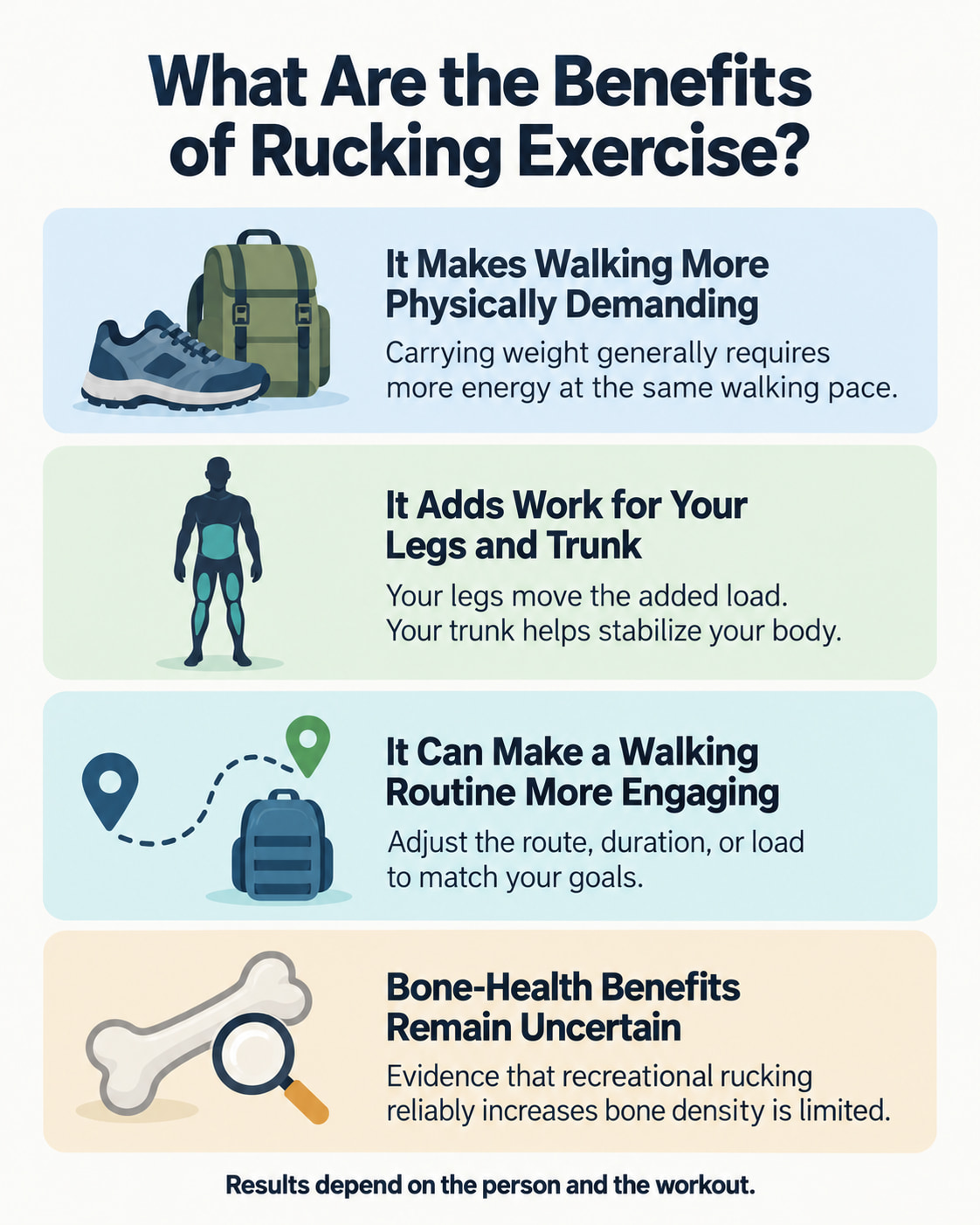
It Makes Walking More Physically Demanding
Moving additional weight generally requires more energy. This can make your usual walking pace feel harder without requiring you to run.
A 2022 laboratory study measured the metabolic demands of backpack walking in 30 healthy, active adults. The findings support the relationship between backpack load, walking speed, and energy expenditure.
However, the study included heavy military-style loads. It does not provide a beginner weight target or prove that every ruck burns two or three times as many calories as ordinary walking.
Your energy use depends on your body size, pack weight, speed, hills, terrain, and session length. If carrying weight makes you slow down substantially, a simple comparison with your usual walk becomes less useful.
It Adds Work for Your Legs and Trunk
Your leg muscles move your body and the added load. Your abdominal and back muscles help stabilize your trunk as you walk.
This makes rucking a way to practice sustained loaded movement. It may help develop the capacity to carry a pack comfortably, which is useful for hiking and similar activities.
Still, working a muscle harder during a session does not guarantee substantial muscle growth. Keep exercises that train all major muscle groups in your routine, including pushing, pulling, and lower-body movements.
It Can Make a Walking Routine More Engaging
Rucking gives you several ways to adjust a walk: the load, duration, route, or pace. You can also walk with a friend whose pace matches yours.
For some people, this variety makes regular movement more appealing. You do not need an event, a special distance, or a heavy pack to make the activity worthwhile.
Bone-Health Benefits Remain Uncertain
Adding weight increases the load your skeleton supports. However, evidence that ordinary recreational rucking reliably increases bone density is limited.
A 2025 randomized clinical trial involving 150 older adults with obesity found that weighted-vest use did not significantly reduce hip bone loss during a 12-month dietary weight-loss program compared with weight loss alone.
That study tested prolonged vest wear during weight loss, rather than backpack rucking workouts. It does not settle every question about rucking and bones, but it shows why stronger-bone claims need caution.
How to Start Rucking Exercise
1. Establish a Comfortable Walking Routine
Before adding weight, make sure ordinary walking feels manageable. If a short walk already leaves you exhausted, causes pain, or feels unsteady, work on that baseline first.
Choose a familiar route with an easy way to return home. Short loops are useful because you can finish without having to retrace a long outward journey.
2. Choose a Backpack That Fits Securely
A sturdy backpack can work for a light introductory load. Look for comfortable shoulder straps, secure stitching, and a fit that limits bouncing.
Use both shoulder straps. A suitable chest strap or hip belt may help keep the pack stable, but it should not restrict breathing or movement.
Place the weight close to your back and secure it so it cannot shift. Water bottles or other compact items can work. Cushion hard objects, and avoid loose weights that jab into your back.
Wear comfortable walking shoes with suitable traction and socks that limit rubbing. Specialized rucking boots or weight plates are optional.
3. Start With a Light Load
In its January 2024 guidance, Cleveland Clinic recommends easing into rucking, including starting with an empty backpack when appropriate. Around 5 pounds of added weight is one example of a light starting load.
Five pounds is approximately 2.3 kilograms. It is an example, not a requirement. Less weight may be appropriate, and the backpack itself contributes to what you carry.
Weigh the complete loaded pack, including water, so you can track the actual load. Avoid choosing a starting weight solely because an online chart recommends a percentage of your body weight.
4. Keep the First Sessions Short and Easy
Use a flat, predictable surface and a pace that lets you speak comfortably. Walk naturally, with relaxed shoulders and your gaze ahead. Reduce the load if it makes you hunch, shuffle, or struggle to keep your balance.
Here is an illustrative starting session for an adult who already walks comfortably:
| Part of the session | Practical starting example |
|---|---|
| Warm-up | Walk easily without added weight for a few minutes. |
| Loaded walk | Try 10–20 minutes with a light, secure pack. Shorten this if needed. |
| Route | Use a flat loop close to home. |
| Finish | Remove the pack and walk easily for a few minutes. |
| Initial frequency | Consider one or two sessions weekly, with recovery time between them. |
This is a flexible example, not a research-established dose. If you normally walk for only 10 minutes, your first loaded walk should be shorter than that.
5. Progress According to Comfort and Recovery
Repeat a manageable session before making it harder. Notice how your feet, joints, back, and energy levels feel afterward and the following day.
When a session feels repeatable without pain or lingering fatigue, change one element slightly. For example, extend a comfortable 15-minute walk by a couple of minutes while keeping the same pack and route.
Avoid increasing weight, distance, speed, and hills together. There is no requirement to increase the load every week.
A simple record of pack weight, walking time, route, and symptoms can help you recognize what your body tolerates.
Rucking Risks and Who Should Get Advice First
Walking with a pack adds stress as well as challenge. Common concerns include:
- Blisters and chafing: Footwear, socks, sweat, and pack movement can cause friction.
- Back or shoulder discomfort: Poor fit or excessive weight can make carrying the pack uncomfortable.
- Joint and overuse problems: Rapid increases in load or distance can contribute to pain and injuries, including stress fractures.
- Trips and falls: Uneven ground and fatigue can make balance more difficult.
- Heat-related illness: Demanding exercise in hot conditions requires extra attention to weather, hydration, and breaks.
Military load-carriage research documents injuries under demanding conditions. Those findings support gradual progression, but military injury rates should not be assumed to represent short recreational rucks.
Who Should Seek Individual Guidance?
UCLA Health cautions that added weight may aggravate back or neck injuries and arthritis in the hips, knees, or ankles. Its October 2025 guidance also notes that a backpack can challenge stability.
Get individualized advice before starting if you have an injury, painful joints, balance difficulties, osteoporosis or a fracture history, or a condition that limits exercise. During pregnancy, discuss loaded walking with your prenatal care professional before trying it.
Age alone does not determine the right load. Your walking ability, health, balance, and recovery matter more than matching someone else’s pack weight.
When Should You Stop?
Stop and remove the pack if you develop sharp or worsening pain, numbness, tingling, or difficulty walking normally. Seek assessment for persistent symptoms or focal bone pain.
Stop exercising for dizziness or unusual breathlessness. Chest pain or pressure, fainting, or severe breathing difficulty warrants urgent medical help.
You do not need to push through pain to benefit from exercise.
How Rucking Fits Into Your Weekly Exercise Routine
The CDC recommends a combination of aerobic and muscle-strengthening activity. Adults should aim for at least:
- 150 minutes of moderate-intensity aerobic activity weekly, or 75 minutes of vigorous activity, or an equivalent combination.
- Two days of muscle-strengthening activity that works all major muscle groups.
Rucking can contribute to the aerobic portion when the effort is sufficient. At moderate intensity, you can generally talk but have difficulty singing.
You do not need to make every walk a ruck. Combine loaded walks with ordinary walking, strength exercises, and other activities you enjoy. Older adults should also include balance activities.
Frequently Asked Questions
Is Rucking Better Than Regular Walking?
Rucking can create more effort at the same pace, but the better choice depends on your goals and tolerance. Ordinary walking remains useful, especially if adding weight causes discomfort or makes you less likely to exercise consistently.
How Much Weight Should a Beginner Carry?
Start with an empty backpack or a light load you can carry comfortably. About 5 pounds of added weight is one possible starting point. Reduce it if your posture, stride, or balance changes noticeably.
How Long Should Your First Ruck Last?
Keep it shorter than your usual comfortable walk. A 10–20-minute outing may suit some established walkers, while others need only a few minutes. Finish while the activity still feels manageable.
Can Rucking Help With Weight Loss?
Rucking can increase energy expenditure and contribute to a weight-management routine. Results depend on your overall eating pattern, activity, and consistency. It does not specifically target belly fat or guarantee a particular rate of weight loss.
Does Rucking Build Muscle?
It adds work for the legs and trunk, but substantial muscle growth from rucking alone is not well established. Use progressive strength exercises alongside it if building muscle is a primary goal.
Can You Ruck Every Day?
Daily loaded walking is unnecessary, especially when starting. Give yourself time to see how you recover between sessions. Ordinary walks or other comfortable activities can fill the days between rucks.
Is a Weighted Vest the Same as a Rucksack?
Both add weight, but a vest distributes it around the torso while a rucksack carries it primarily behind you. Fit, comfort, balance, and health considerations determine which, if either, is suitable.
Conclusion
Rucking offers a straightforward way to add challenge to walking. Its clearest benefit is increased physical demand; claims about dramatic calorie burning, muscle growth, or stronger bones need qualification.
If you already walk comfortably, begin with a short, familiar route and a light, secure pack. Let comfort and recovery guide your next step.
References
- American Council on Exercise. The Surprising Benefits of Rucking.
- Cleveland Clinic. Should You Add Rucking to Your Workout?.
- Looney DP, et al. 2022. Modeling the Metabolic Costs of Heavy Military Backpacking.
- Beavers KM, et al. June 2025. Weighted Vest Use or Resistance Exercise to Offset Weight Loss-Associated Bone Loss in Older Adults.
- UCLA Health. Should You Walk With a Weighted Vest?.
- Harvard Health Publishing. What Are the Benefits of Walking With a Weighted Vest?.
- U.S. Army. The Weight of War: Marching to Win Means Keeping Ahead of Injury.
- National Institute on Aging. Three Types of Exercise Can Improve Your Health and Physical Ability.
- Centers for Disease Control and Prevention. What Counts as Physical Activity for Adults.