
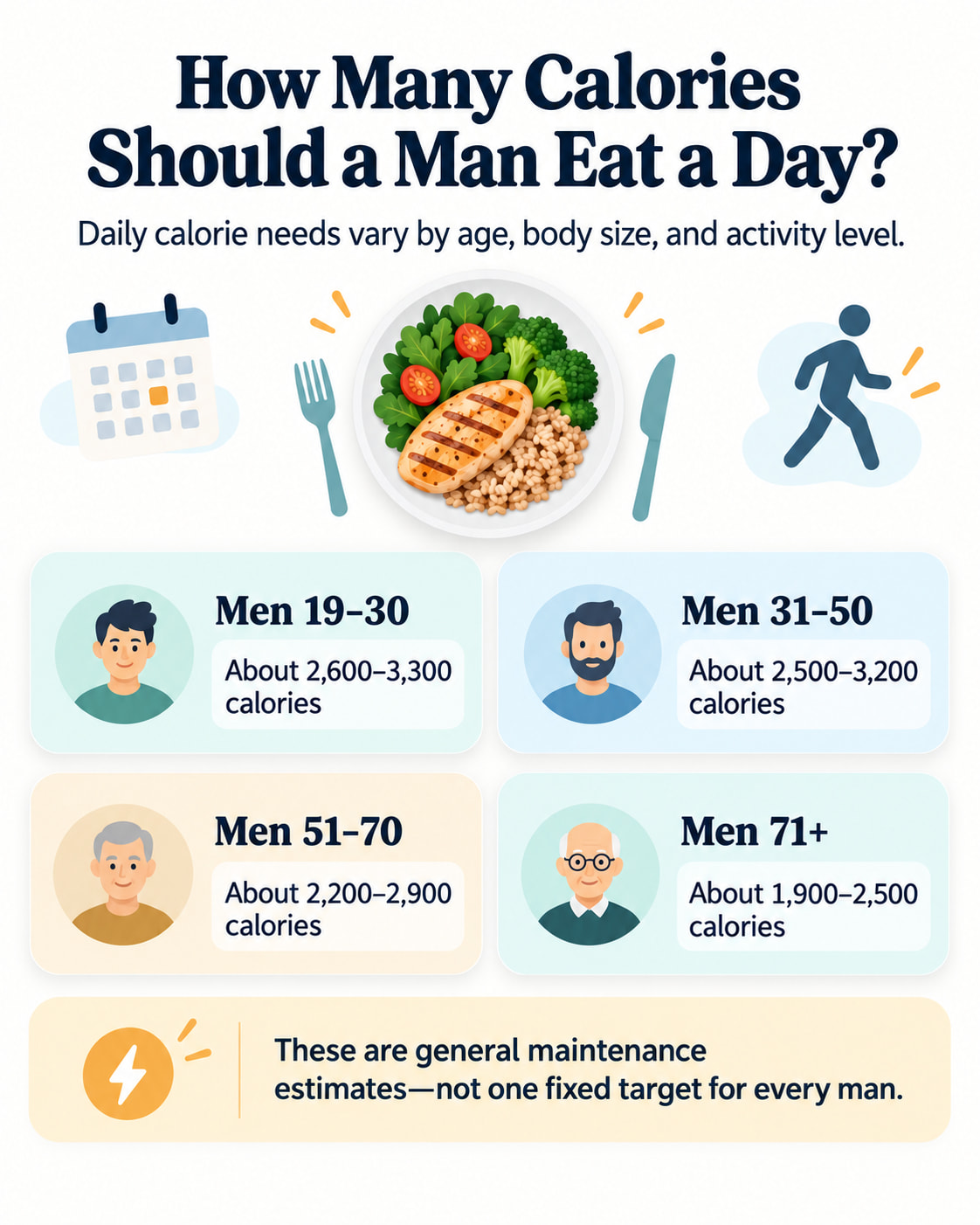
How many calories should a man eat a day? The reference estimates below range from about 1,900 to 3,300 calories daily for weight maintenance, but there is no universal target. Your age, body size, and activity level affect your requirements, and some men need more or less than this range.
Start by estimating the calories needed to maintain your current weight. Then consider whether maintaining, losing, or gaining weight is appropriate for you. The chart provides a starting point; a personalized calculation and your weight trend help make it useful.
How Many Calories Should a Man Eat a Day by Age and Activity?
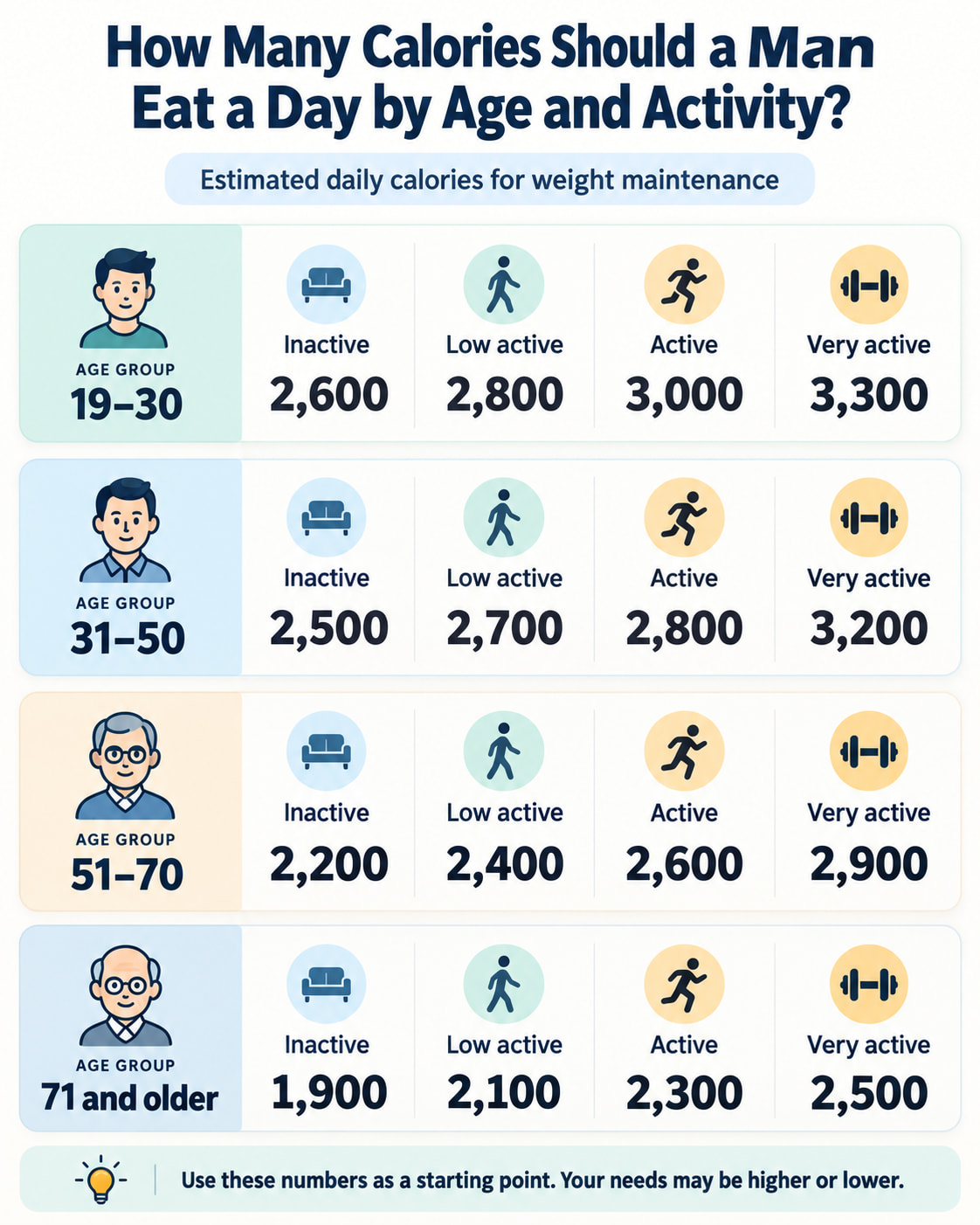
The National Academies’ 2023 Dietary Reference Intakes for Energy provides these reference estimates, rounded to the nearest 100 calories.
| Age | Inactive | Low active | Active | Very active |
|---|---|---|---|---|
| 19–30 | 2,600 | 2,800 | 3,000 | 3,300 |
| 31–50 | 2,500 | 2,700 | 2,800 | 3,200 |
| 51–70 | 2,200 | 2,400 | 2,600 | 2,900 |
| 71 and older | 1,900 | 2,100 | 2,300 | 2,500 |
Table assumptions: These are daily maintenance estimates for the report’s “normal weight” reference groups, approximately 5 feet 7 inches to 5 feet 9 inches tall and 145–156 pounds. Each row uses representative measurements and an age within that group. These are not recommended body weights or individualized calorie prescriptions.
What Do the Activity Levels Mean?
These categories describe overall energy expenditure, not simply how many times you visit the gym. In broad terms:
- Inactive: Everyday activities with little additional movement or physically demanding work.
- Low active: More movement beyond basic daily activities.
- Active: Substantial movement through work, exercise, or both.
- Very active: Strenuous work, extensive recreational activity, or a combination.
These descriptions are approximate. The National Academies cautions that meeting general exercise recommendations does not automatically place someone in the “active” category. Consider your whole routine, including work, transportation, household tasks, and exercise.
What Affects How Many Calories a Man Needs?
Height and Weight
Age alone cannot determine your calorie needs. The current Dietary Guidelines identify height, weight, sex, age, and physical activity as relevant factors. That is why a chart based on reference-sized men may not closely match your needs.
For example, a 200-pound man should not automatically use the same target as a 150-pound man of similar age. A personalized calculation accounts for those different measurements.
Age and Changes in Routine
Older adults may use fewer calories, particularly when they become less active. However, needing fewer calories does not mean needing fewer nutrients. NIDDK emphasizes nutrient-dense foods for older adults because vitamin and mineral needs remain important even when energy requirements decline.
Rather than cutting food simply because you reached a particular birthday, review what has changed: your activity, body weight, appetite, or daily routine.
Health Conditions and Medications
Medical conditions and medications can affect weight management. NIDDK recommends reviewing these factors with a healthcare professional when developing a weight-loss plan. A generic calorie chart cannot account for your medical history.
How to Estimate Your Daily Calorie Needs
Use Your Own Measurements
The USDA DRI Calculator estimates daily calorie needs using your sex, age, height, weight, and activity level. Enter your current measurements and describe your usual routine rather than the activity level you hope to reach. USDA notes that individual needs can be higher or lower than its estimates.
Use the result as a starting estimate, not a precise measurement of your metabolism.
Example: A 40-Year-Old Man
Consider a hypothetical man who is:
40 years old, 175 centimeters tall, and 80 kilograms in weight—approximately 5 feet 9 inches and 176 pounds.
Using the National Academies’ adult male equations, his estimated maintenance needs are:
| Activity category | Estimated calories per day |
|---|---|
| Inactive | 2,600 |
| Low active | 2,800 |
| Active | 3,000 |
| Very active | 3,300 |
These calculated values are rounded to the nearest 100 calories. They illustrate how activity changes the estimate while age, height, and weight stay the same. They are not measured requirements or a recommended intake for every 40-year-old man.
Check the Estimate Against Your Weight Trend
The National Academies recommends a two-step process: calculate estimated energy needs, then monitor body weight and adjust intake when unwanted weight changes occur.
A practical approach is to keep your eating and activity patterns reasonably consistent while reviewing your weight trend over several weeks. NIDDK includes weekly weight checks and monitoring eating and activity habits among useful weight-management strategies.
Do not keep lowering your intake simply because an estimate and your experience differ. Recheck your activity selection, portion estimates, and goal first.
How to Adjust Calories for Your Goal
To Maintain Weight
Maintenance means that your average calorie intake balances the energy your body uses over time. If your weight is stable, that suggests your intake is approximately meeting your current energy needs.
Maintaining weight and having a nutritious diet are separate considerations. A stable weight does not tell you whether your meals provide enough variety, fiber, vitamins, or minerals.
To Lose Weight
A weight-loss target should be based on your maintenance needs, not a standard “men’s diet” number. NIDDK recommends an eating plan tailored to your health, preferences, and circumstances rather than a one-size-fits-all approach.
Here is a hypothetical calculation:
2,600 maintenance calories − an illustrative 300-calorie reduction = 2,300 calories per day.
This is an arithmetic example—not a recommended target or a prediction of how quickly someone would lose weight.
The NIDDK Body Weight Planner can estimate calorie and activity changes for reaching a goal weight and maintaining it afterward. It is intended for adults, not children or teenagers under 18.
The CDC’s January 2025 guidance describes gradual weight loss of about 1–2 pounds per week as more likely to be maintained than faster loss. Treat that as broad guidance, not a rate you must force through aggressive restriction.
To Gain Weight
For adults who need to gain weight, the NHS suggests gradually adding nutritious calories, with approximately 300–500 extra calories per day as one possible approach. This is general weight-gain guidance, not a universal muscle-building prescription.
Practical options include adding a snack, increasing meal portions, or including foods such as yogurt, nuts, seeds, beans, and eggs. When building muscle is part of the goal, strength training matters alongside food intake.
Unexpected weight loss should be assessed rather than managed only by adding calories.
How to Meet Your Calorie Needs With Nutritious Foods
The Dietary Guidelines for Americans, 2025–2030 emphasize appropriate portions and a varied eating pattern that includes protein foods, vegetables, fruit, dairy, and whole grains.
For a practical meal, combine chicken, fish, tofu, or beans with brown rice or another whole grain, vegetables, and a modest amount of olive oil. Fruit and plain yogurt can provide another meal component or snack.
Adjust the amount of food to your needs rather than making every meal smaller or larger by the same percentage. For example, adding a snack may be easier than enlarging every meal when you need more calories.
When tracking intake, check whether a food label lists calories per serving or per package. The FDA explains that eating multiple servings means consuming a multiple of the calories shown for one serving.
Also account for drinks, cooking oils, dressings, and other additions in a food diary. The CDC recommends recording everything you eat and drink for a few days to understand your current pattern.
When to Get Personalized Nutrition Advice
Speak with a clinician or registered dietitian before making major dietary changes when you have a medical condition or take medications that may affect weight management. The right plan may require more than adjusting a calorie number.
Seek medical advice for sudden or unexplained weight loss. The NHS also advises getting support when controlling food becomes a way to cope with difficult feelings or situations.
Older adults who are losing weight or struggling to eat enough should not assume that further calorie reduction is appropriate. NIDDK identifies being underweight as a potential concern in later life and recommends discussing an appropriate weight with a healthcare professional.
Frequently Asked Questions
Is 2,000 Calories a Day Enough for a Man?
It may be enough for some men and too little for others. According to the FDA’s Nutrition Facts guidance, 2,000 calories is a general reference for nutrition advice—not a personalized daily requirement.
Can a Man Lose Weight Eating 2,500 Calories a Day?
Yes, when 2,500 calories is below his actual energy needs over time. The same intake could maintain weight or lead to weight gain in someone with lower requirements. The relevant comparison is intake versus individual expenditure.
How Many Calories Should a 200-Pound Man Eat a Day?
Weight alone is not enough to calculate a useful target. His age, height, activity level, and goal also matter. Use a calculator that includes those details rather than applying a calorie number based only on pounds.
Is 1,500 Calories a Day an Appropriate Target for Every Man?
No. A calorie-restricted plan should be individualized rather than chosen solely because someone is male. A registered dietitian or clinician can help assess whether a proposed intake fits your health, activity, and nutritional needs.
Should I Add Exercise Calories to My Daily Target?
Not when your estimate already includes that activity. The National Academies’ equations account for the selected activity category. Adding calories for the same exercise again would count it twice. Reassess your estimate when your usual activity changes substantially.
Do Older Men Always Need Fewer Calories Than Younger Men?
Not necessarily. Age is only one factor. An older man with a larger body or more physically demanding routine may need more calories than a younger, smaller, less-active man. NIDDK emphasizes considering age, weight, metabolism, and activity together.
The Bottom Line
The most useful calorie target is an individualized estimate that you check against your needs and progress—not a number chosen from age alone.
Use the age-and-activity chart for orientation, then calculate your needs with your own measurements. Choose a realistic goal, keep food quality in view, and review how your eating pattern is working. Start with the USDA calculator and seek personalized guidance when health concerns or weight changes make the next step unclear.
References
- National Academies of Sciences, Engineering, and Medicine. Dietary Reference Intakes for Energy: Reference estimates by body weight status, summary and adult equations, and applications of the energy estimates.
- USDA National Agricultural Library. DRI Calculator for Healthcare Professionals.
- USDA and U.S. Department of Health and Human Services. Dietary Guidelines for Americans, 2025–2030.
- U.S. Food and Drug Administration. How to Understand and Use the Nutrition Facts Label.
- National Institute of Diabetes and Digestive and Kidney Diseases. About the Body Weight Planner and Choosing a Safe & Successful Weight-loss Program.
- National Institute of Diabetes and Digestive and Kidney Diseases. Health Tips for Older Adults.
- Centers for Disease Control and Prevention. Steps for Losing Weight.
- National Health Service. Healthy Ways to Gain Weight.
This content is for informational purposes only and not medical advice.