
Brachialis exercises are movements that target the deep elbow-flexor muscle responsible for adding arm width and overall pulling strength. The brachialis sits underneath the biceps and works in every elbow-flexion pattern—making it essential for bigger, fuller-looking arms.
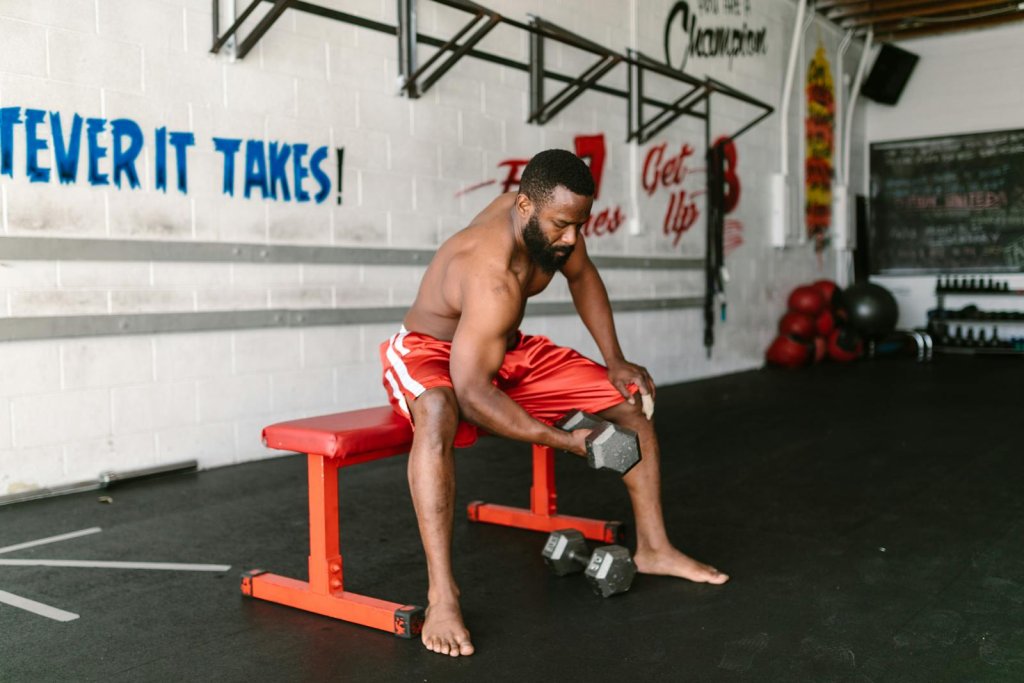
Understanding how to train the brachialis is important because this muscle contributes significantly to arm thickness and strength, yet it is often under-trained. The best approach is to combine neutral-grip, pronated-grip, and stabilized curl variations, which place more emphasis on the brachialis than traditional supinated biceps curls.
In this guide, you’ll learn the 12 most effective brachialis exercises, proper technique, safety guidelines, best training practices, and common questions.
What Is the Brachialis Muscle?
The brachialis is a deep muscle located underneath the biceps on the front of the upper arm. It is the body’s strongest elbow flexor and plays a major role in adding arm width and supporting pulling strength. Unlike the biceps, the brachialis works the same regardless of grip position, making it essential for balanced arm development.
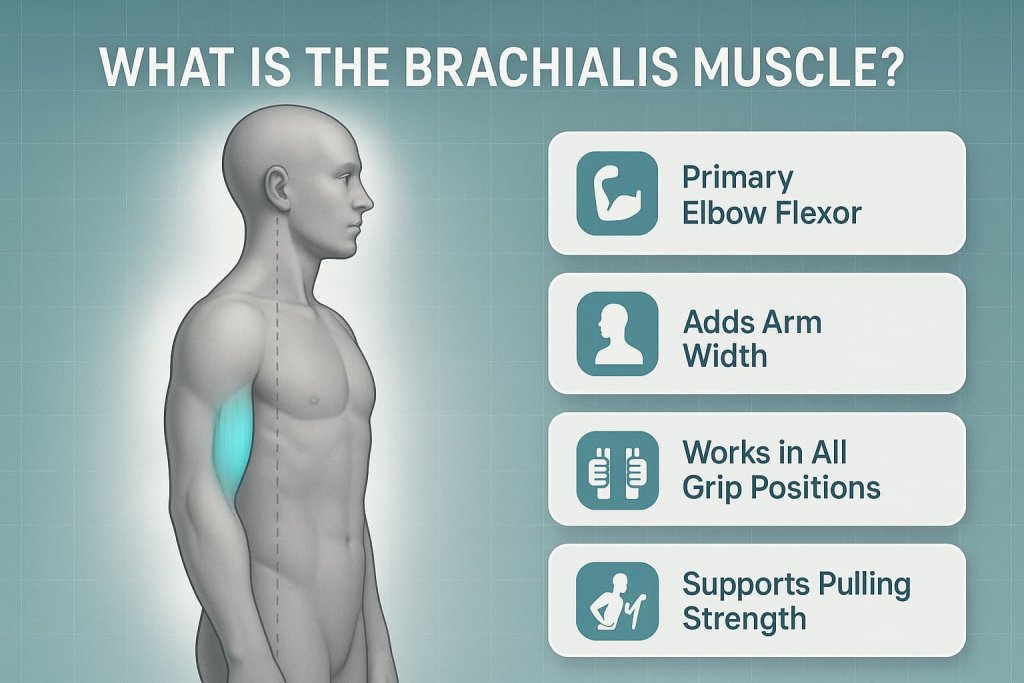
Key functions of the brachialis include:
- Producing pure elbow flexion
- Contributing to arm thickness and width
- Supporting pulling and gripping strength
- Working effectively in neutral and pronated curls
Why Brachialis Training Matters
The brachialis is the strongest elbow flexor, responsible for generating pure flexion force no matter how the forearm is positioned. Strengthening it may support:
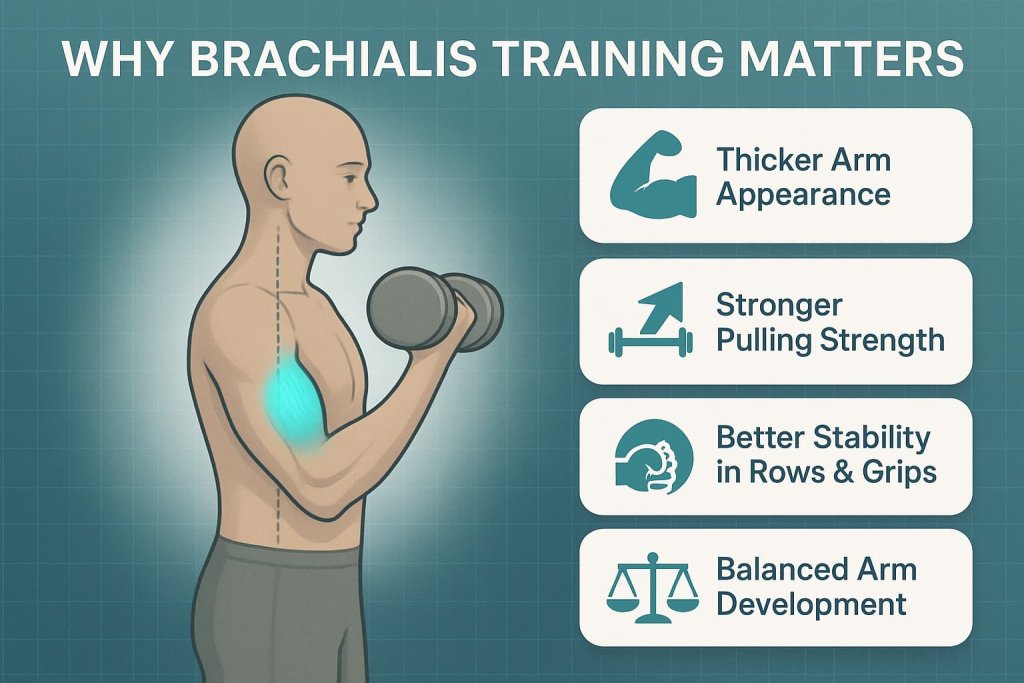
- Thicker upper-arm appearance (arm “width”)
- Stronger pulling and curling strength
- Improved stability in rows, pulls, and grip work
- Better arm balance between biceps, brachialis, and brachioradialis
Because the brachialis attaches to the ulna, it doesn’t assist with rotation. This is why exercises with neutral or pronated grip allow it to take more of the workload compared to the biceps.
12 Best Brachialis Exercises
These exercises use neutral- and pronated-grip curling patterns that place more tension on the brachialis than traditional supinated curls. Together, they help build thicker, wider arms and stronger elbow-flexion strength.
1. Hammer Curl (Dumbbell)
Why it works:
The neutral grip reduces biceps dominance and places greater mechanical tension on the brachialis and brachioradialis. This helps build thicker arms and stronger elbow-flexion strength.
Muscles worked:
Brachialis, brachioradialis, biceps brachii, forearm flexors.
How to do it:
- Stand tall holding dumbbells with palms facing each other.
- Keep elbows close to your torso.
- Curl the weights up without swinging.
- Lower slowly under control.
Trainer Tip:
Keep your wrists locked in a neutral position—bending the wrist reduces brachialis tension and shifts load away from deep flexors.
2. Cross-Body Hammer Curl
Why it works:
Curling diagonally across the body increases brachialis and brachioradialis engagement by changing the force angle and minimizing shoulder involvement.
Muscles worked:
Brachialis, brachioradialis, biceps short head, forearms.
How to do it:
- Hold a dumbbell with a neutral grip.
- Curl the weight across your torso toward the opposite shoulder.
- Lower with control without rotating your torso.
Trainer Tip:
Keep the movement tight and compact—large torso rotation reduces arm isolation.
3. Reverse Curl (Barbell or EZ-Bar)
Why it works:
The pronated (overhand) grip minimizes biceps contribution, shifting more workload to the brachialis and brachioradialis—excellent for arm “width.”
Muscles worked:
Brachialis, brachioradialis, forearm extensors, biceps (minimal).
How to do it:
- Grip the bar overhand, hands shoulder-width.
- Curl without letting your wrists bend or roll.
- Lower slowly for increased brachialis tension.
Trainer Tip:
Use lighter weight than your normal curl—reverse curls are harder due to forearm involvement.
4. Rope Hammer Curl (Cable)
Why it works:
Constant cable tension increases time under tension on the brachialis and reduces momentum, improving muscle activation.
Muscles worked:
Brachialis, brachioradialis, biceps, forearms.
How to do it:
- Attach a rope to a low pulley.
- Grip with palms facing each other.
- Curl up while separating the rope ends slightly.
- Lower under control.
Trainer Tip:
Lean back 2–3 degrees to keep the line of pull aligned with your elbow-flexion path.
5. Preacher Hammer Curl
Why it works:
The preacher bench eliminates swinging and shoulder involvement, placing nearly all tension on the brachialis and brachioradialis.
Muscles worked:
Brachialis, brachioradialis, biceps.
How to do it:
- Rest upper arms on the preacher pad.
- Hold dumbbells in neutral grip.
- Curl up slowly; pause briefly at the top.
- Lower fully for stretch.
Trainer Tip:
Avoid locking out completely at the bottom—keep slight tension to protect the elbow.
6. Zottman Curl
Why it works:
Supinated lifting targets the biceps, while the pronated lowering phase heavily loads the brachialis and brachioradialis eccentrically.
Muscles worked:
Brachialis, brachioradialis, biceps brachii, forearm flexors and extensors.
How to do it:
- Curl palms up.
- Rotate to a pronated grip at the top.
- Lower palms down slowly.
- Rotate back to start at the bottom.
Trainer Tip:
Use moderate weights—too heavy and you’ll lose control during the eccentric, which is the most important part.
7. Reverse Cable Curl (Straight Bar)
Why it works:
The smooth cable resistance prevents cheating and increases brachialis activation, especially during the top half of the curl.
Muscles worked:
Brachialis, brachioradialis, forearm extensors.
How to do it:
- Attach a straight bar to a low cable.
- Grip overhand and curl.
- Keep elbows pinned and wrists straight.
Trainer Tip:
For extra brachialis emphasis, pause for one second at the top.
8. Cross-Body Reverse Curl
Why it works:
Combining pronation + diagonal curling increases activation in the brachialis and forearm extensors while reducing biceps involvement.
Muscles worked:
Brachialis, brachioradialis, forearm extensors.
How to do it:
- Hold a dumbbell with an overhand grip.
- Curl across your torso to the opposite shoulder.
- Lower slowly without twisting your torso.
Trainer Tip:
Keep your elbow slightly in front of your hip for consistent tension throughout the movement.
9. Incline Hammer Curl
Why it works:
Starting from a stretched shoulder position increases brachialis tension through greater range of motion.
Muscles worked:
Brachialis, brachioradialis, biceps.
How to do it:
- Sit on an incline bench at 45–60 degrees.
- Let arms hang fully.
- Curl with palms facing each other.
- Lower slowly into full stretch.
Trainer Tip:
Avoid swinging—use slow tempo to maximize the stretch-loading effect.
10. Reverse Grip Concentration Curl
Why it works:
The single-arm, pronated setup isolates the brachialis and prevents momentum, making it highly effective with light weights.
Muscles worked:
Brachialis, brachioradialis, forearm extensors.
How to do it:
- Sit and rest your elbow on your thigh.
- Grip a light dumbbell overhand.
- Curl slowly toward your chest.
- Lower under control.
Trainer Tip:
Think about “pulling with the brachialis” by keeping the wrist locked and elbow fixed.
11. Cable Reverse Curl (EZ-Bar)
Why it works:
The EZ-bar grip reduces wrist strain while the cable provides continuous tension—perfect for high-rep brachialis work.
Muscles worked:
Brachialis, brachioradialis, forearm extensors.
How to do it:
- Attach an EZ-bar to a low cable.
- Grip with palms facing down.
- Curl smoothly through the full range.
- Lower slowly.
Trainer Tip:
Use higher reps (12–15+) to fully fatigue the deeper arm flexors.
12. Kettlebell Hammer Curl
Why it works:
The offset kettlebell load increases stabilizer activation in the brachialis and brachioradialis.
Muscles worked:
Brachialis, brachioradialis, biceps, forearms.
How to do it:
- Hold kettlebells by their handles with neutral grip.
- Curl slowly without letting kettlebells rotate.
- Lower with control.
Trainer Tip:
Rotate the kettlebell slightly inward at the bottom to feel a deeper brachialis stretch.
How to Train the Brachialis Effectively
Frequency
Most adults benefit from training elbow flexors 2–3 times per week, allowing rest between sessions.
Sets & Reps
- 3–4 sets per exercise
- 8–12 reps for muscle growth
- 12–15+ reps for cable or lighter variations
Tempo Tips
- Use a controlled eccentric (2–3 seconds)
- Avoid swinging or using momentum
- Keep elbows close to the body
Increase weight by 2–10% when you can exceed your rep target comfortably.
Common Mistakes That Reduce Brachialis Activation
- Using weights that are too heavy, causing swinging.
- Bending or rolling the wrists during curls.
- Flaring elbows outward instead of keeping them close.
- Relying on momentum rather than controlled reps.
- Skipping neutral- or pronated-grip curls.
These mistakes shift tension away from the brachialis and reduce training effectiveness.
Safety Guidelines for Brachialis Exercises
- Use a pain-free range of motion
- Keep wrists neutral—avoid excessive bending
- Start with lighter loads and increase gradually
- Stop training if you experience sharp pain
- Avoid overuse by varying grips and angles
- Seek professional advice if you have existing elbow or tendon issues
This content is for informational purposes only and not medical advice.
Who Should Avoid or Modify Brachialis Exercises
Short, clear guidance:
- Anyone with elbow pain, inflammation, or nerve irritation should reduce load or avoid high-tension curls.
- People with forearm tendon issues may need neutral-grip variations instead of pronated grips.
- Beginners should start with light dumbbells and cables before trying heavy barbell reverse curls.
FAQs About Brachialis Training
1. Does the brachialis actually make your arms look bigger?
Yes—developing the brachialis increases arm width, which makes the biceps appear fuller.
2. Is the hammer curl the best brachialis exercise?
It’s one of the most effective, but combining hammer + reverse curls works even better.
3. Should I train brachialis and biceps on the same day?
Yes. Most workouts combine both since they assist in elbow flexion.
4. Can beginners train the brachialis?
Absolutely—start with light hammer curls and cable variations.
5. How long until I see results?
Most lifters notice visible changes in 6–8 weeks with consistent training.
6. Does forearm position matter?
Yes—neutral and pronated grips shift more load to the brachialis.
7. Can I train brachialis at home?
Yes—dumbbells, kettlebells, and resistance bands all work well.
Conclusion
Training the brachialis is one of the fastest ways to build thicker, stronger, more powerful arms. By using neutral- and pronated-grip curl variations, controlling the tempo, and progressing safely, you can significantly improve arm width and elbow-flexion strength. Start with two to three movements per session and train consistently for the best results.
If you’re ready to build fuller arms, begin adding these exercises to your routine today.
References
- Anatomy, Shoulder and Upper Limb, Brachialis Muscle — StatPearls (2023)
Comprehensive overview of brachialis origin, insertion, innervation, and function as a prime elbow flexor. - Brachialis Muscle: Location, Origin, Insertion, Action — Kenhub
Clear anatomical description and visuals of the brachialis muscle. - Brachialis — Physio-Pedia
Practical anatomy and clinical relevance of the brachialis for movement and rehab. - ACSM Position Stand: Progression Models in Resistance Training for Healthy Adults — American College of Sports Medicine (2009)
Core evidence-based guidelines for sets, reps, frequency, and progression that you use in your training recommendations. - Evidence-Based Guidelines for Hypertrophy-Oriented Resistance Training — Brad J. Schoenfeld
Summarizes volume, intensity, and loading strategies to maximize muscle growth, supporting your brachialis programming section.