
If you’re searching for the best bicep workouts, here’s the short answer: the most effective exercises combine strict curling mechanics, multiple grip positions, and varied shoulder angles to maximize activation of the biceps brachii, brachialis, and brachioradialis. Research consistently shows that movements like concentration curls, dumbbell curls, incline curls, and EZ-bar curls rank among the top for muscle engagement and strength development.
Understanding how to train your biceps correctly is important because the muscle has two heads—the long head and the short head—and different exercise angles can emphasize each one. By varying grips, arm positions, and training loads, you support balanced strength, symmetry, and definition.
This guide breaks down the 15 best bicep exercises, proper form instructions, training tips, FAQs, and science-backed recommendations to help you build stronger, more defined arms safely and effectively.
Why Are the Best Bicep Workouts Important?
Choosing the best bicep workouts is essential because different exercises activate the biceps and supporting muscles in unique ways. When you use exercises that target both the long head and short head effectively, you build stronger, more balanced arms and reduce the risk of overuse or poor technique. High-quality bicep workouts also help you train efficiently, follow safe progression guidelines, and achieve better muscle definition without unnecessary strain.
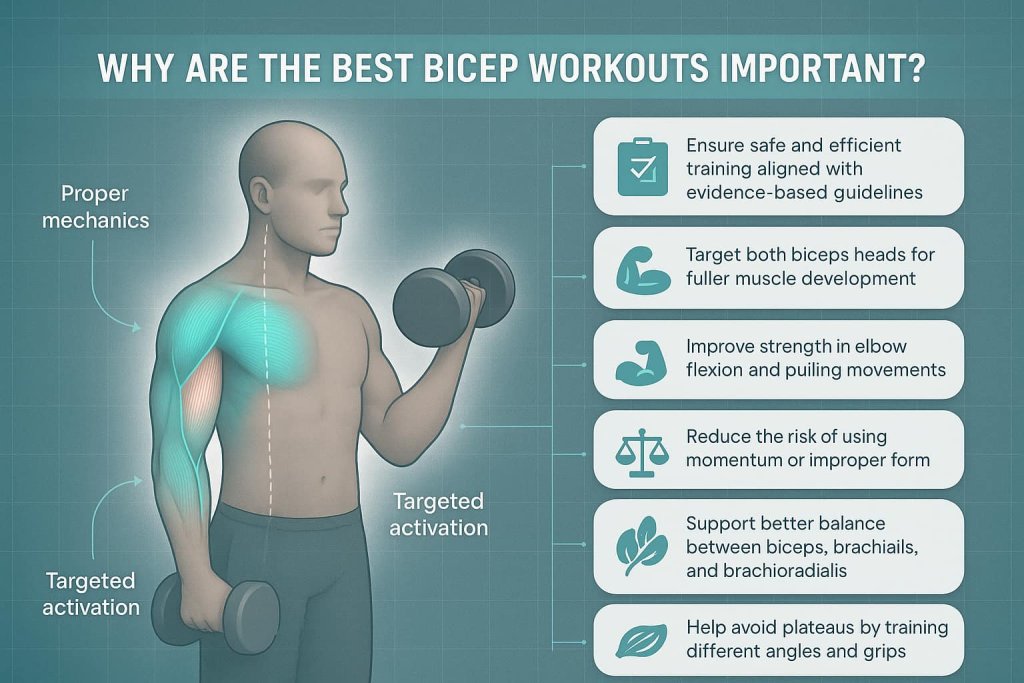
Key reasons the best bicep workouts matter include:
- Ensure safe and efficient training aligned with evidence-based guidelines
- Target both biceps heads for fuller muscle development
- Improve strength in elbow flexion and pulling movements
- Reduce the risk of using momentum or improper form
- Support better balance between biceps, brachialis, and brachioradialis
- Help avoid plateaus by training different angles and grips
- Increase muscle definition through consistent activation
15 Best Bicep Workouts for Strength & Definition
These exercises target every part of the biceps—including the long head, short head, brachialis, and brachioradialis—to build fuller, stronger, and more defined arms. Each movement is selected based on muscle activation, biomechanics, and evidence-based training principles to help you get the best results safely and efficiently.
1. Standing Barbell Curl
Why it works:
This exercise loads both arms simultaneously, allowing heavier weights and strong progressive overload. The standing position encourages full supination strength and helps develop total biceps thickness.
Muscles worked:
Biceps brachii (long & short head), brachialis, brachioradialis, forearms.
How to do it:
- Stand tall with feet shoulder-width apart.
- Hold a barbell with an underhand grip, arms fully extended.
- Curl the bar upward by bending your elbows—keep upper arms fixed.
- Squeeze the biceps at the top, then lower slowly under control.
Trainer Tip:
Do not lean back as the weight gets heavy. Keep your ribs down and elbows at your sides to maintain strict tension.
2. EZ-Bar Curl
Why it works:
The semi-supinated grip reduces wrist stress while still producing high activation in the biceps and brachioradialis, making it a joint-friendly alternative to the barbell curl.
Muscles worked:
Biceps brachii, brachialis, brachioradialis, forearms.
How to do it:
- Stand upright and grip the EZ-bar on the angled handles.
- Curl the bar toward your chest, keeping elbows close to your torso.
- Pause briefly, then lower the bar with full control.
Trainer Tip:
Use the “inner” angled grips if you want more biceps emphasis; use wider grips for more brachioradialis recruitment.
3. Dumbbell Bicep Curl (Standing or Seated)
Why it works:
Allows natural wrist rotation, helps minimize shoulder involvement, and promotes a strong mind-muscle connection. Each arm works independently, improving balance.
Muscles worked:
Biceps brachii, brachialis, brachioradialis.
How to do it:
- Hold dumbbells at your sides with palms facing forward.
- Curl both dumbbells up while keeping elbows anchored.
- Rotate slightly at the wrist if desired, then lower with control.
Trainer Tip:
Avoid shrugging your shoulders as you curl—keep them down and back to focus tension on the biceps.
4. Alternating Dumbbell Curl
Why it works:
Isolating one arm at a time increases stability and allows greater focus on form and contraction. Reduces torso swing by distributing load.
Muscles worked:
Biceps brachii, brachialis, brachioradialis.
How to do it:
- Stand tall holding dumbbells.
- Curl one arm upward while the other remains extended.
- Lower and switch sides in a steady rhythm.
Trainer Tip:
Pause briefly at the top of each rep to maximize peak contraction.
5. Incline Dumbbell Curl
Why it works:
Placing the arms behind the torso stretches the long head of the biceps, producing high tension during the bottom portion of the lift.
Muscles worked:
Biceps brachii (especially long head), brachialis.
How to do it:
- Set a bench to a 45–60° incline.
- Lie back with arms hanging straight down.
- Curl the dumbbells toward your shoulders without moving your upper arms.
- Lower slowly to feel the stretch.
Trainer Tip:
Use lighter weights than your standing curls—this variation significantly increases the difficulty.
6. Preacher Curl (Barbell or Dumbbell)
Why it works:
The fixed-arm position prevents cheating and isolates the elbow flexors, especially in the lower half of the range.
Muscles worked:
Biceps brachii, brachialis, brachioradialis (depending on grip).
How to do it:
- Sit on a preacher bench and rest your upper arms on the pad.
- Hold your bar or dumbbell with an underhand grip.
- Curl upward, pause at the top, and lower slowly.
Trainer Tip:
Stop the bar just before fully extending your elbows to protect your joint and maintain muscle tension.
7. Concentration Curl
Why it works:
Bracing the elbow eliminates momentum and shoulder involvement, making it one of the highest-activating biceps exercises.
Muscles worked:
Biceps brachii (peak emphasis), brachialis.
How to do it:
- Sit on a bench, spread your legs, and brace your elbow against your inner thigh.
- Curl the dumbbell upward in a slow, controlled motion.
- Lower until your arm is fully extended.
Trainer Tip:
Focus your eyes on the biceps during each rep—this improves mind-muscle engagement.
8. Standing Cable Curl
Why it works:
Provides constant tension throughout the lift, unlike free weights where tension varies. Great for hypertrophy and smooth execution.
Muscles worked:
Biceps brachii, brachialis, brachioradialis.
How to do it:
- Attach a straight bar or rope to a low cable.
- Stand close to the machine and grip the handle.
- Curl toward your chest while keeping elbows pinned.
- Lower slowly without letting the weight stack slam.
Trainer Tip:
Lean slightly forward to maintain tension and prevent your shoulders from rounding back.
9. Bayesian Cable Curl
Why it works:
This behind-the-body position places the biceps in an extended stretch, hitting the long head effectively and improving arm shape.
Muscles worked:
Biceps brachii (long head), brachialis.
How to do it:
- Set a cable to the lowest position and stand facing away from the stack.
- Hold the handle with your arm slightly behind your body.
- Curl forward without letting your elbow drift ahead.
- Return to the stretched starting position.
Trainer Tip:
Keep the movement light and strict—this exercise works best with precision, not heavy weight.
10. Hammer Curl
Why it works:
The neutral grip shifts more load onto the brachialis and brachioradialis, contributing to thicker, stronger upper arms.
Muscles worked:
Brachialis, brachioradialis, biceps brachii.
How to do it:
- Hold dumbbells with palms facing each other.
- Curl upward while maintaining the neutral grip.
- Lower until arms are fully extended.
Trainer Tip:
Imagine “pulling your thumbs up” toward the ceiling to maximize brachioradialis recruitment.
11. Cross-Body Hammer Curl
Why it works:
Curling toward the opposite shoulder increases time under tension and emphasizes the outer portion of the upper arm.
Muscles worked:
Brachialis, brachioradialis, biceps brachii.
How to do it:
- Hold dumbbells in a neutral grip.
- Curl one dumbbell diagonally toward the opposite shoulder.
- Lower and alternate sides.
Trainer Tip:
Slow down the eccentric (lowering) phase for added muscle stimulation.
12. Reverse Curl (EZ-Bar or Barbell)
Why it works:
The pronated grip reduces biceps involvement and shifts tension onto the forearms and brachioradialis, promoting balanced arm development.
Muscles worked:
Brachioradialis, brachialis, forearms, biceps (secondary).
How to do it:
- Grip the bar with an overhand (pronated) grip.
- Curl upward while keeping elbows fixed.
- Lower with slow, controlled movement.
Trainer Tip:
Start with lighter weight—this variation is harder than it looks due to forearm involvement.
13. Chin-Up (Underhand Grip)
Why it works:
The underhand grip places the biceps in a strong mechanical position during a large multi-joint movement, resulting in significant activation.
Muscles worked:
Biceps brachii, brachialis, upper back, lats, forearms.
How to do it:
- Grip the bar shoulder-width with palms facing you.
- Pull your chest toward the bar using your back and arm strength.
- Lower slowly to full extension.
Trainer Tip:
Avoid flaring elbows—keep them close to your ribs to increase biceps involvement.
14. Close-Grip Underhand Lat Pulldown
Why it works:
Mimics the chin-up motion but allows adjustable resistance, making it accessible for all strength levels with high biceps engagement.
Muscles worked:
Biceps brachii, brachialis, lats, upper back.
How to do it:
- Sit at the pulldown machine using a narrow underhand grip.
- Pull the bar toward your chest while keeping elbows tight.
- Slowly return the bar to the top.
Trainer Tip:
Lean slightly back (5–10°) to keep tension on the biceps rather than letting the shoulders dominate.
15. TRX / Suspension Biceps Curl
Why it works:
Uses your bodyweight as resistance and challenges stability, making it easily scalable for beginners or advanced users.
Muscles worked:
Biceps brachii, brachialis, forearms, core (stabilizers).
How to do it:
- Stand holding the handles with palms up.
- Step your feet forward to increase resistance.
- Lean back and extend your arms fully.
- Curl yourself toward the handles by flexing your elbows.
- Lower in a smooth, controlled motion.
Trainer Tip:
The steeper your angle, the harder the exercise. Adjust your feet to match your strength level.
How Many Sets, Reps, and Days Should You Train Biceps?
Evidence-Based Guidelines
According to ACSM and leading hypertrophy researchers:
- Frequency: 2 times per week
- Sets: 10–20 total weekly sets (6–12 directly for biceps + indirect pulling work)
- Reps:
- 8–12 reps for muscle growth
- 12–15+ reps for muscular endurance
- 4–8 reps for strength
- Rest: 1–2 minutes between sets for hypertrophy
- Progression: Increase weight by 2–10% when reps become easy
Quick Program Example
Day 1 – Strength Focus
- Barbell Curl – 4 × 6–8
- Hammer Curl – 3 × 10
- Chin-Ups – 3 × 6–10
Day 2 – Hypertrophy Focus
- Incline Dumbbell Curl – 3 × 10–12
- Cable Curl – 3 × 12–15
- Concentration Curl – 2 × 12
How to Get the Most Out of Your Bicep Workouts
Use Strict Form
Avoid swinging your torso. Keep elbows close to your body and move only your forearms.
Train With a Full but Comfortable Range of Motion
Lower the weight fully without shoulder discomfort, then curl smoothly.
Vary Angles and Grips
- Supinated (palms up) → Biceps long/short head
- Neutral (hammer) → Brachialis & brachioradialis
- Pronated (reverse) → Forearms & brachioradialis
Apply Progressive Overload
Increase weight, reps, or sets gradually to stimulate growth.
Balance Direct and Indirect Work
Pulling exercises like rows and pulldowns also strengthen biceps.
Allow Recovery
At least 48 hours between sessions for optimal muscle repair.
Common Mistakes in Bicep Workouts
- Using momentum instead of muscle control
- Lifting too heavy and losing technique
- Not fully extending the arm at the bottom
- Letting elbows flare forward
- Training biceps every day without rest
- Ignoring wrist alignment, causing strain
- Using only one type of curl or angle
Who Should Be Careful With Bicep Workouts?
You may need caution or modification if you:
- Have elbow tendon discomfort
- Experience shoulder pain during curling
- Recently had arm or tendon injuries
- Are new to strength training and require lighter loads
Always consult a qualified professional if unsure about exercise readiness.
FAQ — Bicep Workouts
1. How long does it take to see results?
Most people notice strength improvements within 3–4 weeks and visual changes in 6–8 weeks with consistent training.
2. How often should beginners train biceps?
1–2 sessions per week with low volume (6–8 total sets) is enough.
3. Are dumbbells or cables better for biceps?
Both are effective. Dumbbells help train natural motion; cables provide consistent tension.
4. Do bicep workouts burn arm fat?
No exercise can spot-reduce fat. Bicep training builds muscle, but fat loss requires consistent calorie control + overall activity.
5. Should I lift heavy or light for biceps?
Use moderate loads (8–12 reps) for hypertrophy, mixing in heavier sets for strength.
6. Is it okay to train biceps and back on the same day?
Yes. Many programs pair them because most back exercises also activate the biceps.
7. Do I need multiple angles to grow my biceps?
Yes. Different angles emphasize the long head, short head, and brachialis for balanced development.
Conclusion
The best bicep workouts combine controlled movement, varied grips, and smart programming. By using these 15 exercises and following evidence-based guidelines, you’ll build stronger, more defined arms with balanced strength. Start with strict curls, incorporate incline and preacher variations, and progress slowly for long-term results.
References
- American College of Sports Medicine. Progression Models in Resistance Training for Healthy Adults.
- Physical Activity Guidelines for Americans, 2nd Edition. U.S. Department of Health and Human Services.
- Centers for Disease Control and Prevention (CDC). Physical Activity Basics – Adults.
- Marcolin G, et al. Differences in electromyographic activity of biceps brachii and brachioradialis while performing three variants of curl. Journal of Sports Science & Medicine.
- American Council on Exercise (ACE). ACE Study Reveals Best Biceps Exercises.
- Parpa K, et al. An Exploratory Study of Biceps Brachii Electromyographic Activity during Traditional and Bayesian Cable Curls.
- Schoenfeld BJ, Grgic J, et al. Loading Recommendations for Muscle Strength, Hypertrophy, and Local Endurance: A Re-Examination of the Repetition Continuum.
- Cleveland Clinic. What Is Strength Training and Its Benefits?