
The best foot exercises for seniors help improve balance, strengthen weak muscles, and support safer, more comfortable walking. These simple movements may also help reduce stiffness, enhance mobility, and improve overall lower-body stability.
As we age, foot and ankle strength naturally declines, which can affect balance, walking, and confidence. Gentle, senior-friendly exercises can help improve strength, flexibility, and circulation while reducing fall risk.
This guide covers safe foot exercises for seniors, key safety tips, and expert-backed advice to support mobility and independence.
What Are Foot Exercises for Seniors?
Foot exercises for seniors are gentle movements designed to strengthen the muscles of the feet and ankles, improve flexibility, and support safer, more stable walking. These exercises focus on simple actions like toe movements, ankle mobility, and balance work that help counter the natural decline in strength and joint motion that occurs with age.
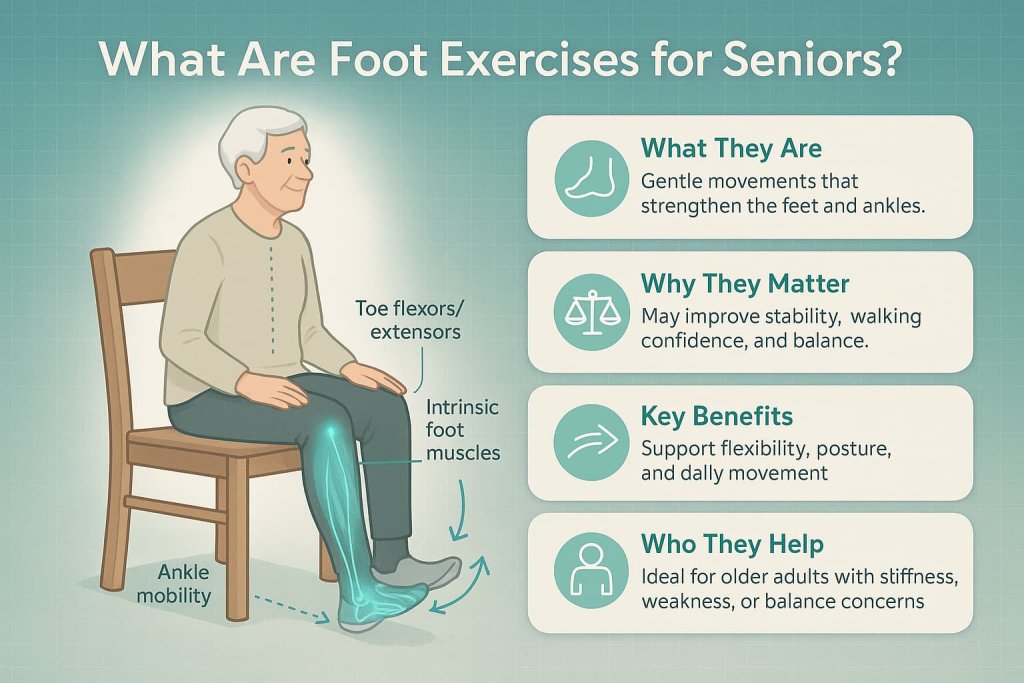
Strong, flexible feet play an essential role in maintaining balance, preventing stumbles, and supporting daily activities such as standing, climbing stairs, and walking on uneven surfaces. For seniors, foot exercises are especially valuable because they:
- Help maintain muscle strength in the toes, arches, and lower legs
- Improve ankle mobility needed for smooth, confident steps
- Support better posture and alignment
- May reduce stiffness or discomfort from age-related changes
- Contribute to overall stability and fall-prevention strategies
These exercises are safe, low-impact, and can be done at home using a chair or counter for support—making them accessible for most older adults.
The 10 Best Easy Foot Exercises for Seniors
These gentle, low-impact exercises help strengthen the feet and ankles to support better balance, stability, and walking comfort. Each movement is simple, safe, and suitable for seniors at any fitness level.
1. Toe Raise, Point & Curl (Mobility + Strength)
Why it works:
This sequence improves toe mobility, warms up the small joints of the feet, and activates the intrinsic foot muscles that support balance and arch stability.
Muscles worked:
Toe flexors, toe extensors, intrinsic foot muscles, plantar fascia.
How to do it:
- Sit tall with feet flat on the floor.
- Lift your toes upward (raise).
- Point your toes forward (extend).
- Curl your toes gently downward (flex).
- Move slowly through each phase.
- Repeat 8–12 times.
Trainer Tip:
Avoid gripping too hard—focus on smooth, controlled movement to build coordination.
2. Towel Scrunches (Intrinsic Foot Strength)
Why it works:
Builds strength in the arch and toes, helping support foot stability during walking and standing.
Muscles worked:
Flexor digitorum longus, flexor hallucis longus, intrinsic arch muscles.
How to do it:
- Sit with feet bare.
- Place a small towel on the floor.
- Curl your toes to pull the towel toward you.
- Repeat for 30–60 seconds.
- Switch feet.
Trainer Tip:
If the towel is too easy, place a small weight on the end for added resistance.
3. Marble Pickups (Dexterity + Strength)
Why it works:
Improves toe coordination, grip strength, and neuromuscular control—all helpful for balance and foot awareness.
Muscles worked:
Intrinsic foot muscles, toe flexors, forefoot stabilizers.
How to do it:
- Place 8–10 marbles on the floor.
- Use your toes to pick up each marble.
- Drop them into a small container.
- Switch sides after finishing.
Trainer Tip:
If marbles are difficult, start with larger objects like small stones or cotton balls.
4. Ankle Circles (Joint Mobility)
Why it works:
Improves ankle joint lubrication and restores motion, helping seniors walk more smoothly and prevent stiffness.
Muscles worked:
Ankle stabilizers, tibialis anterior, gastrocnemius/soleus (light engagement).
How to do it:
- Sit or stand and lift one foot.
- Rotate the ankle slowly clockwise.
- Then rotate counterclockwise.
- Perform 10 circles per direction.
- Switch sides.
Trainer Tip:
Keep the movement slow and controlled—avoid letting the leg swing.
5. Ankle Pumps (Circulation + Mobility)
Why it works:
Helps improve circulation in the lower legs, reduces stiffness, and gently strengthens the ankle.
Muscles worked:
Tibialis anterior, gastrocnemius, soleus.
How to do it:
- Sit comfortably with legs extended or feet on the floor.
- Point your toes away.
- Pull your toes back toward your shin.
- Repeat 15–20 times per foot.
Trainer Tip:
Great for mornings or after long sitting—add to daily routine to reduce swelling.
6. Heel Raises (Calf Strength + Balance Support)
Why it works:
Strengthens the calves, which are essential for push-off during walking and improving overall balance.
Muscles worked:
Gastrocnemius, soleus, intrinsic foot stabilizers.
How to do it:
- Stand behind a chair or counter.
- Hold lightly for balance.
- Lift your heels off the floor.
- Pause for one second at the top.
- Lower slowly.
- Perform 10–15 repetitions.
Trainer Tip:
Stay tall—don’t lean forward; think of rising straight up like an elevator.
7. Toe Raises (Dorsiflexion Strength)
Why it works:
Strengthens the muscles that lift the toes—important for preventing tripping and improving step clearance.
Muscles worked:
Tibialis anterior, toe extensors.
How to do it:
- Stand with hands on a counter for support.
- Keep your heels on the ground.
- Lift your toes upward toward your shins.
- Lower with control.
- Repeat 10–15 times.
Trainer Tip:
If standing is difficult, start seated and progress to standing over time.
8. Toe–Heel Walks (Coordination + Balance)
Why it works:
Trains both the front and back of the lower leg, improves balance, and increases confidence during walking.
Muscles worked:
Tibialis anterior, gastrocnemius/soleus, intrinsic foot muscles.
How to do it:
- Walk forward on your toes for 10 steps.
- Walk backward on your heels for 10 steps.
- Use a wall or counter lightly if needed.
Trainer Tip:
For beginners, reduce to 5 steps or perform near a stable surface for safety.
9. Supported One-Leg Stance (Balance Training)
Why it works:
Strengthens ankle stabilizers and improves balance—critical for preventing falls.
Muscles worked:
Ankle stabilizers, tibialis posterior, peroneals, core muscles (light engagement).
How to do it:
- Hold a counter gently.
- Lift one foot an inch off the floor.
- Balance for 10–15 seconds.
- Switch sides.
- Repeat 2–3 rounds.
Trainer Tip:
Progress by reducing hand support or holding longer as balance improves.
10. Seated Plantar Fascia Stretch (Arch Mobility)
Why it works:
Gently stretches the arch, helps relieve stiffness, and promotes healthier foot mechanics.
Muscles worked:
Plantar fascia, calf muscles, toe flexors.
How to do it:
- Sit tall and cross one foot over the other knee.
- Hold the toes and pull them back toward your shin.
- Hold 15–20 seconds.
- Repeat 2–3 times per foot.
Trainer Tip:
For a deeper stretch, massage the arch with your thumb before or after holding the stretch.
How Often Should Seniors Do Foot Exercises?
- 2–3 times per week for strengthening exercises
- Daily for gentle mobility and stretching
- Consistency matters more than intensity
- Most exercises take only 5–10 minutes
Even small improvements in foot strength can translate into better balance and more confident walking.
Why Foot Exercises Matter for Seniors
Regular foot exercises may help support balance, mobility, and stability—especially important as adults over 60 often experience:
- Reduced ankle and foot strength
- Lower flexibility, especially in calves and arches
- Slower walking speed or toe-dragging
- Higher risk of stumbles or falls
- Foot discomfort from aging, arthritis, or poor footwear
Research highlights that strengthening foot and ankle muscles can support:
- Improved ankle plantarflexion and dorsiflexion
- Better balance with eyes open
- Greater step stability
- Increased confidence in walking
While exercises do not cure medical conditions, they support functional strength and better movement when practiced consistently.
Safety Guidelines Before Starting Foot Exercises
Seniors should follow these guidelines to ensure safe practice:
- Sit in a sturdy chair or use a countertop for support.
- Wear non-slip shoes unless the exercise requires bare feet.
- Move slowly and avoid pushing into sharp pain.
- Start with fewer repetitions and gradually increase.
- Stop if dizziness, numbness, or unusual swelling occurs.
- Speak with a healthcare professional if you have neuropathy, foot ulcers, severe arthritis, recent injury, or balance concerns.
When to See a Healthcare Professional
Seniors should seek medical guidance if they experience:
- Persistent foot pain or swelling
- Numbness or tingling (possible neuropathy)
- Frequent falls or severe balance problems
- Loss of foot strength
- Foot deformities or ulcers
- Difficulty walking that worsens over time
A physical therapist can provide personalized exercises suited to medical needs.
FAQ: Foot Exercises for Seniors
1. How long does it take to see results?
Most seniors notice improvements in 2–6 weeks with consistent practice.
2. Can foot exercises help with balance?
They may help improve balance and stability by strengthening foot and ankle muscles.
3. Should seniors exercise barefoot?
Barefoot is fine for seated exercises. Standing exercises should use supportive, non-slip shoes unless supervised.
4. Are these exercises safe for arthritis?
Most gentle mobility exercises are safe, but seniors with severe arthritis should consult a healthcare provider.
5. Do these exercises reduce fall risk?
They may support better balance, but they do not guarantee fall prevention. They should be combined with full-body balance and strength training.
6. Are these exercises okay for seniors with diabetes?
Yes, but seniors with neuropathy or ulcers should consult a doctor or podiatrist first.
7. How many repetitions should beginners start with?
Start with 8–10 reps and increase gradually based on comfort.
Conclusion
Foot exercises for seniors are a simple, effective way to support balance, walking comfort, and confidence. By practicing these gentle movements regularly, seniors may strengthen their feet, improve flexibility, and maintain independence. For best results, combine these exercises with whole-body strength and balance training.
Take the next step today—start with two or three exercises and build up gradually.
References
- Liang SG, et al. The Effects of Ankle and Foot Exercises on Ankle Strength, Balance, and Falls in Older People: A Systematic Review and Meta-Analysis. Physical Therapy, 2025.
- Futrell E, et al. The Effects of Intrinsic Foot Muscle Strengthening on Foot Structure and Fall Risk in Older Adults: A Randomized Controlled Trial. Frontiers in Aging, 2025.
- Bok SK, et al. The Effects of Changes of Ankle Strength and Range of Motion on Balance Ability in Older Adults. Annals of Rehabilitation Medicine, 2013.
- Hernández-Guillén D, et al. Association Ankle Function and Balance in Community-Dwelling Older Adults. PLOS One, 2021.
- Spink MJ, et al. Foot and Ankle Strength, Range of Motion, Posture, and Deformity Are Associated With Balance and Functional Ability in Older Adults. Archives of Physical Medicine and Rehabilitation, 2011.
- Okamura K, et al. Effects of Plantar Intrinsic Foot Muscle Strengthening on Static Foot Alignment and Foot Kinematics During Gait. Gait & Posture, 2020.
- Abd El-Kader SM, et al. Ankle Dorsiflexors Strength Improves Balance Performance in Elderly: A Correlational Study. European Journal of General Medicine, 2014.
- Centers for Disease Control and Prevention (CDC). Physical Activity Guidelines for Older Adults.