
The best resistance band lat exercises are rows, pulldowns, pullovers, and vertical–horizontal pulling variations that directly target the latissimus dorsi for strength and muscle growth.
These band movements mimic the same pulling patterns used in cable and machine training—making them highly effective for building a wider, stronger back at home.

Understanding how these exercises work helps you train more efficiently and safely. Resistance bands are joint-friendly, portable, and backed by research showing they can build strength comparable to free weights when intensity is matched.
In this guide, you’ll learn the 10 best resistance band lat exercises, step-by-step technique, benefits, variations, and tips to activate your lats more effectively.
Why Resistance Band Lat Exercises Work (Research-Backed)
Studies show resistance bands can produce similar strength gains to weight machines and free weights when tension and volume are matched .
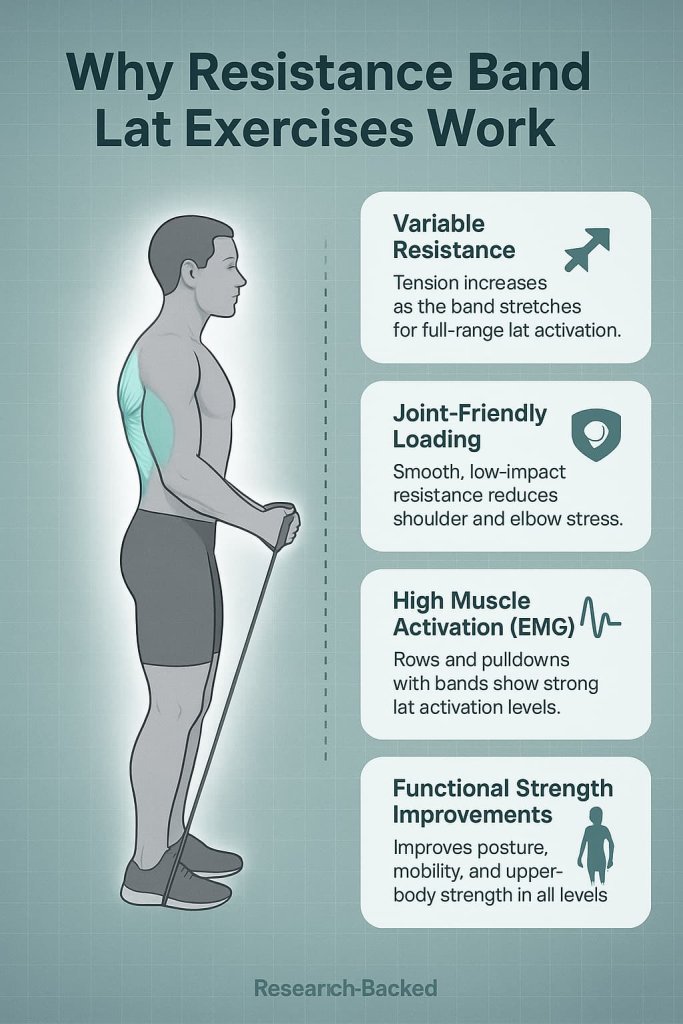
Bands provide:
- Variable resistance — tension increases as the band stretches, challenging the lats through the full range of motion.
- Joint-friendly loading — smoother resistance reduces shoulder and elbow stress.
- High activation levels — EMG research shows band rows and pulldown patterns can reach high muscle activation levels when the band tension is strong.
- Functional strength improvements — systematic reviews show improvements in posture, mobility, and upper-body strength in various populations.
10 Best Resistance Band Lat Exercises
A home-friendly alternative to the cable pulldown that strongly targets the lats through a full overhead pulling motion. Great for building width and improving shoulder stability.
1. Standing Resistance Band Lat Pulldown
Why it works:
This movement closely replicates a cable lat pulldown, placing the lats under strong tension through shoulder extension. The overhead pulling angle stretches the lats at the top and maximizes activation at the bottom of the pull. It’s especially effective for home workouts because it allows a full range of motion without machines.
Muscles worked:
Lats, teres major, mid-back stabilizers, rear delts, lower traps, core (as stabilizer).
How to do it:
- Anchor the band securely overhead (door anchor, pull-up bar, beam).
- Kneel or stand tall with arms extended upward holding the handles.
- Brace your core and keep your ribs down.
- Pull your elbows down and slightly back toward your ribcage.
- Pause at the bottom to feel your lats contract.
- Slowly return to the starting position with full control.
Trainer Tip:
Lean your torso forward just 10–15 degrees—this gives you more stretch at the top and helps you feel your lats engaging instead of your arms.
2. Single-Arm Kneeling Band Pulldown
Why it works:
Training one side at a time deepens lat activation, improves symmetry, and reduces strength imbalances. This unilateral movement also forces the core to stabilize your torso against rotation.
Muscles worked:
Lats (isolated per side), teres major, obliques, core stabilizers.
How to do it:
- Kneel under the overhead anchor point.
- Grab the band with one hand, arm extended upward.
- Pull your elbow down in a straight path toward your hip.
- Keep wrist and forearm neutral.
- Slowly raise your arm back to the start without shrugging your shoulder.
Trainer Tip:
Imagine putting your elbow “into your back pocket.” This cue maximizes lat contraction.
3. Standing Resistance Band Row
Why it works:
A classic horizontal pull that strongly engages the lats while also activating the mid-back muscles. It’s one of the best at-home back-builders because it creates constant tension through the full pull.
Muscles worked:
Lats, rhomboids, rear delts, mid traps, biceps, spinal stabilizers.
How to do it:
- Anchor the band at chest height.
- Step back to create tension and stand tall.
- Pull the handles toward your ribcage, elbows close to your sides.
- Keep shoulders down and back.
- Slowly extend your arms forward without losing posture.
Trainer Tip:
Think of initiating the row by driving your elbows back—not pulling with your hands. This keeps the lats working harder.
4. Bent-Over Underhand Band Row
Why it works:
The underhand (supinated) grip increases the lats’ range of motion and places more emphasis on the lower lats. The bent-over position also mimics a barbell row, activating stabilizers and improving posture strength.
Muscles worked:
Lats, lower traps, rear delts, erector spinae, biceps.
How to do it:
- Stand on the band with feet hip-width apart.
- Hold handles underhand with arms extended.
- Hinge forward at the hips while keeping your back straight.
- Pull handles toward your hips, leading with your elbows.
- Lower the handles slowly to full stretch.
Trainer Tip:
Aim your elbows toward your hips, not your ribs—this keeps the lower lats engaged.
5. Resistance Band Straight-Arm Pulldown
Why it works:
This isolates the lats by removing elbow flexion, forcing the shoulders to do the work. It’s one of the best lat-shaping exercises for improving the V-taper look.
Muscles worked:
Lats, serratus anterior, long head of triceps (stabilizer), core.
How to do it:
- Anchor the band overhead.
- Stand tall with arms fully extended.
- Keep elbows locked and pull the band downward toward your thighs.
- Maintain slight forward lean without rounding your back.
- Return to the top slowly, keeping arms straight.
Trainer Tip:
If you feel this in your triceps, your elbows are bending—keep them fixed to isolate the lats.
6. Seated Resistance Band Row
Why it works:
Sitting stabilizes your lower body so your upper back and lats do all the work. It creates a smooth, controlled pulling pattern ideal for beginners and advanced lifters.
Muscles worked:
Lats, rhomboids, mid traps, rear delts, biceps.
How to do it:
- Sit with legs extended and loop the band around your feet.
- Sit tall with your chest lifted.
- Pull the handles toward your torso while squeezing your back muscles.
- Slowly extend your arms forward.
Trainer Tip:
Keep your torso completely still—don’t lean back. Movement should come only from your arms and shoulder blades.
7. Resistance Band Lat-Focused High Row
Why it works:
Pulling from a higher angle shifts emphasis to the upper lats and upper-mid back. This helps build width and improves the “V-shape.”
Muscles worked:
Upper lats, rear delts, rhomboids, mid traps.
How to do it:
- Anchor the band slightly above chest height.
- Grab handles with elbows elevated.
- Pull elbows outward and back in a high row path.
- Pause at the back before returning with control.
Trainer Tip:
Aim your elbows toward the upper corners of the room to keep the angle correct for the lats.
8. Single-Arm Resistance Band Row
Why it works:
Unilateral rowing increases core activation and helps correct muscular imbalances. It also allows deeper stretch and contraction for each lat.
Muscles worked:
Lats, obliques, rhomboids, scapular stabilizers.
How to do it:
- Anchor band at chest height.
- Stand with feet staggered.
- Row with one arm while keeping your chest squared forward.
- Slowly extend the arm to full stretch.
Trainer Tip:
Do not rotate your torso—your core should prevent twisting to keep focus on the lats.
9. Standing Resistance Band Pullover
Why it works:
Provides a long range of motion that strongly targets the lower and mid-lats. Similar to a cable pullover, it helps develop width and improves lat engagement for beginner lifters.
Muscles worked:
Lats, long head of triceps (as stabilizer), core, serratus.
How to do it:
- Anchor the band overhead.
- Hold both handles with arms slightly bent.
- Pull the band downward in an arc toward your hips.
- Pause briefly, then return upward under control.
Trainer Tip:
Keep your elbows fixed in one position—don’t turn it into a triceps press-down.
10. Band-Assisted Pull-Up
Why it works:
Ideal for beginners, the band reduces body weight so you can perform full-range pull-ups with proper form. Pull-ups are one of the highest lat-activation exercises available.
Muscles worked:
Lats, teres major, biceps, forearms, core stabilizers.
How to do it:
- Loop a thick band over the pull-up bar.
- Place one knee or foot inside the band loop.
- Grip the bar slightly wider than shoulder width.
- Pull your chest toward the bar with controlled motion.
- Lower slowly for maximum muscle recruitment.
Trainer Tip:
Focus on controlling the eccentric (lowering) phase—this builds lat strength faster than just the upward pull.
How Often Should You Train Lats with Resistance Bands?
According to ACSM strength-training recommendations:
- 2–3 days per week per muscle group
- 2–4 sets per exercise
- 8–12 reps for strength and muscle
- 60–90 seconds rest between sets
For optimal growth:
Train lats twice weekly, hitting 3–5 exercises each session.
How to Warm Up Before Resistance Band Lat Workouts
A proper warm-up protects your shoulders, lats, and upper back from strain. It prepares the joints for pulling movements and improves muscle activation so you feel the lats working more effectively. Aim for 2–4 minutes of gentle, controlled movements before starting your lat exercises.
Try this simple warm-up routine:
- Arm Circles – 10–12 each direction
Loosens the shoulder joint and increases blood flow. - Shoulder Rolls – 10 slow rolls
Prepares the traps and rear delts for pulling movements. - Cat–Cow or Spine Mobilization – 6–8 reps
Warms the upper back and helps maintain good posture during rows. - Band Pull-Aparts (light band) – 10–12 reps
Activates the rear delts, rhomboids, and mid-back muscles. - Lat Reach Stretch – 15–20 seconds each side
Gently stretches the lats to improve range of motion before training.
Warm-Up Safety Tips
- Move slowly and avoid aggressive stretching.
- Stop if you feel sharp pain or numbness.
- Use a light band only—this is activation, not strength work.
Common Mistakes to Avoid
Keeping your form clean helps the lats work harder and reduces injury risk. Avoid these frequent errors:
Ignoring pain
Stop immediately if you feel sharp or unusual discomfort.
Using a band that’s too light
If the last reps feel easy, increase tension.
Pulling with your arms instead of your lats
Lead with your elbows, not your hands.
Shrugging your shoulders
Keep shoulders down to avoid overusing the traps.
Letting the band go slack
Maintain tension from start to finish.
Leaning back or using momentum
Move slowly and keep your torso stable.
Shortening the range of motion
Fully extend and fully pull for proper activation.
Who Should Avoid or Modify These Exercises
Most people can safely perform resistance band lat exercises, but certain individuals may need to avoid or adjust specific movements for safety. Listening to your body is essential, especially when working the shoulders and upper back.
You should avoid or modify these exercises if you:
- Have active shoulder injuries
Such as rotator cuff tears, labrum issues, or severe shoulder impingement. - Experience sharp pain during pulling movements
Pain during rows or pulldowns may indicate joint irritation. - Have uncontrolled upper-back or neck pain
Pulling exercises can increase strain if symptoms are not stable. - Recently underwent surgery
Particularly shoulder, spine, or upper-arm procedures. - Have limited overhead mobility
Modify overhead pulldowns to chest-height rows until mobility improves.
Safe Modifications
- Reduce band tension or use a lighter band.
- Perform seated variations to reduce core demand.
- Shorten range of motion if you feel discomfort.
- Switch to chest-height rows if overhead pulls irritate the shoulders.
Medical Guidance Note
If you have a diagnosed condition, chronic pain, or previous injury, consult a physical therapist or healthcare professional before starting new exercises.
Common Questions (FAQ)
1. Can resistance bands build lat muscle?
Yes. Research shows elastic resistance can produce strength gains similar to weights when tension is high and sets are taken close to fatigue.
2. How many lat exercises should I do per session?
Choose 3–5 exercises per workout targeting horizontal pulls, pulldowns, and pullovers.
3. Are band lat exercises good for beginners?
Absolutely. Bands offer smooth, joint-friendly resistance and can be adjusted easily.
4. What band tension is best for back growth?
A medium-to-heavy band works best. The last 2–3 reps should feel challenging.
5. Can I replace gym machines with resistance bands?
Yes—especially for rows and pulldown patterns, which are nearly identical when using anchored bands.
6. How long does it take to see results?
Most people see noticeable strength and posture improvements in 4–6 weeks with consistent training.
Conclusion
Resistance band lat exercises are one of the most effective ways to build a stronger, wider back at home. They are portable, beginner-friendly, and supported by research showing they can match traditional strength training when tension and effort are high. Include these 10 best exercises in your weekly routine, train your lats 2–3 times per week, and progress your band tension over time to keep improving.
References
- Lopes JSS, Machado AF, Micheletti JK, et al.
Effects of training with elastic resistance versus conventional resistance on muscular strength: A systematic review and meta-analysis. - Lopes JSS, et al.
Training with elastic resistance: Systematic review and meta-analysis. - Meng Y, Wang Q, Liu Z, et al.
Effects of elastic band resistance training on lower limb muscle strength and balance in older adults: A systematic review and meta-analysis of randomized controlled trials. - American College of Sports Medicine.
American College of Sports Medicine position stand: Progression models in resistance training for healthy adults. - American College of Sports Medicine.
Physical Activity Guidelines & Resources for Adults. - US Department of Health and Human Services.
Physical Activity Guidelines for Americans, 2nd edition. - Lehman GJ, Buchan DD, Lundy A, Myers N, Nalborczyk A.
Variations in muscle activation levels during traditional lat pull-down exercise. - Buonsenso A, et al.
Electromyographic analysis of back muscle activation during lat pulldown exercise: Effects of grip variations and forearm orientation.