
Yes, resistance band shoulder exercises can effectively strengthen your deltoids, rotator cuff, and upper-back muscles while keeping your joints safe. These exercises use variable resistance to build stability and mobility—key for preventing discomfort and improving posture.

Understanding how resistance band shoulder exercises work is important because the shoulder is a highly mobile and easily irritated joint. With the right technique, bands offer a low-impact, joint-friendly way to train at home, match major fitness guidelines, and support long-term shoulder health. In this guide, you’ll learn the benefits, warm-up steps, safety essentials, and the 12 best exercises to get stronger safely.
Why Resistance Band Shoulder Exercises Matter
Resistance band shoulder exercises matter because they strengthen the muscles that stabilize the shoulder joint without placing heavy stress on your tendons or joints.
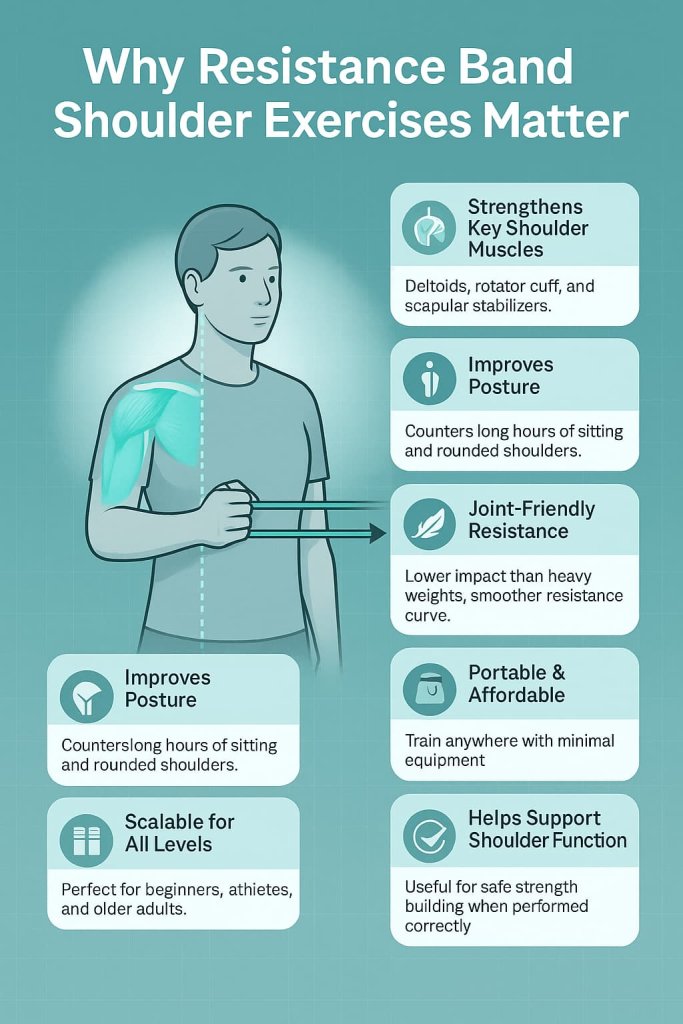
Key benefits include:
- Strengthen the deltoids, rotator cuff, and upper-back stabilizers
- Improve posture by targeting muscles weakened by long hours of sitting
- Provide joint-friendly resistance that’s easier to control than weights
- Offer scalable tension suitable for beginners, lifters, and older adults
- Improve shoulder mobility and stability needed for daily movement
- Portable, affordable, and ideal for home workouts
- Helpful for supporting healthy shoulder function when used correctly
12 Best Resistance Band Shoulder Exercises
These 12 resistance band shoulder exercises strengthen your deltoids, rotator cuff, and upper-back muscles using safe, joint-friendly tension. They’re beginner-friendly, require minimal equipment, and help improve posture, stability, and everyday shoulder function.
1. Standing Resistance Band Shoulder Press
Why it works:
Builds full shoulder strength and trains your core to stay stable during overhead movement.
Muscles worked:
Front delts, side delts, triceps, upper traps, core.
How to do it:
- Stand on the band with feet hip-width apart.
- Hold handles at shoulder height, palms facing forward.
- Brace your core and press upward.
- Lower slowly with control.
Trainer Tip:
If your lower back arches, step one foot forward or perform seated.
2. Resistance Band Front Raise
Why it works:
Targets the anterior delts through a controlled shoulder-flexion pattern.
Muscles worked:
Front delts, upper chest.
How to do it:
- Stand on the band and hold it in front of your thighs.
- Raise arms to shoulder height with a slight elbow bend.
- Lower slowly.
Trainer Tip:
Stop at shoulder level to avoid unnecessary strain.
3. Resistance Band Lateral Raise
Why it works:
Isolates the side delts, helping build rounded, stable shoulders.
Muscles worked:
Lateral delts, upper traps (lightly).
How to do it:
- Stand on the band, arms at your sides.
- Raise arms outward to shoulder height.
- Lower with control.
Trainer Tip:
Lead with elbows, not hands, to keep tension on the delts.
4. Resistance Band Upright Row
Why it works:
Strengthens the upper traps and delts, improving shoulder elevation strength.
Muscles worked:
Traps, delts, biceps.
How to do it:
- Stand on the band and hold it in front of your thighs.
- Pull elbows upward toward chest height.
- Lower slowly.
Trainer Tip:
Keep elbows higher than wrists for better shoulder alignment.
5. Band Pull-Aparts
Why it works:
Strengthens rear delts and upper-back muscles that support posture.
Muscles worked:
Rear delts, rhomboids, mid traps.
How to do it:
- Hold a loop band at chest level.
- Pull hands outward while squeezing your shoulder blades.
- Return slowly.
Trainer Tip:
Keep ribs down and avoid leaning back.
6. Resistance Band Face Pull
Why it works:
One of the best exercises for rotator cuff and rear delt strength.
Muscles worked:
Rear delts, external rotators, mid traps.
How to do it:
- Anchor band at face height.
- Pull elbows back and apart toward your face.
- Squeeze shoulder blades.
Trainer Tip:
Keep shoulders away from ears to avoid trap dominance.
7. Bent-Over Reverse Fly with Band
Why it works:
Strengthens the upper back and rear shoulders—key for stability.
Muscles worked:
Rear delts, rhomboids, mid traps.
How to do it:
- Stand on the band and hinge forward.
- Raise arms outward in a wide arc.
- Lower slowly.
Trainer Tip:
Keep your spine neutral—avoid rounding your back.
8. Standing Resistance Band Row
Why it works:
Supports shoulder alignment by training scapular retraction.
Muscles worked:
Mid traps, rhomboids, lats, rear delts.
How to do it:
- Anchor band at chest height.
- Pull elbows backward.
- Squeeze shoulder blades, then release.
Trainer Tip:
Keep your torso tall—don’t lean backward.
9. External Rotation with Resistance Band
Why it works:
Strengthens the rotator cuff muscles responsible for shoulder stability.
Muscles worked:
Infraspinatus, teres minor.
How to do it:
- Stand sideways to anchor.
- Tuck elbow at your side.
- Rotate forearm outward.
- Return slowly.
Trainer Tip:
Use a light band—this is about control, not power.
10. Internal Rotation with Resistance Band
Why it works:
Balances the shoulder by strengthening internal rotators.
Muscles worked:
Subscapularis, pec major, lats (assist).
How to do it:
- Stand sideways with anchor on working-arm side.
- Tuck elbow at your side.
- Pull forearm across your body.
- Return slowly.
Trainer Tip:
Keep movement small and smooth to avoid strain.
11. Band “W” External Rotation + Retraction
Why it works:
Combines shoulder external rotation with scapular strength for posture.
Muscles worked:
Rotator cuff, rear delts, mid/lower traps.
How to do it:
- Hold band with elbows bent.
- Pull elbows back and rotate hands outward to form a “W.”
- Pause, then return.
Trainer Tip:
Imagine placing elbows into your back pockets.
12. Diagonal Band Raise (Y-Pattern)
Why it works:
Trains the shoulder in a functional diagonal movement pattern.
Muscles worked:
Supraspinatus, delts, upper traps, serratus anterior.
How to do it:
- Stand on the band with opposite hand holding the other end.
- Lift arm diagonally upward (thumb up).
- Lower slowly.
Trainer Tip:
Raise only within a comfortable, pain-free range.
How Often Should You Do Resistance Band Shoulder Workouts?
- 2–3 days per week of shoulder-focused training
- 1–3 sets of 8–12 reps for general strength
- 10–15 reps for beginners or older adults
- Increase tension when movement feels easy and controlled
- Combine pressing, pulling, and rotator cuff work for balance
Who Should Avoid or Modify Resistance Band Shoulder Exercises
You should be cautious or speak with a professional if you have:
- Recent shoulder surgery
- Rotator cuff tears or instability
- Frozen shoulder
- Sharp or radiating shoulder pain
- Numbness, tingling, or nerve symptoms
If you’re unsure, consult a healthcare provider or physical therapist before beginning a new program.
FAQ
1. Do resistance band shoulder exercises build muscle?
Yes. Bands can build muscle when the resistance is challenging and progressively increased.
2. Are resistance bands safer than dumbbells for shoulders?
They are often more joint-friendly, especially for beginners and older adults.
3. How long does it take to see results?
Most people notice improved strength and stability within 3–6 weeks of consistent training.
4. Can beginners do these exercises?
Absolutely—start with light tension and focus on form.
5. Should I train shoulders if I have shoulder pain?
Only if cleared by a healthcare professional. Pain during exercise is a sign to stop.
6. Do I need different types of bands?
Having a light, medium, and heavy band gives the best versatility.
Conclusion
Resistance band shoulder exercises offer a safe, effective, and accessible way to build strength, stability, and better posture—without needing a gym. By combining pressing, pulling, and rotator cuff movements, you can create a balanced routine that supports healthier shoulders over time. Start light, stay consistent, and follow the guidelines above to get the best results.
References
- Garber CE et al. American College of Sports Medicine Position Stand – Quantity and Quality of Exercise for Developing and Maintaining Fitness in Healthy Adults (2011).
- American College of Sports Medicine – Resistance Training for Health and Fitness (Guidelines PDF).
- Li A et al. Effects of Elastic Band Resistance Training on the Physical and Mental Health of Elderly People: A Systematic Review and Meta-Analysis. PLOS ONE. 2024.
- Kim TW et al. Effects of Elastic Band Exercise on Subjects with Rounded Shoulder Posture and Forward Head Posture. J Phys Ther Sci. 2016.
- American Academy of Orthopaedic Surgeons (AAOS) – Rotator Cuff and Shoulder Conditioning Program (OrthoInfo).
- AAOS – Rotator Cuff and Shoulder Conditioning Program (Exercise Handout PDF).
- Cruz DC. Preventing Shoulder and Rotator Cuff Injuries Through Corrective Exercise Programming (Part 2). National Academy of Sports Medicine (NASM) Blog.