
The best barbell tricep exercises are those that keep your elbows stable, load the triceps through a full range of motion, and allow progressive overload safely. These exercises help strengthen the long, lateral, and medial heads of the triceps—muscles essential for arm size, lockout strength, and upper-body power.
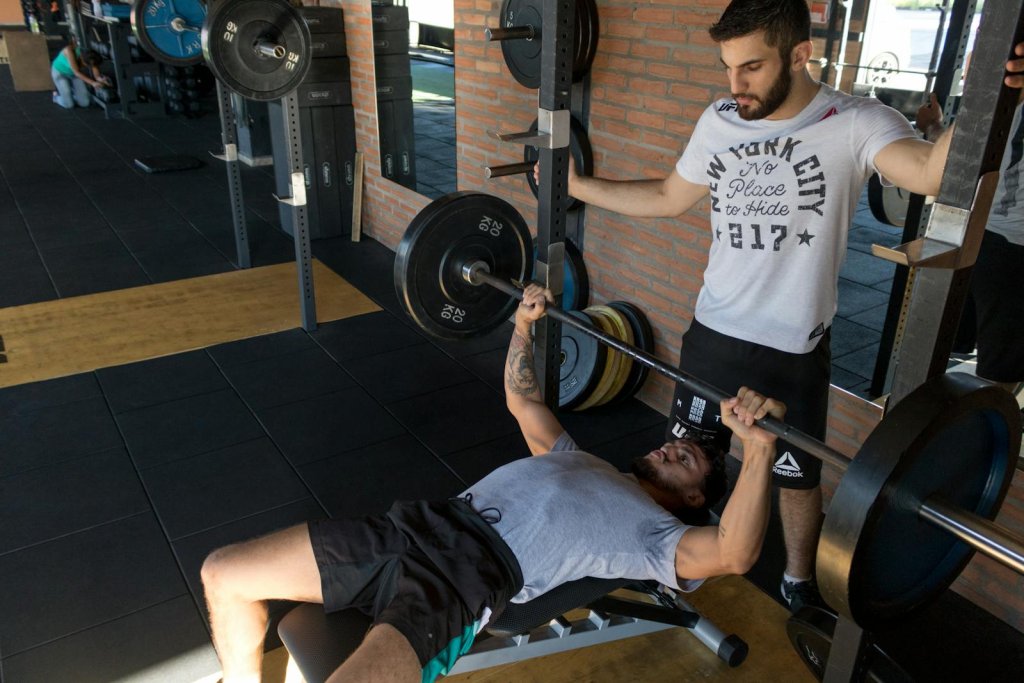
Understanding how barbell tricep exercises work supports better programming, safer training, and more balanced arm development. This guide covers the top barbell movements, correct form, training volume, safety rules, and when to seek professional guidance.
Benefits of Barbell Tricep Exercises
Barbell triceps training may help support:
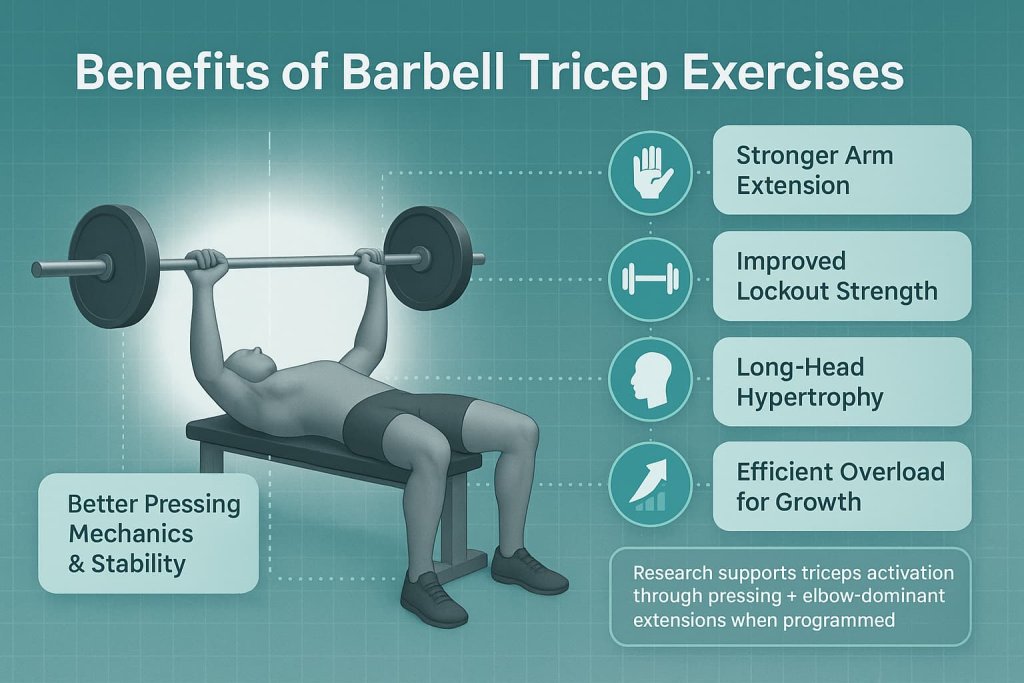
- Stronger overall arm extension
- Better lockout strength for bench press and overhead lifts
- Long-head hypertrophy for fuller upper arms
- Improved pressing mechanics and shoulder stability
- Efficient overload for strength and muscle growth
Research shows that multi-joint pressing and elbow-dominant extension exercises both stimulate the triceps effectively when programmed within appropriate volume ranges.
The 8 Best Barbell Tricep Exercises
These exercises combine heavy pressing and targeted elbow-extension movements to strengthen all three heads of the triceps. Each one supports bigger, stronger arms by improving tension, stability, and lockout power.
1. Close-Grip Barbell Bench Press
Why it works:
This pressing variation reduces chest involvement by narrowing the grip, forcing the triceps to take on more of the load—especially during the mid-range and lockout phases. It also allows heavier loading than most isolation exercises, supporting strength and hypertrophy.
Muscles worked:
Primarily triceps (lateral, medial, long head), with secondary involvement from chest and anterior deltoids.
How to do it:
- Lie on a flat bench with feet firmly planted.
- Grip the bar slightly inside shoulder width (not ultranarrow).
- Unrack the bar and position it above your lower chest.
- Lower the bar under control, keeping elbows close to your body.
- Press back up until arms are extended without locking out harshly.
- Maintain a neutral wrist and stable shoulder position throughout.
Trainer Tip:
Keep your elbows at a 30–45° angle from your torso—too much flare reduces triceps tension, too much tucking can irritate wrists and elbows.
2. Barbell Skull Crusher (Lying Triceps Extension)
Why it works:
This isolation exercise heavily targets the triceps by maximizing elbow flexion and extension with minimal shoulder movement. Lowering the bar slightly behind the forehead increases long-head stretch and reduces joint stress.
Muscles worked:
All three triceps heads, with extra emphasis on the long head due to the backward arm angle.
How to do it:
- Lie on a bench and hold a barbell or EZ bar with straight arms above your shoulders.
- Keep upper arms fixed and elbows pointing upward.
- Bend your elbows to lower the bar toward your forehead or slightly behind it.
- Extend your elbows to return to the starting position.
- Keep movement slow and controlled.
Trainer Tip:
If you feel elbow discomfort, lower the bar behind your head instead of to your forehead—this shifts tension off the joint and onto the muscle.
3. Incline Barbell Triceps Extension
Why it works:
Changing the bench angle places the shoulders in slightly more flexion, allowing a deeper stretch on the long head. This stretch-loaded position is excellent for hypertrophy and provides a different mechanical stimulus than flat extensions.
Muscles worked:
Triceps long head (primary), lateral and medial heads (secondary).
How to do it:
- Set an incline bench to 30–45°.
- Lie back with a barbell held above your forehead.
- Keep elbows fixed and pointed upward.
- Lower the bar behind your head for a deep stretch.
- Extend your elbows to return to the top.
Trainer Tip:
Use moderate weight—stretch-focused movements become risky with overly heavy loading.
4. Overhead Barbell Triceps Extension
Why it works:
Placing the arms overhead puts the long head of the triceps in a lengthened position, allowing stronger tension and greater growth potential. This is one of the most effective long-head builders.
Muscles worked:
Primarily triceps long head; lateral and medial heads assist during elbow extension.
How to do it:
- Sit or stand tall while gripping a barbell or EZ bar overhead.
- Keep upper arms close to your head.
- Lower the bar behind your head by bending your elbows.
- Extend the elbows to return the bar overhead.
- Maintain a tight core and avoid arching your back.
Trainer Tip:
If shoulder mobility is limited, use an EZ bar instead of a straight bar for a more natural hand position.
5. JM Press
Why it works:
This hybrid lift provides massive triceps tension because it combines the elbow flexion of a skull crusher with the pressing mechanics of a close-grip bench. It increases triceps strength at the top range—critical for bench-press lockout power.
Muscles worked:
Triceps (lateral and medial heads emphasized), chest and shoulders minimally involved.
How to do it:
- Lie on a bench with a shoulder-width grip on the bar.
- Lower the bar toward your nose or upper face with elbows still slightly tucked.
- Stop when elbows reach about 90°.
- Press the bar back up in a slight arc, not straight down/up like a bench press.
Trainer Tip:
Start very light—this movement places high tension on the triceps and needs precise technique before heavy loading.
6. Close-Grip Barbell Floor Press
Why it works:
Pressing from the floor limits shoulder range and forces a shorter motion that stresses the triceps. It also prevents excessive shoulder stretch, making it more joint-friendly while still encouraging strength.
Muscles worked:
Triceps (all heads), chest, anterior deltoids.
How to do it:
- Lie on the floor under a barbell or use a rack.
- Use a grip slightly inside shoulder width.
- Lower the bar until your upper arms gently touch the floor.
- Press back up, focusing on triceps-driven lockout.
- Keep elbows tight and controlled.
Trainer Tip:
Pause for one second at the bottom—this eliminates momentum and increases triceps activation.
7. Barbell Rack Lockouts (Pin Press)
Why it works:
This partial-range press lets you overload the top half of the bench-press motion, where the triceps work the hardest. Using pins allows heavier weight than a full bench press, building tremendous lockout strength.
Muscles worked:
Triceps (primarily), chest and shoulders assisting minimally.
How to do it:
- Set safety pins in a rack at your preferred height (mid to upper range).
- Lie on the bench and unrack the bar.
- Press the bar from the pins to full extension.
- Lower under control until it touches the pins again—no bouncing.
- Repeat while keeping wrists straight and elbows stable.
Trainer Tip:
Use small weight jumps—overloading too quickly increases elbow stress.
8. Barbell Close-Grip Push-Up on Smith Bar
Why it works:
This variation mimics the close-grip push-up but uses a barbell as a stable surface, allowing easy adjustment of difficulty. Raising or lowering the bar determines how much bodyweight you lift, making it beginner-friendly but scalable.
Muscles worked:
Triceps (all heads), chest, shoulders, and core stabilizers.
How to do it:
- Set a Smith bar or barbell in a rack at chest or hip height.
- Place hands slightly inside shoulder width.
- Step back into a plank with straight body alignment.
- Lower your chest toward the bar while keeping elbows close.
- Press back up using triceps-driven extension.
- Adjust bar height to increase or decrease difficulty.
Trainer Tip:
Lower the bar gradually over weeks—this provides consistent progression without needing extra weight.
How Many Sets & Reps Should You Do for Chest Growth?
For triceps hypertrophy and general strength, the following ACSM-aligned guidelines apply:
- 8–12 reps for most working sets
- 1–3 sets per exercise (beginners)
- 3–5 sets per exercise (intermediate and advanced)
- 2–3 weekly sessions for optimal growth
- Total weekly triceps volume: 8–15 sets, depending on experience level
If you’re training chest and triceps together, distribute the volume to avoid excessive elbow strain.
Common Mistakes to Avoid During Barbell Tricep Training
Avoid these frequent errors to protect your elbows and improve results:
- Grip too narrow or wide, reducing triceps emphasis
- Elbows flaring out instead of staying close to the body
- Wrists bending backward instead of staying neutral
- Lowering the bar too quickly, stressing joints
- Using too much weight before mastering technique
- Shoulders unstable instead of pulled back and down
- Skipping warm-up sets before heavy triceps work
Trainer Tip:
If your elbows feel irritated, reduce load and adjust your grip angle—an EZ bar often feels more comfortable.
How to Perform Barbell Tricep Exercises Safely
Training the triceps with a barbell requires attention to technique and load management. Follow these guidelines:
- Keep elbows close to your body—avoid excessive flare.
- Maintain a neutral wrist position to protect ligaments.
- Avoid ultranarrow grips; use a grip just inside shoulder width for most pressing.
- Lower the bar under control—never bounce or yank.
- Use a spotter or safety pins for heavy lifts, especially pressing.
- Begin with lighter loads for skull crushers, overhead movements, and JM presses.
These recommendations align with ACSM’s resistance-training safety guidelines and common injury-prevention practices used by certified strength professionals.
Who Should Avoid or Modify Barbell Tricep Exercises?
Barbell tricep movements may not be suitable for everyone. Modify or avoid if:
- You have active elbow pain or tendon irritation
- You’re recovering from a recent shoulder, elbow, or wrist injury
- You have limited wrist or shoulder mobility
- You’ve recently had upper-body surgery
- You’re a beginner lacking barbell stability
- You have medical conditions where straining under load is unsafe
Trainer Tip:
When unsure, start with lighter variations—such as Smith-bar close-grip push-ups—or consult a healthcare professional for personalized guidance.
FAQ
1. Are barbell tricep exercises good for beginners?
Yes, but beginners should start with lighter loads and stable movements like close-grip bench press and Smith-bar push-ups.
2. Should I use a straight bar or an EZ bar?
An EZ bar is often more comfortable on wrists and elbows, especially for skull crushers and overhead extensions.
3. Can I train triceps and chest on the same day?
Yes. Most programs pair them together because both muscle groups work during pressing patterns.
4. Do barbell tricep exercises build bigger arms?
They may help increase arm size by overloading the triceps—the largest muscle of the upper arm.
5. How many times per week should I train triceps?
Two to three sessions per week is effective for most people, assuming recovery is adequate.
6. Which barbell tricep exercise is best for strength?
The close-grip bench press and JM press are the strongest choices for improving triceps lockout strength.
7. Which exercise hits the long head best?
Overhead barbell extensions increase shoulder flexion, placing more tension on the long head.
Conclusion
Barbell tricep exercises are some of the most effective movements for building arm strength, improving pressing performance, and supporting balanced upper-body development. By combining heavy presses with controlled extension work—and using proper safety guidelines—you can progressively strengthen all three heads of the triceps.
If your goal is stronger, more defined arms, start incorporating the 8 exercises above into your routine and increase the load gradually over time.
References
- American College of Sports Medicine – Progression Models in Resistance Training for Healthy Adults (Kraemer WJ et al., 2009)
- National Strength and Conditioning Association – Strength and Conditioning Professional Standards and Guidelines
- American Council on Exercise (ACE) – ACE-Sponsored Research: Best Triceps Exercises
- Kholinne E et al. – The Different Role of Each Head of the Triceps Brachii Muscle (Clin Anat, 2018)
- Akima H et al. – Effect of Elbow Joint Angles on Electromyographic Activity of the Triceps Brachii Muscle Heads (PLoS One, 2021) –
- Harvard Health Publishing – 8 Tips for Safe and Effective Strength Training