
Shoulder mobility exercises are movements designed to improve how freely and comfortably your shoulder joint moves through its natural range of motion. Improving shoulder mobility matters because limited movement can interfere with daily tasks, overhead lifting, posture, and long-term joint comfort.

Authoritative organizations such as the American Academy of Orthopaedic Surgeons and the Mayo Clinic consistently emphasize gentle range-of-motion and mobility work as a foundation for healthy shoulder movement. When done regularly and with proper technique, these exercises may help support pain-free motion and better control of the shoulder complex.
Below is a clear, evidence-informed guide to the 12 best shoulder mobility exercises, along with safety guidance and FAQs.
What Are Shoulder Mobility Exercises?
Shoulder mobility exercises focus on maintaining or improving movement at the shoulder joint and the surrounding structures. This includes:
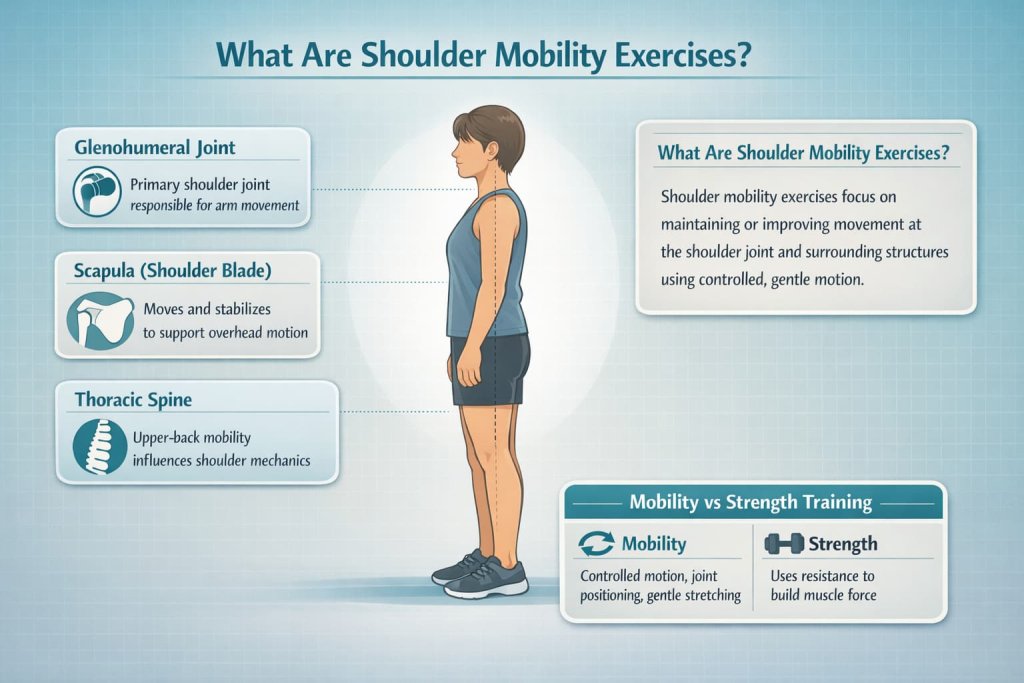
- The glenohumeral joint (ball-and-socket shoulder joint)
- The scapula (shoulder blade), which must move smoothly for overhead motion
- The thoracic spine (upper back), which influences shoulder mechanics
Unlike strength training, mobility exercises emphasize controlled motion, joint positioning, and gentle stretching, not heavy resistance.
Why Shoulder Mobility Exercises Matter
Regular shoulder mobility work may help support:
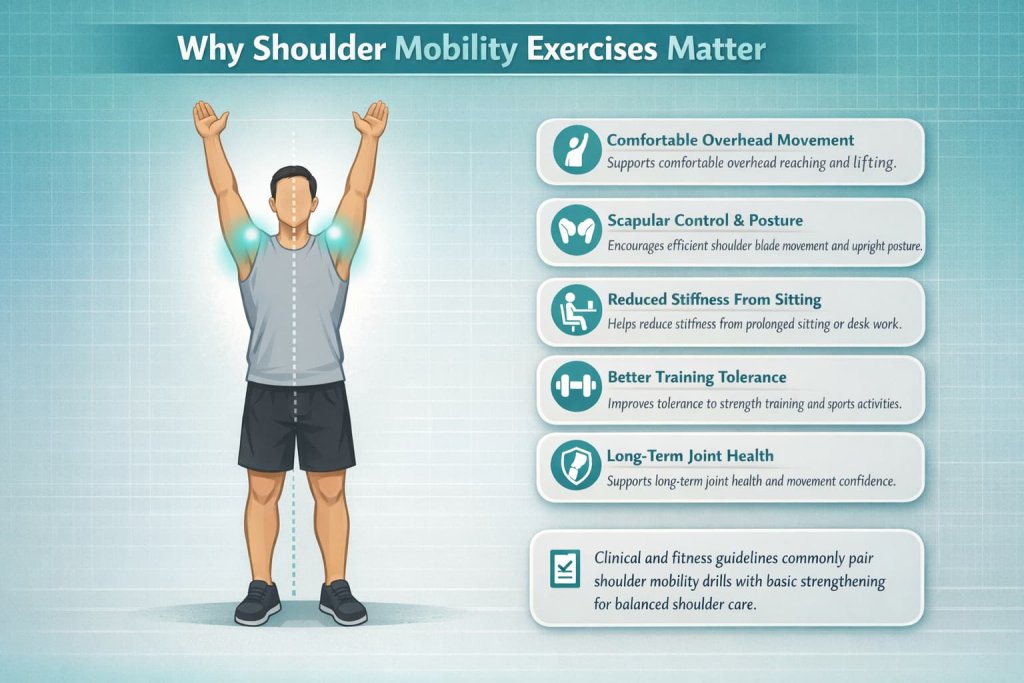
- Comfortable overhead reaching and lifting
- Efficient shoulder blade movement and posture
- Reduced stiffness after long periods of sitting or desk work
- Better tolerance to strength training and sports activities
- Long-term joint health and movement confidence
Clinical and fitness guidelines commonly pair mobility drills with basic strengthening for well-rounded shoulder care.
12 Best Shoulder Mobility Exercises
These shoulder mobility exercises focus on improving joint movement, scapular control, and upper-back mobility. Practiced consistently, they may help support pain-free motion, better range of motion, and more confident everyday movement.
1. Pendulum Swings
Why it works:
Pendulum swings rely on gravity rather than muscular effort to create gentle movement at the shoulder joint. This passive motion helps lubricate the joint surfaces, encourages synovial fluid circulation, and reduces stiffness without stressing irritated tissues. Because the shoulder muscles stay mostly relaxed, this exercise is commonly used during early mobility phases or on low-energy recovery days.
Muscles worked:
There is minimal active muscle engagement. The movement primarily affects the shoulder joint capsule, with very light involvement from the rotator cuff and surrounding stabilizers to maintain arm positioning.
How to do it:
- Lean forward from the hips and support one hand on a chair or table
- Allow the opposite arm to hang freely toward the floor
- Gently swing the arm forward and backward using body momentum
- Progress to small side-to-side swings
- Finish with small, controlled circles in both clockwise and counterclockwise directions
Trainer tip:
Let gravity do the work. If your shoulder muscles tense up, reduce the swing size and slow the movement.
2. Wall Crawl (Finger Walk)
Why it works:
The wall crawl provides assisted shoulder flexion, allowing you to gradually explore overhead range of motion while staying in control. Using the fingers reduces joint load and helps prevent sudden or forced movement, making this exercise useful for rebuilding confidence with overhead motion.
Muscles worked:
Anterior deltoid, rotator cuff (light activation), and scapular stabilizers that assist with upward arm movement.
How to do it:
- Stand facing a wall and place your fingertips against it at waist height
- Slowly walk your fingers upward, allowing the arm to follow
- Stop before shoulder pain, shrugging, or rib flaring occurs
- Hold briefly at your highest comfortable point
- Walk the fingers back down under control
Trainer tip:
Keep your ribs stacked over your pelvis. If your lower back arches, you’ve gone too high.
3. Cross-Body Shoulder Stretch
Why it works:
This stretch targets the posterior shoulder tissues, which often become stiff from repetitive reaching, lifting, or prolonged sitting. Improving flexibility in this area may help reduce shoulder tightness and support smoother arm movement across the body.
Muscles worked:
Posterior deltoid, rotator cuff muscles, and upper-back connective tissues.
How to do it:
- Bring one arm straight across your chest
- Use the opposite hand to gently pull the arm closer to your body
- Hold the stretch at a comfortable tension
- Release slowly and switch sides
Trainer tip:
The stretch should feel targeted in the back of the shoulder, not painful at the joint.
4. Passive External Rotation With Stick
Why it works:
External rotation is essential for overhead lifting, throwing, and daily reaching. This assisted movement allows you to improve rotational range without forcing the shoulder, helping maintain joint balance and rotator cuff function.
Muscles worked:
Infraspinatus, teres minor, and the shoulder joint capsule.
How to do it:
- Hold a stick or dowel with both hands
- Keep elbows bent and tucked close to your sides
- Use one arm to gently push the other hand outward
- Rotate only to a comfortable range before returning to center
Trainer tip:
If your elbow drifts away from your side, the movement shifts away from the shoulder joint.
5. Passive Internal Rotation With Stick or Towel
Why it works:
Internal rotation often becomes limited with prolonged sitting, poor posture, or repetitive shoulder use. This exercise restores that motion gradually, supporting balanced shoulder mechanics and functional reaching behind the body.
Muscles worked:
Subscapularis, posterior shoulder muscles, and surrounding soft tissues.
How to do it:
- Hold a towel or stick behind your back with both hands
- Use the top hand to gently guide the lower hand upward
- Keep your chest relaxed and shoulders level
- Lower slowly after reaching a mild stretch
Trainer tip:
Avoid twisting your torso to cheat the movement—keep it slow and controlled.
6. Sleeper Stretch
Why it works:
The sleeper stretch targets the posterior shoulder capsule, an area commonly associated with restricted internal rotation. Addressing this stiffness may support smoother shoulder mechanics during reaching and lifting.
Muscles worked:
Posterior rotator cuff muscles and posterior deltoid.
How to do it:
- Lie on your side with the bottom shoulder under you
- Bend the bottom elbow to 90 degrees in front of your body
- Use your top hand to gently press the forearm toward the floor
- Stop well before pain or joint discomfort
Trainer tip:
This stretch is subtle. More pressure does not equal better results.
7. Assisted Shoulder Flexion (Supine)
Why it works:
Lying on your back provides external support, reducing strain while allowing controlled overhead movement. This makes the exercise especially useful for individuals rebuilding range of motion with minimal joint stress.
Muscles worked:
Anterior deltoid, upper chest muscles, and light rotator cuff support.
How to do it:
- Lie flat on your back with knees bent
- Hold one wrist with the opposite hand
- Gently guide both arms overhead toward the floor
- Return slowly to the starting position
Trainer tip:
Exhale during the lift to encourage relaxation and smoother motion.
8. Scapular Retraction Drill
Why it works:
Healthy shoulder movement depends on proper shoulder blade positioning. This drill improves awareness and control of the scapula, supporting better posture and more efficient arm movement.
Muscles worked:
Mid-trapezius, rhomboids, and posterior deltoid.
How to do it:
- Sit or stand tall with arms relaxed
- Gently pull the shoulder blades back and slightly downward
- Hold briefly without arching the lower back
- Relax and repeat
Trainer tip:
Think about widening your chest rather than squeezing hard.
9. Shoulder Abduction in the Scapular Plane
Why it works:
Moving the arm in the scapular plane aligns with the shoulder’s natural anatomy, reducing joint stress while encouraging smooth, pain-free motion.
Muscles worked:
Deltoid, supraspinatus, and rotator cuff stabilizers.
How to do it:
- Stand tall with your arm slightly forward of your side
- Lift the arm smoothly to shoulder height or a comfortable range
- Lower slowly with control
Trainer tip:
If you feel pinching or catching, reduce the range and slow down.
10. Thoracic Extension Mobility
Why it works:
Limited upper-back mobility can restrict overhead shoulder movement. Improving thoracic extension allows the shoulders to move more freely without compensating elsewhere.
Muscles worked:
Thoracic spine extensors and postural support muscles.
How to do it:
- Sit upright with hands behind your head
- Gently extend your upper back over a chair or foam roller
- Pause briefly, then return to neutral
Trainer tip:
The movement should come from the upper back, not the lower spine.
11. Doorway Chest Stretch
Why it works:
Tight chest muscles can pull the shoulders forward, limiting mobility and posture. This stretch helps rebalance the shoulder girdle by improving anterior flexibility.
Muscles worked:
Pectoralis major and pectoralis minor.
How to do it:
- Place your forearms on a doorway frame
- Step forward slightly with one foot
- Feel a gentle stretch across the chest and shoulders
Trainer tip:
Keep your neck relaxed and avoid shrugging the shoulders.
12. Scapular Wall Slides
Why it works:
Wall slides combine shoulder mobility with controlled scapular movement, reinforcing coordination between the arm and shoulder blade during overhead motion.
Muscles worked:
Lower trapezius, serratus anterior, and rotator cuff muscles.
How to do it:
- Stand with your back, forearms, and head against a wall
- Keep ribs down and core lightly engaged
- Slide arms upward while maintaining wall contact
- Lower slowly back to the start
Trainer tip:
Range of motion matters less than control—stop before form breaks.
How Often Should You Do Shoulder Mobility Exercises?
Most clinical exercise programs recommend:
- Frequency: Daily or at least 4–5 times per week
- Volume: 2–3 sets per exercise
- Tempo: Slow, controlled movement or gentle holds
- Sensation: Mild stretch or tension, never sharp pain
Consistency matters more than intensity for mobility progress.
Common Mistakes to Avoid With Shoulder Mobility Exercises
Even gentle mobility work can become counterproductive if performed incorrectly. Avoiding these common mistakes helps reduce unnecessary strain and supports safer, more effective progress.
- Forcing range of motion: Pushing into sharp pain or aggressively stretching beyond comfort may irritate the joint rather than improve mobility.
- Moving too fast or using momentum: Swinging or jerking through movements reduces control and shifts stress away from the intended tissues.
- Shrugging the shoulders during overhead drills: Excessive upper-trap dominance can limit true shoulder and scapular mobility.
- Ignoring posture and rib position: Flaring the ribs or arching the lower back often compensates for limited shoulder or upper-back movement.
- Holding your breath: Breath-holding increases tension and can limit smooth, relaxed motion.
- Skipping consistency: Doing many exercises once in a while is less effective than practicing a few drills regularly.
A good rule: movements should feel controlled, smooth, and repeatable—not forced or rushed.
Who Should Be Cautious or Modify These Exercises
Shoulder mobility exercises are generally safe when performed gently, but certain individuals should proceed carefully or modify ranges.
You may need extra caution if you have:
- A recent shoulder injury, surgery, or fracture
- A history of recurrent shoulder dislocations or instability
- Sharp, worsening, or unexplained shoulder pain
- Numbness, tingling, or radiating symptoms into the arm or hand
- Significant loss of strength or range following trauma
In these situations, mobility work should stay well within a comfortable range, and guidance from a qualified healthcare or rehabilitation professional is recommended before progressing intensity or volume.
How to Combine Shoulder Mobility With Strength Training
Shoulder mobility and strength training work best when programmed together rather than treated as separate goals.
Practical integration guidelines:
- Before workouts: Use light mobility drills (5–10 minutes) to prepare the joints for pressing, pulling, or overhead lifting.
- After workouts or on rest days: Perform slower, longer-held mobility exercises to support recovery and range of motion.
- Pair mobility with stability: Combine mobility exercises with rotator cuff and scapular strengthening to support joint control.
- Adjust volume, not intensity: Mobility work should feel restorative, not fatiguing, especially on heavy training days.
Mobility helps create usable range of motion, while strength training helps control that range. Together, they support efficient, confident shoulder movement over time.
Frequently Asked Questions
Are shoulder mobility exercises safe to do every day?
Yes, gentle mobility exercises are commonly performed daily when done without pain or excessive force.
How long does it take to improve shoulder mobility?
Many people notice small improvements within 2–4 weeks of consistent practice, though individual results vary.
Should mobility exercises hurt?
No. You should feel mild stretching or tension, not sharp or worsening pain.
Can shoulder mobility exercises replace strength training?
No. Mobility and strength work best together for shoulder health and function.
Are these exercises good for desk workers?
Yes. Several of these drills specifically address posture-related stiffness common with prolonged sitting.
Do I need equipment?
Most exercises require no equipment or simple items like a towel or stick.
Conclusion
Shoulder mobility exercises play a key role in maintaining comfortable, efficient, and confident movement. When practiced regularly and with proper technique, these 12 exercises may help support pain-free motion and better range of motion in daily life and training.
If you’re ready to move better, start with a few exercises from this list and build consistency over time.
References
- American Academy of Orthopaedic Surgeons (AAOS) – Rotator Cuff and Shoulder Conditioning Program (includes pendulum, cross-body stretch, passive IR/ER with stick, sleeper stretch)
- Mayo Clinic – Shoulder exercises (pendulum + wall/finger walk for ROM)
- Journal of Orthopaedic & Sports Physical Therapy (JOSPT) – Exercise therapy for rotator cuff–related shoulder pain (systematic review + meta-analyses; FITT principle)
- Frontiers in Bioengineering and Biotechnology (2025) – Exercise improves pain/function in rotator cuff–related shoulder pain; compares exercise modes
- MDPI Sports (2025) – Scapular-focused exercise protocol effects (supports scapular control emphasis like wall slides/retraction work)
- Journal of Orthopaedic & Sports Physical Therapy (2006) – Serratus anterior activation during wall slide exercise (supports scapular wall slide rationale)
- CDC – Physical Activity Guidelines for Adults (supports combining mobility with strength training; muscle-strengthening 2+ days/week)
- WHO – Physical activity recommendations (supports weekly movement + strengthening guidance)